


I’d tell him: everybody thinks each day full of nothing in particular, but you can construct your day differenly! This is a blog on Ira Sach’s Peter Hujar’s Day
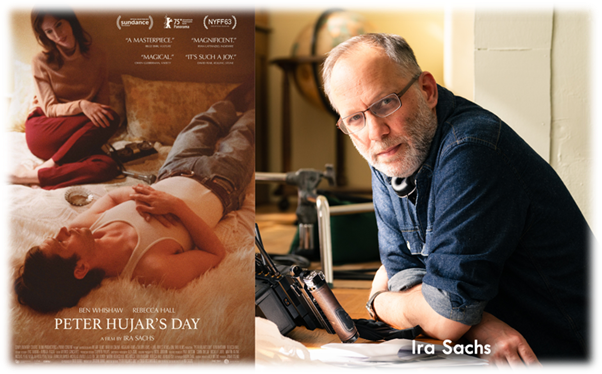
The sub-title to Peter Bradshaw’s review in The Guardian of Ira Sach’s masterpiece Peter Hujar’s Day is: ‘Whishaw is not tested by this verbatim retelling of Hujar’s day in hip 1970s New York, recounting encounters with Ginsburg, Burroughs and Leibowitz’. I never know to what extent article authors are responsible for the summaries that form their titles and sub-titles, and, although this is in line with what Bradshaw says in the article, his judgement of the acting therein is equally distributed between Ben Wishaw and Rebecca Hall. English journalists love to diminish what they see as inflated reputations – and this is a case in point. As a judgement it stands, as long as we are agreed that a judgement need be no more than an opinion, based on very little that can, or at least is, articulated in argument. Needless to say, I would not have called the film a masterpiece if either my opinion or judgment were the same as his. There has always been in English newspaper reviewing a bias towards seeing art as a thing that needs to justify itself in all possible terms, and Bradshaw recounts the plot tiredly as if that was the feel of the viewing experience. Here’s an excerpt to see if you agree, because it leads up the classic statement about all the ‘fuss’ that some types expend on ‘art’: ‘What’s the point of it?’ In the part of his resumé quoted below, Bradshaw recounts the conversation between the then two forty-somethings (Peter Hujar [Ben Wishaw] and Linda Rosenkrantz [Rebecca Hall]) about their health and sense of mortality.
He’s also getting longsighted. Rosenkrantz agrees – she has bursitis and they both thought that these old-people things could never happen to them. On the subject of having to stand back to look at something, Hujar regales Rosenkrantz with the story of photographer Maurice Hogenboom, who was on a shoot in Brazil, stood back to look at something, fell off a cliff and died. Perhaps the most important moment comes with an epiphany of sorts, as Hujar reveals that he has only recently grasped – perhaps at this very moment – that you need time to be a photographer, or any sort of artist: time to think, time to work, time to stand and stare. Maybe this real-time transcription of his day has disclosed this to him.
And what is the point of this film? Perhaps it is inevitably going to be of limited interest, and as intelligent as the two performances are, neither Whishaw nor Hall is tested very much. But it is an intriguing experiment in recovering the moment-by-moment reality of a lost time and place.[1]
Maybe, it’s all in the delivery, but the story of Hogenboom falling off the cliff (‘thousands of feet’ Hujar rather incredibly adds) has a different feel in his enactment than with a tired journalist retelling it. Of course, it’s funny but it does have a point: some stances from which to re-look at a thing involve risks, here to life and limb, that are more than about the fact that artists are mortal and vulnerable because they are driven to stances others do not dare, but also they have no power of negotiating with reality, for its parameters are constructed (for they are still fictionally constituted) by other interests than those of a seer or visionary, a looker convinced that what they see is not anywhere near the whole picture.
Moreover, then the issue remains about what a ‘day’ in the life of an artist means – that particular unit of time on which this film concentrates in two ways – first, in filming the day (or filming enacted and predesigned events that are in sequence constructed to look like the events and transitions that occur in one day) on which in reality Rosenkrantz collected the events of the previous day (December 18, 1974) on tape that were then transcribed and then that transcript silently edited to make a book, that are, with the reflections and random memories they illicit in the telling in conversation, the subject of the talk in the film. How does the experience of such passages of time relate to Hujar saying that artists ‘need time’ to be an artist: ‘time to think, time to work, time to stand and stare’. Likewise, time needs space in which work, growth and observation occur – space that is valid and reliable enough to sustain you, unlike that air that fills the precipice one falls down in neglecting ‘realities’ – like making money that sustains you as an artist. Robert Abele in The Los Angeles Times explains this better than I can:
Apart from not explaining Hujar for us (nor explaining his many name drops), Sachs also doesn’t hide the meta-ness of his concept, occasionally offering glimpses of a clapperboard or the crew, or letting us hear sound blips as it appears a reel is ending. There are jump cuts too, and interludes of his actors in close-up that could be color screen tests or just a nod to Hujar’s aptitude for portraits. It’s playful but never too obtrusive, approaching an idea of how art and movies play with time and can conjure their own reality.[2]
As Ira Sachs says in his ‘Filmmaker’s View’, available on some DVD versions of the film (the one I watched for instance), he too is a maker of time (including ‘days’), reconstructing those things that reconstitute the evidence of passing time – like the presence and absence of light, the function of dark and the volume of shadow, which can be collected in external nature (and technically enhanced sometimes) or provided by other less natural means. The use of hand-held camera,16 mm photography and static frame narration sometimes emphasises all this – likewise the cuts in the tape (that supposedly recording the original event as described by Abele above) and the film tape it is imagined the digital shooting is occurring on. The cuts sometimes give way to the couple continuing to enact the typescript but outside – on a balcony or elsewhere.
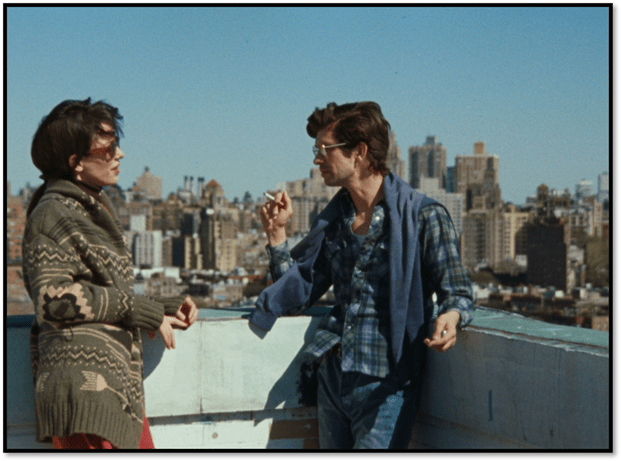
We almost forget in these shots, the need for (if this were realistic recreation of history) the presence of the antique tape-recorder is forgotten (as it never is in Beckett’s Krapp’s Last Tape (see my blog on this here).
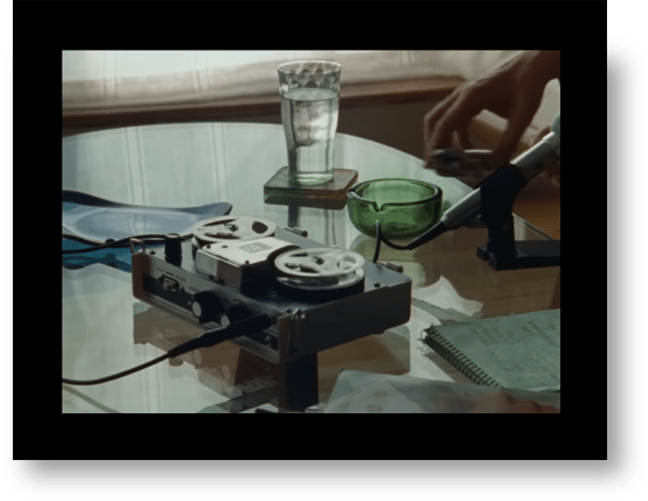
In one scene (referred to by Abele) we see the two actors on the artificially lit side of a frame representing a window looking into a lit room interior (obscured though I think by curtains) whilst we see the lighting equipment that captures the scene as the director wants it, the crew with camera and sound booms of the old-fashioned type. All of this, we are reminded, is constructed even the illusion of how time passes for the characters. American reviewers clearly use better metaphors to suggest the constructedness and artifice of art, that is sometimes replicated in life, and not only the life of artists: Here is Abele’s first sentence: ‘If our waking hours are a canvas, the art is how one fills it: tightly packed, loosely, a little of both’. [2] Our waking hours are not ‘a canvas’, neither are they the spooling of an audio tape, nor film tape, but in understanding how our day is constructed (so much more is actively constructing that day than washing over our passivity passively .
There is more than ‘recounting encounters with Ginsburg, Burroughs and Leibowitz’ (Bradshaw) and even more than ‘name drops’ which Abele refers to in a quotation from him I gave above. Artists are not accorded the right to endurance in time, after the deaths, yet artists can interact sometimes with the idea in mind that the interest in the concept of a renewed vision is as much important to them in the ‘mundane’ in their lives as in their creative moments of reconstruction of the world in a chosen medium – paint, photography, words, stories, and film. In Peter Hujar’s Day it remains the fact that, as Adele suggests, if he does not say explicitly, there is as much that resonates in an encounter between human animals whether it the great mundane, the stuff of life as experienced’ with a poet (Ginsberg) or novelist (William Burroughs) or Susan Sontag (the critic) moaning about the assumptions people make about her, or ‘freelancing woes (is this gig going to pay?)’ as in ‘chance meetings (some guy waiting for food at the Chinese restaurant)’ .
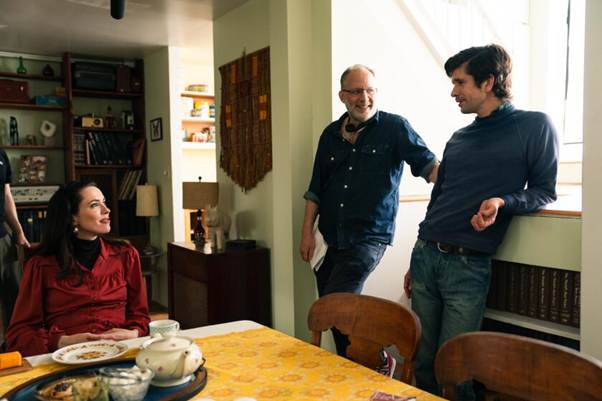
Direction and acting as constantly revised preparation Hall, Sachs(with his annotated script in hand) and Wishaw on the set – provided free by an artists’ housing project.
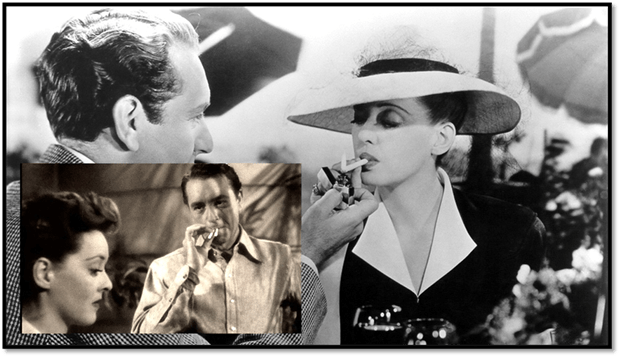
In his Filmmaker’s View, Sachs makes the point that he too wanted to contribute to the endurance of that which constantly passes. Given access to Rosencrantz’s copy of the tapescript, he restored to the conversation in the film a section on meeting with film stars, about which Wishaw as Hujar says he is slightly obsessed, whilst Rosenkrantz felt time spent with Joan Crawford would be intensely ‘boring’, though she does not feel quite the same about Bette Davis. This conversation Rosenkrantz had edited out of her book based on the transcript:
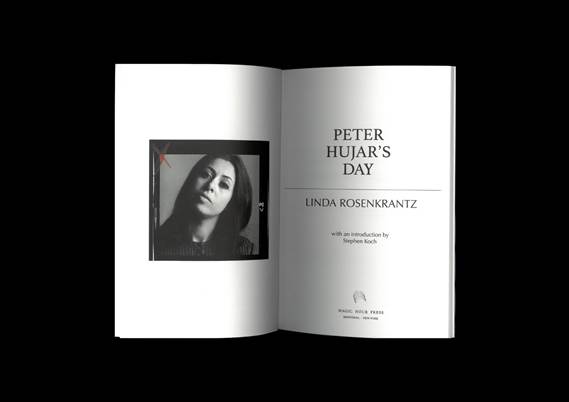
Putting the conversation back in, Sachs says, restored more than a few words, it allowed the endurance on reflection on the stuff in endurance in art. Again I can’t improve, as I definitely can on Bradshaw, on Abele’s reflection that:
For each of us, any given day — maybe especially a day devoid of the extraordinary — is the culmination of all we’ve been and whatever we might hope to be. That makes for a stealthy significance considering that Hujar would only live another 13 years, succumbing to AIDS-related complications in 1987. It was a loss of mentorship, aesthetic brilliance and camaraderie felt throughout the art world. [2]
And I cannot improve either on their conclusion about what is the point of a 1 hour, 16 minutes film summarising a day, summarising how significance comes not from consistent obsession about immortality or of being forgotten entirely (or time itself) but from the fact that time must be filled, and will be, and not always with what is obviously significant and weighty. Browning called this putting the ‘infinite’ into the ‘finite’, for he knew that latter is all we get to know for certain, the rest being uncertainty – shadowland. These words of Abele are beautiful:
The interior play of light from day to night across Whishaw and Hall’s faces is its own dramatic arc as Hujar’s details become an intimate testimony of humor, rigor and reflection. It’s not meant to be entirely Whishaw’s show, either: As justly compelling as he is, Hall makes the act of listening (and occasionally commenting or teasing) a steady, enveloping warmth. The result is a window into the pleasures of friendship and those days when the minutiae of your loved ones seems like the stuff that true connection is built on. [2]
In discussing Caravaggio we speak of his chiaroscuro as a perception of the nuance hidden behind binary distinctions of dark and light, and of the idea of motion in time as enhanced not stopped by shadow. Ginsburg tells Hujar he will not be represented in ‘portrait style’ in photography, but Hujar feels representation is in part a negotiation between desire, opportunity in time and planning, with the final agency not as powerful as it thinks. Yet the film continually plays with movement between realistic everyday motion set against still portraiture, most notably in moments like those below:
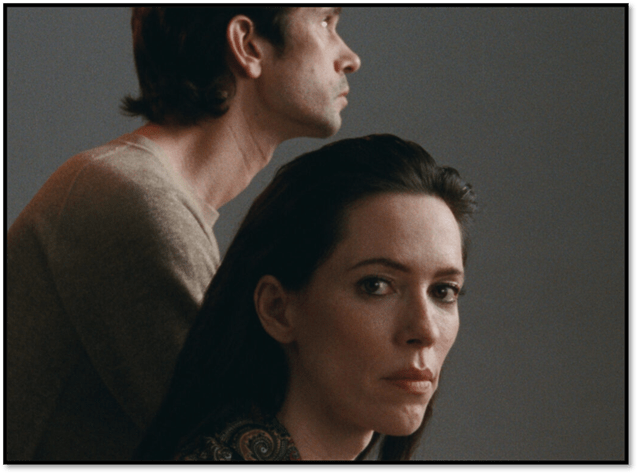
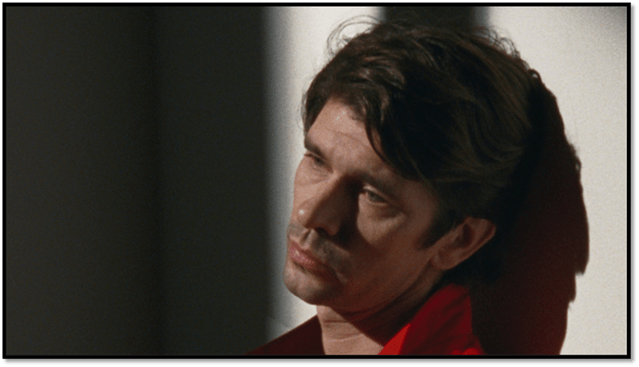
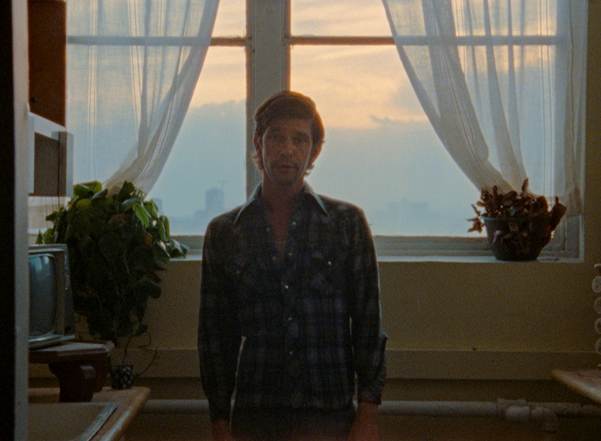
Light, dark and shadow, monochrome and colour redefine each other here in beauty and significance. More so, the use of frames, especially window frames to capture the subject in mixed lights, and what looks likea filter to render the capture of the image blurred, as if this were an effect of over-exposure on an old camera:
One particularly moving movement comes when Rosenkrantz shows her anger at the time Hujar spends smoking, so that often he has, he says ‘a day long nicotine hangover’. It works because a cigarette is ubiquitous in Wishaw’s representation of Hujar, so that we become even more conscious of it in terms of the risks the man himself took with his health. But the cigarette is not allowed to be a sign of error, even less of sin, any more than it is with Better Davis in the film Now Voyager.
Take these three stills where Hujar smokes:
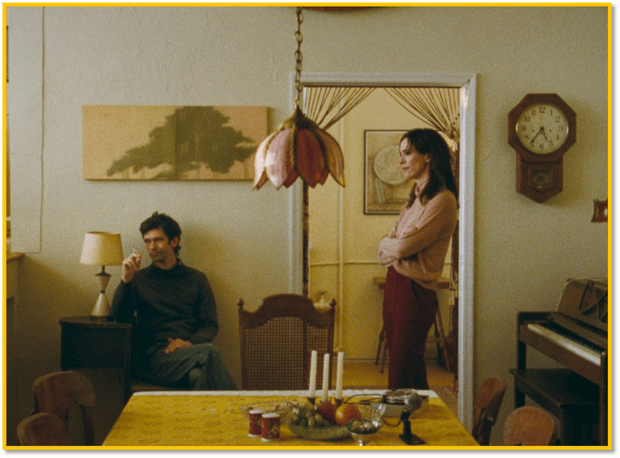
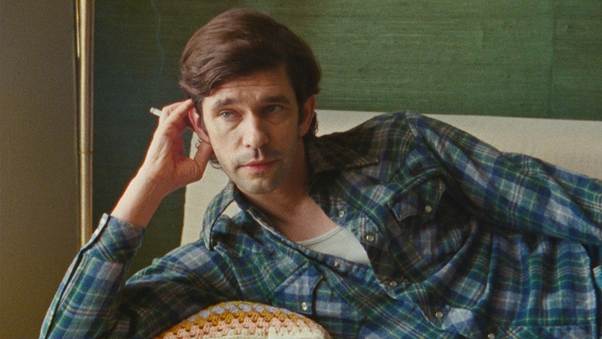
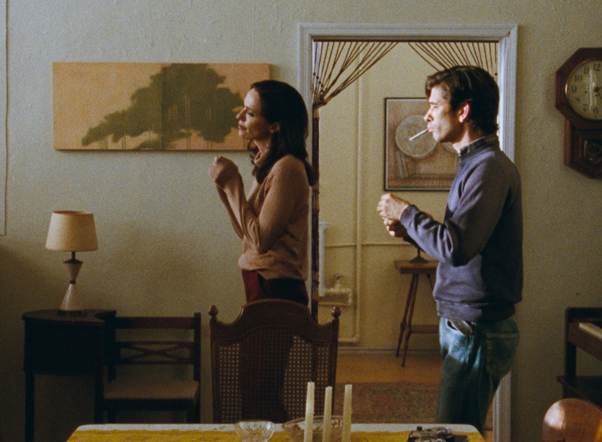
None of this uses the gesture and pose of cigarette smoking consistently and without nuance. The final one shows the pair dancing – more a kind of rhythmic shuffle but beautiful, in which the cigarette confirms that this is a private recreation of a public act and a sharing of trust and mutual belief. In the two stills preceding it, the cigarette is used to dramatise the gaze both in as far as it directs the look of Hujar onto the gaze of the viewer, or in part deflects that gaze. It becomes part of the means of the actor and the person represented by the acting share space. For mutual gaze is the drama of a lot of this film, often contextualised in ways that are nuanced giving heightened means to furniture such as tables, chairs and beds, even to interior and exterior defining walls and corners and ambient light and shade, which is not only about the passage of time:
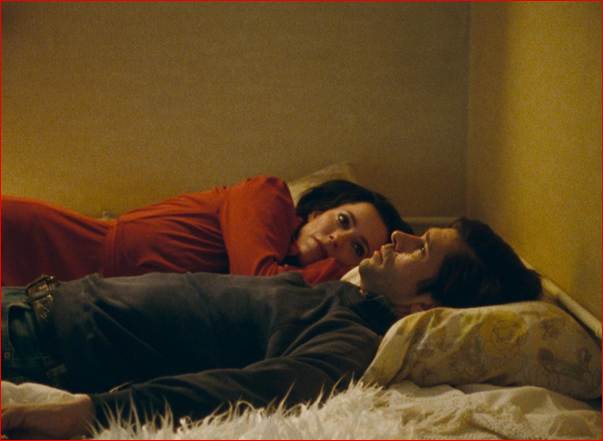
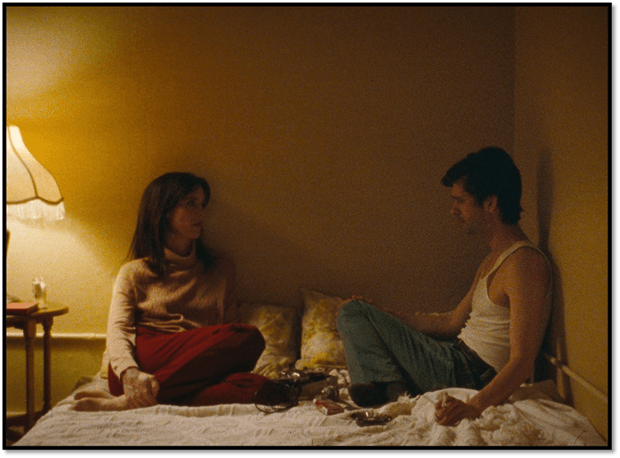
The DVD we bought has a beautiful collage of scenes that in itself records the beauty of this film:
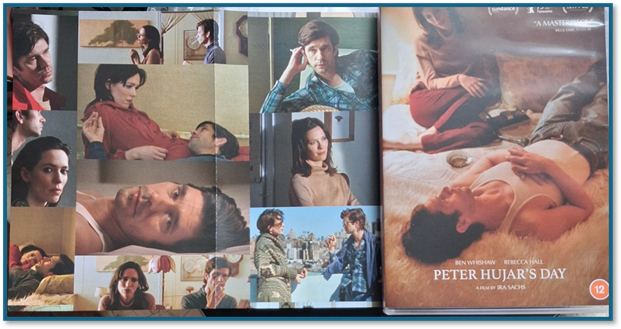
On the rear of this collage is an essay by Michael Koresky, where in he says that art is about ‘connection’ (Forster’s ‘Only connect’) and particularly about ‘something greater that’ that between the ‘great selves’ of important artists, but about ‘the ability to be present for another person’.
Do watch it! I had to order it from a source that took a long time to provide it – though on Amazon.
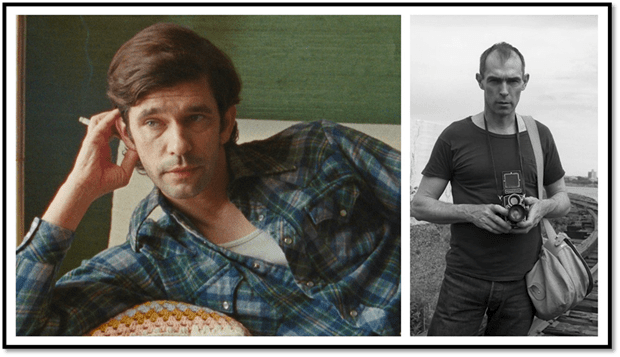
The represented Peter Hujar.
With love
Steven xxxxxxxxxx
[1] Peter Bradshaw (2025) ‘Peter Hujar’s Day review – Ben Whishaw goes low-key in snapshot of the photographer’s remarkable life’ in The Guardian [Fri 14 Feb 2025 18.00 GMT] onl;ine. Last modified on Mon 29 Dec 2025 15.57 GMT. Available at: https://www.theguardian.com/film/2025/feb/14/peter-hujars-day-review-ben-whishaw-berlin-film-festival
[2] Robert Abele (2025) ‘Review: In a diarylike conversation, a 1970s art scene comes to life in Peter Hujar’s Day’ in The Los Angeles Times online (Nov. 6, 2025 4:36 PM PT. available at: https://www.latimes.com/entertainment-arts/movies/story/2025-11-06/peter-hujars-day-review-ben-whishaw-rebecca-hall-ira-sachs

