


Explaining why I go to art exhibitions is almost the same as explaining why I feel a need to prepare myself to see them. The pleasures and perils of researched prescience is however a subject in itself. This blog anticipates seeing the new Zurbarán ExWhen the subject is ‘seeing’, why exclude visual art, for that too allows us to ‘see’ in more than ways that are entirely visual. This blog is an explanation of why I go to art exhibitions. This is almost the same as explaining why I feel a need to prepare myself to see them. The pleasures and perils of researched prescience is however a subject in itself. This blog anticipates seeing the new ‘Zurbarán’ Exhibition at 12.00 midday to 13.30. Will it change my world?
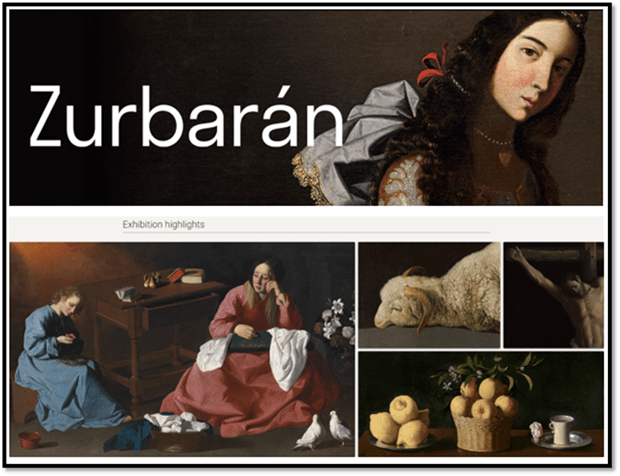
This piece refers to my overnight-er culture-fest visit to London in July (at this link). Other events are linked to their own blogs in the table.
| Wednesday 8th July | Thursday 9th July |
| LNER Train Durham – Kings Cross 10.40 – 13.32 | Leave Hotel by 11. 00 |
| Southbank Hayward Gallery, Anish Kapoor 14.30 – 16.00 | National Gallery, Zurbarán Exhibition 12.00 – 13.30 |
| Hotel (Travelodge, Kings Cross) | Haymarket Theatre, David Hare’s Grace Pervades 14.30 – 17.00 |
| Bridge Theatre, Simon Stone’s Oresteia 19.30 – 21.45 | LNER Train Kings Cross – Durham 18.33 – 21.23 |
I prefer to go prepared to events – if I see an author read, I like to have read and thought out in informal print (my blogs) what I have learned and felt (aspects of the same process I hope) so far. Likewise with a play where a script is available – for this visit it is for David Hare’s Grace Pervades (which premiered in Bath not London) but is not (yet) for Simon Stone’s Oresteia (which has not yet previewed at the Bridge Theatre). With art exhibitions I buy the catalogue if available and read reviews, even though I have already committed to go. This is sometimes perilous (especially regarding catalogues especially from the more conservative art institutions like The National Gallery) for they can show the worst of the curatorial and art history professions (as I see the worst) bound up in academic conventions about the primacy of documentary evidence for both history and the meanings of art in a lens cut to see (as if that were possible) to see things as the artist saw them in their own time.
That is certainly the issue with National Gallery’s catalogue for the Zurbarán Exhibition: a visually beautiful and superbly crafted book I’m pleased to add to my collection but with textual essays that are, in the main, as dull as ditchwater, with some exceptions or impossibly weighted to art historical genre or technical (even in reading meaning – tied to a Panofskian tradition of how innovation occurs in visual iconography) themes that are the particular specialisms of academics and academic curators brought up to despise literary readings of painting.
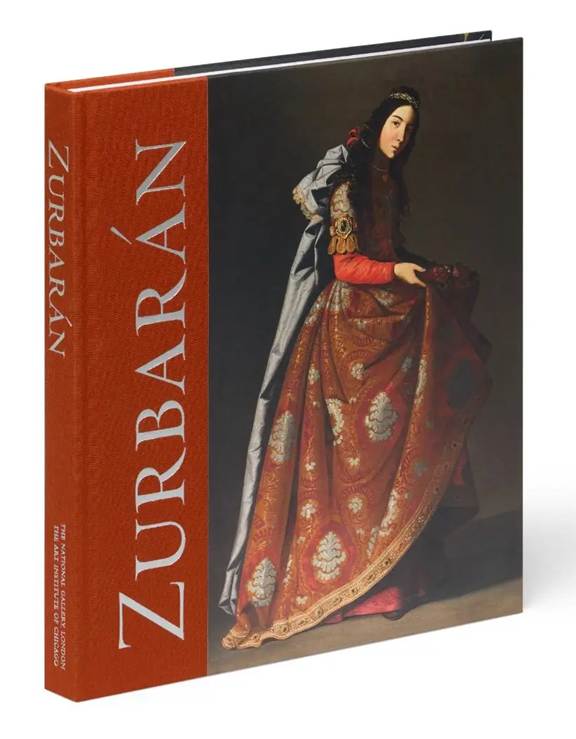
In these circumstances, and having read the essays, I needed to turn back to journalistic art criticism – even that of a critic I often don’t like, such as Jonathan Jones. In this case, however, his review of this exhibition is a tonic and refresher to renew my enthusiasm in seeing a painter I have often speculated about – coming from Bishop Auckland’s environs near where the ‘The Twelve Tribes Of Israel’ series are on show (though two of them have been borrowed by this show). In 2019, on my birthday, I even attended a lecture devised by the Auckland Project on the painter – in those days I wrote very short blogs (see it at this link). Having read that again (since I had forgotten it was there) I noticed how I used what I was told to turn it to my own preoccupations about the representation of male beauty, and the communality of diversity in social groups (even nations) and between individuals:
Those great illustrations of diversity can be put in the context of an art that was not merely a servant of the Counter-Reformation but also, in some hands, an illustration of love person-to-person, even when that person was sometimes the divine. It threw up some great paintings – not least The Circumcision, a strangely haunting painting about enforcing commitment, where love, pain and ritual are confounded. For many of us this is difficult because it forces us to confront religious difference, even when we may have no original religion, complexly. It is full of problematic moments, as is the wonderful Saint Serapion, in which a young male battered and broken body is clothed in symbolic love. Clothing as symbol never was so beautifully handled and this alone might be something very special about this artist, whose links to the linen trade the talk touched upon. We need to reassess clothing too in the Sons of Jacob.
There is no doubt that both the exhibition, and, truth to speak, the catalogue help us here with one excellent contributor’s reference to the teaching pressed upon post Counter-Reformation Baroque painters, and tested in practice by craft guild institutional examiners, to ‘mix colours and capture “the fabric and folds that make up clothes and flesh out faces and hair”’. Although Alonso Cano criticised Zurbarán for not having taken these examinations and tried to have him pressed to do so, it is clear that Cano must have realised that the rival painter’s skill in these areas, even without institutionalised learning, was greater than his own.[1] But these bits of art history still leave me needed interpretation from the point of view of expectations of joy in my learning rather than, what Carlyle called, Professor DryasDust explications.
Jonathan Jones, the Guardian art critic, rather blotted his copybook with his review of the Spanish Gallery in Bishop Auckland, dealing largely with seventeenth-century Spanish art. The review was widely disliked in the town in the same terms I disliked it, and especially by the local volunteers who staffed the Gallery, for its metropolitan sneers (see my blog on it at this link). Nevertheless on Zurbarán, Jones is a tonic with his queer eye on Christ’s loincloth as a way into realising the engagement with everyone made in these paintings, whilst making the same point on fabric painting, referring as I did to the entrancing image of Saint Serapion, which I cannot wait to see ‘in the flesh’ or rather in the flesh as it manifests under clothing (for my blog on the ‘in the flesh’ paradigm see this link about its use by Martin Gayford).
Jones starts by exploring ‘Zurbarán’s ravishing aestheticism’, as a possible product of Spanish wealth in the gold of the Americas thus: ‘No other artist has ever made loincloths so exquisite. The Crucified Christ towers above you, a pale body manifest in darkness, but over his groin dances a flower-like formation of pure white freshly laundered fabric’. Of course we need to see that painting:
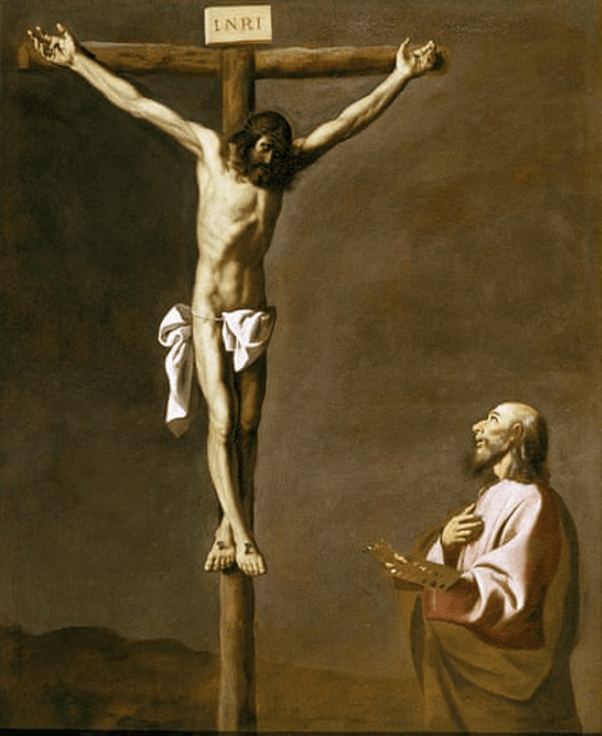
Saint Luke as a Painter before Christ on the Cross by Francisco de Zurbarán
He continues in a more generalised but still with a strong taste for representation of male bodies:
Once you let yourself be entranced by this lavish loincloth you start to see Zurbarán’s eye for fabric everywhere. The whiteness of holy garments obsesses him. Saint Serapion, who was tortured to death on a Mercedarian mission to save Christians, has his beaten body hidden in a billowing white sail of a garment. Alongside acres of white cloth are the blue, silver, bronze and red garments of Saint Casilda of Toledo, a Muslim princess who (it was said) gave bread to Christian prisoners. When she was caught, the bread miraculously turned to flowers – which Zurbarán depicts with the same observational brilliance, turning this picture of a saint into a springtime celebration. It’s a truly popular painting – another reason this exhibition is so captivating. You are in the presence of great art for the masses, with a passion that must have touched the working people of 1600s Seville just as much as it will hit you.[2]
I will come back to that loincloth and the parameters of Zurbarán’s interest in the recreation of the male nude in Counter-Reformation Spain, and with reference to his fabricated (by which I partly mean fully clothed or habited monks). I will also return to that garden of roses in the lap of Saint Casilda.
However, I want to first dwell on what might be expected from the exhibition when I do see it from the catalogue. That is divided by essay, which roughly describe serially developments in the master’s art: starting with a summary of his ‘singular vision, his early life in Seville – or the little known about it – and his earliest commissions, the major mid-life commissions, the nature of the art of Zurbarán, caught either problematically or otherwise between sacred and profane interpretation (a subject I have considered if in different terms and as an amateur in relation to Jusepe Ribera – at this link – and on polychromy in Spanish religious art – at this link).
Thereafter, there is an essay on the role of export markets for art to the Americas – with a fascinating perspective on ‘The Twelve Tribes of Israel’ as responding to a belief in those continents that, apart from the tribes represented by Jacob’s sons, Judah and Benjamin, the other sons may have been believed to be the progenitors of the ‘indigenous people’ of South America (Peru and ‘New Spain’), and ‘establishing links between the Old Testament and the Americas’, and further justifying the Christian missionary role of Spain there, and with a fascination those interested in costumery in the artist.[3]
There is a further chapter on still lifes, by that expert in the genre in Spanish art, Peter Cherry (mentioned in an earlier blog – at this link – I wrote on still lifes in Bishop Auckland), which has a most fascinating diversion back to a more radical issue in the interpretation of the art of everyday objects as potentially sacred. The book thereafter finishes with a concluding chapter – both on the profane and sacred interpretations them and the life development of the art on the idea of the ‘Intimate and Sacred: The Late Paintings’. Each of these chapter are scarred by a mixed agenda, wherein ideas and interpretive possibilities get squashed under the agenda of art historians desiring to be institutionally comprehensive. As a result most of the chapters have over-divergent foci – at least for the non-specialist.
No wonder then that I look to Jones to thrill the expectations of travellers to distant galleries with passages like this: ‘Space becomes different in his world, melting distance and erasing the barrier between you and the picture’. Starting with a broad generalisation of the sort hated by academic historians, who tend to write on student essays as they did in the Open University on mine: ‘But what do you mean by space?, he goes on to say the ‘very first painting in this dreamlike ecstasy of a show dissolves logic’, and tells us that we would, had this painting NOT come to the exhibition, we would have had to have travelled to the Prado in Madrid to see it:
A monk robed in white kneels before a living man hanging upside down, his hands and feet nailed to an inverted cross: it’s a vision as real and close to us as it is to the awestruck monk, held in a penumbra of bronze fire, a stream of smoky light from heaven. [2]
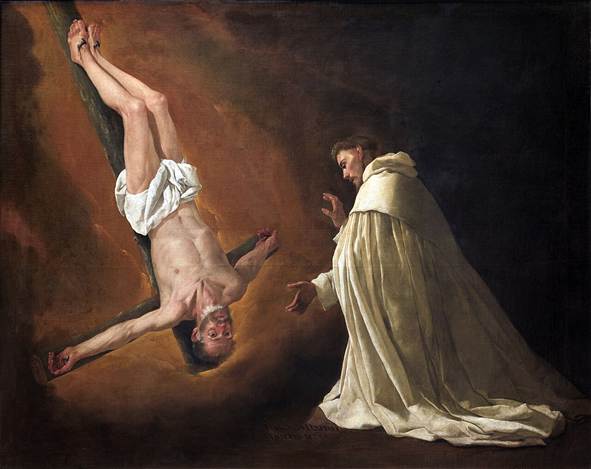
The Apparition of Saint Peter to Saint Peter Nolasco from 1629
The quality of a great painting means that no-one can, in truth, be comprehensive about it. But I so much want to see it. And for me this painting is central to some feelings I want to check out whilst at the exhibition, for here the only way in which Zurbarán confronts the paradigm in the traditions of art handed down to him of the male nude is to use it as an inverted image of a much younger fully habited man, with exceedingly beautiful face and hands who gazes at it as visionaries do, and appears not only to marvel at it but also embrace it notionally (for it is an ‘apparition’). I say above ‘the only way’ but I do so in puzzlement over a comment by Francesca Whitlum-Cooper and Imogen Tedbury in one of the catalogue essays (about the painter’s ‘singular vision’ so therefore attempting in some way to generalise speaks about the series of The Labours of Hercules, painted for the Hall of Realms in the new Imperial place of Buen Retiro as Zurbarán’s ‘sole systematic engagement with the male nude’.[4] The curatorial authors go on to repeat the ways in which these images have been described as lacking in every way images of heroic manhood. It is hard to disagree; however one asserts that the King of Spain clearly accepted them as worthy.
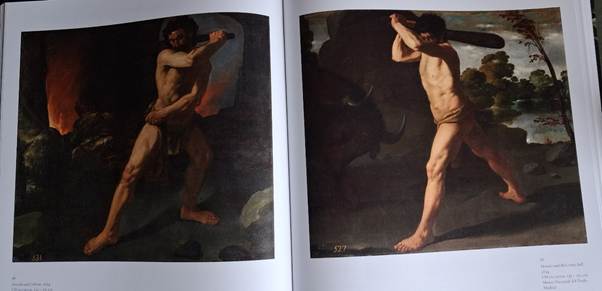
The examples from the 1634 ‘Labours of Hercules’ (with Cerberus – left; the Cretan Bull – right) in the catalogue: ‘an awkward figure who needs to strain every muscle’.
But to say they are the painter’s sole systematic engagement with the male nude is to assume that Crucifixion paintings, of St. Peter or Christ are not a systematic engagement with the male nude at all. A lot could be intended by the word ‘systematic’, as if drawing on a life-class tradition that did not yet exist, although classical models of the nude to use for practice did, but one of the inadequacies of the Hercules pieces reproduced (I await them ‘in the flesh’) is that they fail to match the beauty of the Christ nudes by the painter. The issue matters in this catalogue which claims to discuss the differentiation of the sacred and profane, though does so more in relation to the painter’s wondrous example trademarks of cup and rose and linen basket than with the figure of Christ. It is still difficult to engage with religious ecstasy in relation with human sexuality it seems, except in the case of women like Theresa of Avila, and then in Italy not Spain.
Until I have seen it I cannot know but the inversions in The Apparition of Saint Peter to Saint Peter Nolasco contrast the nude and clothed holiness in men as much as the orientation of the figures. The facial beauty of Nolasco contrasts with the pained expression of St. Peter, the expression of unworthiness before Christ in Peter before Nolasco’s capacity to bless the sinning Peter, who denied Christ thrice, to forgive and bless as Christ did (John 21:15-17). Whether intended or not there is even a kind of contrast of descent, surrounded in infernal flame even of Peter’s unwillingness to identify with Christ, with Nolasco’s whitened holiness in the light firmly defying the darkness at his back. Whether Zurbarán intended the painting to exemplify male beauty in the clothed saint we can never know, and whether there is anything ‘profane’ in that beauty is imponderable. However, with the master’s many ‘Crucifixion of Christ’ depictions, the variation of male nudity, varying attitudes to flesh and the incarnation, to the eye are clearly intended – to shock or create awe. Consider some of the variations below that I long to see in the exhibition:
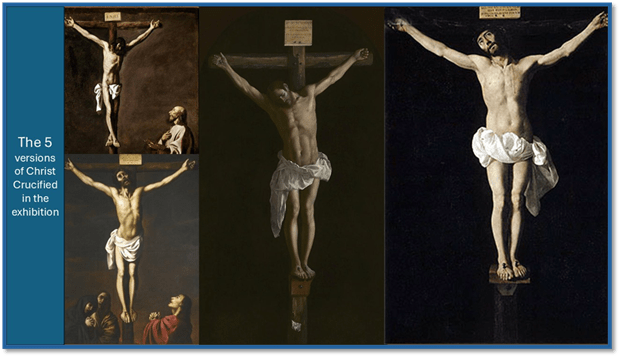
Of course the relationship between nudity, the naked, flesh and corporal attraction is very complex, not least because it can be divided too between the flesh offered in sacrifice or in love, and the iconography of the Cross necessarily confutes these boundaries, one reason why Whitlum-Cooper and Tedbury say the figure of St. Luke, they use a title that merely names the figure ‘A Painter’ because of the critical trends which insist that the ‘Painter’ is a self-portrait of Zurbarán, although they insist with art-historian fence-sitting that it is ‘most plausible to view the painter as Zurbarán’s proxy, rather than a literal likeness’.[5] Nevertheless here as elsewhere the figures at the cross’s base insist that the way we view Christ’s body on the cross is a matter of perception and composition, how you see and how you reproduce what you see, particularly when ‘vision’ is a mix of divinely inspired hallucination and ‘the real’. Jonathan Jones, of course, expresses this crudely but appropriately, for my purposes:
The word “visionary” is done to death but the 17th-century Spanish painter Francisco de Zurbarán demands it: he paints supernatural things naturally and natural things supernaturally.[6]
As for envisioning the sacred male nude, I think I will leave considering that util I have seen the exhibition, and partly my interest is in fully clothed, indeed habited, men, for are not these what people once solely associated with Zurbarán. Nevertheless. It would be wrong that I import the sexualising of body, as was the accusation of James Kirkup for his poem about the sexual body of Christ, for this has always formed part of religious discourse, though oft explained away as allegory (as with the Song of Solomon). This cannot be done with the liturgical reading of marriage however: ‘With my body I thee worship’. When I see the works, there has to be attention to the placement, distribution of basic loin clothing on the otherwise naked body and the conventions of its Baroque folds and creases.
However, in truth, I visit as much to see the monks & saints that so entranced Zurbarán, and whose youth and virility, though covered in volumes of cloth, has always been noted. Odile Delenda may well explain this by her words in the Preface to the catalogues: ‘By capturing the beauty of these saints, free from any trace of suffering, devotees were reassured of their power of direct intercession with God’.[7] Free of suffering also involves the lack of signs of ugly scars on the body, deformity and damage of the skin, organs, and limbs through torture or starvation (except where the stigmata are called for, but that Zurbarán’s versions of St. Francis look more for shadowy male beauty than wounds). In the exhibition I need to see ‘ in the flesh’ the two chosen stars of the genre: Saint Serapion and The Venerable Miguel Geronimo Carmelo.
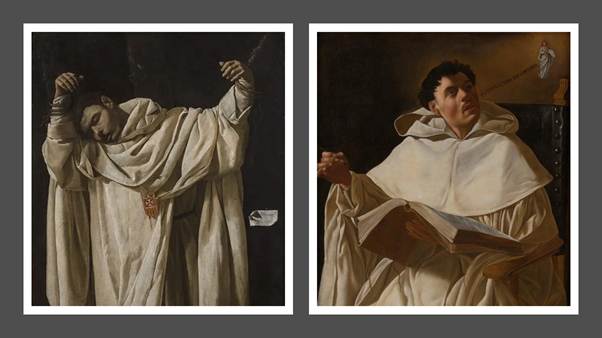
Serapion attempts to rest, tied up from the wrists, in an attitude that is neither agony nor ecstasy and somewhat near sleep. We do not see his feet for Serapion was tortured on his feet and they were removed as part of his martyrdom. It is entirely passive, and is recalled by the Agnus Dei, whose feet are bound in the tradition of the paschal lamb readied for slaughter in sacrifice. Light picks out the frontage of his vestments but penetrates enough to create a shadowed entry to the body beneath the outer vestments including a tight belt. The vestments were of his service to Catholic congregations, the Maltese cross richly showing, But is the shadowed tumulus of his eyelids and the plump rose of his open lips that startles (how will look in the flesh?). That with the large, flexed hands that don’t droop but still clench renders , I think, the picture full of the sense of the concealed taut body of the young man given to God and the service of the Catholic community. The Venerable Miguel Geronimo Carmelo strikes a different note. Charlotte Chastel-Rousseau and Rebecca Long argue that its method of using vestment frontage to intensify striking and reflected light makes it parallel to the Serapion painting.[8]
The comparison brought about by that parallel is that, they say, both are on missions, though Carmelo’s is that of the intellectual not of the missionary in non-Christian countries. The scrolled legend reads ‘Tota pulchra est amica mea (You are altogether beautiful, my love)’ and is addressed to the vision of a living icon of the Virgin Mary that has just caught his sight to the right and to the rear of his chair and caused him to turn his head. This is the subject of his book – though the quotation from the Song of Solomon. Again the visible naked extremities – hands are head are those of a virile young man, a boy almost, and the open mouth speaking endearments has the same plump full lips, though the body is entirely covered from sight by outer garments.
I will hold back judgement about male beauty personified however because it needs testing in the wonderful portraits of St. Francis of Assisi.
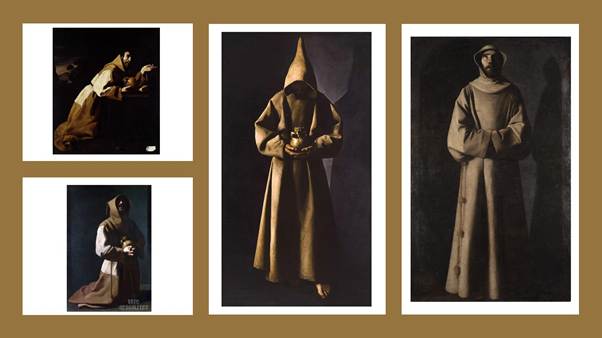
Navarrete Prieto makes much of the fact that Zurbarán used the myth of the saint resurrected in the shadows of his tomb when inspected by Pope Nicholas V.[9] Unmoving but definitively living in the Pope’s eyes, this says Prieto a sacred model for his method of painting sculpturally with the illusion of flesh, and without the need for dynamism of any kind being suggested. Likewise the meditational pictures with a skull still life, just as in a still life painting But the beauty and elegance of Francis are clearly the painter’s gift, heavily swathed in shadows, which fill out the sculpted feel. . The foot in the Tomb painting of 1630 – 4 has all the light of the painting but the skull stared at by Francis seems to illuminate the face such that we flesh it out from the bridge of the nose backwards in a symmetrical beauty. And of course, shadows in the niche of the tomb effect a more concrete feel of living body presence. But, as I say, I need to see ‘in the flesh’ and will report back in error and disappointment or otherwise.
There is a sense in which faces are landscapes and I long to see too the Colossal Head attributed to Zurbarán. It haunts with beauty and solidity. Jones describes it as ‘a wall-filling mask of a giant, possibly painted for a stage set: it makes a mockery of proportion yet is beautifully detailed, full of character, weirdly alive’.
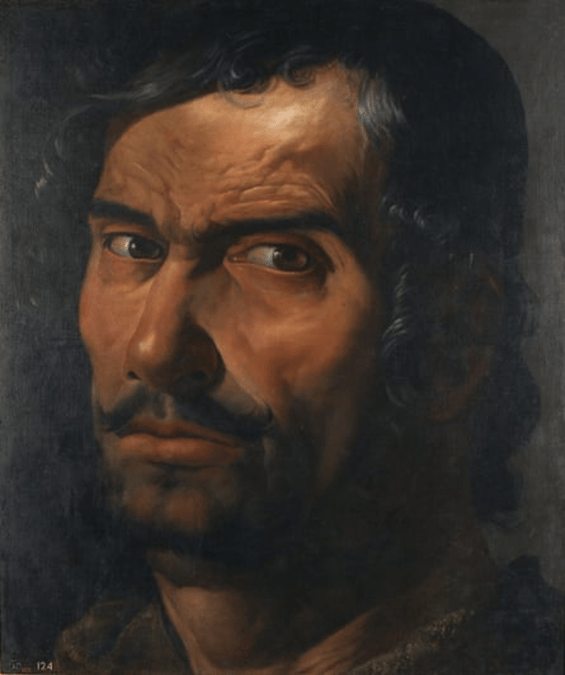
As yet that fits into no paradigm I have of the artist, but let’s see. There are clearly important sections of the exhibition that may surprise me. I h love still life, precisely because it hovers between death and life – especially of flowers, fruit and vegetables, but I do not know what to make f this artist’s penchant for ceramics in serial rows, though, of course, I cannot wait to see the famous A Cup of Water and a Rose (c. 1630). It is this piece that often ignites the debate about the sacred and profane in the artist, roses being in particular associated with the Virgin, precisely because what they display – the idea of passionate blooming – contradicts ideas of purity that they become a higher vision of it
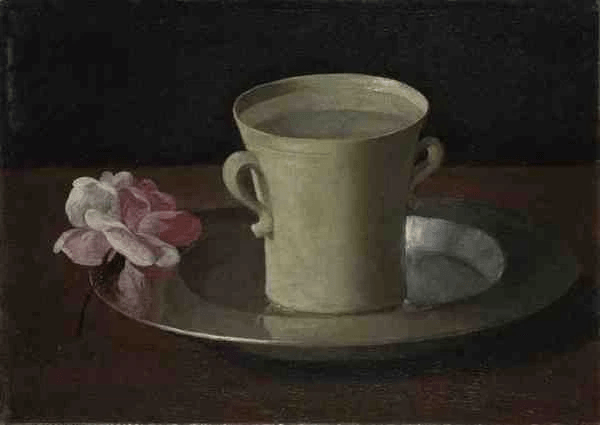
As with all still life, it evokes the talent of the artist in deceiving the eye, especially the look of water painted as a refraction, and of the reflection of a still living rose in a silver plate. This motif occurs in many narrative paintings by the artist too, associated with purity and the Virgin: moreover the rose is the basis of the rosary, that Counter-Reformation necessity, connoting a series of songs of love to the Virgin. Some find in it an echo of the Immaculate Conception. But rosaries too are emblemed in gardens and Zurbarán certainly played allegoric games with this. Out of interest rather than desire, I look forward to seeing the Annunciation pictures, for they look complex and inset with still life motif.
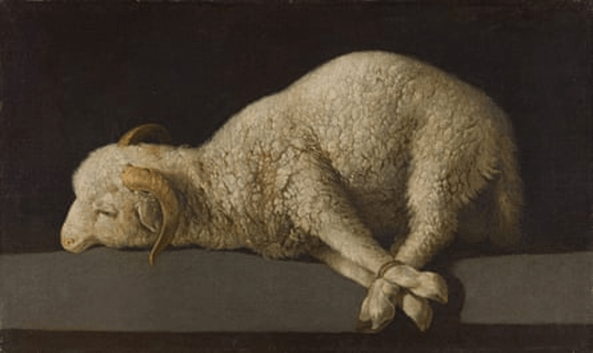
Peter Cherry makes an interesting point that still life in Spain had important connection to economies of food availability and distribution in Spain, and to food riots in Seville.[10] I both do and don’t want to have any thoughts about this in relation to that famous painting, Agnus Dei, which already makes me suffer to see, with thoughts neither sacred nor profane but frankly, those of the depressive who has given in finally. Jones though is good on it, with the requisite triggering cruelty:
In Zurbarán’s most moving “still life” a lamb lies trussed up for slaughter. You cannot see if it is already dead or passively awaiting its fate. Obviously Agnus Dei symbolises Christ, but it is also an actual lamb, a victim of human butchery, painted lifesize with such perfection it might be a specimen in a vitrine. Each fold and knot of its fleece is soft and thick enough to touch. Zurbarán drags you through the picture plane to pity its suffering. You cannot ask more of a work of art.[11]
However, bye for now
With love
Steven xxxxxxxxxxxxx
[1] Benito Navarrete Prieto (2026: 91) ‘Between the Sacred and The Profane’ in Francesca Whitlum-Cooper, Daniel Sobrino Ralston, Imogen Tedbury & Rebecca Long [Eds.] Zurbarán London, National Gallery Global Ltd., 89 – 110
[2] Jonathan Jones (2026) ‘Zurbarán review – ecstatic visions, primitive surrealism … and the finest loincloths ever painted’ in The Guardian (Wed 29 Apr 2026 00.01 BST) Available at: https://www.theguardian.com/artanddesign/2026/apr/29/zurbaran-review-spanish-master-national-gallery-london
[3] Akemi Luisa Herraez Vossbrink (2026: 116) ‘The Lure of the Americas’ in ibid (111 – 123)
[4] Francesca Whitlum-Cooper & Imogen Tedbury (2026: 33) ‘A Singular Vision’ in Francesca Whitlum-Cooper, et. al. op.cit: 23 – 43.
[5] Ibid: 25
[6] Jonathan Jones, op.cit.
[7] Odile Delenda (2026: 20) ‘Preface’ in ibid: 17 – 20.
[8] Charlotte Chastel-Rousseau and Rebecca Long (2026: 65) ‘The Major Commissions’ in ibid: 63 – 87.
[9] Benito Navarrete Prieto, op. cit: 92ff.
[10] Peter Cherry (2026: 140f.) ‘The Zurbaráns and Still Life: A Shared Devotion’ in Francesca Whitlum-Cooper, et. al. op.cit: 125 – 147.
[11] Jones op.cit.


4 thoughts on “When the subject is ‘seeing’, why exclude visual art, for that too allows us to ‘see’ in more than ways that are entirely visual. This blog is an explanation of why I go to art exhibitions. This is almost the same as explaining why I feel a need to prepare myself to see them. The pleasures and perils of researched prescience is however a subject in itself. This blog anticipates seeing the new ‘Zurbarán’ Exhibition at 12.00 midday to 13.30 (about) on Thursday 9th July. Will it change my world?”