


A habit, implies that splendid queer aesthetic philosopher, Walter Pater, must, by its very nature, sully the claim that it has improved your life. If so, could it be because a habit like a cloak enfolds and hides the body of healthy action, and lets it corrupt.
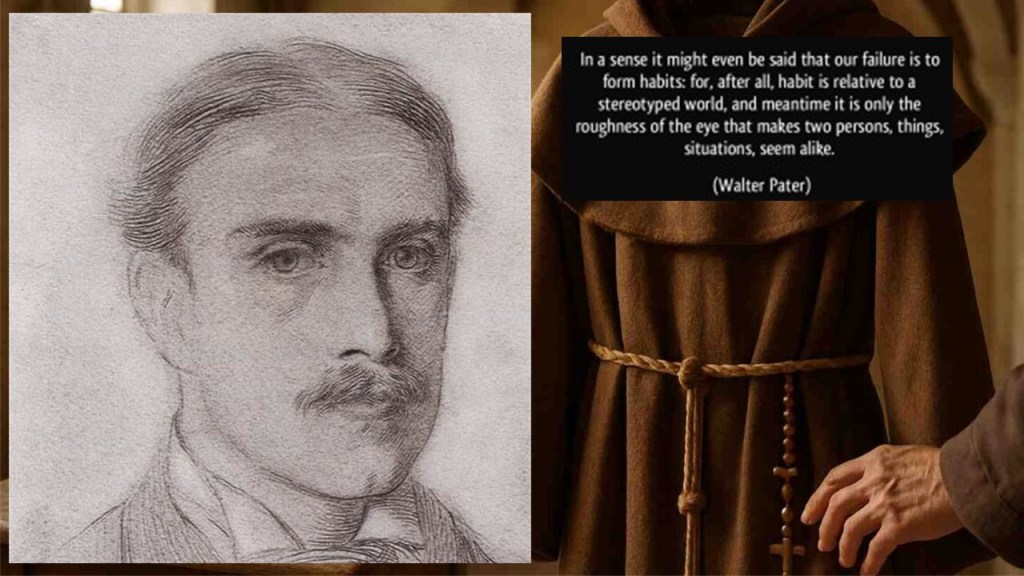
A habit, implies that splendid queer philosopher, Walter Pater, must, by its very nature, sully the claim that it has improved your life. If so, could it be because a habit like a cloak enfolds and hides the body of healthy action, and lets it corrupt. I have mentioned this idea before whilst talking about Samuel Taylor Coleridge (at this link if you wish to see it) and must again later in this blog, for I think Pater’s particular use of the term ‘habit’ anyway may owe a great deal to Coleridge’s use of it in Dejection: An Ode, the most under-rated poem in English.Of course, by ‘habit, neither poetic soul may have intended that other meaning of the word besides the name given to repetitive actions or behaviours in the life of a person’s mind, body and spirit, that is that vestment that acts to cover the entire body out of religious modesty and distrust of the body’s capacity to ignore the demands of a God who seeks to regulate our life. But, nevertheless, it is an effective simile – the ‘habit as vestment’ – for the habits by which we organise life, I’ll stick with it, for a little while anyway. that is partly because, whilst I was in London a day or two ago, I saw a fine sculpture at the Hayward Gallery current exhibition by Anish Kapoor called Cloak (for my preparatory blog on Kapoor see this link):
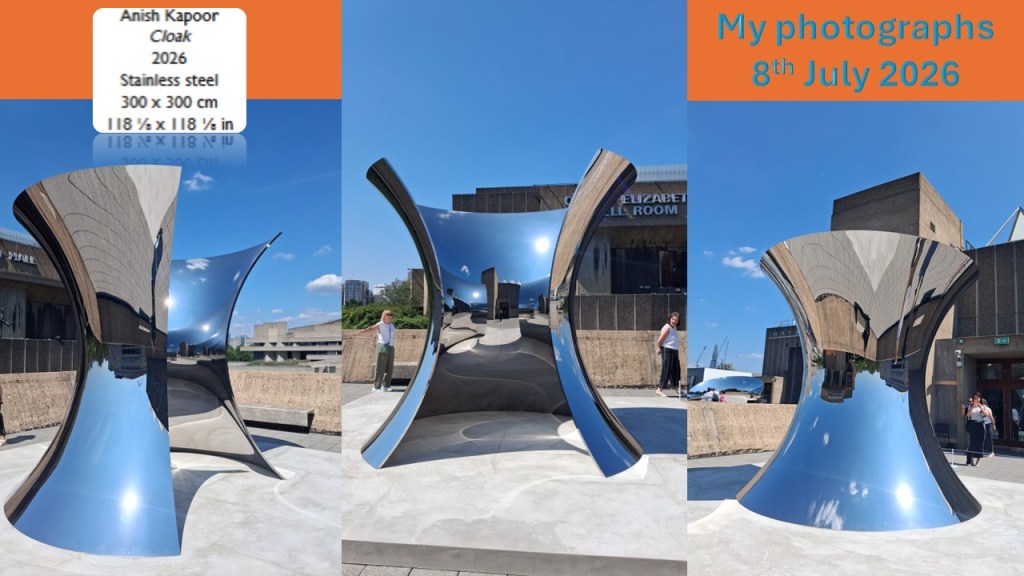
I will return to that piece because nothing could more effectively nuance Pater’s apparent, if only hinted, view of artistic appreciation in his most famous passage of writing in ‘The Conclusion’ to his The Renaissance: Studies in Art and Literature. Here is the particular passage, in a little more fullness, I referred to in my collage above:
Philosophiren, says Novalis, ist dephlegmatisiren, vivificiren. The service of philosophy, of speculative culture, towards the human spirit, is to rouse, to startle it to a life of constant and eager observation. Every moment some form grows perfect in hand or face; some tone on the hills or the sea is choicer than the rest; some mood of passion or insight or intellectual excitement is irresistibly real and attractive to us, — for that moment only. Not the fruit of experience, but experience itself, is the end. A counted number of pulses only is given to us of a variegated, dramatic life. How may we see in them all that is to seen in them by the finest senses? How shall we pass most swiftly from point to point, and be present always at the focus where the greatest number of vital forces unite in their purest energy?
To burn always with this hard, gemlike flame, to maintain this ecstasy, is success in life. In a sense it might even be said that our failure is to form habits: for, after all, habit is relative to a stereotyped world, and meantime it is only the roughness of the eye that makes any two persons, things, situations, seem alike. While all melts under our feet, we may well grasp at any exquisite passion, or any contribution to knowledge that seems by a lifted horizon to set the spirit free for a moment, or any stirring of the senses, strange dyes, strange colours, and curious odours, or work of the artist’s hands, or the face of one’s friend. Not to discriminate every moment some passionate attitude in those about us, and in the very brilliancy of their gifts some tragic dividing of forces on their ways, is, on this short day of frost and sun, to sleep before evening. With this sense of the splendour of our experience and of its awful brevity, gathering all we are into one desperate effort to see and touch, we shall hardly have time to make theories about the things we see and touch. What we have to do is to be for ever curiously testing new opinions and courting new impressions, never acquiescing in a facile orthodoxy of Comte, or of Hegel, or of our own. Philosophical theories or ideas, as points of view, instruments of criticism, may help us to gather up what might otherwise pass unregarded by us. “Philosophy is the microscope of thought.” The theory or idea or system which requires of us the sacrifice of any part of this experience, in consideration of some interest into which we cannot enter, or some abstract theory we have not identified with ourselves, or of what is only conventional, has no real claim upon us.
From ‘Conclusion’ to The Renaissance: Studies in Art and Literature by Walter Pater (for text in full see: https://dev.gutenberg.org/files/2398/2398-h/2398-h.htm
The idea of habit being a kind of psychological and spiritual sickness is a thoroughly Romantic one, as implied in the quotation by Pater of Novalis, particularly in that impossible word in German to translate into English, dephlegmatisiren. The nearest we might get is to point out that it indicates a process, possibly rooted in medicine, of reducing the amount of phlegm clogging the airways though which life is breathed in to refresh and out to leave themselves unclogged by dead life. What Novalis wants is a perception of the thing as it is not as it is filtered through dead models of knowledge that mask and cover it up.
Coleridge knew Novalis too, possibly better than anyone in Great Britain until Thomas Carlyle, and for him his constant bouts of depression were partly, at least, induced by his opium habit, a behaviour he never quite relinquished, but which for him was linked to his habit of abstruse learning and scholarship in almost every domain known to late eighteenth and early nineteenth century science and humane endeavour: whether in the psychology of perception (he called his son Hartley after the early scientific philosopher, David Hartley) or theories of magic. These habits both stultified the life in him, in a way that robbed him of connection to the dynamic body reduced to the ‘still and patient’, forever waiting for the glory that has yet to come (the problem for Goethe’s Faust too – it was a Romantic paradigm)
For not to think of what I needs must feel,
         But to be still and patient, all I can;
And haply by abstruse research to steal
         From my own nature all the natural man—
         This was my sole resource, my only plan:
Till that which suits a part infects the whole,
And now is almost grown the habit of my soul.
His thought cut away from his feeling, partly because these feelings torment now, allows only so much as feeds ‘abstruse research’, which yet again dries up and takes away life most from where life is most needed – what he calls the ‘natural man’. Without a body Coleridge is left with a habit that enfolds the man that was and envelopes him in its unnatural death-like demeanour. That this was like a monk did not escape Coleridge – for him the elite who shaped cultural ideals were a clerisy, its most withdrawn leaders confined to a world where all but the functions of the cleric remain locked inside, as in him. Note that the man reduced from what nature made him is the result of an infection of over-specialisation in the dead rather than living arts.
Hence, Pater’s insistence that the pursuit of beauty is a refinement of life that is found in the particular, not the stereotype, in which alone beauty lives: ‘any contribution to knowledge that seems by a lifted horizon to set the spirit free for a moment, or any stirring of the senses, strange dyes, strange colours, and curious odours, or work of the artist’s hands, or the face of one’s friend‘. Those particular friends are loved for the queerness of the particularising grounding of beauty in themselves – it is to become this, the religion of Oscar Wilde. After all, if the ‘theory or idea or system which requires of us the sacrifice of any part of this experience, in consideration of some interest into which we cannot enter, or some abstract theory we have not identified with ourselves, or of what is only conventional, has no real claim upon us’. Indeed it is not even part of us but a mask and habit we wear together to avoid life, as if that were the point of life.
But let’s return, as promised to Anish Kapoor, for, on my return home, I found in the book published simultaneously with the exhibition, a telling and different image of a cloak and habit named Mother as Mountain, from 1985, which, though not in this show is mirrored in its many ‘mysterious mountains’. One model in our mind as we look at this piece is surely the image of the Madonna as the Church of Christ, which she wears in medieval representations as a huge habit or all-encompassing cloak – the best example being, of course, that of Piero della Francesca but clearer, if less beautiful, in the example by the Master of San Miniato.
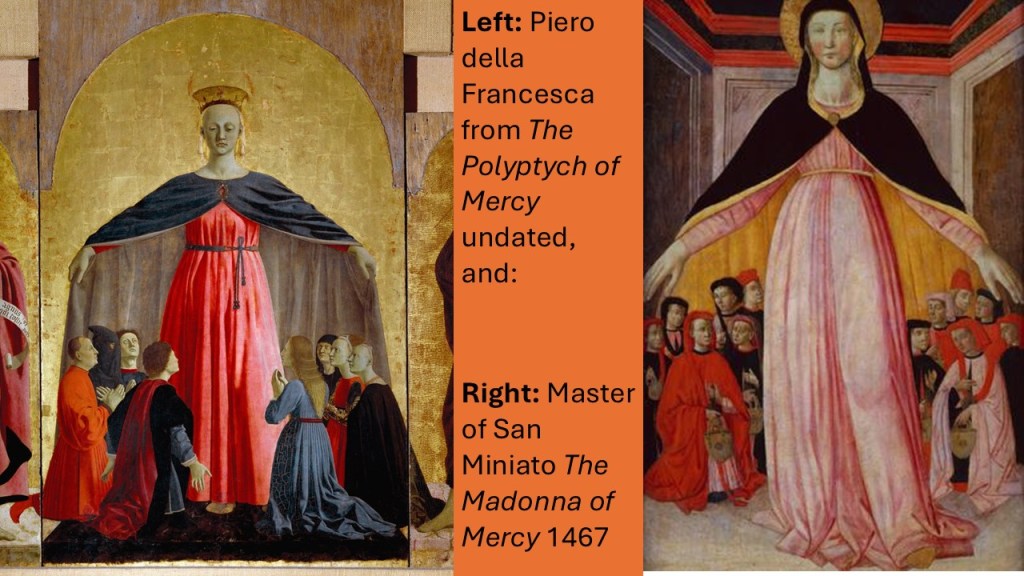
Clearly Kapoor, whose abandoned belief systems are mainly those of Judaism and Hinduism, can refer to a Mother without invoking the necessity of Church nor the Mercy of the Christian God, but his sculpture feels related to those, not least in their desire to create an illusion of a reality in which folds and enclosures occur. Here it is, in different locations (photographs from the exhibition catalogue) from the side and front respectively.
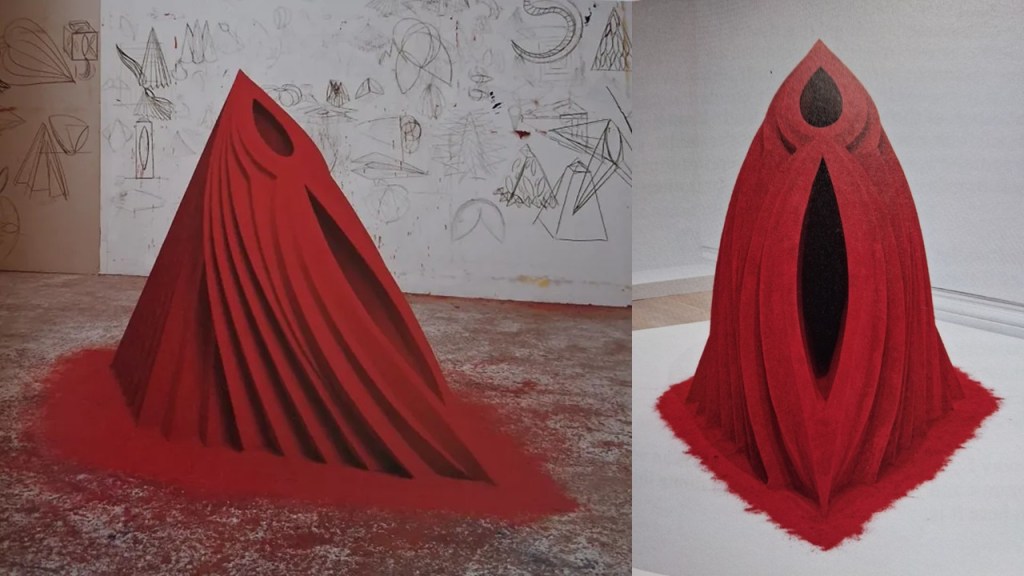
The same folds and enclosures here work to constitute what sometimes appears as a habit like that worn by Mary in the medieval examples, even though Kapoor attributes the shape to his childhood experience of the Himalayas viewed from his childhood home Dehradun. Together these cover not an embodiment of the Virgin but an embodied absence, indeed viewed from without a Void that might be deeper than the space inside the structure itself – a kind of infinite depth of pure black with no visual access to the inner contents of the enclosure, at least from the front. From the side, the inner architectural structure of the piece is glimpsed. It is clear that the longer hole represents an extremely stylised vulva, from which visceral organic material has been erased (just as the effect of blood is obviously dried to an obvious powder). The head of the (absent) body could be concealed within the cowl of the hood of this ‘habit’ but equally it is as absent as the viscera of the vulva proper. If we glance back at the late medieval, early Renaissance examples, there too the body is apparent under the folds it makes – even suggesting the enclosure between the legs of the Virgin in the San Miniato example.
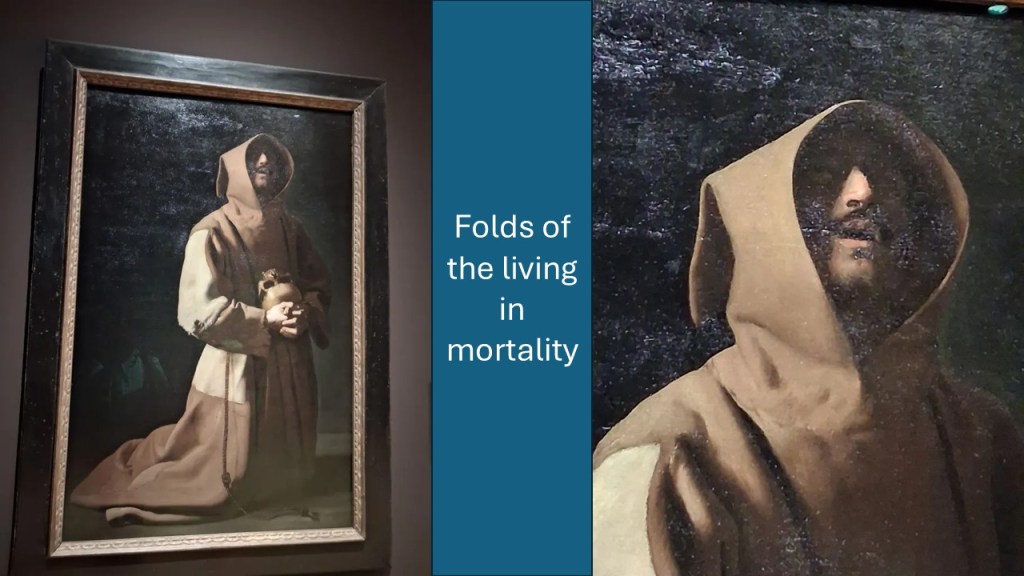
In the interview with Ralph Rugoff in the catalogue, Kapoor makes it clear that folds – their presence or eradication into modern voids (using the new material covering paint, Vantablack) are important to him. He says the invention in the Renaissance that matters as much as perspective is ‘the fold’: ‘The fold, especially in early Renaissance painting, is absolutely essential. It is a sign of being, no less, and it is very elaborate‘. (Kapoor in Anish Kapoor & Ralph Rugoff (2026: 71) ‘In Conversation’ in Clare Chapman & Anish Kapoor Studio Anish Kapoor London, Hayward Gallery, 68 – 79). Looking at the relation of fold, void and interior / exteriors ought to wait for my proper blog on this exhibition, but here, let’s linger on the fact that some painters potentiated this link unintentionally, or perhaps intentionally given the ‘darkness’ implied in Counter-Reformation Catholic theology from the seventeenth-century. Whilst in London I also saw the wonderful exhibition on Zurbarán (for my preparatory blog see this link), Again I will address this exhibition in a later review blog, but having seen Kapoor the day before my head was stuffed with the import of holes, folds and enclosures. I saw them in Zurbarán’s finest monastic life paintings but particularly around the depiction of habits. Start with the living beauty of his Saint Francis:
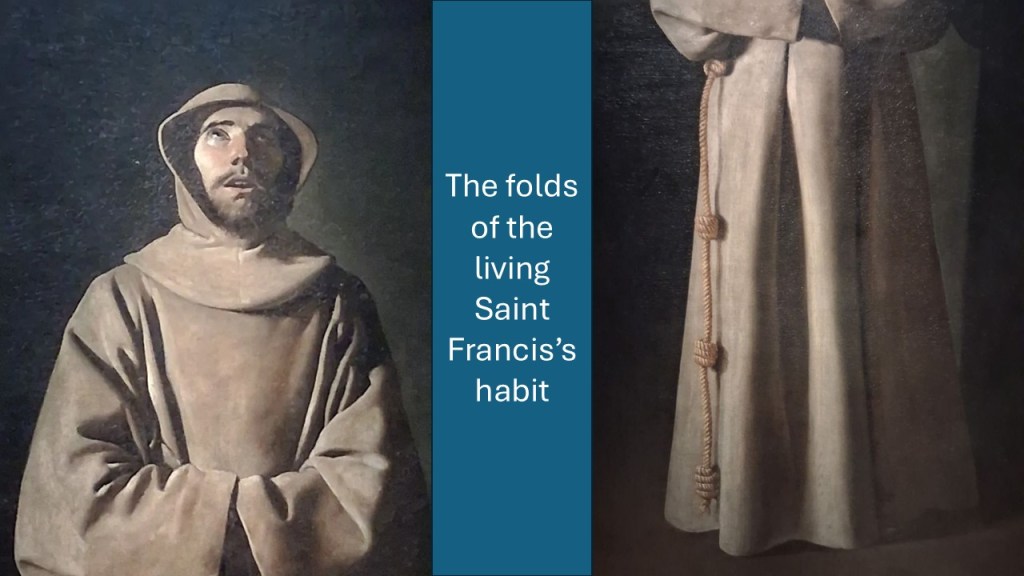
In that painting the beauty of Saint Francis’s face is surrounded by a halo of darkness created as the shadow of the cowl of his habit. The habit negates the shape and beauty of the body if not the face, for that can be directed in gaze directly to God and away from the admiration of the viewer’s gaze. Moreover the shadow is darker than one might expect – it is as if the face hangs in a void of the unknown in which the saint will practice intercession for the sinner. Everything reminds us of the chastisement of the body – especially the knotted belt, whose heavy punishing knots when used to lash the flesh cast rich shadows, but the being of the being persists in the folds that otherwise obscure its shape and flesh. That the play of dark and light is sensual as well as sensuous is as undeniable as the mystery of renunciation and atonement it is meant to manifest.
When a saint becomes more clearly a momento mori, shade can act differently. The monk again has a beautiful face, offered to the gaze of the sinner whilst its gaze looks upwards, as in the process of mediation between God and the mortal suppliant. Here the folds do only half the job for the black of the background, described in the exhibition as the ‘deepest black’ ever evoked in paint, feels somewhat like Vantablack, though not yet invented. Its mysterious evocation of a void larger than any other makes the folds of the habit less important, the shade under the cowl less effective in eradicating the flesh of the face. As a result the mystery of the painting is greater.
And maybe that is because habits and cloaks are twofold in significance – not only deadening as in Coleridge and Pater but also potentially life-breathing, the signification of being not negation as they are usually read. That is, at least what Cloak suggests to me. Instead of enclosing only what it contains it opens itself at top and bottom as if legs and arms were spread in the gesture of welcome. Let’s look again:
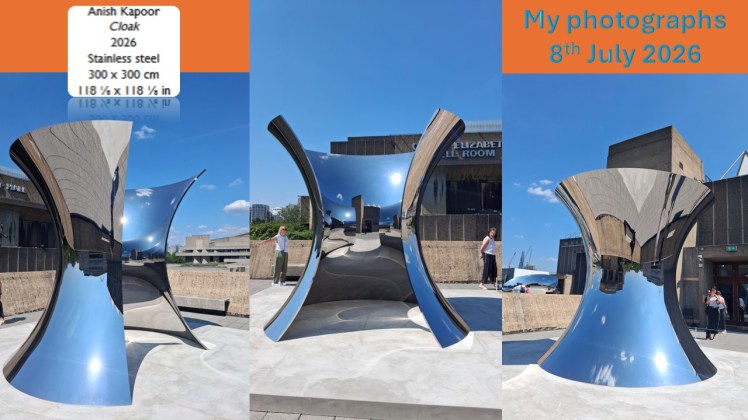
The shadows Cloak casts within itself are no more forbidding, even if suggestive of a deeper interior than exterior. It is only with that the reflecting mirror reflects the world as a viewer standing in front of it would, including for some viewers the viewer themselves (I stayed away from the invitation). The outer reflective walls invert the seen world so that the sky touches the ground it stands on directly rather than aspirationally. Nevertheless, I still see the ‘habit’ here, only much more in nuance, for habits offer some enclosure, but without enclosure there can be no disclosure, which latter usually shows that we filter our reality as we must without threatening our security totally and becoming merely vulnerable. It is true we must love our vulnerability but not at the exposure of it for the crushing feet of worldly authority that cares not a jot for that which cannot somewhat resist it too. For that reason we need our habits to cover our vulnerability and be shareable with others – who do need stereotyped lives some of the time.
Bye for now
With love
Steven xxxxxxx


2 thoughts on “A habit, implies that splendid queer aesthetic philosopher, Walter Pater, must, by its very nature, sully the claim that it has improved your life. If so, could it be because a habit like a cloak enfolds and hides the body of healthy action, and lets it corrupt.”