


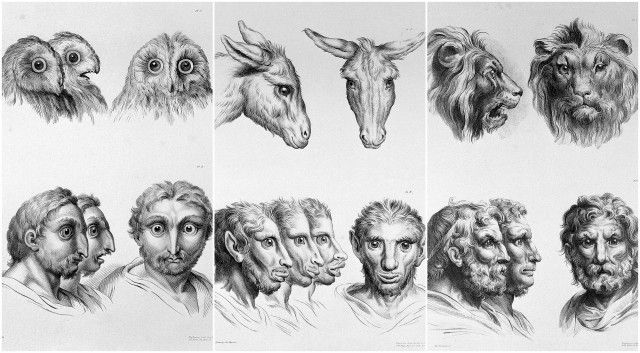
Why has so much word-play gone into disguising the fact that human beings are more strictly knowable as human animals? Why has a binary distinction been created between the human animal and other animals that is heavily bounded by discourse, sometimes falsely called ‘discourse of reason’, since it is always a discourse stuffed with the most unreasonable persuasion and weighted words. We could quote Shakespeare, yet believe we have grown beyond the bounds of his thought and the world-picture of the sixteenth and seventeenth century. In Hamlet we remember most the way in which appetite defines animality – most usually and quickly in misogynistic thought about women – especially grieving mothers who ought to know better, for Ophelia is young and virginal enough still to be dispatched to a ‘nunnery’ *though some claim Shakespeare meant a ‘brothel’ by that phrase used to Ophelia. But Hamlet, former student but now drop-out from Wittenberg, thinks himself a philosopher often discoursing quite abstractly on that binary distinction man or beast (as in Act 4, Scene 4, lines 35 and following)’.
... . What is a man
If his chief good and market of his time
Be but to sleep and feed? A beast, no more.
Sure He that made us with such large discourse,
Looking before and after, gave us not
That capability and godlike reason
To fust in us unused. Now whether it be
Bestial oblivion or some craven scruple
Of thinking too precisely on th’ event
(A thought which, quartered, hath but one part wisdom
And ever three parts coward), I do not know
Why yet I live to say “This thing’s to do,”
Sith I have cause, and will, and strength, and means
To do ’t. Examples gross as Earth exhort me:
Witness this army of such mass and charge,
Led by a delicate and tender prince,
Whose spirit with divine ambition puffed
Makes mouths at the invisible event,
Exposing what is mortal and unsure
To all that fortune, death, and danger dare,
Even for an eggshell. Rightly to be great
Is not to stir without great argument,
But greatly to find quarrel in a straw
When honor’s at the stake. How stand I, then,
That have a father killed, a mother stained,
Excitements of my reason and my blood,
And let all sleep, while to my shame I see
The imminent death of twenty thousand men
That for a fantasy and trick of fame
Go to their graves like beds, fight for a plot
Whereon the numbers cannot try the cause,
Which is not tomb enough and continent
To hide the slain? O, from this time forth
My thoughts be bloody or be nothing worth!
Let me correct false impressions, first. There is nothing, at least in this speech, to indicate that beast and man so differ that they are opposed natures. Indeed Hamlet admits there are worse traits in any living being than ‘bestial’ ones, which, after all only, he says, cause indolence or laziness to get in the way of doing the very thing necessary whilst it is possible still to say: “This thing’s to do”. Look at the example he gives not only of a man other than his self, stuck in delay in doing what he thinks necessary, but one with the ‘delicate and tender’ look of a great Prince and a little bit of motivation all deign to call ‘divine’. That man does what?
Fortinbras, for it is he referred to here, necessitates the death of at lest ‘twenty thousand’ other men merely to stoke that Prince’s (not too ‘tender and delicate’) ‘fantasy and trick of fame’. Even if you call other animals ‘beasts’, though to signify a loaded and fearful response to what is, after all, only an animal, their preference to merely eat and sleep does far less harm.And what does Hamlet conclude – he should turn his human abilities (‘Looking before and after, … / That capability and godlike reason’) to simple thoughts as ‘gross as Earth’ and sticky with much blood of killing.
Shakespeare clearly did not think that reason changed the nature of man. Rather the beast in man transformed the nature of ‘reason’ to make it self-interested and worth little more than great gouts of thickening blood spilled for nothing, not even to eat the flesh once drained of blood and sleep afterwards. In King Lear, the character saying it might be thought of as ‘mad’, and thus having lost ‘discourse of reason’ but speaks total sense in abandoning seeing men as aomething distinct in nature from an animal, suggesting instead it is not reason, or even language that distinguishes the concepts but the mask to the naked, because hairless) beast within that is the clothes we wear (and homes we live in for shelter) and the distinctions, even between humans, they insist upon: like class, rank and other status hard to see once the animal is bared of all show. And Lear says this all in unaccomodated prose – perhaps in this showing that poetry is more than the look verse lines give it:
LEAR  Thou wert better in a grave than to answer with
thy uncovered body this extremity of the skies.—Is
man no more than this? Consider him well.—Thou
ow’st the worm no silk, the beast no hide, the sheep
no wool, the cat no perfume. Ha, here’s three on ’s
are sophisticated. Thou art the thing itself; unaccommodated
man is no more but such a poor, bare,
forked animal as thou art. Off, off, you lendings!
Come, unbutton here.Tearing off his clothes.
And man considers himself no animal precisely because he can rob beasts of all they have, it being little enough, to manufacture signs of specifically human distinction turning the beast into a reduced form of use in human clothing – to leather, wool, silk, and the ‘civet’ for which the grandest of cats gives its life to perfume great slobs of the human that think themselves sophisticated. But ‘unaccomodated man’ is that animal free of ‘lendings’ (a rich word in itself) that thinks walking on two legs makes it better than those animals who use four.
Now, to the question! What animal would I be if ‘forced’ to choose to be one for the time specified? I would be an animal that has no choice but that which can be forced on them so that our natures’ are moulded to make them suit the needs and more frequently the desires of the thing that forces me to choose from a restricted menu of options. I would be that animal in human imagination that, whilst feared and despised, is taken as a pet to stop it being an animal in the fullest sense and enslaved and/or caged . Moreover, that ‘fullest sense’ of animal is not the definition that an animal itself might give if its cognition and the articulation of its cognition even allowed that it could have that capacity.
Humans call animals free sometimes; at other times they call them entirely determined, by either instinct, environment or combination of the two. Sometimes animals are thought entirely to lack any motive but self-interest, even if abstracted to the level of the genes, at others to show a means of cooperative living in their own or with other species. When Tennyson called Nature ‘red in tooth or claw’ he employed animal metaphor to characterise that every species in nature that is not human is too self-interested to care for anything other than its own survival, but these animals are pure inventions of human thought. It is true that some animals kill for other reasons than food but none seek mass extinction of species, groups or races in the same way humans do.
The only truth I can think of in relation to wishing to an animal of one’s own choice is the choice humans exert most: the choice to appear to have more power than any other being. WHEN Browning decided to write on this he turned to investigate the mind of a imagined creature: a sea-beast but with capacity for learning and particularly prone to attempt to match the human instinct for power over other beings, except those it cannot see, understand or control, which it calls Gods. The poem Calibon on Setebos imagines that sea-creature Caliban imagining the most powerful God it can think of, greater than those it can name, which themselves stand above the only humans they know (Prosper and Miranda also vaguely taken from Shakespeare’s The Tempest, who are the ones who show him that the lust for power is endless and tbus model God for him.
Caliban not being human nor an animal learns first that it is those things about him that are animal that he must learn to control first, understanding why and how it is the domesticatable and taxable animals that will first feed his power. When Calibab imagines a controlling power he imagines it as acting like he does with animals, which is how he thinks Prosper behaves with him. ‘He’ is a very slippery word in the poem:
All need not die, for of the things o' the isle
Some flee afar, some dive, some run up trees;
Those at His mercy,—why, they please Him most
When . . . when . . . well, never try the same way twice!
Repeat what act has pleased, He may grow wroth.
You must not know His ways, and play Him off,
Sure of the issue. 'Doth the like himself:
'Spareth a squirrel that it nothing fears
But steals the nut from underneath my thumb,
And when I threat, bites stoutly in defence:
'Spareth an urchin that contrariwise,
Curls up into a ball, pretending death
For fright at my approach: the two ways please.
But what would move my choler more than this,
That either creature counted on its life
To-morrow and next day and all days to come,
Saying, forsooth, in the inmost of its heart,
"Because he did so yesterday with me,
And otherwise with such another brute,
So must he do henceforth and always."—Ay?
Would teach the reasoning couple what "must" means!
'Doth as he likes, or wherefore Lord? So He.

'Conceiveth all things will continue thus,
And we shall have to live in fear of Him
So long as He lives, keeps His strength: no change,
If He have done His best, make no new world
To please Him more, so leave off watching this,—
If He surprise not even the Quiet's self
Some strange day,—or, suppose, grow into it
As grubs grow butterflies: else, here are we,
And there is He, and nowhere help at all.

'Believeth with the life, the pain shall stop.
His dam held different, that after death
He both plagued enemies and feasted friends:
Idly! He doth His worst in this our life,
Giving just respite lest we die through pain,
Saving last pain for worst,—with which, an end.
Meanwhile, the best way to escape His ire
Is, not to seem too happy. 'Sees, himself,
Yonder two flies, with purple films and pink,
Bask on the pompion-bell above: kills both.
'Sees two black painful beetles roll their ball
On head and tail as if to save their lives:
Moves them the stick away they strive to clear.
The whole nature of aiming to understand species you decide are beneath your power of comprehension and/or control is to ensure they at least appear to choose their inferiority to you or if not learn to die, even though ‘All need not die‘.
Would teach the reasoning couple what "must" means!'
Doth as he likes, or wherefore Lord? So He.
There is a hint here of how God behaves in the Garden of Eden with the couple Adam and Eve. The point Caliban makes is that all power is about its own right of implementation regardless, ensuring that the inferior being is reminded continually of the limits of their choice in the context of the superiors capacity to enforce their choice. We teach pets how to obey us but do not want them to have any knowledge of us that can be exploited, such as a consistency of behaviour that can be understood.
So don’t ask me which animal I would be if forced. Tbe whole point is we all choose to be human to minimise the forces we know can already be exerted on us from above, because we mimic them with those ‘below’ us.
That’s all for now
With love
Steven xxxxxxx

