


This blog uses Elizabeth Strout (2026) The Things We Never Say London, Viking / Penguin as a test case for a thesis based on the difficulty of erasing trends from history. In it, the narrator says that Artie Dam, thinks his despair at the ‘state of the world’ relates to the hopeless hope that a dangerous right-wing demagogue does not win an American election fought(and won by the wrong person) in the background of the narrative yet influential within it. However: ‘because he had studied history. He was aware that in all human existence there had never been a time where people were not killing one another, and why he had not been affected by this as strongly throughout his life as he was these days he could not understand’. As he gets home and removes his sailing boots he suddenly understands that his despair had another more primary cause: ‘It was an accretion of loneliness; …’ (page 24).
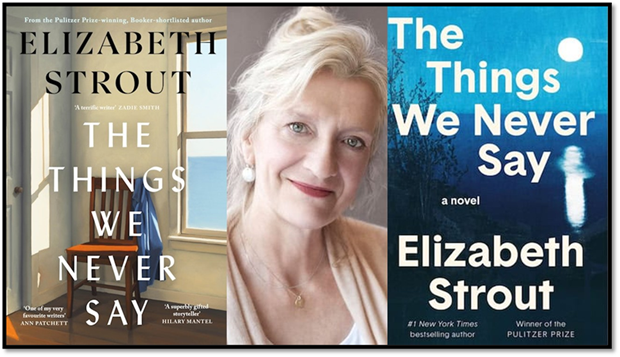
[For links to other 2026 Booker nominees, use this link first}
Elizabeth Strout’s new focal character in yet another of her novellas of American consciousness is a history teacher – indeed a talented, though not highly intellectual, one who won Teacher of the Year and is beloved by his teachers who call him Damn-Dam, because of his fondness for that nowadays mild expletive. His grasp of history is being challenged just as the principles of statehood are to be by Trump’s style of thinking about lost causes of the right in American politics, and a demand that he teaches the American Civil War as much through the eyes of the Confederacy and its agents and military as well as thouse of the Union. He must learn too not to talk about girls but women in speaking of students. His outdatedness has therefore some negative forces in it as well as positive ones. But he knows that one cannot kick against the trends of history forever. What he hadn’t realised was how much he relied on the myth of a progressive consensus over what history was, is and shall be in the future, whether in academic terms or any other.
There are various ‘trends’ in history of which the book mourns from Fascism to the cult of leadership and the use by leaders of internal repression and foreign war to quell dissension. However, there is a truth the book faces that we need to face too, and in this question. That is because, in order to erase even one trend, continuous or cyclical, from ‘history’, history would have to be as malleable as fiction (a kind of ‘magical thinking’ governing the narration of the times in which we live), which to some. even those with heft in the shaping of history, it is sometimes said to be. But the narrative form we call history owes a duty to history as it is experienced by multiple stakeholders in it, and even for Donald Trump, there can be no rewriting that isn’t validated by the tough processes through which reality is tested for accuracy and validity in the community. Nevertheless, when asked in class whether anyone, including Jews, did not ‘revolt’ against the Holocaust, Artie Dam says:
“Some did. They tried. There was, in some instances, resistance. But speed and magnitude of the support for the Nazis overwhelmed them.” He told them how he thought it had happened, the effectiveness of the nazis. “In one month and three weeks and two days, Hitler managed to change the entire government, the entire country.”[1]
This blog uses Elizabeth Strout (2026) The Things We Never Say as a test case for these theses as they appear in history as it was and is lived. Artie Dam, as mentioned already, is, significantly a history teacher but one from a family formerly known by the surname Damm until the family changed it to disassociate the name from its German historical origins and their past history as exiles from Fascism. Linked to that is his desperation that Donald Trump does not win the Presidential election fought against Camilla Harris in the background of the novel, with neither candidate being named, because of Trump’s reputation as a military hawk and user of internal state oppression. He thinks his despair at the ‘state of the world’ relates to this hopeless hope, yet: ‘because he had studied history. He was aware that in all human existence there had never been a time where people were not killing one another, and why he had not been affected by this as strongly throughout his life as he was these days he could not understand’. But as he gets home and removes his sailing boots he suddenly understands that his despair had another cause. That was the primary cause he sought: ‘It was an accretion of loneliness; …’.[2]
How that experience of accreted loneliness (not only his but that of most characters in the book and a significant theme of the novel) relates to the novel’s concern with history is fundamental but not voiced very clearly, for loneliness too is surely a psychosocial historical product. I have raised some ideas about how Strout sees her role and responsibility in relation to the historical traditions of the novel in an earlier speculative blog (see it at this link if you wish). Of course, the novelist’s intentions are not merely cerebrally and reflexive on novel-writing, for Strout is already a considerable poet of modern American existential loneliness (for some thoughts about her earlier Booker-shortlisted novel Oh William! see this link) and we need to beware equating such a considerable novelist with either carrying of a social message or a repeated existential crisis. Interestingly enough in the scene where Artie informs his class about German Fascism, Strout focuses on the ethics of Artie’s teaching qualities. Long accustomed to being thought ‘stupid’, the asker of question he answers, Temera, receives his answer, with its bow to the intelligence and appropriateness of the question in a way that ‘he saw her receive … with a sense of gratitude – an understanding for a moment that she was not stupid’.[3] It is this practical understanding of the ethics of human communication that makes me see Strout as a modern George Eliot, in my eyes a considerable and necessary achievement.
However, the issue I want to focus on in the novel is the interplay between the knowledge of both loneliness and history in parallel, without too obvious social messaging linking them – one of the signs of a great novelist, as it was in Eliot too. When after a party reflects to his wife on ‘why people never say anything real’ (the first reflection of the novel’s title) he references not only that no-one replies to him about his current desire to talk about whether humans have free will in their decision-making, he is also referring to their shared silence about their personal histories as well, in families afflicted with separation, illness, affairs and their daughters’ abortions. Artie’s wife, Evie, says it is ‘idiotic’ to expect this, giving the reason that each person is, as it were, so isolated that it is unlikely that they will breach that isolation with talk that implicates them with another, except that she says that even more obliquely than that, so that we cannot be sure what she is saying, referring to the dead husband of a mutual acquaintance, Flossie MacDonald:
Evie walked through the side-door of the house, which Artie had opened for her, and she turned back to him and said, “Reg used to say, !each man is an island.'”
“Who said what?”
“Reginald MacDonald. You know that saying, ‘No man is an island,’ well, Reg thought that was all baloney. He said we were all islands.”
“I don’t understand, ” Artie said, slipping his coat off.
Evie waved her hand. “Forget it. But what is this with you, anyway, this free will stuff?” She handed him her coat.
” I told you, it’s just something my mind plays with these days. We all think there is free will, but what if there isn’t?”
Evie gave a sigh and shook her head slightly.
And Artie, as he walked to the closet with their coats, felt a dismalness return to him.
Why not quote that in full – in that it contains only an illustration of the void that is often ‘the things we (all) say’ which, in the event matters less than ‘the things we never say’. It will take more of the novel for it to be clear (and massive spoilers follow) that Evie mentions this comment of Reg’s but does not here as she has not and and will not ever say to Artie that she had a long affair with Reg and that Artie’s ‘son’, Rob, is actually Reg’s biological son. Reg, supposedly a friend of Artie had not said that to Artie nor to Rob either, though he leaves the latter a note that gives the game away after his death. Rob is reluctant to say that to Artie and tries to speak to Evie about it but cannot, and hence talks about his upcoming marital separation to her. When Rob eventually feels forced to share the news with Artie, after a serious accident in which Artie nearly dies, neither intend to tell this ‘thing’ to Evie yet, and neither ever do. Evie will learn of Artie’s knowledge of the things she never said when Artie dies and Reg’s note (given by Rob to Artie) is discovered in his papers. But Artie is keeping secrets too – the reason he is obsessed with free will is that he is planning his own suicide, and even dreams about it, by precisely the same method as unfolds contingently in his sailing accident that nearly kills him. When Rob later asks Artie if he was trying to kill himself in the accident, Artie can conveniently deny (luckily for he later works out that Rob too has become suicidal and his father’s attempt would prompt his if it was shared with him) an intention that he had, but was not what led to the accident.
Sorry again about the spoilers but at the moment I am interested in the aspect of the technique of the novelist based on the ‘things people never say’. For me, when reading the passage above, I note that here, a theme of isolation and existential loneliness has been started off, using the ‘saying’ that is actually a quotation from seventeenth-century divine, John Donne (1572-1631) from his Devotions Upon Emergent Occasions and Seuerall Steps in my Sicknes – Meditation XVII, 1624:.
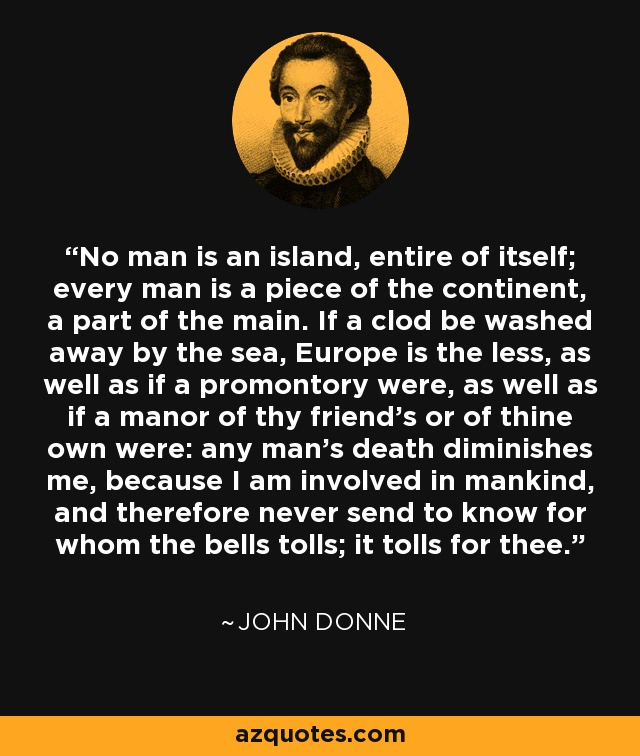
Yet how pertinent to put the reverse possible meaning of Donne’s phrase, that suggests we all are forever separate from each, unable or unwilling to communicate across the gulfs that surround our island nature. Artie at once point shares his knowledge about Rob with the man involved in rescuing him from the boating accident, Ken Moynihan,when they become friends in a way no-one could have been predicted, but when he learns that Ken is a supporter of Trump, even after his second election to office, Ken falls into a changed relation to him. However it is not exactly the same relation as to everyone else, prior to this revelation.
If course, Ken is a man he barely knows anything about, even though he is sure he is a ‘good man’, but that ‘even though’ marks a bigger difference than seems to be the case. Reg had not been a ‘good man’, not really, nor had anyone in the Peabody family, coastal neighbours, but Ken is not sullied by knowledge of him that was intended to be ‘never said’, though clearly a ‘secret’ in a different way from other secrets. In the significant passage I refer to, Artie is still wondering whether he will or not show Evie that he knows her secret s about both Reg and their son. He returns home in a narrative silence, a phrase made into a paragraph of ois own islanded by white space:
The house was silent.[5]
Artie casts his mind around people who matter to him, finding much that he wants to say but cannot, or even when he does, does so whilst not having intended to do so, like telling Rob he is depressed. What difference does knowing about Ken’s politics, not shared with Artie make? It extends to new moral propositions about the relation of self to the world and its histories: [5]
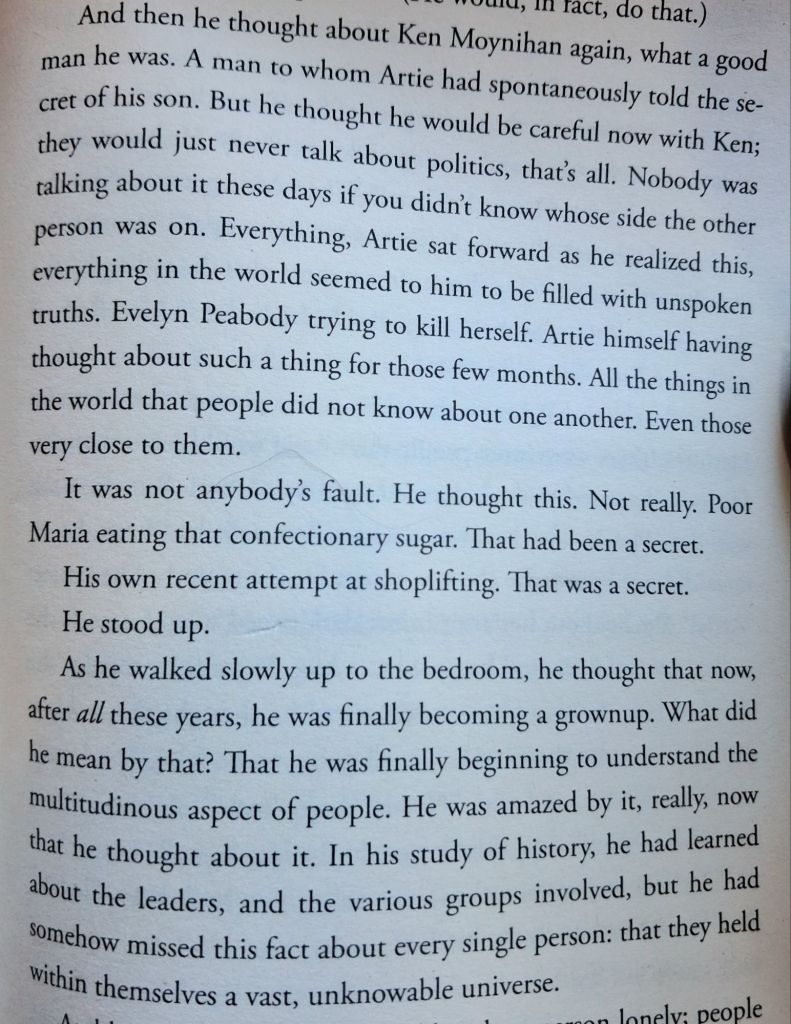
There is learning in the generalisation that Artie makes that ‘everything in the world seemed to be filled with unspoken truths’, there is learning that grows through this wonderful writing to make us backtrack to rethink the way he discovers the secrets of Evelyn Peabody (whom he hardly knew and who no-one talked about directly to him), about that strange beautiful ‘secret’ he discovered about his now dead sister, Maria, eating confection sugar secretly in the cellar in rebellion to her family, and about his shoplifting thefts, which he barely knows how to talk to himself about even but knows the shopkeeper did in an act of tremendous kindness and respect to his family and him, It is only in the last paragraph that the learning is consolidated and where he and we as readers collate the experiences into a more finished learning where a man of considerable age thinks of himself as ‘finally becoming a grownup’ : but only in the process of ‘becoming’. And what makes this more finessed is that Artie ties his learning to things he could have learned more significantly in his study of history had he not eradicated his person from it, as we all tend to do. Learning the ‘multitudinous aspect of people’ (as groups or individual persons) when he learns that most of what we have to know about them is concealed because of its size and diversity.
It takes only another paragraph for that learning to be linked to learning about the possibly true nature of isolation, in which ‘loneliness’ may continue, but was but one of many truths – some of which are beautiful and special if not redemptive of the whole world – except in the ways they are for those lovely characters Rhonda Lazarre and Danny Merino whom we see grow up into grownups too, a little faster and with more to rejoice in because of Damn-Dam the history teacher. All Artie understands is this, and it is as if he is benefiting in being his own learner:
And he understood that it could make a person lonely; people had to take and give to one another wherever they could. If it was not enough … Well, then it meant one just had to be a grownup. [5]
This has a certain moral obviousness about it but only if you have been brought up on the tradition of the novel, especially in the nineteenth century. But it is nuanced enough as from the point of view of a not particularly intellectual man but one who was sensitive to learn about and with others, eventually, without habitually stereotyping them, as many other characters do, including Evie, Reg and Flossie – if not Rob and Francesca, Rob’s returning wife, those last with a kind of tremendous intelligence that seeps through their presence and moral cognition. However, that there is nothing sentimental about this learning strikes when Artie finds out before dementia fully strikes him that the Flossie he obviously loves in his own celibate way and trusts as a friend is the friend of ‘that self – himself’ that ‘seemed far away now, so much has had transpired’. [6] What transpires is history from which nothing gets erased even though it is kept silent and secret. Evie patronises Flossie and always has, and not just by having a son to Flossie’s husband, but learning that she admires Donald Trump actually pushes Flossie into a different relation to Artie which means that he confronts the growing up process again, not long before he dies.
That the Trump presidency may yet lead to Fascism is a problem in this problem novel neither assured or refuted. Nor is its negation allowed to reassure us as readers. Strout’s world is still a cruel one despite the fact that we can learn to see it more richly and as more varied. Personal, national and global history will still remain as open to tragedy as things we see as redemptive. Open too to un-imagined events that we are powerless to stop (for ill or well, even though that does not absolve us from trying when they are ill, as Rob and Francesca try though having become enforced exiles from the USA in the process, and will eventually, the novel tells us, be denied a visa as much as other undesirable migrants of the Trump regime’s making. We will all live with the accretion of loneliness that tries to outweigh the ambivalence of history, properly understood by making us feel its downsides though. Not however, that this novel joins the positive psychologists in pretending that we can choose to make things feel better by thinking them so. The novel is littered with people (a fact shared somewhat mildly redemptively between Artie and Rhonda in mental asylums on either side of those delusions of history and its true persistence in moving on and in lying to us, or at least omitting the truths. For after Artie tells Rhonda the secret of his mother’s institutionalisations, ‘it left him in a state of even more heightened anxiety’. [7]
However, as for erasing trends from history, because they upset us or we claim they upset children, that happens too much already, with people feeling forced as Artie is as his life reduces to watch ‘people in Gaza starved and the United States did nothing about it’.[8] Not that Artie’s principled refusal not to ‘exact a good look at the Worst’ before allowing the children he teaches to plan a ‘Way for the Better’, that we can only hope for the beautiful characters that are Rhonda and Danny with their memories and relics (Rhonda keeps a pillowcase in which Artie used to confiscate cellphones during class) , necessarily leads to improvement but it does lead to the hope that our ethical imaginations haven’t died with the success of immoral government. When Artie learns that civic classes are not covering FASCISM and not therefore given the chance to begin to see the processes involved in extreme right-wing government, he changes his class from the subject of the American Civil War to modern European history: [9]

I have already referred to this event above, but given more detail now to try and assert just how relevant this novel is to the easy option of magical thinking about the erasure of trends that I see as truly evil from history – those that hang their credos on the hatred of the ‘other’, however manifested. Before Artie dies, like the Othello so brilliantly analysed in Danny Merino’s essays, he thinks back to the re-election of Trump, conveyed in one sentence islanded on an entirely blank page:
… he slowly understood that what he had felt the day of the election was true: His country was committing suicide.
Yet many suicides are either planned or completed in this book, some by characters on the margin of the novel but whose death we are made to care about, like that of headteacher, Hoover Lakeland. Suicide is one of the ‘things we never say’, but need to lest we sleepwalk into it, as a person, a group or a nation. Amidst of this is the heroism of some teachers though it may be a tragic heroism. And then their is the heroism of caring fathers, a major theme in the book, where caring does not equate with the qualifier in ‘biological father’. Reg could not be less caring, as Artie is, but then there are fathers who care partially – what of Evie’s father or the sad under-story of Artie’s father, whom sons sometimes betray, as in this beautiful passage which I will leave you with. Evie has mentioned that her own father advised her against Artie because of poor status of his migrant family. There follows a brilliantly written ‘row’ that means both dead fathers get insulted to slight their offspring. Then we get this (it breaks my heart): [10]
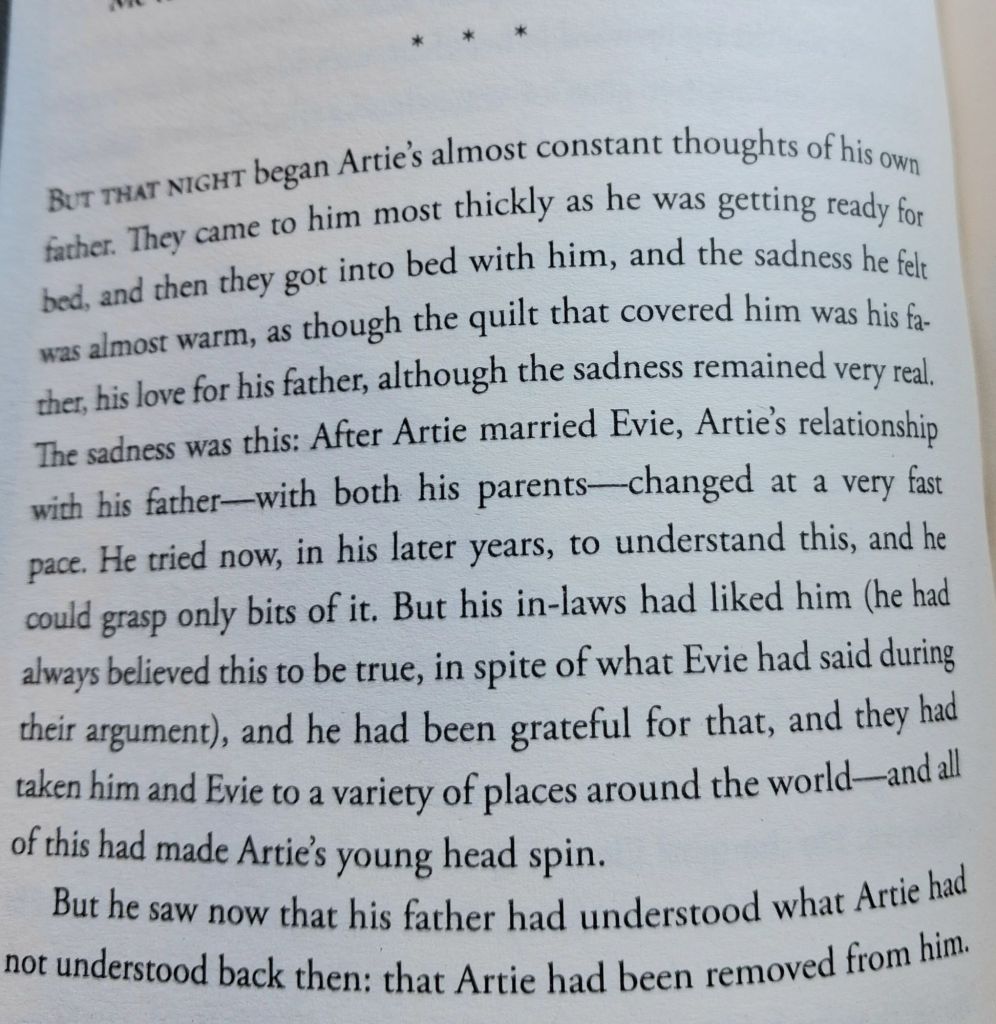
Beautiful as this, it is beautiful because of the ethical decisions we make that are so often hidden from even our own consciousness. Let’s say it again – this novelist is great. The very least is that she should be on the Booker shortlist for this novel in my view. But great novelists matter less now than our need for moral sages to address our grotesque lack of history as the Victorians set as their task: from Carlyle to Dickens and George Eliot.
Bye for now
With love
Steven xxxxxxxxxxxxxx
[1] Elizabeth Strout (2026: 78f.) The Things We Never Say London, Viking / Penguin
[2] ibid: 24
[3] Ibid: 79
[4] ibid: 13f.
[5] Both quotations and my photograph from ibid: 183f.
[6] ibid : 187f.
[7] ibid: 33f.
[8] ibid: 190
[9] my photograph of ibid: 78
[10] my photograph of ibid: 116.


5 thoughts on “This blog uses Elizabeth Strout (2026) ‘The Things We Never Say’ as a test case for a thesis based on the difficulty of erasing trends from history. In it, the narrator says that Artie Dam, thinks his despair at the ‘state of the world’ relates to the hopeless hope that a dangerous right-wing demagogue does not win an American election fought(and won by the wrong person) in the background of the narrative yet influential within it. However: ‘because he had studied history. He was aware that in all human existence there had never been a time where people were not killing one another, and why he had not been affected by this as strongly throughout his life as he was these days he could not understand’. As he gets home and removes his sailing boots he suddenly understands that his despair had another more primary cause: ‘It was an accretion of loneliness; …’.”