


Let’s pretend we can get in the mind of great artists, and consider how Anish Kapoor might translate the question, ‘What’s a time you followed your gut and it turned out to be exactly right?’ This is a blog preparing to see his new exhibition at the Hayward Gallery.
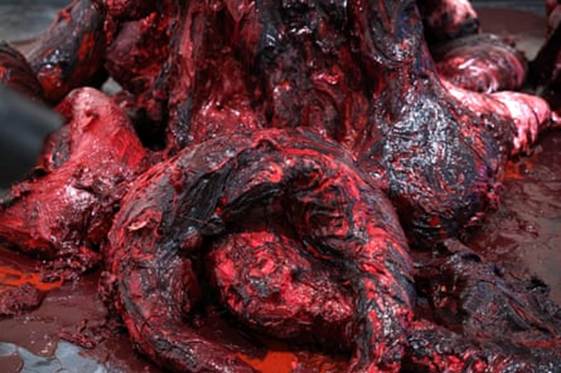
Following your gut to their source: ‘A divine bloodbath … Ritual Expiation by Anish Kapoor, Hayward Gallery, London. Photograph: Neil Hall/EPA‘
I suppose I am determined not to prepare in some small way for things I see in national art galleries. This is another installment of the preparation for my July 8-9th trip, for which the schedule again is thus, together with the surrounding commentary from an earlier blog on another event (the whole is at this link):
Other events are linked to their own blogs in the table.
Wednesday 8th July Thursday 9th July LNER Train Durham – Kings Cross 10.40 – 13.32 Leave Hotel by 11. 00 Southbank Hayward Gallery, Anish Kapoor 14.30 – 16.00 National Gallery, Zurbarán Exhibition 12.00 – 13.30 Hotel (Travelodge, Kings Cross) Haymarket Theatre, David Hare’s Grace Pervades 14.30 – 17.00 Bridge Theatre, Simon Stone’s Oresteia 19.30 – 21.45 LNER Train Kings Cross – Durham 18.33 – 21.23 I prefer to go prepared to events – if I see an author read, I like to have read and thought out in informal print (my blogs) what I have learned and felt (aspects of the same process I hope) so far.
I had to start with the above quotation from the last of the series on this trip to save typing but, of course, here the focus in on an exhibition of sculptural art. Thus, what applies here is that for an art exhibition where I will only be permitted to buy the catalogue when I visit, which, as yet, is the situation at the Hayward, I need to prepare differently. For this I have looked at materials previewing and reviewing the exhibition from newspapers and Reuters news agency, as available in hard copy or online.
But I linked this installment to a prompt question for a reason, prefacing it with a picture available online of one of the exhibits which looks like nothing less than a pile of ‘guts’, or, if you prefer, viscera. Before we go on, let’s interrogate the idea of ‘following your gut’. The word gut has multiple resonances, its nearest association in the ‘Following your Gut’ paradigm is the idea of making decisions by a supposed instinct, a prompting or drive in the body, perhaps associated with what you feel inside.
Of course, the gut is heavily implicated in decisions of the brain, the stomach, (sometimes all we mean by ‘gut’) being surrounded by a subsystem of neurons that are collectively sometimes miscalled the brain of the fleshly body, remote from its cerebral associated neurons, though connected, of course, through the spinal column sub-system of nerves.
Gut feeling often comes from this activity as do bodily symptoms such as bowel functions, even working in deficit or excess and labelled disorders. Driving aenergies towards eating g or inhibition thereof, they also work hard in fear or freeze responses, implicated then in anxiety and depression responses to stressor internal and external. But when we speak of ‘guts’, which also can be understood in tje singular ‘gut’, we remfer to the collection of internal viscera – that spilled in.wars and in pretence in horror and ear FILMS as ‘blood and guts’. Art prior to filming representations has exploited the exposure of gut too, a phenomenon made much of a brilliant exhibition I saw at York Art Gallery, entitled Flesh, some time ago, when I wrote shorter blogs (see it at this link). One of tbe exhibits therein is referred to by Jonathan Jones in his review of the Hayward’s Kapoor exhibition, whilst apparently defending that exhibition from tne charge of being ‘(s)ensationalist and macabre?’:
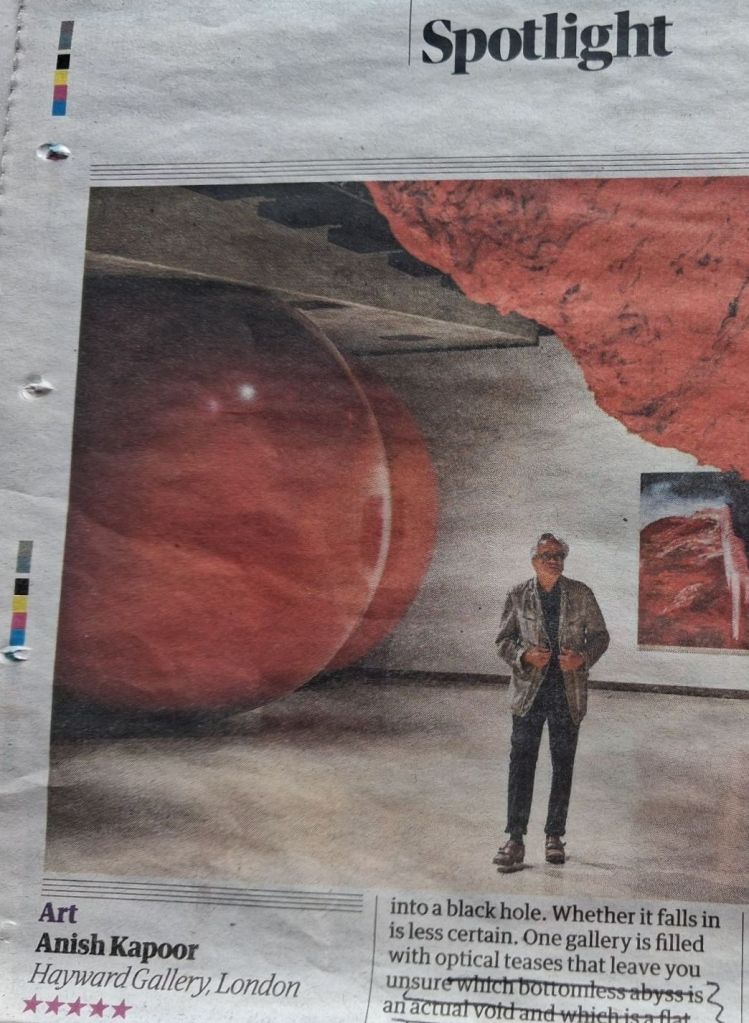
Rembrandt’s painting Slaughtered Ox is just as visceral as it contemplates the flayed, hollowed body of a huge ox hanging upside down, its yellow fat and blood-dark meat a mirror of our own doomed flesh, not to mention the crucifixion. In the age of smartphones and minuscule attention spans, Kapoor gives artistic depth a go, addressing God and mortality, those themes of the old masters, in a metaphysical rollercoaster ride of a show, a divine bloodbath. [1]
I would have chosen ‘divine ‘blood-and-guts-bath’ to end that quotation I think; Jones having left the idea of guts to be conveyed by the term ‘visceral‘.See the photograph, from the online, if not hard copy, version of the article to see what I mean in regard to Kapoor’s Ritual Expiation, a work that acknowledges that we often seek expiation for our sins from spilling the viscera of others, and is also, almost certainly (though not acknowledged by Jones) a reference to the treatment of Palestine by Israel. It surprises that Jones does not acknowledge this because one might have thought that he would have consulted an earlier article in The Guardian Saturday Supplement by Dale Berning Sawa, photographs by Manuel Vasquez (views of the article are collaged below).
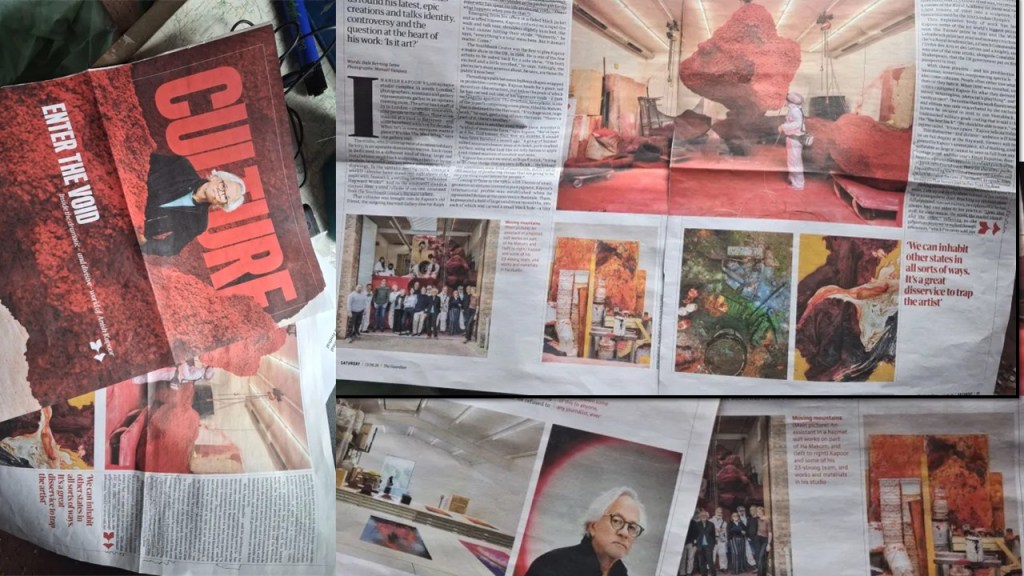
This is a fine article, not least because it is born of a visit to Kapoor’s workshop ‘and its staff of 23 … at a yard in Battersea’ There they saw finished works, although not positioned as they would be in the Exhibition, and ‘a long list of “Unfinished Hayward Works’” that bears no reference to an intentional non-finito condition of the art but merely to the state of the pieces in the timetable for completion of a show with a lot of newness for us to see in it, as well as retrospective pieces.But one piece of information is vital. Whereas previously and in other pieces now, Kapoor is referred to as British-Indian, this piece, partly because of the titles of some pieces, refers to a wider ethno-cultural background, and not least his Iranian-Jewish mother, without claiming that the works should be read as ‘psychobiography’, especially given that by religion, Kapoor now claims Buddhist beliefs. Nevertheless there is resonance with Jewish idea-and-belief systems, not least in the work Sawa refers to below:
… language is centra to unpacking his work. Ha Makom – the title of the new mountains piece – means “the place” in Hebrew. It is used in the traditional phrase spoken when leaving the home of mourners sitting shivs (the Jewish grief ritual), praying to God to comfort them. “makom in kabbalistic language literally means “place”. But it’s also one of the names of God. I like that strange overlap,” says Kapoor.[2]
After questioning him further about the fundamental nature of Jewish identity to the patterns of being that make up the artist and yet Kapoor’s sense that it is “weird” to have a Hebrew title, “especially now”, he says that he has “deep trouble with the politics, revolting politics” of the current Israeli Government. “But what to do?” [2] This dilemma, of a tension between Jewish identity and a deep hatred of the doings of Israel in the occupation of Palestinian homelands and Lebanon, is clearly referenced, and gives a kind of horrifying association to the uses to which Hebrew ideas have been put whilst still claiming their virtue, as all must who know of them at base. He posits that his ambivalence has something to do with, whilst living in Israel, he and his brother’s experience of being called “kushi” or Cushi: ‘a racial slur. “I can’t tell you how shocking it was, to be, if you like, the ‘Black Jews’.” But that is so only up to a point, for Kapoor feels that his experience makes him aware that all identity positions are really ones we a are able to imagine, if we experience, think and feel deeply enough about human experience, rejecting ‘”this strange, I think, bit of bullshit” that you can only make work that pertains to your narrow identity: so, for example, that only female artists can make feminine art. …’. All of this is perhaps relevant to that that in the end, under surface distinctions, human guts are in on the whole identical between humans who pay a great deal of attention to their differences from others and only that.
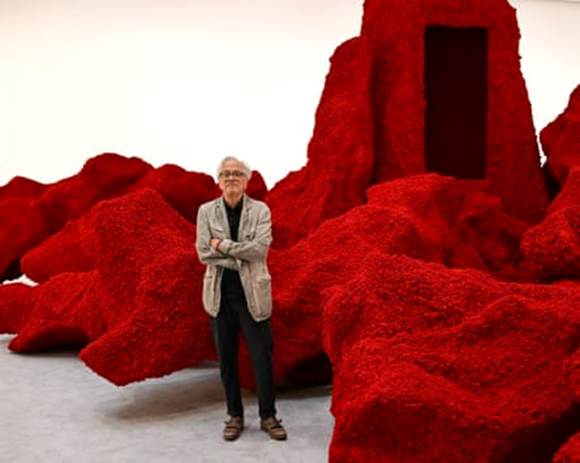
A mountain of great cultural currency but also a sculpture of the blood-and-gut invisible surfaces of our interiors, including portals to the dark voids. Anish Kapoor next to Ha Makom. Photograph: Nicky J Sims/Getty Images from Jones piece online, of which he says: ‘Tentacular outcrops of fake stone, covered in pulsing globs of red pigment, emanate from a towering central pinnacle containing a dark portal – a door to the hidden, like Kapoor’s black voids, but here it represents something definite. God, I guess’.
But Jones does make the atavistic religious base of the art clear to us and appreciates it as it needs appreciating, though he, for me, needs to remember that this isn’t recall of some primitive phase of humankind, or deeply buried wish of the human for the othering of those (with human animals as it has done already to the things which human call ‘animals’ without acknowledgement of commonality) whose blood and guts it wants to consume. It is not all about religion, however well otherwise Jones describes the art in his review, here on Mount Moriah at the Gate of the Ghetto, which I cannot wait to see but dread feeling what I must feel.
But his interest in religion is more explicit than ever – and much more provocative. The room of eye-fooling voids is an aperitif for what turns into a jaw-dropping sacrificial banquet. In the next space you are staggered by a mind-warping spectacle, a mountain hanging upside down from the ceiling. Huge enough to feel real. He calls it Mount Moriah at the Gate of the Ghetto, referring to the place where God told Abraham to sacrifice his son Isaac.
It’s like being inside a cave, under the earth. The dangling mass is painted in thick slathers of red and black paint suggesting both geology and the human body as the mountain drips fire or lava that metamorphoses into wet, fresh blood pouring down, or up. Kapoor’s overhanging cave-mountain is the scene of God’s cruellest moment. Kill your son for me, he demands, and Abraham is ready to do it. There’s no angel here to stay his hand. You wonder if you too are about to be sacrificed. Will this mountain plonk down on your head, making you a martyr to modern art? It’s hard to create a sense of danger in a gallery when we are so inured to outrage and extremity, but this had me trembling with horror – and delight. / ……
Art doesn’t have to be rational or explicable. Kapoor’s thesis that religion begins in sacrifice, that blood and spirit are one, may seem bizarre, even absurd, but it has produced work that moves, frightens and stuns. In an era when art often seems content with small, dry efforts, Kapoor soaks the Hayward in the blood and guts of his unfettered imagination.
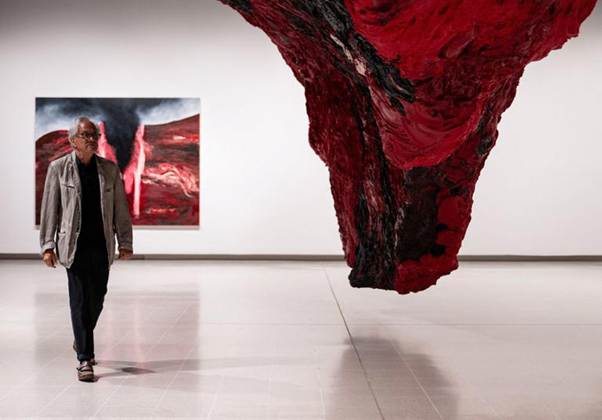
British-Indian sculptor Anish Kapoor poses for a photograph next to his installation ‘Mount Moriah at the Gate of the Ghetto’ (2022) during the press view for ‘Anish Kapoor’ at the Hayward Gallery, in London, Britain, June 15, 2026. REUTERS/Chris J. Ratcliffe© Thomson Reuters
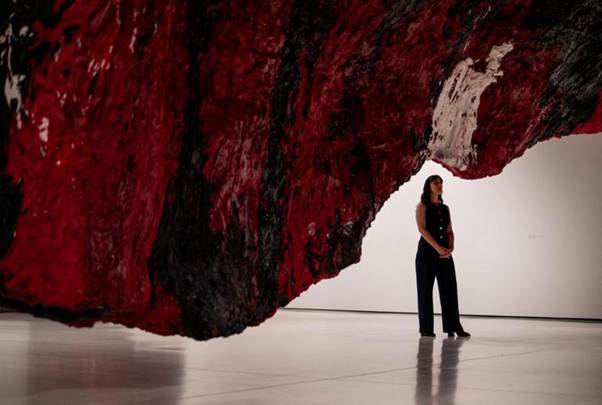
A gallery assistant poses for a photograph next to Anish Kapoor’s installation ‘Mount Moriah at the Gate of the Ghetto’ (2022) during the press view for ‘Anish Kapoor’ at the Hayward Gallery, in London, Britain, June 15, 2026. REUTERS/Chris J. Ratcliffe© Thomson Reuters
Reuters, the source of the photographs above, go for considerably more simplicity in describing the general effect of the works – picking on the ‘redness’ of them all, as if ‘red were only one colour, even if you admit the co-terminosity of red with with black:
On display are shiny sculptures made with mirrored steel or others in void-like black, visceral paintings and gory bloody pieces as well as large-scale installations the 72-year-old Mumbai-born Turner Prize winner is known for. / ….
“I’ve explored or looked to explore that question of the object and the non-object and how they live with each other. It’s obvious that red must feature in that equation, because in a sense, all of that interior is red,” Kapoor told Reuters of his use of red in his works.
“Red, of course, is at one level a colour of celebration, but it’s also a colour of deep darkness, of terror, of fear. As we know, the sublime is wonder and fear together. So somehow the two live with each other and I’m interested in what red does in… those conditions.” [3]
That issue however is validated by Kapoor who explains red as the colour of physical interiority – the real presence of the gut that you follow in making art or in other decision-making domains, that cannot be turned into simple statements about genocide, but does include awareness thereof. But clearly the exhibition uses other materials with other colours – black, white, reflective silver, for don’t they all make up an awareness of human selves in their diversity, including those moments when we allow appearance to cover up our commonalities.
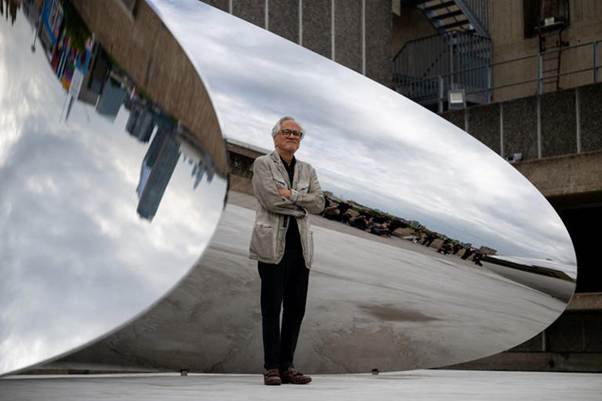
British-Indian sculptor Anish Kapoor poses for a photograph next to his installation ‘Tsunami’ (2025) during the press view for ‘Anish Kapoor’ at the Hayward Gallery, in London, Britain, June 15, 2026. REUTERS/Chris J. Ratcliffe© Thomson Reuters
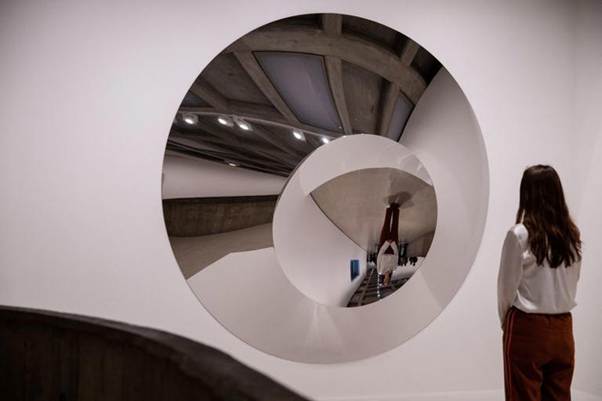
A gallery assistant poses for a photographs next to Anish Kapoor’s installation ‘Untitled’ (2026) during the press view for ‘Anish Kapoor’ at the Hayward Gallery, in London, Britain, June 15, 2026. REUTERS/Chris J. Ratcliffe© Thomson Reuters
Literally this must be seen ‘in the flesh’, but how deep that ‘in the flesh’ moment goes I can only record later. And as for ‘following your gut – if that is all you follow you follow a most dangerous guide. Even precedent of it turning out well for you (often a precedent established only in the magical thinking of retrospect anyway) does not make it good advice for self or others. We have responsibilities for our humanity that do not, cannot, lie only in the gut, whatever Jones says about his best thrills in the art world.
With love
Steven xxxxxxxxxxxxxxxxxxx
________________________________
[1] Jonathan Jones (2026) ‘Anish Kapoor review – this gutsy, gore-splattered show is a divine bloodbath’ in The Guardian (Mon 15 Jun 2026 14.01 BST Last modified on Tue 16 Jun 2026 05.09 BST) Available at: https://www.theguardian.com/artanddesign/2026/jun/15/anish-kapoor-review-hayward-gallery
[2] Dale Berning Sawa (2026: 36) [photographs by Manuel Vasquez] ‘Enter the Void’ in The Guardian Saturday Supplement (13.06.26), pages 33-36.
[3] Marie-Louise Gumuchian (ed. Barbara Lewis) at Reuters (from MSN) (2026) ‘Artist Anish Kapoor presents works old and new in London gallery return’ (June 15th 2026)


2 thoughts on “Let’s pretend we can get in the mind (or guts) of great artists, and consider how Anish Kapoor might translate the question, ‘What’s a time you followed your gut and it turned out to be exactly right?’ This is a blog preparing to see his new exhibition at the Hayward Gallery.”