


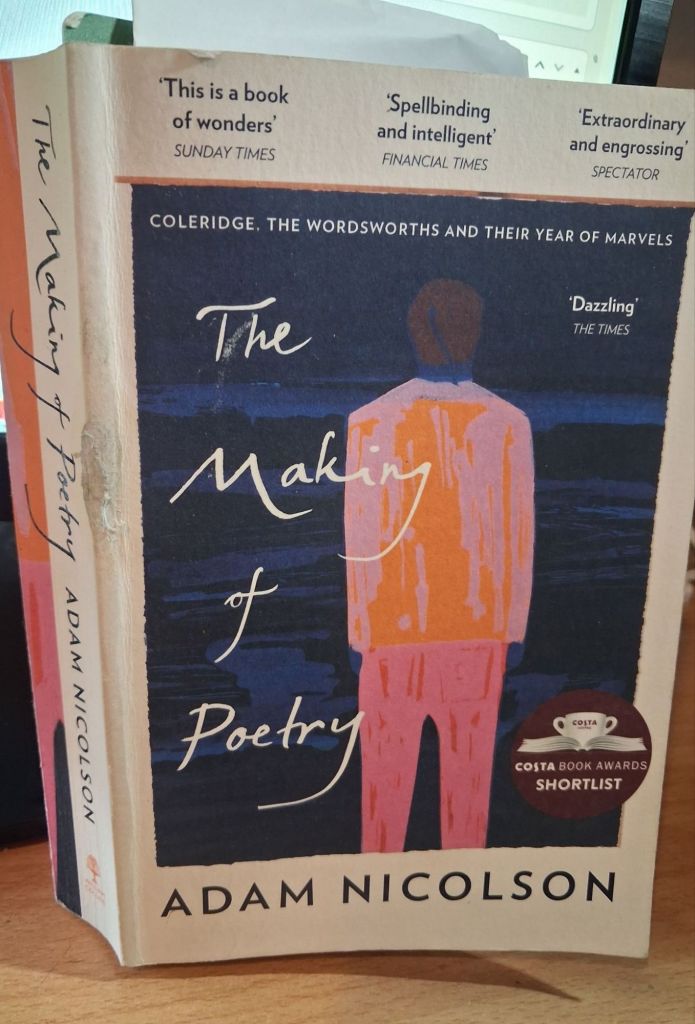
The best advice is to be aware of and distrust the impulse, or the advice of others, that you be always in control of what you say and do, for it too often means that you surrender yourself to the controlling ideologies of the status quo, which is, often as not, embodied by that which demands your self-control. I think I learned this from Adam Nicolson’s characterisation of Samuel Taylor Coleridge in his ‘The Making of Poetry’ (2019)

Coleridge’s Cottage under occupation by The National trust at Nether Stowey
Adam Nicolson learned to love Wordsworth as he learned to distance himself from the way that Wordsworth turned everything around him into parts of his own experience, contained only in his body and its external and internal movement. In the former case, it was the rhythms of a walking pace attuned to the rhythms of passages of ‘blank verse’ (blank is the wrong word since rhythmic patterns fulfill its living force), in the latter case, the sensed flow of his own blood through the strictures of vessels giving way to the onslaught of the heart’s dynamic energies. There never was a more driven poet since Milton, as the very different sensibility of Coleridge recognised. It seems that, in order to understand how, for Wordsworth, the world became the rhythm of his walking by also feeling not only his muscles flex but his heart beat with a difference in response to external and internal stimuli, Nicolson sought to reproduce those rhythms (and invest them, and those more traumatised ones of Coleridge) in the rhythmic underpinning of some of his best prose) by walking the same paths as they, and often further, in the same conditions over time, whether in annual or diurnal cycles, using the transitions between seasons and light and dark. I have pointed to one such passage, reproducing Wordsworth’s consciousness of the need to escape his constraining present obscurity into acclaimed greatness in an earlier blog (see it at this link).
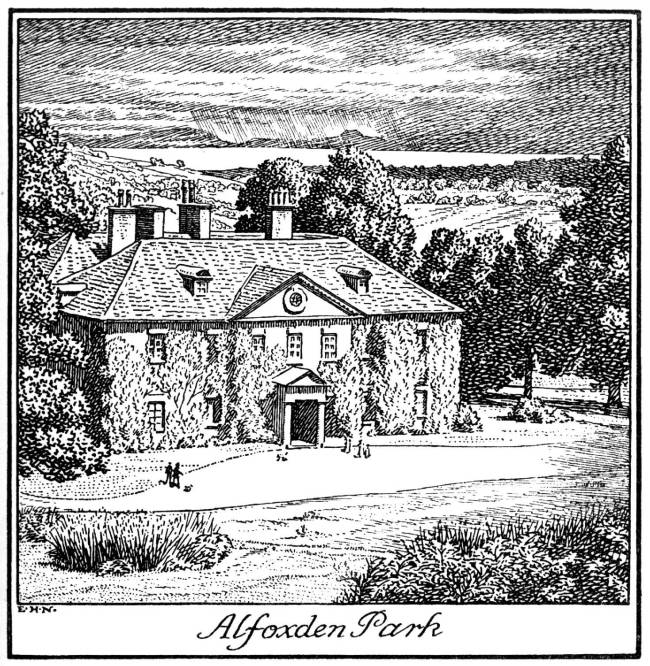
The meeting between Coleridge and the Wordsworth siblings was a process rather than an event, replete with walking to and from each other’s homes and on excursions into the varieties of landscape from the Somerset Levels, the Devon Coast of rocky chasms and coastal coombes, and the deceptively low but challenging Quantock hills by night and day and through all seasons, that filled a whole year, which Nicolson charts through interactive phases of reflective experience, often feeding different choices about how they should be fancied or imagined – by dark deep adventures within the self as in Coleridge, replete with fancy as with imagination, or imagined as the highest and greatest consciousness of what is at base merely ordinary instances of real life in Wordsworth, or to close observation and prose that embodied it in the senses in Dorothy. These paths, once set, would lead to Coleridge’s Biographia Literaria, Wordsworth’s The Recluse, and Dorothy’s private notebooks respectively, and to a split which left Coleridge alone and relatively undervalued in the valley of his Dejection: An Ode (one of the most honest statements about life in literature).
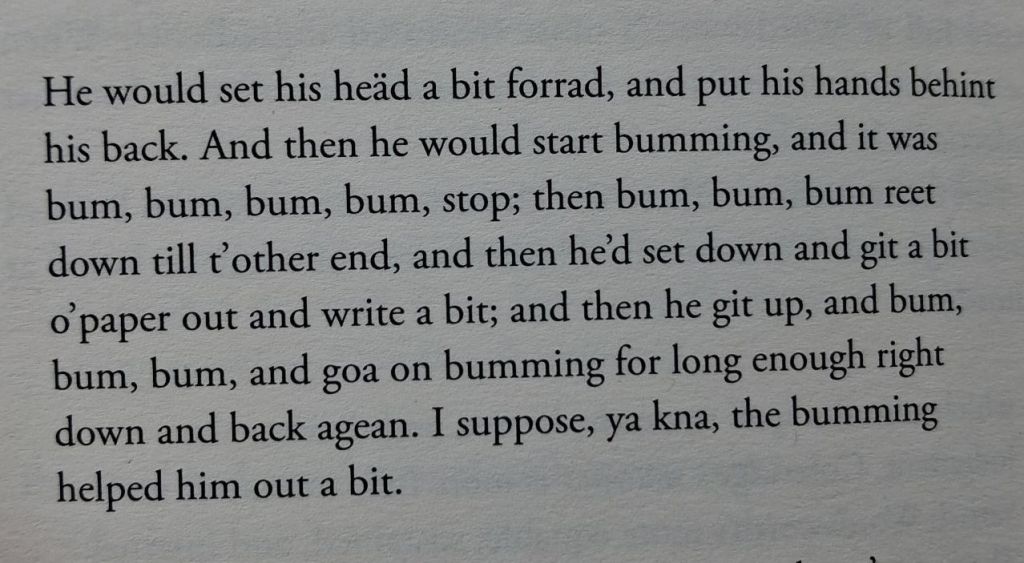
Wordsworth, once any of us has begun to absorb his quality as a poet, is a dangerous figure: capable of absorbing us and spitting out what are but fragments of pips and rinds. Nicolson felt he began to know him as a friend but still also found ways of relishing perspectives on the poet that distances him and makes him more a comic figure than a dangerous occupier of the senses let into our innards by the reader’s hypnotic saccading gaze. He quotes this unforgettable story of Wordsworth observed by a Westmoreland farmer (hence well after the year of our story in the author, with the Wordsworth locked into the Lake District as the poet walked around his home near Ambleside composing rhythmic passages of verses, which the farmer called ‘bumming’:[1]
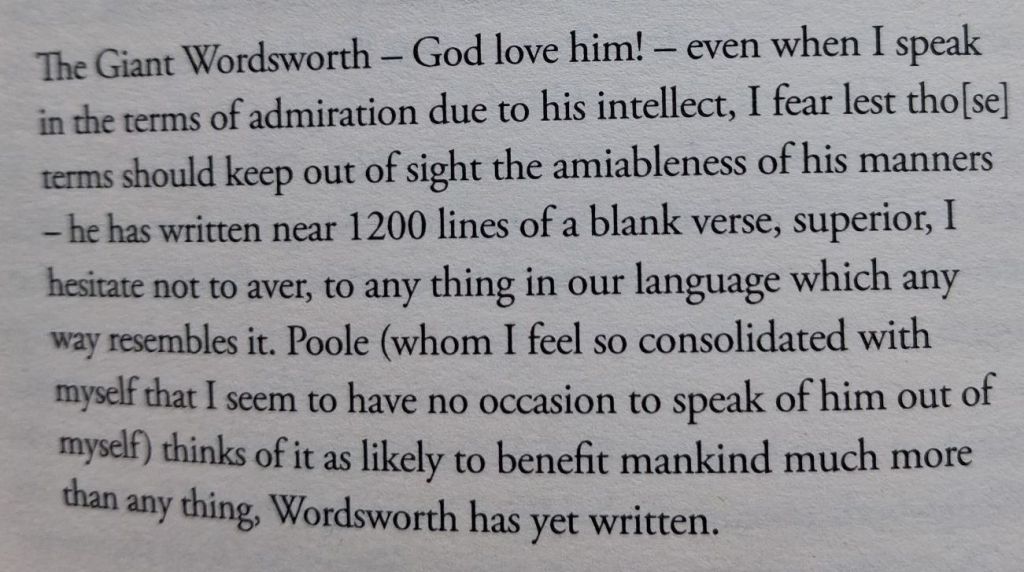
But Coleridge, as his friends knew – gentlemen Radicals like Thomas Poole and William Godwin, had few defences against his sense of the greatness of another’s inner power and its outward effect on him of silencing his own constantly firing brain with its too-easy connection to his organs of articulating what was in that brain and the interconnections he made between these contents. Listening to him begin to create The Prelude, as yet in fragments like others destined for their conjoint Lyrical Ballads, Coleridge seems, when he writes to publisher Cottle in Bristol for instance, to be constantly fighting off awareness of the dangers of his hero-worship: [2]
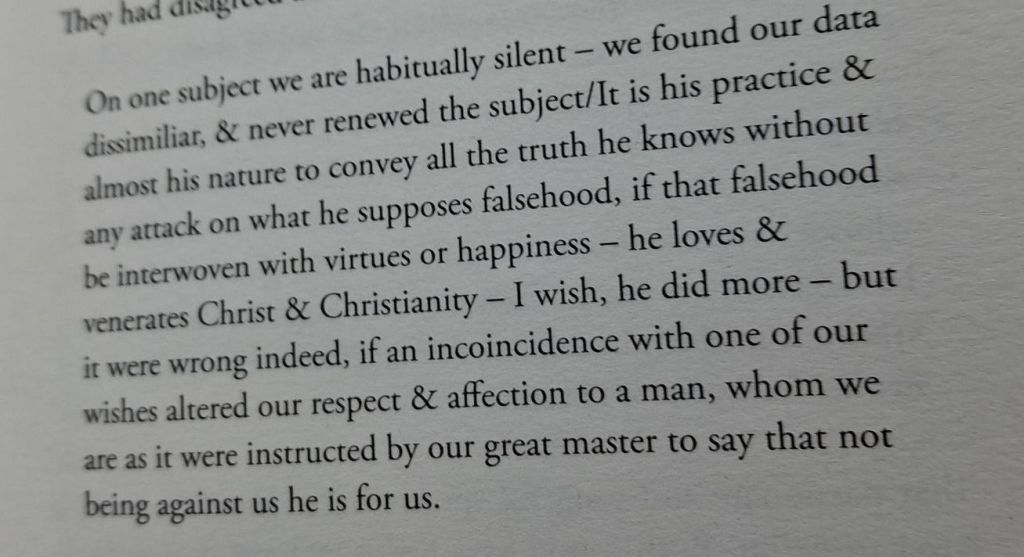
There is too much protest and special pleading her for this to a record of ‘love’ for another, or even ‘friendship’. As Nicolson suggests there is ‘awe’, and ‘(m)ore in adulation than affection’. In other letters, to other recipients, he even lets slip how he, more learned in matters of theology and philosophy than Wordsworth would ever be, or want to be, deals with Wordsworth imperious need to be right about the conduct of self in argument and self-presentation. Nicolson suggests the ‘subject’ referred to in the following passage was Coleridge’s belief in the active presence of Christ in the world redeeming the inevitable errors of me, at least men like Coleridge (or The Ancient Mariner) but whether that is so or not, the important thing is that Wordsworth refused to discuss ideas of which he had no interest because his new-found purpose as man and poet was ‘not to correct the errors of others but to make his own presence so vast that others came to shrink beside it’.[3]
Most of remember having lost control of ourselves in asserting the feelings or thoughts of ourselves or others. Most often we regret the ‘outburst’ as people call it who hate any hint of an unregulated world outside them. But perhaps we need to remember too the moments where we have controlled our response to people who make us feel powerless or unworthy in comparison to their entitlement to be the one in control, becoming ‘habitually silent’ in these times or ‘contained’ in too tight a flask. This can happen in very close relationships. For many years the relationship between Samuel Taylor Coleridge and the Wordsworth siblings, Dorothy and William, was pictured as, at the first where they formed the dual centres of a community of friends at their respective homes of Nether Stowey and Alfoxden Hall in Somerset, as ideal. The belief was based on a supposed statement of Coleridge to the radical philosopher Godwin that the three of them could be described as ‘three persons and one soul’.
I imagined them walking the hills aware of each other’s thoughts and feelings and the environment that meant they finished each other’s sentences when one of them felt the need to speak, though to speak at all may have been unnecessary. In fact this didn’t seem to fit at all into what I knew of these characters, especially the males. A.S. Byatt quoted it in her popular account of both poets in 1970 even supposing that it evidenced how Coleridge’s presence gave external vent to the unbearable hot-house of intimacy between Wordsworth and his sister.[4]
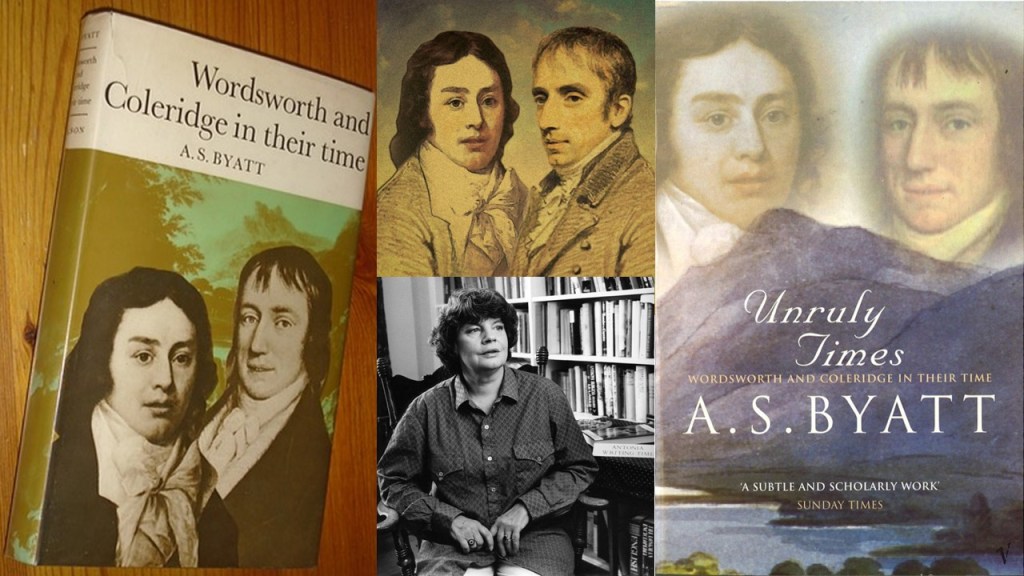
However, even in Byatt’s sensitive reading of inter-relationships of great complexity, this idea rings false, however short-lived we suppose that triunity to be. Moreover, for me, since Coleridge’s volubility as a talker was a matter constantly witnessed by many and Wordsworth’s equally well-known silences the product of his belief that he had, as ever, pronounced the last words that could be said on the current matter. In fact both were, in Nicolson’s account very vulnerable to self-doubt when they met in early summer 1797, though both much changed by the other by the same time in the following year, 1798.
And Nicolson cites scholar Ruth Aldrich to show that that Coleridge never used the ‘three persons but one soul’ phrase (as he captures it). I was pleased for I couldn’t see Coleridge turning a borrowing of words on the nature of the Trinity in such a sloppy and sentimental way. What he did say was a riff on the doctrine of the Trinity nevertheless but with heavily ironic and wicked reflection on Wordsworth, one that, I suppose, he never said to his face. This is the actual letter extract as quoted by Nicolson:[5]
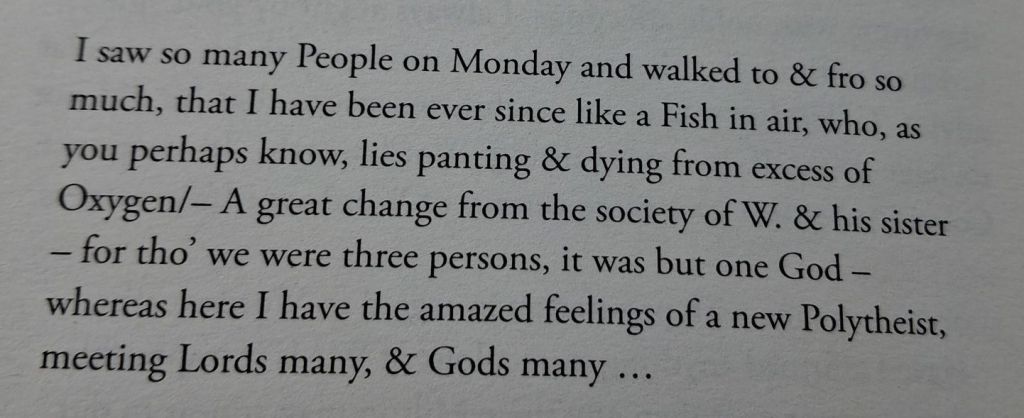
Note the humour of course shared by two Radicals about Catholic doctrine, though the actual phrase is also humour directed at Wordsworth’s sublime egotism in which there could only be one God in any place, and that, by virtue of relative greatness of soul, must be He: the ‘pantocrator Wordsworth’, as Nicolson dubs him. For Nicolson, this charts the end of the relationship that had involved learning that each poet took from the other, in which Coleridge indeed may have contributed more at this time. In the ongoing relationship, Wordsworth (and his sister) took on a much more patronising tone in speaking of Coleridge, even expunging him of importance in their lives, except of course in the beautiful verse in thanks to him for the Alfoxden year in The Prelude.
It may be that Wordsworth’s dominance lived on in Coleridge’s definition of the ‘secondary Imagination’ and Fancy, in Chapter XXIII Biographia Literaria (see full text at this link) in , as a reflex of the primary imagination in humans which enables perception of all and everything in living dynamism, which he called ‘the infinite I Am’, the name of God in the Burning Bush when he appeared to Abraham. He never doubted that Wordsworth had that reflex in him – the infinite I AM being itself narrated in full as The Prelude based on The Growth of Poet’s Soul.
I suppose the point that Coleridge’s example makes is that excellence, or even the merely ‘good enough‘ , in any domain of endeavour is not always self-conscious, constantly being itself and saying I Am ….. but sometimes a life, brain and mind driven by too many associations, as were Coleridge’s life, brain and mind. Unable to pull all those associations together into a whole because of their multiplicity and complexity of inter-relationship, he still felt the need to do so. That Wordsworth managed superbly to pull it altogether is partly because of his exceptional nature and talents but partly too his manner of concentrating all into one subject: himself, a thing Biographia Literaria tries to do but fails at. Try teaching it, because you love it as I do, and you will see what i mean. Learners on the whole find it too much in every way.
Coleridge was a man easily overwhelmed, despite his loquacity. Indeed I had not known Virginia Woolf’s characterisation of him in her personal notebook which feels to me entirely accurate now I have seen it quoted by Nicolson. She approached through his prose which some see as too dense in ideas and the words used to convey them. She calls it:
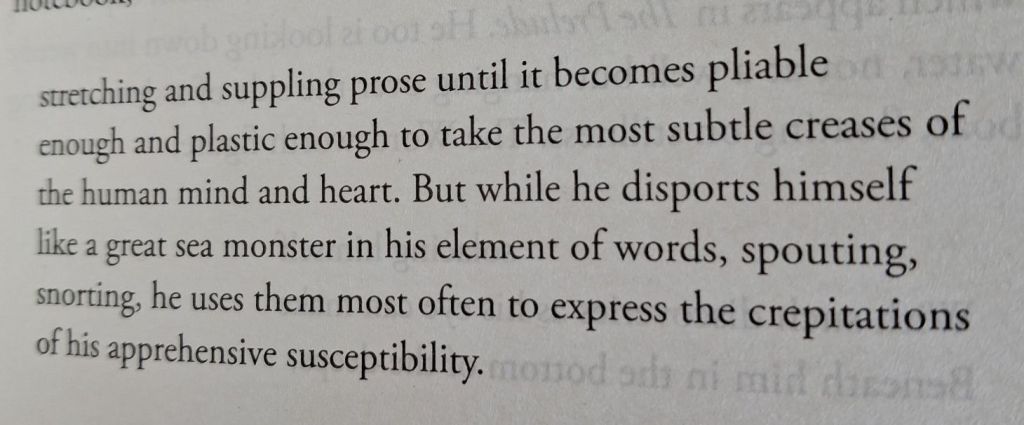
That is not unlike Woolf sometimes, except that there is no obvious sportive whale, Leviathan or Kraken in her prose having fun’ though there is expression of ‘the crepitations of’ her ‘apprehensive susceptibility’, though often openly exposed as a character’s vulnerability, like the artist in Between the Acts. In Coleridge there are sentences constantly aware of their potential for contradiction and hence piling on self-justification after self-justification.
A. S Byatt went so far as to determine, through long and deep reading of both poets, ostensibly close friends, that Coleridge was constantly trying to achieve the full acceptance of himself that he failed to get in childhood, but that knowing only rejection, he courted it such that it fell upon like the proverbial self- fulfilling prophecy. I have long been accommodated to that reading. However, Nicholson has a much more politicised sense of the relationship in which we cannot blame only the victim for their own dejection and feelings of rejection, as Wordsworth does with Coleridge, even Dorothy calling him ‘ Poor C.’. Wordsworth was a person who not only felt he was a ‘great man’, a thing Byatt also saw in him with some true feminist distaste, but a need to project inferiority into those not accepting of his full powers and ready to acknowledge them in demeaned behaviours.
They are behaviours presented as noble, yes,but only in stoicism at their common human state and a readinees to be ‘noble’ only at that low status, that of journeymen, leech-gatherers and single mothers bereft and driven to child-murder.. These are the various characters of his Lyrical Ballad poems, characters thoroughly proud in their lowness among the detritus in already depressed rural economies. In Coleridge’s characters, in contrat, there is still hope for a return in life of hope long lost in solitude. These are characters combining the imagined and fanciful, taking the form of Ancient Mariners and women wailing for their demon lovers, or the lesbian desire of Christabel. Wordsworth soon took against the viability of such characters in poetry and though Coleridge should have too.
As I home my advice to the younger person in our prompt question, I would beg them to see rhar the egotistical sublime is a delusion even in Wordsworth, more so in people unable to stiffen themselves into a self-image requiring only self-validation. Most of us are more like Coleridge, without the prodigious talent, intellect, and skills. Coleridge still serves as our model though because his resources were never believable to him. He felt he was, despite everything he published and the poems he wrote, an impostor (a sure candidate for the much later defined imposter syndrome). His greatest poem Dejection: An Ode is the great poem of the poet who feels he has no right to be called a poet. And yet there is realistic nobility in what he says to Thomas Poole of the difference between him and Wordsworth that is to Coleridge’s favour, and cited warmly by Nicolson:
My many weaknesses are of some advantage to me; they unite me more with the great mass of my fellow-beings – but dear Wordsworth appears to me to have hurtfully segregated and isolated his being…. [6]
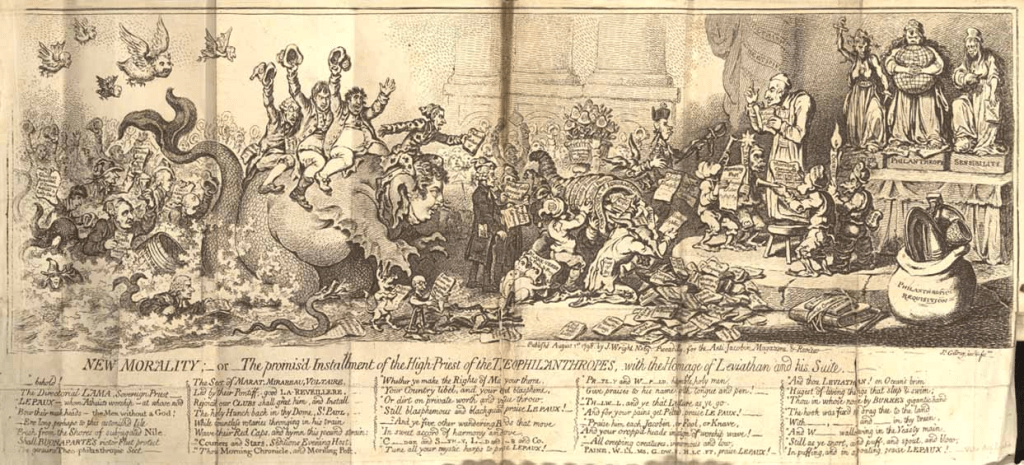
Wordsworth contributed to help Coleridge find his way to this self-image. No doubt he would have got there anyway but Nicolson shows me how he did so quickly, perhaps in the ‘one year of marvels’ he writes about, by virtue of Wordsworth draining the life-blood of his poetry and making it the basis of his own quite distinctly different poetry of sublime selfhood but based on the same life rhythms of the verse of Frost At Midnight and The Lime Tree Bower, my Prison. What I didn’t know, heavily influenced as I am by being taught Biographia Literaria by Byatt, was that the latter autobiographical text was in part one that succumbed to Wordsworth ‘s desire to clear that year of Marvels of its active political content, that which still tries to grasp the reader and make them see the ways in which we degrade the very concept of life, as the Mariner does the wedding guest. Coleridge, says Nicolson only pretended that he was not still a radical of the London Corresponding Society type in 1797 where he expected a visit from an arch villain in the eyes of government, John Thelwall (below as depicted by government lickspittle James Gillray).
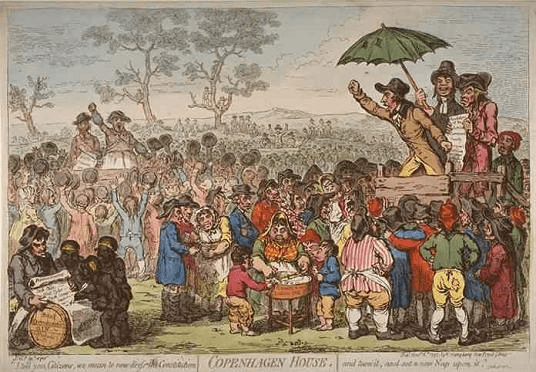
The local gossip about Thelwell as being one of a nest of radicals probably lost the Wordsworth their advantageous rental arrangement at Alfoxden and set on Coleridge Government spies – including a big nosed one, says Nicolson, who became known as Spy Nosy. In Biographia Literaria, the story of Spy Nosy is told differently. It was the result of a report against Coleridge, who heard his philosophical talk about Spinoza as being about a mythical Spy Nosy (an agent for the wicked French radicals). Kubla Khan contains the remnant of Coleridge as dangerous radical and visionary of an earthy communal Paradise or Pantosocracy:
And all should cry, Beware! Beware!
His flashing eyes, his floating hair!
Weave a circle round him thrice,
And close your eyes with holy dread
For he on honey-dew hath fed,
And drunk the milk of Paradise.
This was a key poem of the Year of Marvels that could never have been written by Wordsworth, whose message (and Nature’s too he claimed) was sublime ‘wise passivity’. It’s contemporary to tie the dream-vision of Kubla Khan (pronounced Nicholson says ‘Kubla Can’ emphasising the active element of power politics, to drug visions as in Thomas De Quincy, but not to tie it to politics as Shelley certainly did. When Wordsworth repressed the idea of a poetry such as that represented by young Coleridge and both lost faith in the French Revolution, he had to suppress the example of Coleridge too. I read Dejection: An Ode as not only a goodbye to politically communal vision but of a poetry where the Imagination made a just world not just a passive stoic world of hierarchy accepted and seen as the human condition. Think of these great lines where the passive patience (the living death of ‘still and patient’) Nicolson shows us always being thrust upon Coleridge is seen as the agent of suspension of his living nature, the origin of profound Depression, where Fancy has been lost not to the Imagination but as a stage in the loss of ‘shaping Imagination’ (my emphases in quotation below), a romantic communitarian politics:
There was a time when, though my path was rough,
         This joy within me dallied with distress,
And all misfortunes were but as the stuff
         Whence Fancy made me dreams of happiness:
For hope grew round me, like the twining vine,
And fruits, and foliage, not my own, seemed mine.
But now afflictions bow me down to earth:
Nor care I that they rob me of my mirth;
                But oh! each visitation
Suspends what nature gave me at my birth,
         My shaping spirit of Imagination.
For not to think of what I needs must feel,
         But to be still and patient, all I can;
And haply by abstruse research to steal
         From my own nature all the natural man—
         This was my sole resource, my only plan:
Till that which suits a part infects the whole,
And now is almost grown the habit of my soul.
Coleridge in a monk’s habit is a flash image in this poem, that shows that all people robbed of imagination become mere robots of habitual conventional behaviours, without life. I have never lost this view of politics, however Romantic it be! I do not want to draw my conclusion too harshly and without nuance – no more anyway than is in my title. I would sit my young mentee down and say:
Be aware of and distrust the impulse, or the advice of others, that you be always in control of what you say and do, for it too often means that you surrender yourself to the controlling ideologies of the status quo, which is, often as not, embodied by that which demands your self-control.
Be aware, that is, that when people shout to beware of you, that sometimes even they do not see quite how much it is about self-interest in the status quo. They go a long way to make you look diminished, for even if you speak of the Leviathan Many, you can be made to look ridiculous. Witness again Gillray on the radicals of London including Thelwall and Henry (Orator) Hunt – THEOPHILANTHROPES to a one, squandering the cornucopia of the National Wealth on the ignorant animal rabble.
Do read Adam Nicolson. I extrapolate from him of course, but great writing gives you that license.
With Love
Steven xxxxxxxxxxxxxxxx
[1] Adam Nicolson (2019: 286) The Making of Poetry: Coleridge, The Wordsworths and Their Year of Marvels Londo, William Collins Books. My photograph.
[2] Ibid: 298. My Photograph
[3] Ibid: 299, as for my photograph below this note of the quotation from Coleridge’s letter, which preceded Nicolson’s analysis of it.
[4] A.S. Byatt (1970: 20) Wordsworth and Coleridge In their time London, Thomas Nelson & Sons Ltd.
[5] Adam Nicolson op.cit: 302, Quotation in my photograph below also from that page.
[6] cited ibid: 321


2 thoughts on “The best advice is to be aware of and distrust the impulse, or the advice of others, that you be always in control of what you say and do, for it too often means that you surrender yourself to the controlling ideologies of the status quo, which is, often as not, embodied by that which demands your self-control. I think I learned this from Adam Nicolson’s characterisation of Samuel Taylor Coleridge in his ‘The Making of Poetry’ (2019)”