


I don’t believe in tips for life, let alone top ones, and am circumspect about success as a thing to be realised. Consider Wordsworth as he must have felt in Alfoxden in 1797.
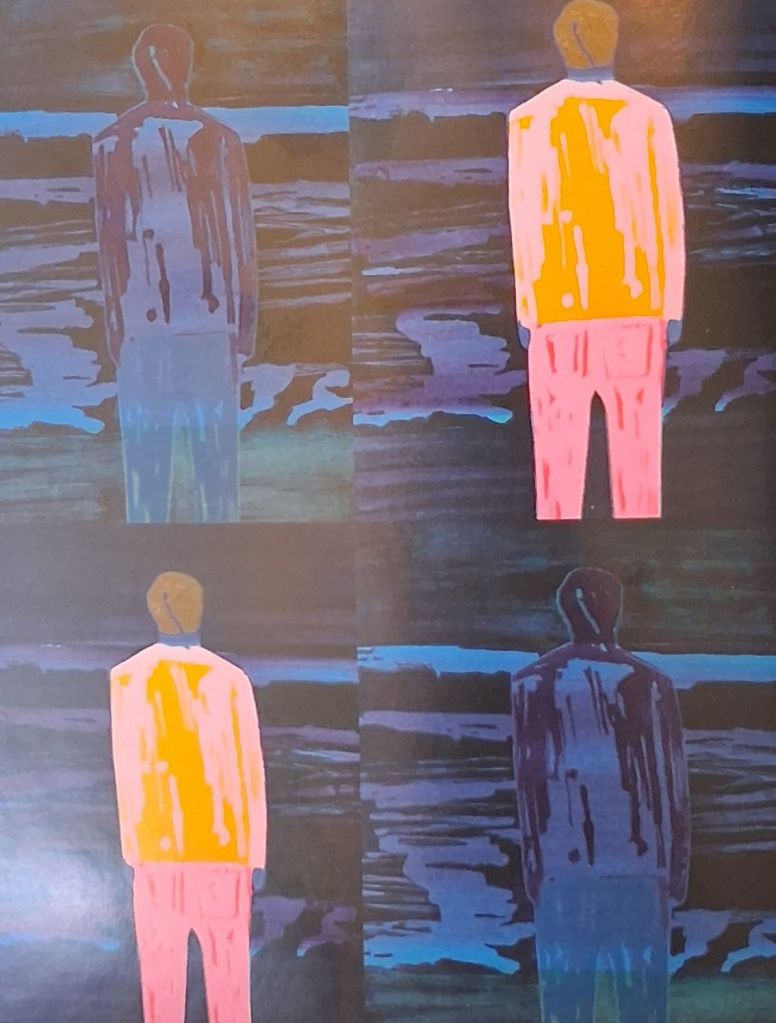
Wordsworth in Darkness by Tom Hammick from Adam Nicholson (2019) The Making of Poetry: Coleridge, the Wordsworths and Their Year of Marvels London, William Collins.
I was left with nothing to read and so I picked up a paperback I had recently purchased at The People’s Bookshop in Durham, Adam Nicolson’s story of the year 1797 – 1798 in the life of Samuel Taylor Coleridge, Dorothy and William Wordsworth. Coleridge inhabited, with wife, Mary, and son, Hartley, a small cottage on the corner of the main street of Nether Stowey, a name now synonymous with the publication of his Kubla Khan. That street was then so full of mud that Coleridge called it a ‘Slough of Despond’ after Bunyan, rather than to distinguish it from Slough, near Eton and Windsor, through which even the rich establishment of royalty and the public school rarely ventured no doubt. The Wordsworths, by contrast with Coleridge, lived in grandeous homes gifted to them for the interim at first or on very much reduced rents (until the absentee landlowners realised that they might be housing a den of radicals (such was the local gossip), fitting their higher social aspiration.
I am now committed to reading this book whole, even though I had decided before starting it to read only a little before starting on Kae Tempest’s debut nove. I will finish it now because it enchants me with its subject, its written style and Tom Hammick’s very colourful woodcuts and paintings. And tbis prompt came up again, which I have previously answered only in relation to the feeling of some poets, and especially Robert Browning in Childe Roland To The Dark Tower Came, that the pursuit of ‘failure’ is the most usual pursuit of our post heroic age of males, and is even more suited to tbe non- binary ends, where failure and success are but in the same range of purpose, that ought to satisfy our twilight years following the Death of God, as announced by Nietzsche.
I came upon this passage as I committed myself to Nicolson’s book, which describes the author haunting the place where Alfoxden once stood in grandeur, now in ruins and uncelebrated, unlike Coleridge’s cottage, now a National Trust site. In tne latter cottage, Coleridge still dreamed of Pantiscocracy (a communal living in equality with each other and Nature), an ideal he had dreamed of with Robert Southey, and long before both these men had soured into apologists for the status quo, Nicolson imagines Wordsworth in the darkness, in guilt at abandoning his illegitimate child in France, with Annette Vallon, the child’s mother, and rapidly turning disillusion with The French Revolution, into aims that turned only on his personal success as a poet, not just in the long duration of immortality, but in a worldly way too that would lead to recognition by oppressive British governments and high society. Here is Nicolson describing him In July 1797:
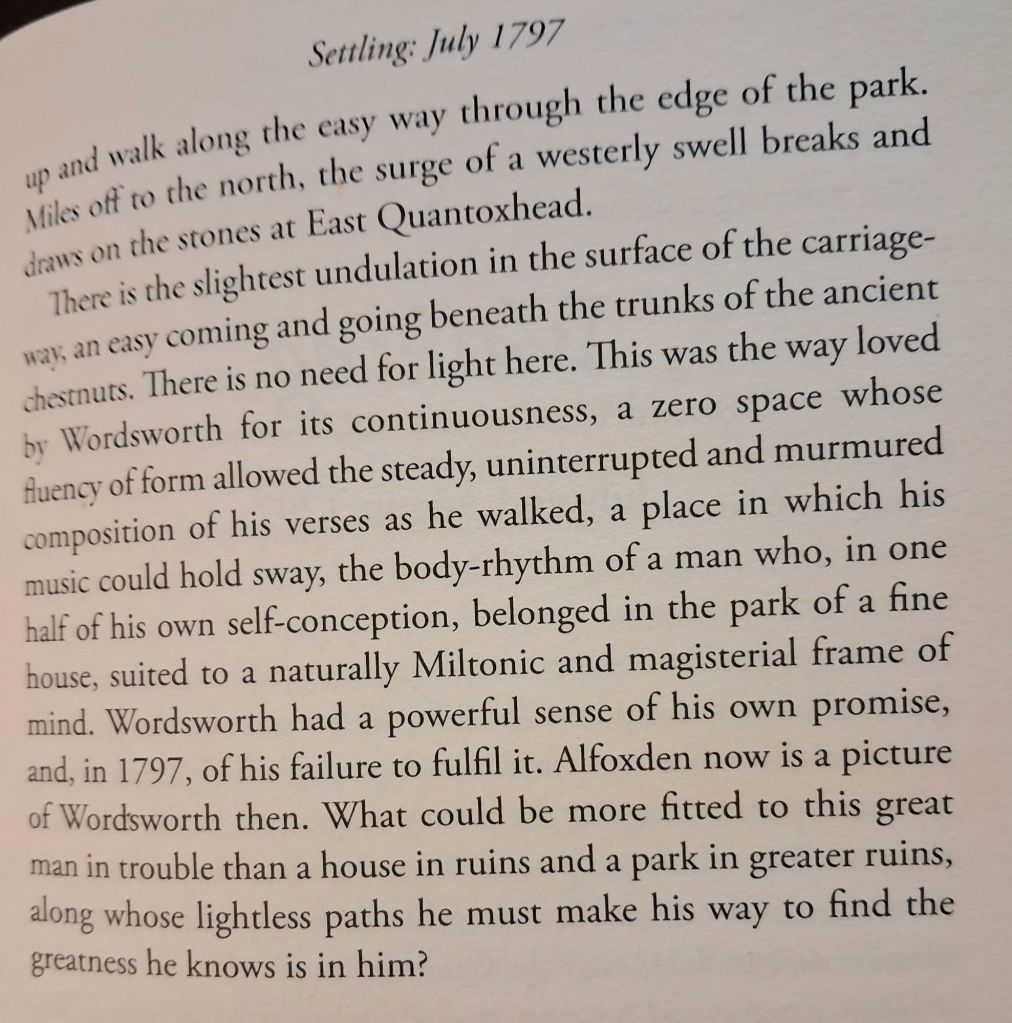
A ‘naturally Miltonic and magisterial frame of mind’ seems to embrace Milton’s fame and celebrity as a poet more than his Republican politics. The ‘promise’ of success is individual not socio-political. In 1797, remember, the park and house was not in the ruinous state observed by Nicolson wandering around it in the twilight; it seemed the home of a successful gentleman, his childish political fling behind him. But William and Mary did not own this home. Instead, they were renting cheap until it fell back into the line of the generations that owned it. This was a shallow version of the hope that Wordsworth would become to be adored as the triumphal poet that would embody human life as it was amongst the unmentioned and struggling (and will always be. Wordsworth was to concede to High Tory values), and be recognised by all the trappings of personal success.
One could say it was Dorothy Wordsworth who gave all the top tips needed for Wordsworth to become the kind of success he desired to be. Nicolson however suggests here that the worldly Wordsworth to be with a government pension and no interest in social change in tje interests of liberty and democracy was the ruin Alfoxden is now, a place more beautiful in the desiccated light it shone on a shallow world of material wealth and living. What was ‘in’ Wordsworth came out triumphantly but what was left on the outside was a past rebel without any cause, The Lost Leader.
Just for a handful of silver he left us,
Just for a riband to stick in his coat—
Found the one gift of which fortune bereft us,
Lost all the others she lets us devote;
They, with the gold to give, doled him out silver,
So much was theirs who so little allowed:
How all our copper had gone for his service!
Rags—were they purple, his heart had been proud!
We that had loved him so, followed him, honoured him,
Lived in his mild and magnificent eye,
Learned his great language, caught his clear accents,
Made him our pattern to live and to die!
Shakespeare was of us, Milton was for us,
Burns, Shelley, were with us,—they watch from their graves!
He alone breaks from the van and the freemen,
—He alone sinks to the rear and the slaves!

We shall march prospering,—not thro' his presence;
Songs may inspirit us,—not from his lyre;
Deeds will be done,—while he boasts his quiescence,
Still bidding crouch whom the rest bade aspire:
Blot out his name, then, record one lost soul more,
One task more declined, one more footpath untrod,
One more devils'-triumph and sorrow for angels,
One wrong more to man, one more insult to God!
Life's night begins: let him never come back to us!
There would be doubt, hesitation and pain,
Forced praise on our part—the glimmer of twilight,
Never glad confident morning again!
Best fight on well, for we taught him—strike gallantly,
Menace our heart ere we master his own;
Then let him receive the new knowledge and wait us,
Pardoned in heaven, the first by the throne!
Bye for now
With love
Steven xxxxxxx


One thought on “I don’t believe in tips for life, let alone top ones, and am circumspect about success as a thing to be realised. Consider Wordsworth as he must have felt in Alfoxden in 1797.”