


Édouard Louis shows us that ‘happiness’ may be the result only of ‘social determinism’ succeeding in its function to ‘condition the person’ you are. [1] This is a blog on Édouard Louis (2026) Collapse [Trans Tash Aw], London, Harvill.
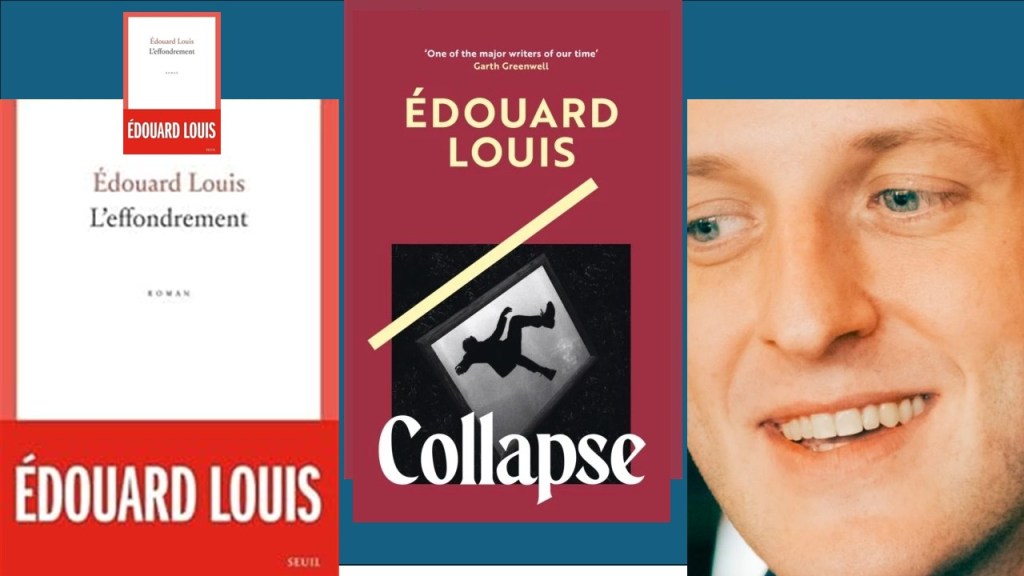
This piece probably relates to what I have tried to say in blogs about earlier books. The blogs can be accessed at the links on the earler bopks’ separate titles, namely Change and Monique Escapes.
Édouard Louis is a writer it is difficult to categorize. As I was reading Collapse, I thought often of Tom McCarthy a writer I like a lot, particularly with regard to the use of versions of repetition as theme and method, but the analogy does not work because McCarthy writes at length and self-consciously about the nature of human inter- and intra- communication whilst Louis, though being a writer and writing and its oft associated events appear in his account of his own life events, they do not make themselves the forefront of the reader’s experience of his stories. Louis is a storyteller par excellence, and that is the basis, I believe, of his exceptional achievement that is not confined to audiences who think of themselves as intellectual. For my blog on McCarthy’ novel Incarnation, use this link.
Let’s pursue this non-analogical comparison though for a while, for both writers I have mentioned reference Freud’s essay usually known as Mourning and Melancholia, a text that links repetitive acting out (repetition compulsion) with self- harm and the ‘death drive‘.
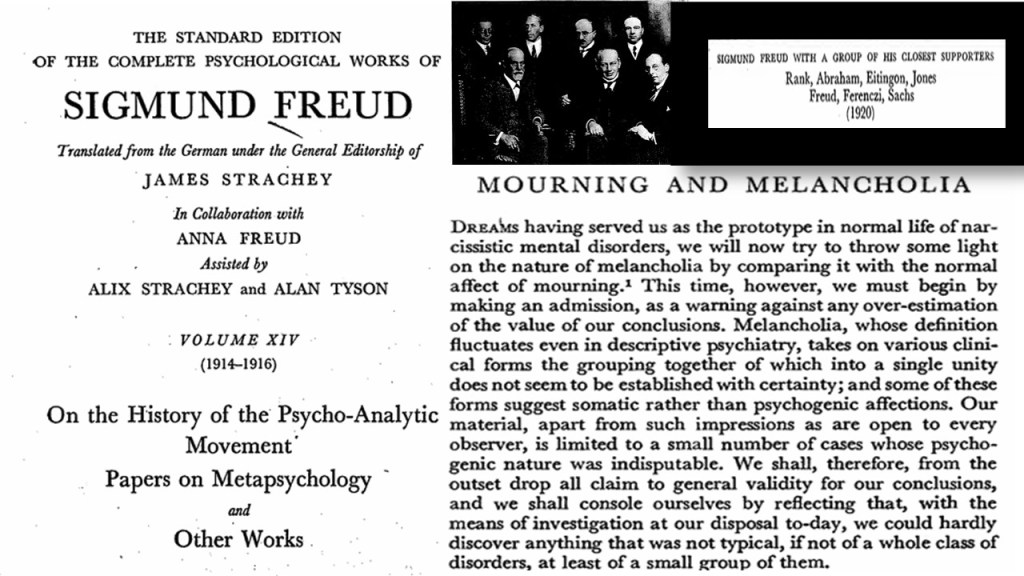
Édouard Louis often comments on his reading in his writing, as both a reflection and as an event in his stories – one of the most interesting and puzzling moments in his latest story, of the long, slow repeated cycles (all covered in short readable compass) of the death of his never-named brother is that wherein, in travelling to meet his mother and confront the fact of his brother’s, and her son’s tp an ealier father, death, he takes with him a significant ‘stack of books’ to help explain his reactions and those of others, including HIS failure to react as he or others might have expected him and themselves to act, notably Joan Didion’s The Year of Magical Thinking and the work of Phillipe Ariés on death in the Middle Ages. [2] Among these might be the Freud text on death and depression to which he refers much later in the book as being ‘one of the most beautiful texts’ by the philosophical psychoanalyst. [3]
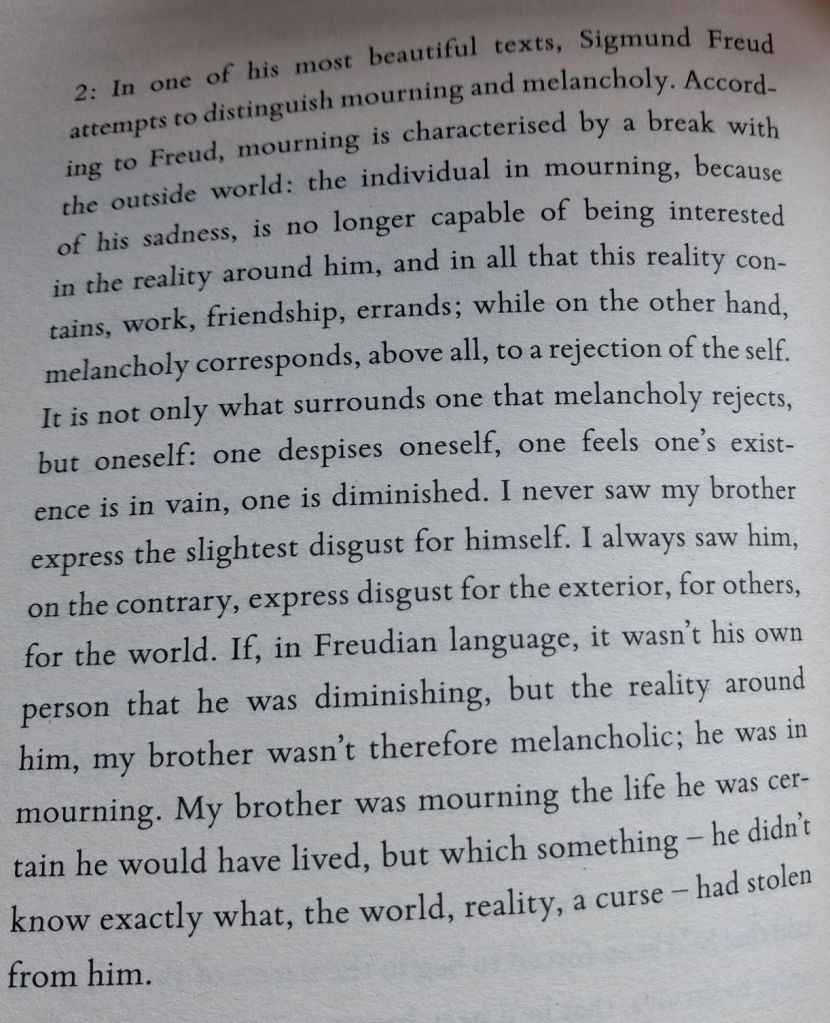
A reader unused to Louis’s methods [the difference is implicit in the French title of his novel Change, which is Changer: méthode] as a writer, taking generic markers from texts across the usual boundary set between discursive scientific, and some kinds of philosophical, investigations, on the one hand, and stories and novels, on the other, might be startled at the number heading this photographed paragraph, which marks it out as a step in a progressive argument about what Édouard learns by the deatb of his brother and varied attempts at interpretation of memories of his brothers life and relationship to Édouard himself. But that is typical of Louis – as are chapters labelled as based on specific FACTS, which ‘facts’ are not easily stated on their own and are merely numbered in sequence without explanation of this practice, and chapters in bullet points like the one here referred to.
Yet strangely I think this does feel like life can do, as contingent events, including the reading of a book, or reflection on learned theoretical paradigms, add up to a reflection on what stories are or can be to persons forced a mode of being that is reflexive on Itself and must be written in some way or other regardless of generic convention. It may be that, like the author, I feel that this mode of experiencing life is more typical of first generation university educated working class children than of those who have been conditioned to accept divisions of authority between different modes of knowing, feeling and acting as natural ones they adopt with entitlement. For me, and other working-class friends I know reading had to be purposive and justify itself as an event in life like any other.
The content of this paragraph labelled 2 is a summary of an idea from Mourning and Melancholia used as a tool to understand not only his brother’s death but the nature of the cyclical and repetitive behaviours acted out that led to the point of death and Édouard’s inability to understand his own thoughts and feelings in regard to it. The burden of his quest is to understand if his brother was the agent of his own destiny, to die having achieved nothing as his brother saw it, or if that death and sense of unfulfilled life was tbe product of complex effects of social construction, and particularly class. It is complex because it also involved why Édouard felt alienated from the rigorously homophobic and near fascist ideology of life often espouse by his brother, if not always. Hanging behind the discussion of whether the brother ever expresses ‘disgust at himself, as a melancholic and/or depressed person would or ‘for the exterior, for others, for the world’ as a person in mourning would, and the decision that, as in Fascist ideology too, it was for ‘other people’ that his brother expressed disgust is the memory of the latter’s hared of fags, Édouard being a fag and his desire to kill all fags and Édouard as a proof of this, when the brother spoke to his last girlfriend, Géraldine, when she informs Édouard after the brother’s death.
Now this use of Freud is necessary to the story of Édouard and his brother’s death not merely a prescribed theory of the nature of storytelling, and possibly lived life, as in Tom McCarthy (but don’t get me wrong, I love Tom’s novels). What Louis does. however, feels like the way I read books too, regardless of category as fiction or non-fiction, and the numerous boundaried sub-categories of genre each of those larger binary headings generate but for their situated purpose in the stream of events that just seem to occur or that I cause to occur. Édouard Louis’s works differ from others precisely because his stories cut across any, and potentially all, of those boundaries – not just art, literature, science, philosophy, not sociology or psychology, not fiction nor fact, but all of these things in innovative admixture.
What using the Freud text permits is for Édouard to argue that his brother was not clinically depressed, however that might be defined, but in lifelong mourning, for the loss of the world as he dreamed it might be. Most working-class people, Louis says, are ‘conditioned’ to accept that dreams of communal or individual achievement are not for them, and will make them literally ‘sick’ if pursued or desired in a way that attempts to authenticate them. From early on Édouard knows that ‘My brother was sick because of his dreams‘.We need to return to the relationship between dreams and misery or unhappiness, but Louis insists that we know first that the repetition compulsion of relationships to people and alcohol in sequence and together, of seeking adventure anmd a ‘new beginning’ (the brother’s words more than once and of other alcoholics I have loved) in the world that leads inevitably to disappointment (it comes to be called ‘the cycles‘ in the novel) is a result of social determinism whether it starts inside the brother’s own psyche or is introjected from external experience. [6] This is discussed in that passage I cite in my blog title: in bullet paragraph point 4 of the sequence of which I have already quoted point 2.
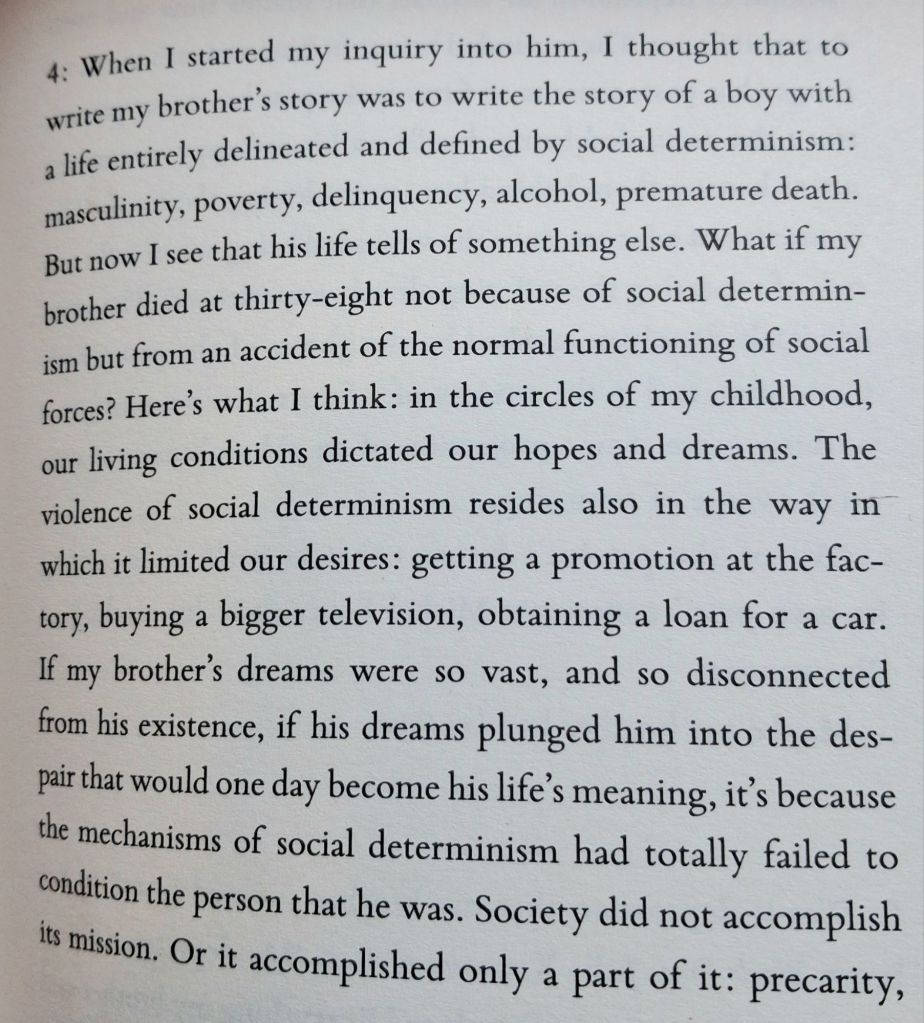
isolation, alcohol. But not the rest. Not the circumscribing of dreams.[7]
To me this justifies Louis’s reputation of a writer of force on the queer left. It offers a means of understanding why the, in particular, male working-class are so implicated in the shift to the right in public ideologies at national levels, and its basis in ‘precarity, isolation, alcohol’. It is a space where collective dreams – ones I would call disordered and sick, based on hate of marginalised otherness – based on race, sexuality, and normatively constrained bodies. – supplant the individual dreams and ‘escape’ from lives branded as failures or as wasted (‘escape’ is that term so important in Monique Escapes), meant to be the engine of capitalist growth but inaccessible in the long term to the working-class. For Monique, escape is entirely contingent on the access to resources that her son, Édouard’s, success as a writer permits her. No such escape is possible for her unnamed son, who has lost a future and ‘lost time‘. The reason for that latter loss is also theorised in the novel – via Michel Foucault‘s resurrection of the psychodynamic thought of Ludwig Binswanger.
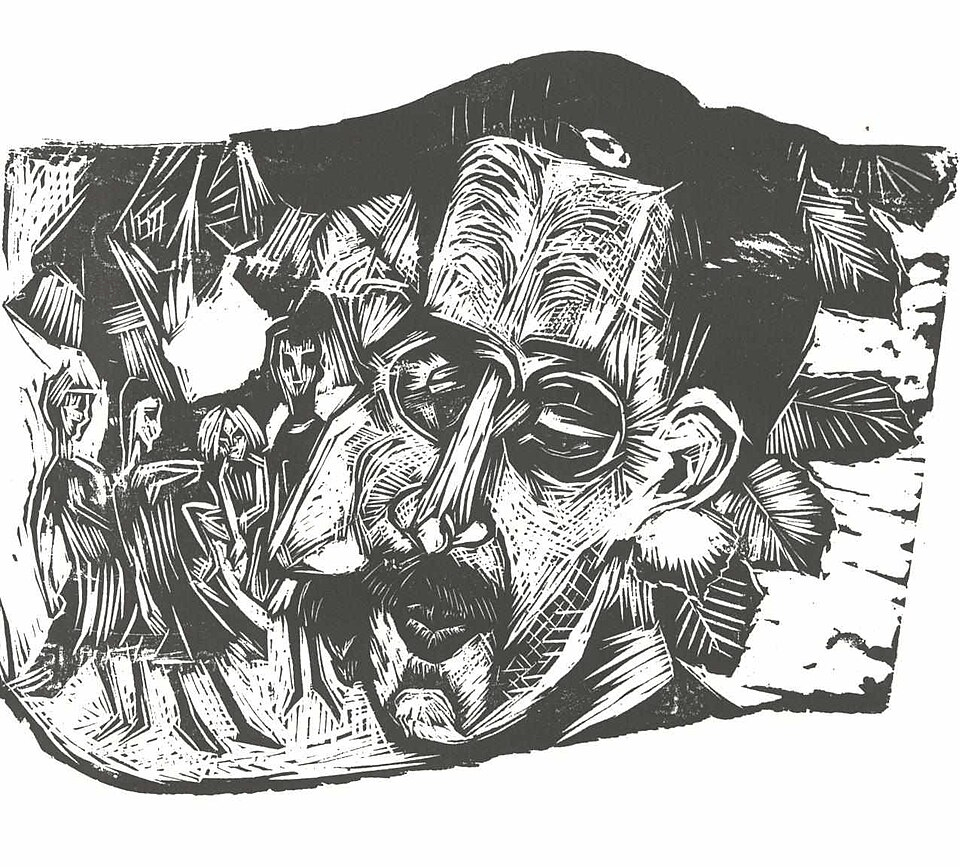
Portrait of Binswanger By Ernst Ludwig Kirchner – Copied from an art book, Public Domain, https://commons.wikimedia.org/w/index.php?curid=7104936
In brief, the argument insists, Édouard’s brother is forever lost in cycles of repetitive acting-out of striving, failing and collapsing up and until his final COLLAPSE, the starting point of the book and its goal. From Binswanger, Louis, via Foucault, takes the concept of the WOUND to characterise the sickness afflicting his brother which made him ‘psychologically incapable of losing’ (and is based on the loss of the capacity for love replaced by an ‘ideology’ of hate) in ways absolutely necessary for those systematically denied success, except in accidents in time like those that cause The End of Eddy (the title of Louis’ first book). Though Louis insists his alter ego, Édouard, whose story this book also is could not love his brother, the book continually finds space for that love to be articulated. Silence and the loss of articulation and naming characterise the brother, but, in a way, it does that to Édouard also – on the surface at least of the words that make up the book. If there is love in this book, it is in the purpose that drives it – a narrative quest to find what has been lost.Love, time, communion wherein we hold each other up from general collapse. Hence, another cycle here is that between disappearance, silence consequent upon it (and sometimes being the only constituent of the disappearance for those who fade into inarticulable spaces of despair and acceptance thereof) and temporary reappearances. You can trace these cycles in the brother’s life in the book.
You can even see the bits of repressed hope- in Édouard and his brother – in the mysterious passage about the fact that Édouard remembers ‘my brother’s smile when he saw me appear, the smile he always wore in my presence’ and yet the equally clear and resistible fact that Louis knew he did not want to mention that smile, and had not in ‘a first draft of this text’ because ‘this sign of attachment makes me face a form of responsibility or at least questioning’. [8] For me, this cuts into and through the surface or skin of the text – another Wound, that of a failure or over-limitation of love in Édouard as well as his bother – a lack of love that limits a future communalism of hope and love rather than divisive hate. The repetitive cycles end in collapse, but ‘the collapse’ is that one that Louis registers as a metaphor of the drunk’s unsteadiness in his gait and feet as a solid connection to something grounded:

At this point in the story, my brother’s life topples over. He – who had dreamed in years past, had dreams too grand fior himself – he drew away, from that moment, from all that could have transformed him or all that could have fired his imagination. If I believe Stéphanie, my brother started to hate all those who reminded him he could have changed, or that he still could. He had lost too much. He was no longer strong enough to lose. He searched constantly for immobility because he was now scared of the future or of movement – that is to say, of the risk of repetition and failure and of the Wound.[9]
In another confusion of genre, one chapter is written as a play-script, an ‘Imaginary dialogue with my brother’s ghost’, in which the Ghost tells his brother that he perhaps ought to confront what he already knows, that the person called BROTHER in the play (representing Édouard) is really, as he says ‘writing about myself’ and that he could avoid fear by representing his brother as hopeful, not fully collapsed. But BROTHER replies: ‘The less likeable I make you, the more I give you pity and justice’. But does anyone want to GIVEN these things, that ought to be a birthright. Our only conclusion can be, that the WOUND continues to run trough the Édouard Louis that survives his unnamed brother. That WOUND is poignantly articulate at the near end of the story, when he compares his literary project with Anne Carson in Nox, a set of lyrics about her brother’s death, whom she hoped to provide with something that “forms a lock against oblivion”. Louis retorts:
Maybe I know nothing about my brother, but I need to believe that I do. Maybe I need a story, an explanation of something that has a meaning.
A rampart against forgetting. [10]
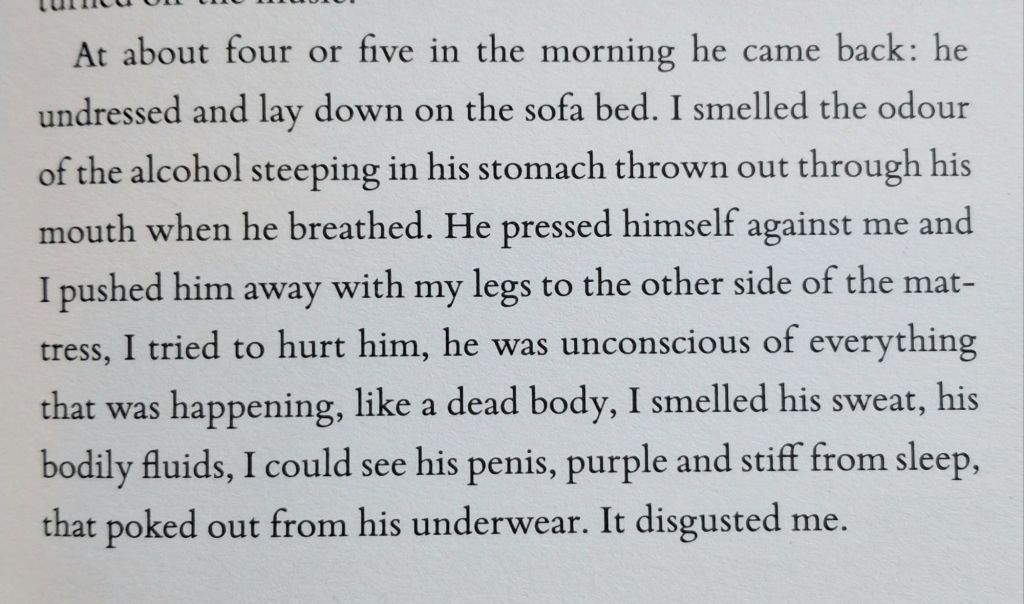
And if Édouard cannot overcome the ‘disgust’ he knew his brother often expressed about him and his ‘homosexuality’, perhaps there is in Louis something still struggling to overcome over-proximity to his brother when reduced to naked unaccomodated man – though at this point the young Édouard is sleeping over with his brother to be nearer school for his exams. Here is a passage very much of disgust at the brother merely for being what a naked man is without love: [11]
If a brother’s death has meaning, it may be because it allows articulation from the mouth of the WOUND of the working-class that for them has been sewn shut by exclusion from education and thought. I found this remark, numbered 3 in another chapter of bullet points, very moving and identifiable:
3. In a large part of the working class, psychological wounds do not exist. In my brother’s circle they never spoke of trauma, of melancholy, of depression. In the more privileged classes there exist collective places and institutions to evoke wounds: psychoanalysis, psychology, art, group therapy. If my brother had been wounded, he had nowhere to speak of it. [12]
Louis, of course, has graduated in class , voice and to spaces where he has a voice: in art, even in French politics, but the need continues to use energy not to move on but to cycle back, in ever repetive stories from the past of his own family – having finished by this time his own completed childhood as Eddy, his mother, his father (a Dad like the different one his brother kept seeking), his mother again (having escaped), and now his brother in this novel. Where to go next? Is there a story leading to Louis’s own future. The alternative is represented as unthinkable – the possibility that Louis might be like his brother (and like one of Ariés medieval witnesses) to their own impending death that they cannot perhaps speak of:
I imagine my big brother, alone, in the night, conscious of his impending death, without a language to describe it, just a dark and ghostly stream flowing in his mouth. Like inverted vomiting.
A warning of death. [13]
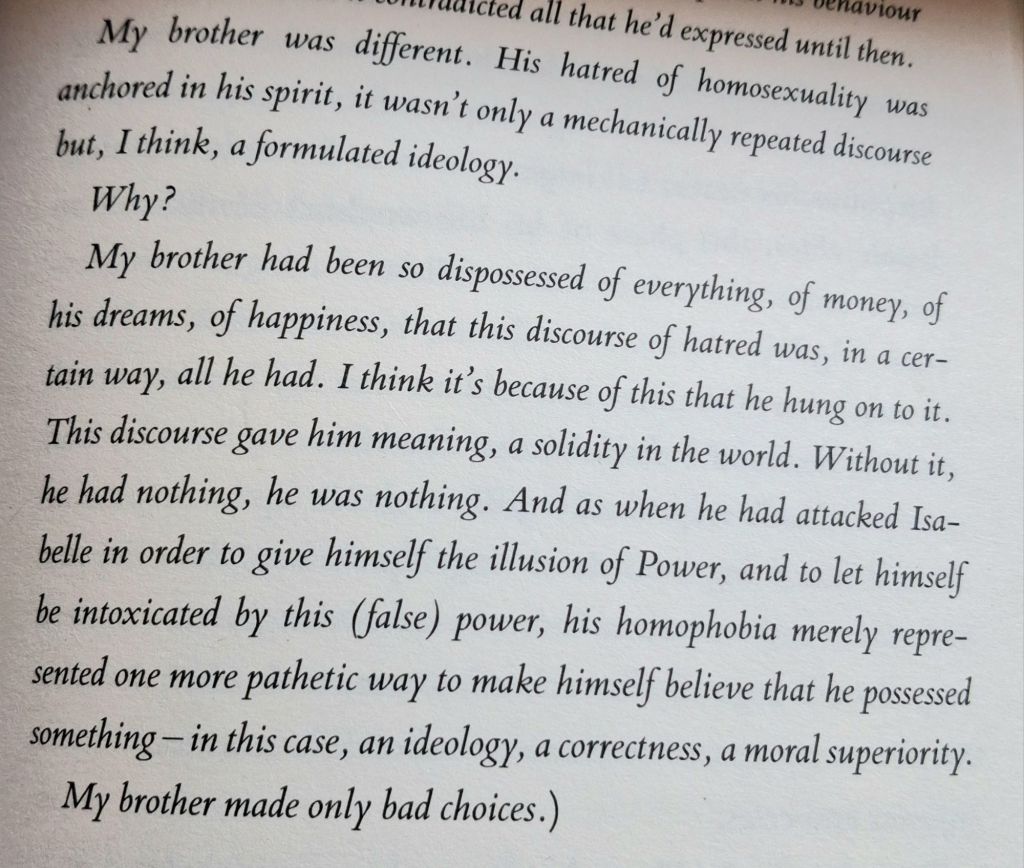
Louis is left with a brother’s example of a rigid ‘ideology’ of the right, a ‘bad choice’ in the world for based only on hate and the thought that power is denied to you. But we have no evidence in truth of Édouard either having made ‘good choices. This passage feels very reflexive – italicised because it was a speech that Édouard feels it difficult to articulate – why did his brother so hate him, if he did, and is not my left stance possibly too ‘an ideology, a correctness, a moral superiority’ that feels like Power but is a false one. This is a text for all of us – for me too! [14]
But why is this all relevant to the prompt question. It is because Édouard’s brother forget that he needed to be conditioned to see that he had no real basis of expectation of ‘happiness’, but that he refused to learn this and hence lived in recurrent ‘violence and sadness’ because he could not stop expecting a ‘happiness’ for which he was not born in the right class of society to expect, and which, therefore, only alcohol provided ‘happiness’:
This happiness is indescribable. I mustn’t forget to say that when he drank, for the first few hour, my brother was a joyful charcter, generally much more joyful than those around him; he danced, he sang, he swept his family and friends up with him. It was only subsequently that his state evolved towards despair and violence. And perhaps the two were linked. [15]
I typed this with tears in my eyes, with memories of those, including that person who is me at times and under some chains of necessary containment still, it reminds me have who I have lost: my father, dear Justin and others. We all should love more. Failing that read Édouard Louis.
Bye for now
Love
Steven xxxxxxxxxxxxxx
_____________________________
[1] Édouard Louis [trans Tash Aw] (2026:111) Collapse, London, Harvill.
[2] ibid: 26
[3] my photograph from ibid: 110
[4] See ibid: 163f.
[5] ibid: 12
[6] See ibid: 132, 171.
[7] my photograh of ibid: 111, followed by end of point in quotation, from ibid: 112.
[8] ibid: 150f.
[9] ibid: 168
[10] ibid: 191
[11] My photograph of ibid: 23
[12] ibid: 47f.
[13] ibid: 27
[14] My photograph of ibid: 165
[15] ibid: 117


4 thoughts on “Édouard Louis shows us that ‘happiness’ may be the result only of ‘social determinism’ succeeding in its function to ‘condition the person’ you are. This is a blog on Édouard Louis (2026) ‘Collapse’, London, Harvill.”