


Inspiration is a word that should be less used. Today, be open to be breathed into by an ensemble.
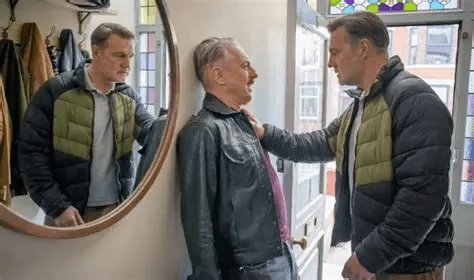
Alan Cummings & David Morrissey
Today is dominated by a blend of thoughts about inspiring drama. Last night Geoff and I completed watching the Channel 4 series Tip Toe, wherein a company of TV actors goes as far as it can to shape how much Hell may become other people in a way less philosophically based than in Sartre’s Huis Clos, and not merely as a shaping forth of the grim vision of a writer who is becoming increasingly boxed in by despair and who writes of an individual and flawed queer Everyman who will bear the burden of the violence prompted in other people by, they say, the way he acts.
I was also reading David Hare’s Grace Pervades, in preparation for seeing it in early July in London – a more earnest attempt to make a summary of theatre I find that investigates theatre and theatricality in 2 aspects:
- The notion of individual performance and its relation to issues of spectacle, action to some end (often political or avowedly definitively not so), and nature (sometimes seen at odds with the notion of spectacle and pageant) and;
- The notion of theatre as a holistic art, torn between options –
- a theatre of grand gestures and appearances, in which acting is an art towards that end, and often patriarchal;
- a theatre of the natural turned into the mode of art, even of politics thus turned, and;
- a theatre that is entirely an aesthetic performance directed not in acting but in production values that cross the boundaries of other arts: dance, paintingand music.
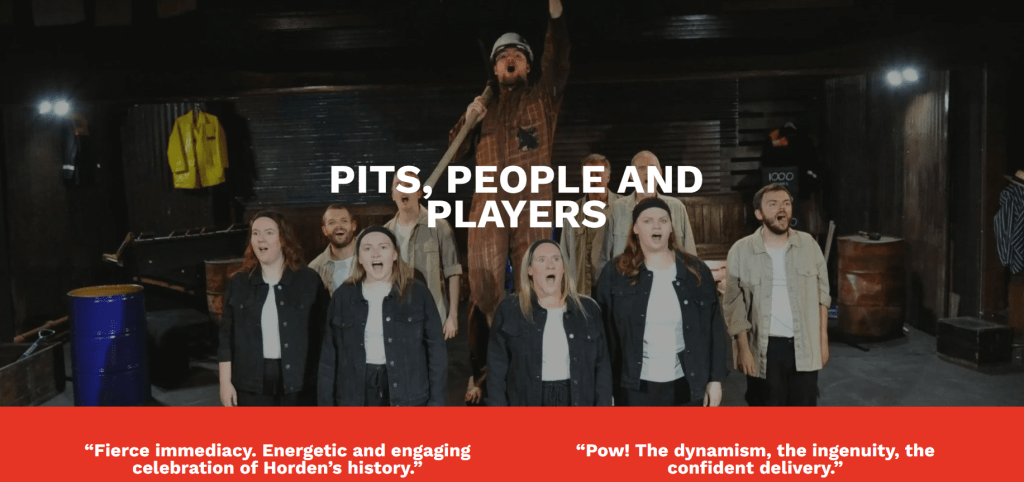
But today Geoff and I go to Horden Playhouse to see the revival of the 125th Anniversary of Horden production of Pits, People and Players, an open challenge to what it means to play theatre in and for an economically depressed but socially proud region once served by mining. Miners play roles in many domains and I expect the history of mining across these role to make sense in terms of the history of this village and specifically of Horden pit, which was dismantled in 1987 after the defeat of the Miners Strike.
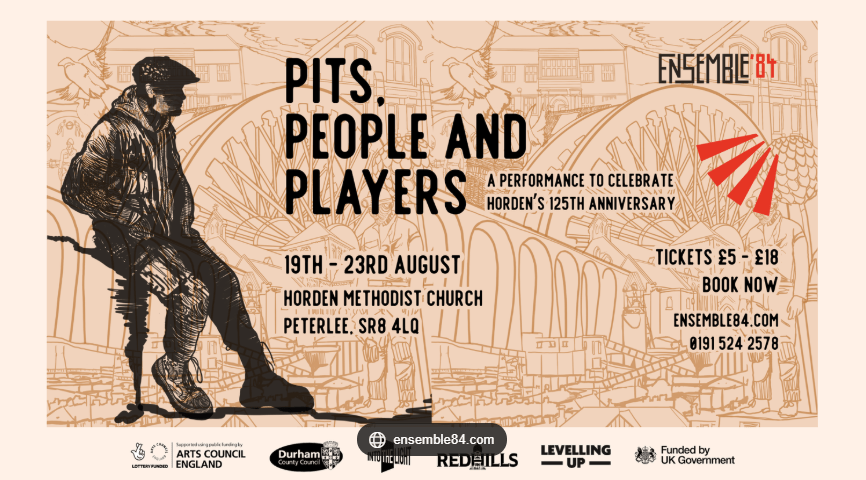
Graphic from the original production when housed in the Methodist Church, with its telling illustration
What has this to do with ‘inspiration’, which I have already said is a word that should be less used. it’s etymology lays the ground for me, for ‘inspiration’, though a Latinate word (through French), is grounded in the visceral knowledge of what supports real bodies. Here is the Online Etymology Website:
Inspiration (noun): c. 1300, “immediate influence of God or a god,” especially that under which the holy books were written, from Old French inspiracion “inhaling, breathing in; inspiration” (13c.), from Late Latin inspirationem (nominative inspiratio), noun of action from past-participle stem of Latin inspirare “blow into, breathe upon,” figuratively “inspire, excite, inflame,” from in- “in” (from PIE root *en “in”) + spirare “to breathe” (see spirit (n.)).
And the Lord God formed man of the dust of the ground, and breathed into his nostrils the breath of life; and man became a living soul. [Genesis ii.7]The sense evolution seems to be from “breathe into” to “infuse animation or influence,” thus “affect, rouse, guide or control,” especially by divine influence. Inspire (v.) in Middle English also was used to mean “breath or put life or spirit into the human body; impart reason to a human soul.” Literal sense “act of inhaling” attested in English from 1560s
What that passage calls ‘sense development’ in the word is really a progress to the removal from it all references to the ‘senses’ of the body – for instance of the feel of breath proceeding in and out of the body and passed onto others, or to things enacted as if they were done so in bodies and by their agency. The Genesis example from the website does not use the Latinate word, and hence its relation to the issue gets obscured, unless you search for the verse in the Vulgate – the Latin Old Testament in particular, favoured in Rome over the Septuagint, used in Constantinople where people who called themselves Romans happily spoke Greek. In that Latin translation, we see the source of the word in the verb ‘inspiravit‘
formavit igitur Dominus Deus hominem de limo terrae et inspiravit in faciem eius spiraculum vitae et factus est homo in animam viventem
And the Lord God formed man of the slime of the earth: and breathed into his face the breath of life, and man became a living soul.
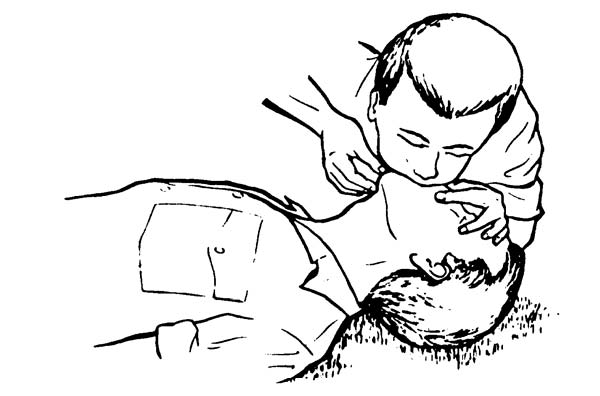
How do or should we read this? How close does God get to man to ‘breathe in‘ his face? Is there an embodiid transfer of breathing as Man is inspired by God? Is ‘spirit’ the breath of an active visceral kiss of life? In Chaucer’s Prologue to The CanterburyTales, through, the word is used of abstracts like those imagined operative in Nature but personified – there is still something of body, as the embodied wind (Zephirus) blows his sweet breath (swete breeth sounds more like sweaty breath in Middle English – though perhaps not at the time – and to me is more visceral) right into the openings of landscape features, open to receive him – nature pricks the heart. It is all so physical:
Whan that Aprille with his shoures soote
The droghte of March hath perced to the roote,
And bathed every veyne in swich licour
Of which vertu engendred is the flour;
Whan Zephirus eek with his swete breeth
Inspired hath in every holt and heeth
The tendre croppes, and the yonge sonne
Hath in the Ram his halfe cours y-ronne,
And smale foweles maken melodye,
That slepen al the nyght with open ye
(So priketh hem nature in hir corages);
Thanne longen folk to goon on pilgrimages,
To inspire is to be breathed into, such that you feel the otherness of the inspiring forces. Nowadays it too often means: you give me self- confidence to be me alone and not sharing breath / spirit / communion with you. Now to return to those performances I had on my mind.
Of Tip Toe I feel reticent to speak. Here it is hard not to hear the voice of a playwright who has been defeayed, his spirit strangled out of him by public hanging out to dry. He told Huffington Post that ‘he didn’t view Tip Toe as a cautionary tale about a not-too-distant future, but a reflection on the modern world as he sees it‘. Maybe I feel this is all too near that modern world I share of its victim and his fate of total misrepresentation. It’s A Sin was as fresh as Queer As Folk in Russell Davies’ work, but too much in Tip Toe, despite its brilliance, is about symbolizing the end of queer consciousness and the free breath of life it gave to open diversity.
I admired this drama more than any other TV series I have seen but it felt like a kiss of death rather than life to a queer spirit not ready yet to give in to invisibility. The character Melba played by Rhys Davies says of queer liberation that ‘it is dead’ I cannot write or think about this show yet. Its power was too near the reality of the current situation. Great though to see David Morrissey as the spirit of ‘Reform Party Man’ and in it boiling the entrails of queer people in homophobia that is partly self-directed. This breathes life into my expectation of seeing him live on stage in July in Simon Stone’s Oresteia: playing a modern man haunted by his inner being becoming Agamemnon.
I will write on Grace Pervades in full in preparation of seeing that play in a later blog – for the concept of theatre is embodied and I want to antivipate how that appears in action.
However, I have returned now from Horden where I know what inspires me – which is the very concept of the ensemble drama – that thing of multiples that performs as one. It celebrates Horden and research done by the theatre amongst Horden people, collecting memories (stories and perceptions) that get moulded too like a group of persons into the concept of a people.
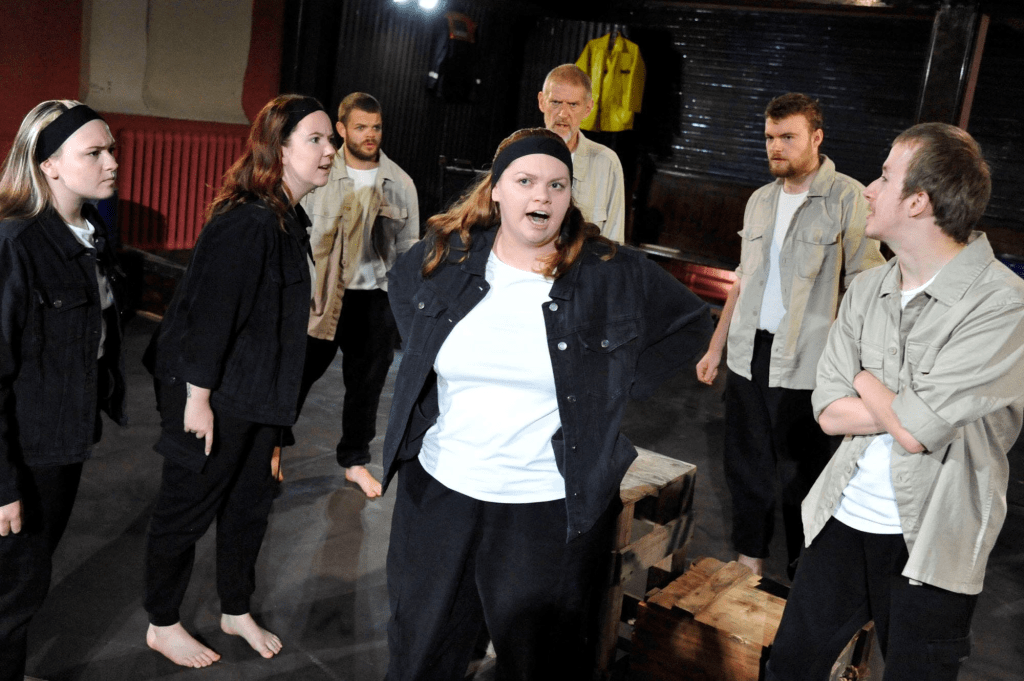
Pits did that too in the North East I believe, though we have to beware a kind of sentimentality over that act of fusion – because it comes from the grind of hard enforced labour and of conflict. At one point, when the story of the Bevan Boys coming to the pit in war-time is told, they were represented by some of the male cast – the last asked his civilian job by a manager was played By Joseph Hamall, who played Hamlet in the First Quarto production (exceedingly brilliantly). This raised a laugh when the character Bevan Boy declared himself to be an actor and having had played Hamlet recently – together with a kind of sample that was more Henry Irving-cum-Olivier – before the pit manager said ‘he didn’t care what he’d been’, the thing is, he was a pitman now – one of many. It is almost a symbol of any pretension allotted to playing major roles being put back where it belongs – into the ensemble (though in truth that is how Joseph played Hamlet anyway, and it worked better than seeing Benedict Cumberbatch in the role for me.
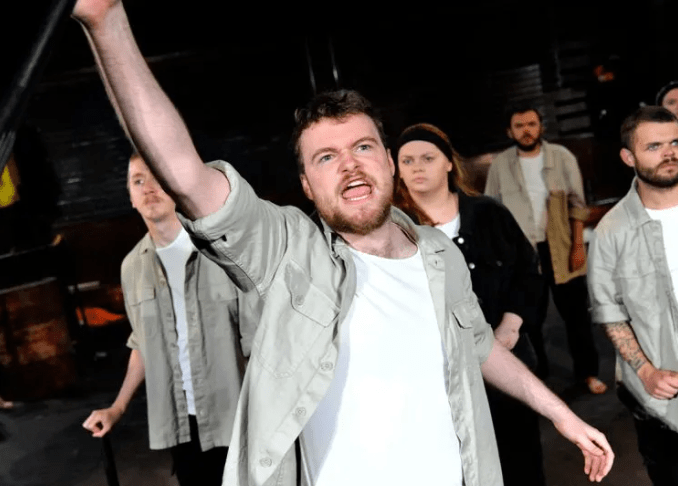
For me seeing the actors I had saw so recently in Hamlet made me feel I was seeing friends again, showing different facets of themselves – in choreographed movement, dance, song, instrument playing and sound-making. Brodie Joseph feels like a friend met again, though I don’t know him at all – my husband though noticed how he shone as I had in Hamlet- not in carving out some special identity for himself – but in being all he could be in interaction with others, helping them to shine too. For these people – these players – in the pit of the theatre in the round, and the imagined Horden pit with the whir of its shaft cage wheel, behind them, until in line with the text it was dismantled in the representation of 1987 and suddenly the stage pit seemed empty – were it not for the players being the people, which filled it again. In truth one feels breathed into by the human energy of the whole group. Let’s say it – what most inspires one is genuinely live and living theatre.
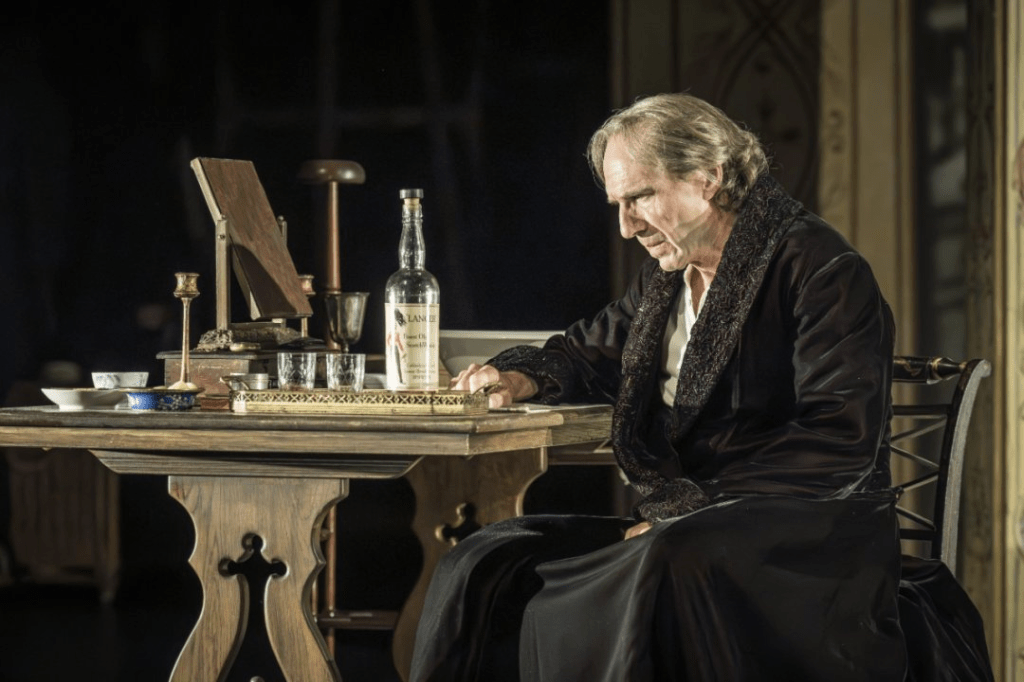
I might take that theme into a Grace Pervades blog, which, in a sense, allows Ralph Fiennes to unpack the debt of great modern actors to the unenviable centre of play that this type of actor once was. It can’t redeem human hope from Tip Toe, but hope is not everything. Sometimes great individual acting, across a whole cast, still makes a whole, even when a certain reality being brilliantly enacted deadens you into anomie – a kind of death.
Bye for now
Steven xxxxxxxxx


3 thoughts on “Inspiration is a word that should be less used. Today, be open to be breathed into by an ensemble.”