


John Dyer, the hero of Nicholas Shakespeare (2026) Frame 37, London, Harvill, uses the phrase, ‘… nothing ever disappears completely, and when it returns it does so in exaggerated form’. It is so very nearly an echo of the many ways in which Sigmund Freud described ‘the return of the repressed’.[1] However, it would be a gross simplification to rest on this echo, and use as a favoured tool to interpret this work, for it is an artwork full of forms of the ‘disappeared’, including human forms of that phenomenon common in historical South American political life, and of ‘ghosts’ and other souls lost to reliable and valid memorial forms even in artforms, like the sculpture of Terry Fox. This blog considers whether it is the purpose of ‘good stories’ to locate the source of truth of an incomprehensible universe, but to continually suggest that this truth runs like ‘a non-verbal poetry’ with a ‘rhythm that feels fresh’ and might wake us up ‘to the unspoken part of the universe’ around us.[2]
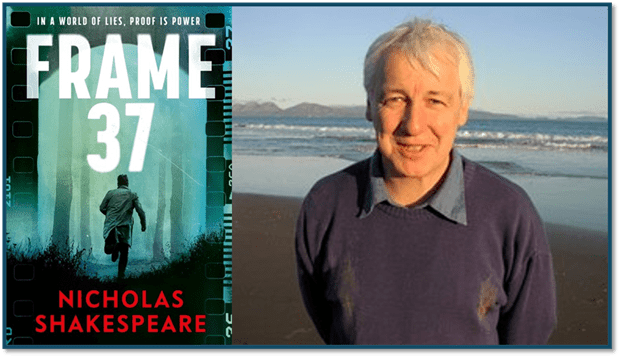
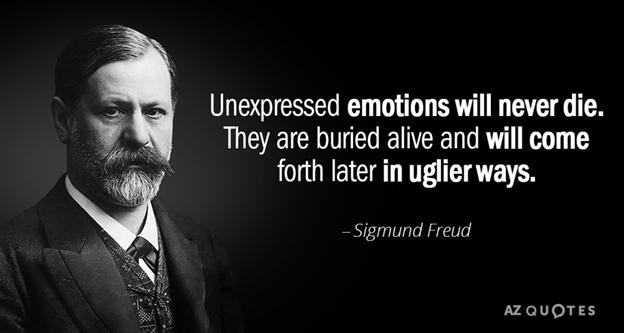
It is possible that the phrase relating to the life of dangerous rendezvous’ of John Dyer, the hero of Nicholas Shakespeare (2026) Frame 37, London, Harvillis a reference to what Freud calls the ‘return of the repressed . Dyer’s phrase is ‘… nothing ever disappears completely, and when it returns it does so in exaggerated form’.[3] Freud perhaps, for the attribution of these words to him is disputed (even by practising psychodynamic therapists), expressed this in ways even more connected to the Gothicised supernatural:
However, though I often favour as a reader unearthing echoes in text that explicate the whole text, this is not how I feel about this one, which I read because it held me to it, promising more in suggestion than it ever gave in explicit forms. For though I am fairly certain Shakespeare intends the echo of Freud, I cannot guarantee he means it to be a tool of th interpretation of his novel, which, so often feels like the transcription of a dream-or-nightmare state. For the novel is full of moments that act as if the echoed something underlying them, a son lyric and its suggestibility, like that which puzzled Jamie Portman in his review for National Post about its vicious assassin-murderer, Oliver Kerr, named after a reader of Shakespeare’s novels who won that elevation in a competition:
Shakespeare adds a further ironic twist to its horrors with a glimpse of a hired killer driving to safety along the Thunder Bay expressway, relaxing to the strains — would you believe? — of Neil Young’s Rocking In The Free World on his car radio. [*]
Now to some extent, Portman seems, somewhat naïve to sum up the appearance of this song as something to which someone, even a hired killer, for that job must have its stresses, can be ‘relaxing to the strains – would you believe? – of’. Of courses strains occur in song but they can also be themselves a word for stresses! But that particular song has lyrics that satirise the attempt of politicians, namely George Bush (from whom it quotes that attempted poeticism – ‘a thousand points of light’ about the nature of ‘freedom’ in the ‘free world’) to sanitise the motives of vicious right-wing policies at home and abroad – and a satiric paeon to the likes of Kerr: ‘ Machine-gun hand’.
"Rockin' In The Free World"
There's colors on the street
Red, white and blue
People shuffling their feet
People sleeping in their shoes
But there's a warning sign
On the road ahead
There's a lot of people saying
We'd be better off dead
Don't feel like Satan
But I am to them
So I try to forget it
Any way I can

Keep on rocking in the free world
Keep on rocking in the free world
Keep on rocking in the free world
Keep on rocking in the free world

I see a woman in the night
With a baby in her hand
Under an old street light
Near a garbage can
Now she puts the kid away
And she's gone to get a hit
She hates her life
And what she's done to it
There's one more kid
That will never go to school
Never get to fall in love
Never get to be cool

Keep on rocking in the free world
…

We got a thousand points of light
For the homeless man
We got a kinder, gentler
Machine-gun hand
We got department stores
And toilet paper
Got Styrofoam boxes
For the ozone layer
Got a man of the people
Says keep hope alive
Got fuel to burn
Got roads to drive

Keep on rocking in the free world
…
In a sense the issue here is the disparity between cruelly relentless descriptive stories in words and the relaxation of rhythm. But the point is that, though Shakespeare doesn’t quote the song to give us the echoes he might be aiming to resuscitate in his readers. Some of these suppressed lyric utterances are traceable, like the background music at the impromptu evening part of Miguel’s rich estancia inheritance where the young visitors, all memories of people at this point of telling the tale, celebrate the staid Portuguese Argentinian (I could but won’t in this text show how Shakespeare shows us that Miguel’s family are Portuguese not Spanish speakers in Argentina) parents going to bed.[4] They play ‘single-sided 78s’ (now there’s a blast from the past – like much in this book including analogue photographic cameras) including one picked for the ‘inglés’ but named in Spanish: “Quier Ser Felix”, which sounds so much more romantically entitled than ‘I want to be happy’, even sung with fey-happy rhythms of Ella Fitzgerald: several lines of the piece seem to comment and animate the beginning of a relationship between Dyer and Lia (amid other sexual dynamics), so important to the novel – since Lia is the first person to be seen murdered (by Kerr, although we don’t know that then).
Life's really worth living
When we are mirth-giving
Deborah glances half-expectantly over at Dyer. She spreads her hands on the back of the chair and leans forward. But Dyer’s singular focus is on Lia as he struggles to relight his cigar.
Why can't I give some to you?Dyer looks around. Their eyes lock.
She smiles oddly and he feels himself tilting. In a new latitude.
Her vital presence. The tight pull in his chest as if a dumb person is tugging for help.[5]
Notice the strain inside and outside Dyer, and the silenced desire for articulation felt under stress, and again the disparity of the rhythm of lyric with its unpredictable effect in mechanical performance. However, Shakespeare often seems to quote bits of rhythmic language that I, at least, can’t source, and wonder whether they are intended to be sourced or to come from a deep private reservoir. One of my favourites is that emotional ghost of a puzzle that surrounds a passing reference to Dyer’s dead wife meeting his wife Astrud on a beach in Rio, though at this point of the story he ‘had buried her four years before’. It comes at a reunion between Dyer and Doug Medland – to me one of the most intriguing characters of the novel [6]:
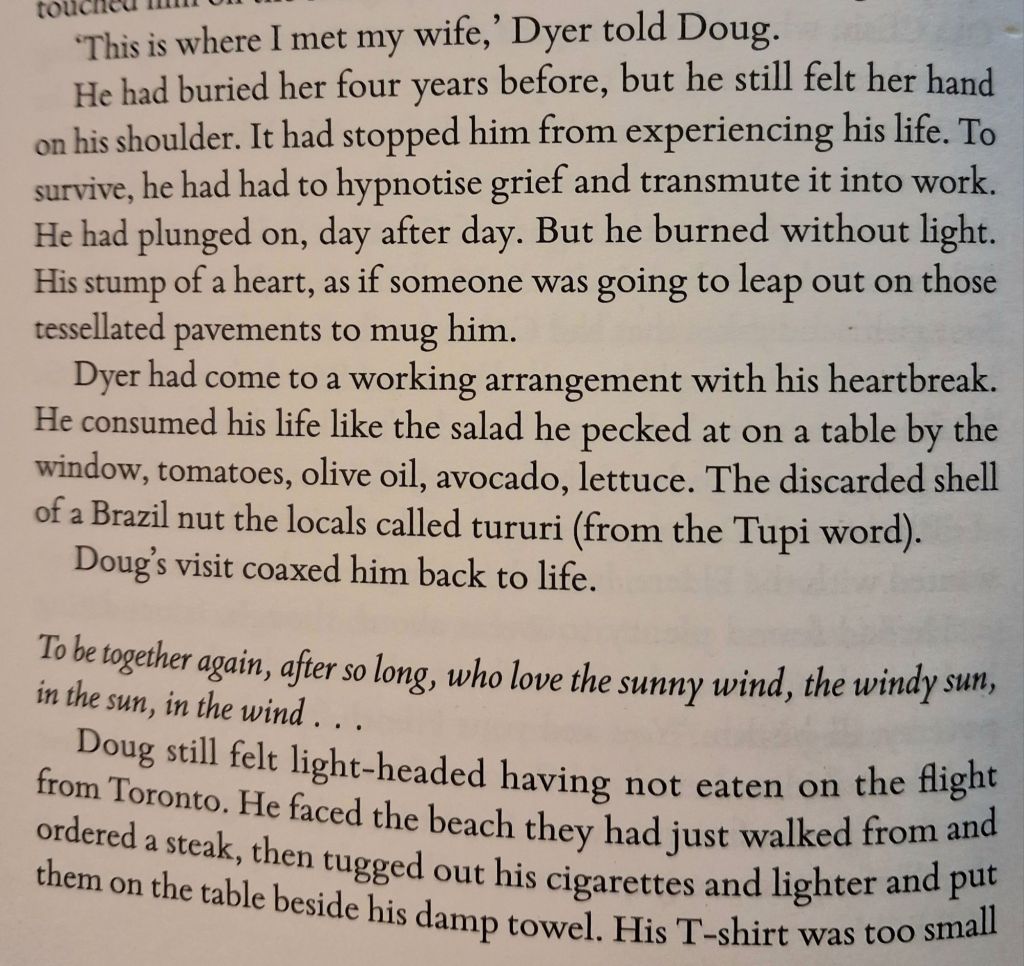
One of the intrigues regarding Doug is the entirely inexplicable closeness of the two: they are the ones who share a bedroom in the estancia, but I think this closeness is not a hidden explanation as a totally unknowable one (by anyone), yet the rhetoric of Doug’s capacity to coax John ‘back to life’ like a resurrected corpse or ghost, which he likens to a Tupi name for the ‘discarded shell’ of a Brazilian nut. Whether, in the eating metaphors and discarded shells is any reference to the contested belief in cannibalism in Tupi speaking people’s also can’t be known.
And then following this heightened referential language of life and death, loss and redemption is the italicised and rhythmic prose, a rhythm that is indeed largely an effect of repetition with variation, and a kind of romantic popular song cliché:
To be together again, after so long,who love the sunny wind, the windy sun, in the sun, in the wind ...
The prose following that patterned lyric set of phrases, fitting perhaps in terms of Dyer’s thoughts about his dead wife, recalls that, at this point in the novel the reunion, after so long, is between an emptied out Dyer and his friend in student days at Ann Arbor, Doug Medland, now running to a Falstaffian roundness of form, represented in a comic manner, yet both manifesting that they have met ‘after so long‘. Tonally everything clashes here: pathos and bathos, lost love and resurrected academic blokely comradeship of two aging anthropologists in its place. It is all so strange. Yet being ‘together again’ or not is very much an patterned theme of this novel, even runs into semi-mythical union of now distant unconnected land masses – that are nevertheless possibly hypothetical versions of a certain truth, as in the discussions of continental drift that had separated the continents of South America and Australasia, and particularly, with some homogeneity of animal species, once connected the regions of Patagonia & Tasmania in Gondwana, in some contested versions of the evolution of the current continental land-masses.
These ideas are invoked by Miguel in moments of what may be patterns of lucidity in madness, as he tries to persuade John to come and see him in Argentina and will not take into account the distances that militate against them being ‘together again’: [!]
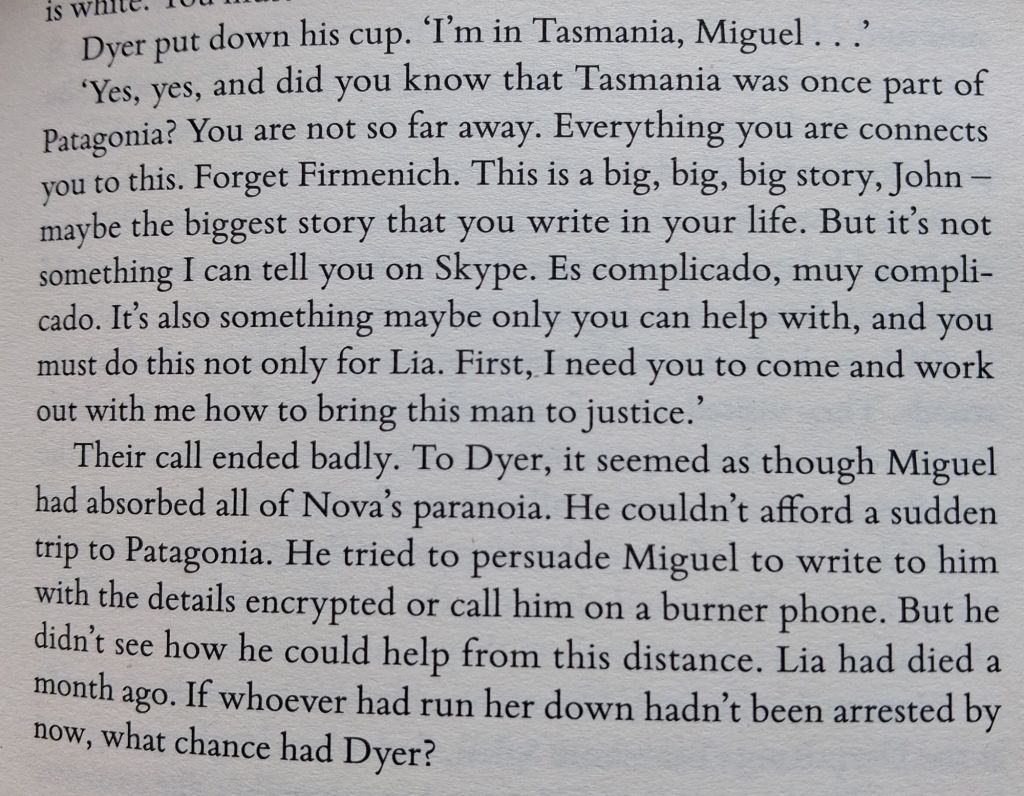
From some perspectives of truth nothing is ‘so far away’ that it cannot be reconnected, ‘together again’ and the ‘big, big, big story’ configured despite the fact that without John to unravel and tell the story it is ‘complicado, muy complicado (complicated, very complicated)’. For stories pattern facts that do not seem to fit together – perhaps especially in thriller mysteries, but really in all novels, and some comings together must transcend the everyday facts of distance, including budgets for travel and the logistics of long-distance communication.
Jamie Portman, mentioned before, actually questioned Shakespeare (by telecommunication interestingly, about his self-concept as a storyteller, and I want to move onto this theme. Portman notes that ‘The Wall Street Journal has hailed him as “one of the best English novelists of our time.” As for Shakespeare himself, he has a less lofty view of his endeavours. “I’ve always been interested in stories that can’t be told,” he says simply. In fact, however simply you say it, telling stories that explicate both inner and outer worlds and how they ‘come together’ is itself ‘muy complicado‘. There may be reasons why he writes as he does but they aren’t easily categorised he insists – though people keep doing it. That may partly be because of a fact mentioned by Portman, that his history with the Booker longlist meant, though previously regarded as a mainstream novelist, Shakespeare rather threw critcs when he was clear that he might now be writing thrillers. Hence, they looked for ‘literary’ examples of these for comparison; ‘the likes of Graham Greene and John Le Carre. Shakespeare is uncomfortable with this label’.
“I don’t see these novels as thrillers,” he says with a laugh. “I don’t feel that a good story has to be put into a genre. I’m not competent to be a thriller writer or a crime writer. I don’t even read those books with sufficient attention to know what I’m supposed to be doing. I just want to tell a story as excitingly as possible … I don’t know what a thriller is or how to do one.
“I just hope people will read it to the end and will be excited by the story. My novels usually start with a predicament, so I think I really write them for myself as if I’m trying to tease a pebble out of my shoe.” [*]
I read and collect the work of Nicholas Shakespeare and have blogged on him once before (read it at this link) – on his last novel The Sandpit, in which the hero of this novel appears (as he does in The Dancer Upstairs, a much earlier novel). In my blog, I entered, without knowing any of the immediately above, into this question of genre and the unhelpfulness of generic classification. I ended my blog on The Sandpit with the following words – but I won’t reproduce the manner in which I got to that conclusion – which point to the fact that reading itself is made problematic in Shakespeare’s characters:
Echoes of other books will be found in its language and narrative elements. This isn’t just a literary game. If it were, why would Shakespeare hide them under cover of an espionage thriller. There is much to discover here – if anyone takes the trouble. Reading some reviews suggests that this will not be a certainty. Books are vulnerable: there may be little hope for them or of achieving a good reading in this world.
Strangely enough, this was a misleading start for me with this book but not an unfruitful one. Literary reading, if it exists at all, exists in the laying of clues to patterns of meaning, repetitions of references to central markers of what we like to call a novel’s themes. It shouldn’t be easy to unearth these clues and to reconfigure them and it only has value if what it yields is significant enough to readers. However, described as I describe the process, it is not unlike that of the thriller and / or the detective novel, except in that the latter provides false clues – elements that seem to emerge in patterns across a novel but lead nowhere – they, as it were, keep the reader on the lookout about what exactly will yield the clue that resolves the narrative and brings it to its conclusion. Now this book is scattered with false clues that we expect to come to fruition – whether it a significance we have easily recognised in the fact of Dyer’s dislike of ‘stewed apple’ (which recurs often), of the motif of Joan of Arc that yields one surprise, but ones easily left behind in the progression of the novel beyond their recurrence.[7] Consider too the passage in the photograph below, which seems both inconsequential and at the same time to offer explanatory material that illuminate the earlier parts of the narrative (and might – readers will think) become important later, although in fact it does not. The plot element it explicates is why earlier in the novel Doug Medland is remembered by people because of a peculiarity of his hand – he shakes hands using his left not right extremity (a trivial enough thing in all).[8]
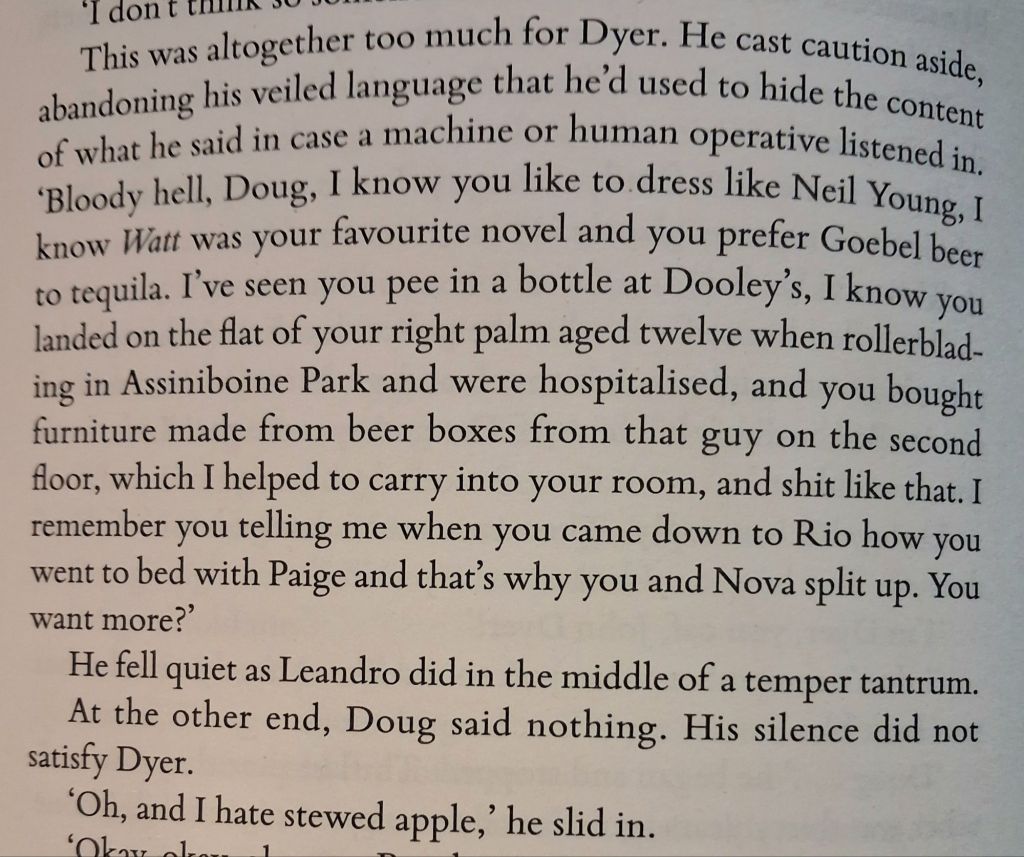
The use of ‘veiled language’ may make things harder to read but then some details (and you see the ‘stewed apple’ here, are given too much weight by being read over and over again. Maybe we also need to consider the many failures of ‘reading’ in this novel, not least the enigmatic blind poet who is the mother of Miguel and Deborah. Miguel urges people to write in her visitor’s book, even though she will never read the words herself ,but even before this she ‘peers at’ Dyer ‘as if he is a page she can no longer read’. [9] At Lia’s grave, Dyer ‘went on looking at her name‘ (which the novelist prints in large well-spread type font), ‘forcing his eyes into each engraved letter,as if this might unpack the riddle of her death and Miguel’s death, and open up the meaning sealed in the silences of Nova and Doug‘. [10] The sense in which reading interrogates words for meanings they cannot ever reveal is forceful here, but even more so, when, in the very next chapter, Dyer questions his competence in reading events, character and gaining an idea of the drift of a plot even: ‘Returning to Ann Arbor had made him realise that he was not the observant or proactive person he like to think he was. What else am I not reading properly?’ [11] This is why, so often, people are characterised in terms of their reading, both its content and their perspicacity with it, whether it be the text of a newspaper of a certain type of newspaper (the heroic role of local newspapers for instance as truth-tellers) or an academic article, a national history, a text in another language (Portuguese, Spanish or Tupi) – even those read in youth. And then there is the fact that we have to read through lines of text to find repressed or hidden content, or the real root of neurosis as Freud insists. As Portman says, and I imply, Dyer with his ‘“fatal passivity” and “unexpressed passions.”’ is a difficult read, for those who want things to make immediate sense. This has something to do, Shakespeare told Portman with the fact that, according to Shakespeare: “the real world actually defies our understanding,” … “As a novelist, you have to find ways of fashioning it into a more realistic narrative.” [*] The reason Miguel identified Dyer as a necessary reader of the mystery to be unravelled is not because of his superb ability to read things right, as Dyer recognizes, but because he had an inner ‘need, like a compulsive illness, to follow a story yo its end, even if he was unlikely to end up writing about it’. [12].
And it those with inner drives and compulsions who sense the existence of the ‘disappeared’ from accounts, those who persisted in following through stories – like those in early Shakespeare novels, of the ‘NN – a no name or “Natalia Natalia” – who could not be identified after being marched off the street by a hit squad …’ [13]. But it includes those who choose the option of ‘going dark’, like Ker who become ‘Shamrock’, as Dyer does by going to Tasmania, or by use by others of burner phones, false credit card accounts and aliases. He later uses an alias when he becomes Azavedo or those who take on fake identities like Howard Ockloss — the president so like Donald Trump) and also the man does who tries to become his successor and the true villain of the piece, responsible for disappearing witnesses to his rape, who is variously known as the young heir of the Levigne name, Malcolm Levigne Jr., but also, by his neighbour as ‘Little Malcolm’, as a student as ‘Talcy Malcy’, and later as Jaime Pardo. In the Presidential race, the secret society that makes Republican winners suggests using as an alias is fine – Warmuth their representative (‘the Barn Owl’) even compares it to what Emily Brontë, Marian Evans,’ Eric Blair and David Cornwell did in becoming Ellis Bell, George Eliot, George Orwell and John Le Carré because ‘the name of a thing is not the thing’. [14] And that is why readers readso voraciously, to get to the end that is the purpose of a book – its revelation of some truth.
Or perhaps not? This may be because the end of reading is not final revelation but a means of coming to terms with time. the things that also disappear are the dead (Lia and Miguel – but silent Paige (page) and get forgotten, Indigenous tribes – the history and culture wiped out – in this novel there are many including the Tupi but also the Blackfoot wives of Doug – as well, the ghosts which dead people or those forgotten as if they might as well be dead become: ‘Lia, Nova, Doug, Paige, even Miguel – they had retreated like thinning ghosts into the darkness and the mists of years’. [15] One version of this helps us to see the means of ending the novel – an analogue camera photographic negative – as a symbol of what we lose in memory of the lost or fading: [16]
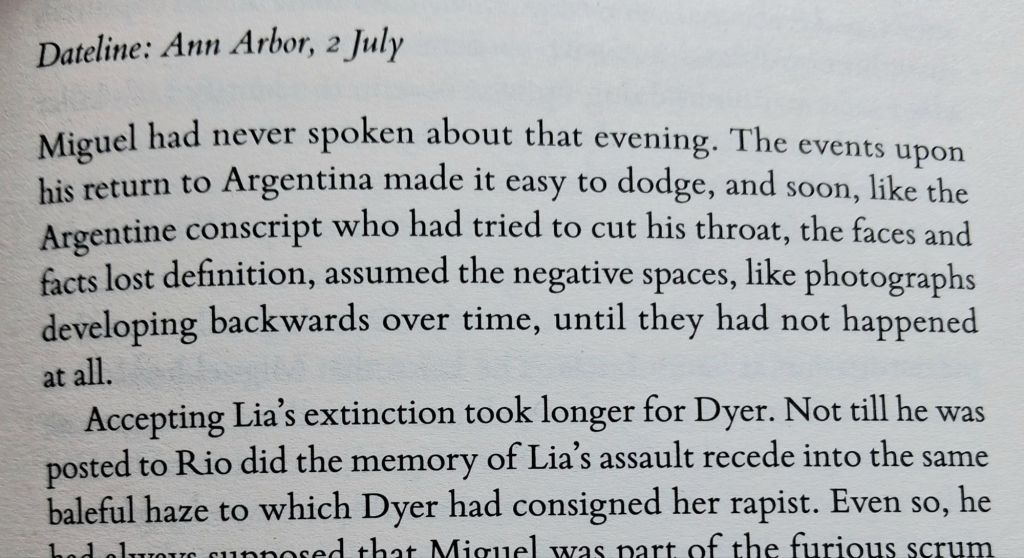
But another word jumps out here: extinction. For extinction is an act of repression of inconvenient persons who witness what they should not, or whole races, cultures, and species. We congratulate ourselves on driving a ‘rapist’ to extinction in memory. What we call ‘nature’ is something we too often say goodbye to as we think it as something to say goodbye with. These metaphors are so rich in Shakespeare, even though they may seem a cliché on the surface: ‘Seeds from a blown flower, their small circle of friends parted on sad terms’. [17] I think that all of this can be resolved, should you wish, but it would reduced the multiple ways Shakespeare novels give pleasure by the way it begins as a novel to spin themes of time as a way of reducing the sorrow of the loss of flesh, and even then, the loss of memory of that flesh, by seeing the purpose of rt and culture as a reconfiguration of time into less painful forms. We do this it suggests – to me at least – by invoking memes that are wordless, that are rhythms, and may be found in other bodily activity such as running (together with Roger Bannister – my Dad did his decorating) – a thing so often invoked in the novel, and compared to the effect of reading poetry, as an avoidance of dislocation in space and time. Dyer finds escape in Tasmania because ‘the universe came into a rhythm that felt fresh’. [18] That phrase recaptures a longer sequence about running, poetry and rhythm in the ‘Prologue’ wherein Lia is murdered: ‘with running, she entered a non-verbal poetry, a flow state that promised to wake her up to the unspoken part of the unverse around her’. [19]
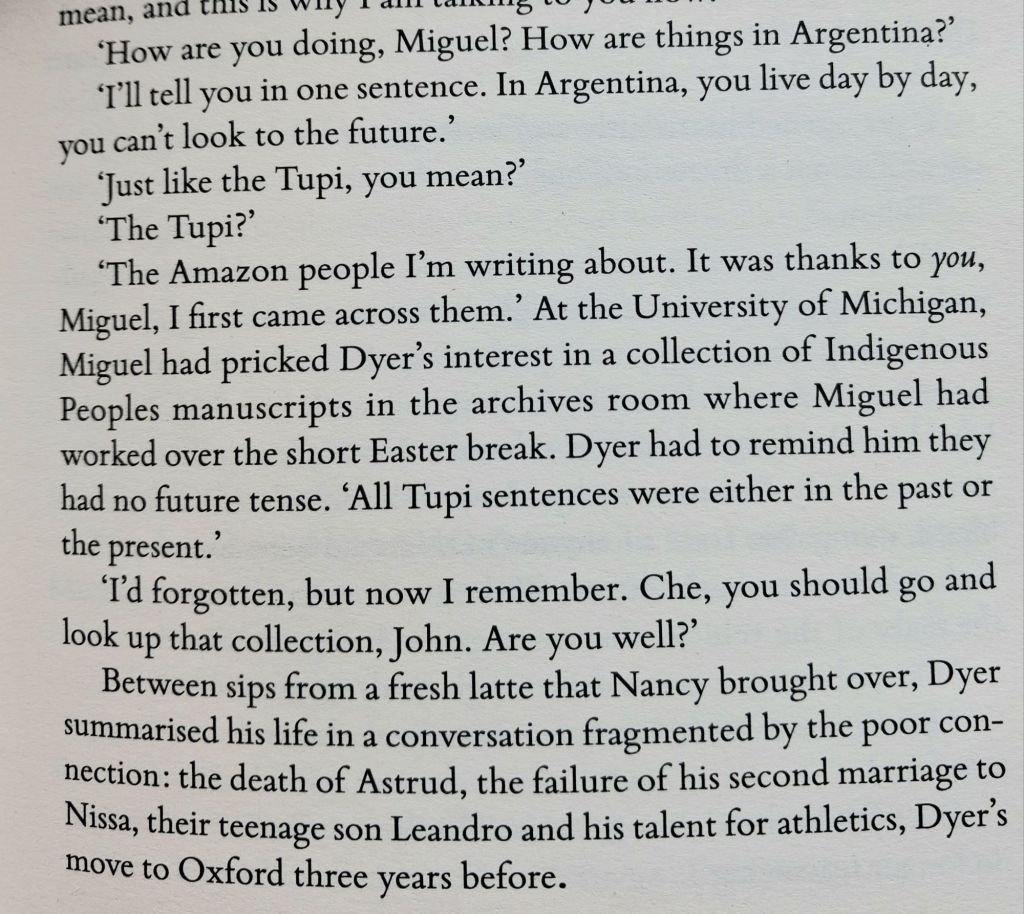
Art, running and rhythm may be as near as we get to Csíkszentmihályi’s ‘flow state’ , but that state is only a ‘promise’ not a fulfillment, and in my view a sham, but it is a beautiful idea. The thing is that beautiful ideas aren’t the answer – that is reading through the contradictions and developing necessary resilience to the horrors ahead. In fact this is implied early in this novel in reference to the cultural framework of the Tupi, the indigenous tribes worked on by Dyer. It is a passage of reading offering no hope but some point – that we look not to a fictive future and flow into it, but sort out our present moment, not only in Argentina.[20]
That’s all for now. Read this novel. It is funny enough too to obscure my misery.
With love
Steven xxxxxxxxxxxxxxxx
[1] Nicholas Shakespeare (2026: 25) Frame 37, London
[2] The quotations collaged here are from ibid: 2 & 8
[3] Ibid: 25
[4] For the curious – the name Miguel gives to Dyer and which he later adopts as a disguise is in the Portuguese form (ibid: 9; ‘João Dyer de Azavedo’) and his own grandfather loses ‘himself in the pages of the Anglo-Portuguese News’ (ibid: 248). Inter-globe diasporic correspondence matter in this novel, and yet, don’t – as much else in its puzzling pages.
[5] Ibid: 59
[6] My photograph of detail from ibid: 178
[7] For ‘stewed apples’ see Nicholas Shakespeare (2026: 44, 103f., 264) Frame 37 London, Harvill & for Joan of Arc (for example see ibid: 65, 76, 80, 90).
[8] My photograph of ibid: 264. The ‘hand’ peculiarity is on ibid: 36 & 176.
[9] Nicholas Shakespeare, op.cit: 41
[10] ibid: 256
[11] ibid: 261
[12] ibid: 27
[13] ibid: 31
[14] ibid: 170
[15] ibid: 109
[16] My photograph of ibid: 271
[17] ibid: 134
[18 ibid: 8
[19] ibid: 2
[20} My photograph of ibid: 11
MISSED NOTES IN NUMERATION PROCESS
[*] Jamie Portman (2026) ‘A chilling reflection: Nicholas Shakespeare’s new book hits hard in today’s political context’ in National Post (Online) [Jun 05, 2026] Available at https://nationalpost.com/entertainment/a-chilling-reflection-nicholas-shakespeares-new-book-hits-hard-in-todays-political-context
[!] My photograph of Nicholas Shakespeare, op.cit: 15

