

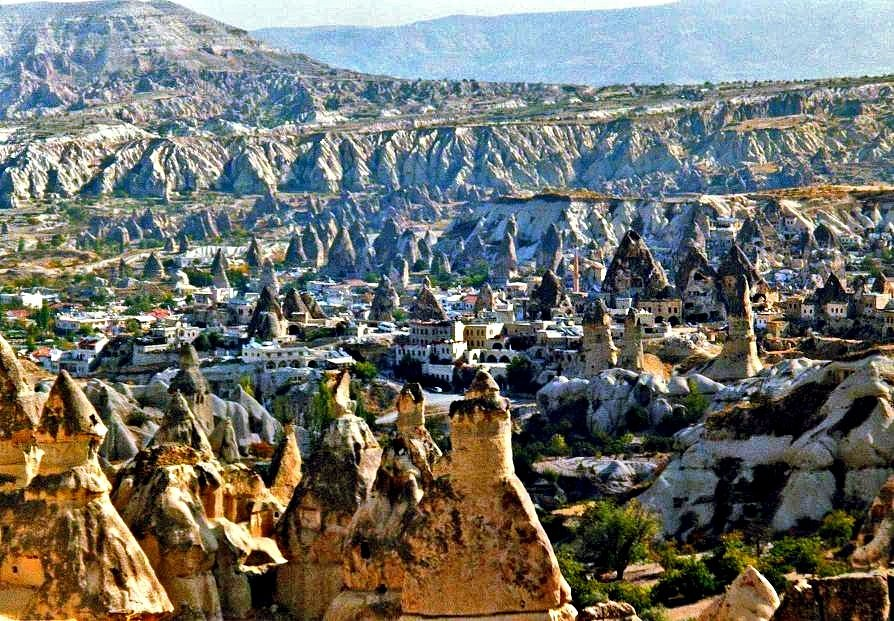
Since nothing is certain, we aren’t likely, any of us to get hold of truth and keep hold of it. The sands shift and what looks a solid foothold in the mountainside crumbles when asked to bear the weight of a person already in doubt of it, falling more from lack of any faith that some footholds need to be used lightly before they crumble because you need to leap up to something hoped more durable – though never forever. The quotation above has no quotation mark at its opening as all other lines have in the passage from the poem I quote below. That maybe because this line is to be capable of being some kind of interpolation of an interpretive summary of the feel of what the narrator was seeing and hearing in the poem, A Death In The Desert by Robert Browning. The poem tells of the death of St. John, deep in a cave in the desert (I imagine it to be one in Cappadocia as above in The Trip Advisor photograph) whom Browning creates as the author of John’s Gospel and of Revelations, though the identity of the two is questioned now, and was when Browning was alive – and he knew a bit about modern (for his day) Biblical Criticism (Ernest Renan and David Strauss who both embraced the idea of Biblical narrative as ‘myth’ are both named in his later poems) of the New Testament accounts. Revived by a text on resurrection, John continually gropes among uncertainty. In the extract from which this comes, he tells of going to sleep in physical sickness bearing on his great age but feeling he held some provisional truth, only to awake with this truth seeming imagined, with him ‘slidden down and fallen afar’, from where he had his foothold on the face of a mountain he was imaginatively scaling.
He even knows that even his own existence will be mythicised and doubted later, speaking of:
... unborn people in strange lands,
"Who say—I hear said or conceive they say—
" Was John at all, and did he say he saw?
" Assure us, ere we ask what he might see!'
If people doubt your existence, how can they believe what you say you saw. Yet you know they only do so because they fear to stand on their witness to truth, what he (or they) ‘might see’ in the world to come. If it is interpolation from the narrator of the poem, whose identity we are told by the antiquarian who presents the poem in its introductory preface in brackets, is only ‘supposed’ to be who he is said to be (Pamphylax from Antioch, who is anyway a person not knowable in history) it is an important guide to how to see the truth as something based on supposed witness reported by a supposed witness and based on written materials that are fragile enough and possibly fabricated (three skins glued together):
[Supposed of Pamphylax the Antiochene:
It is a parchment, of my rolls the fifth,
Hath three skins glued together, is all Greek,
... ]
Maybe the guide to life is that quotstion:
Feeling for foot-hold through a blank profound,
And though we spend a lot of time concentrating on finding, testing the foothold, we spend very little resting in it based on its discovered capacity for holding us whilst it does and the fact we need to search for another even to stay where we are if it should crumble. And because our attention is on the footholds, we don’t notice that outside (I prefer the Scottish term ‘outwith’) it: for who can look at a ‘blank profound’ ? We tend to think of ‘blank’ as a two dimensional thing – a ‘blank page’ for instance, but a blank that has profundity, in either the sense of a third dimension of depth or the sense of intensity is that which is unthinkable, where nothing is heard, seen nor written.
Of course we have our footholds in science whose very rationale is to doubt past discovery and hypothesise in uncertainty (unless you really can’t bear such truth and speaks of what ‘science tells us’ as if written in durable rock with room for feet to hold on) but more than anything we have a world whose writings are being erased as fast, or faster, than they are written or inscribed by one or another form of rubbing out or scraping off of material, even by time, of course.
So I will stick by my quotation: musical though it be as a line of verse, yet profoundly ungiving as to meaning, such that some find it trite: Feeling for foot-hold through a blank profound.
The passage from the poem (see in full here) is below:
For men said, 'It is getting long ago:
" Where is the promise of His coming?'—asked
"These young ones in their strength, as loth to wait,
"Of me who, when their sires were born, was old.
"I, for I loved them, answered, joyfully,
"Since I was there, and helpful in my age;
"And, in the main, I think such men believed.
"Finally, thus endeavouring, I fell sick,
"Ye brought me here, and I supposed the end,
"And went to sleep with one thought that, at least,
"Though the whole earth should lie in wickedness,
"We had the truth, might leave the rest to God.
"Yet now I wake in such decrepitude
"As I had slidden down and fallen afar,
"Past even the presence of my former self,
"Grasping the while for stay at facts which snap,
"Till I am found away from my own world,
Feeling for foot-hold through a blank profound,
"Along with unborn people in strange lands,
"Who say—I hear said or conceive they say—
" Was John at all, and did he say he saw?
" Assure us, ere we ask what he might see!'

