


As I read Jem Calder’s celebrated novel ‘I Want You to Be Happy’, Ella Fitzgerald’s best-known lyric sung through as if it has lived with me forever. This is really a blog on that novel.
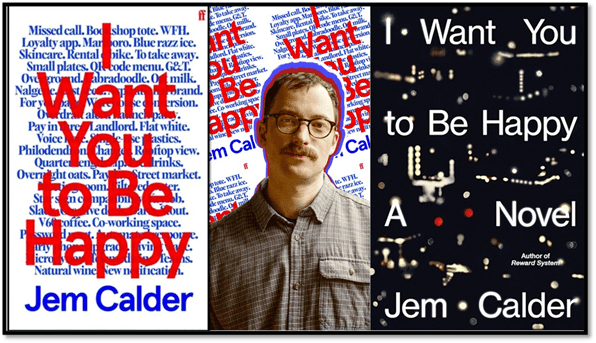
To be honest, I was reading Jem Calder’s novel because is aid I would because he is appearing at the Edinburgh Book Festival with a favourite writer of mine, Derek Owusu I I made the promise at this link). However, the novel has taken on a life of its own for me – though not at Owusu levels, and then this prompt turns up which made me think more about the book.
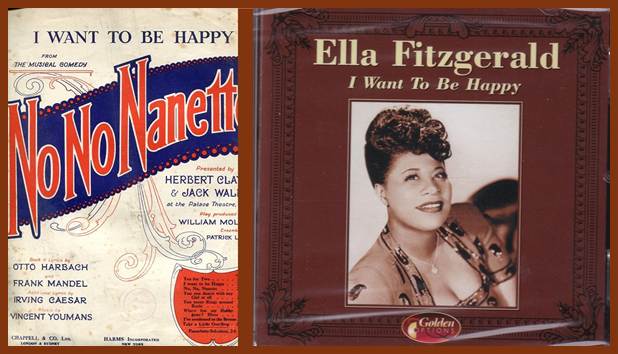
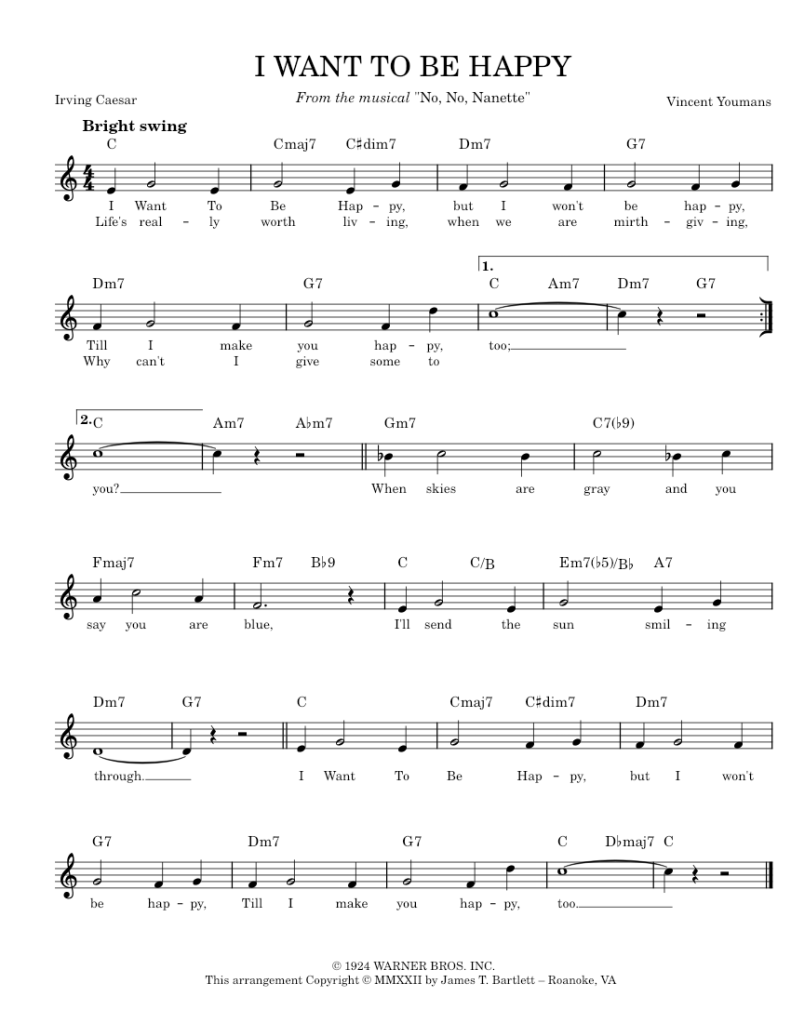
It is not necessarily a ‘good thing’ that a song lyric and its music stay with you ‘forever’, not that any of us expect anyway to be around forever, but even a shorter-than-desired or a little longer lifetime is too long to be haunted by a song that jingles so much as I Want To Be Happy, in whatever voice you remember that song since Ella Fitzgerald sung in as a stand-alone lyric1937. But originally it was a song with a dramatic import. It was written for the silly musical No, No, Nanette and sung by the character Jimmy Smith, a millionaire Bible publisher, who is married to Sue, who unlike Jimmy does not spending money nor having it spent on her. Jimmy likes to use his money ‘to make people happy’ and finds three ladies happy be the object of his wish to make them happy. Jimmy and Sue have a young ward, Nanette, who they hope will become a respectable young lady, so there is much happiness possible to bought for her too. Jimmy’s philosophy is simple. It is common too but I have no idea how the very common phrase in folk psychology, ‘I want you to be happy’ relates to the lyric – as influence or source or neither. Here are the lyrics of the song:
I want to be happy
But I won't be happy
'Til I make you happy, too

Life's really worth living
When we are mirth-giving
Why can't I give some to you?

When skies are grey
And you say you are blue
I'll send the sun smiling through

I want to be happy
But I won't be happy
'Til I make you happy, too
I Want to Be Happy” is a song with music by Vincent Youmans and lyrics by Irving Caesar written for the 1925 musical No, No, Nanette. It is sung by Jimmy to his ward. Ella Fitzgerald – recorded December 17, 1937 with Chick Webb and his Orchestra for Decca Records, catalog No. 15039A
It is a chilling song in my mind and that is why I hate it worming into my brain and continually reproducing itself – it is not because of the sickening positive psychology it implies but because it quite directly makes it a duty on ‘you’ to be happy not because it might enhance your life but because it gives the singer want they want, It is cleat the common phrase ‘I want you to be happy’ can have a similar, but less overtly spoken agenda. This is what psychologist Susi ferrarello (sic. – the lower-case ‘f’ is how it is printed online) says about the phrase. However in quoting her I leave the solution to the issue open – it is not my concern. However, you can read ferarello’s view by following the link in the footnote.
Often, people who love us say, “I want you to be happy.” This “I want” in front of your happiness transforms this mysterious feeling into an obligation that puts a strange pressure upon us. So much so that when we feel down, or we are just mulling over our (sometimes insignificant) problems, we prefer to hide them rather than share them with the people we love.
To our surprise, we realize that happiness creates a wall. We don’t want to disappoint the people we love by showing our lack of motivation toward life or our sudden low, inexplicable moods. It’s as if a part of us believes that we are not lovable if we are not happy. Good moods and love seem to go hand in hand. Love is earned with happiness.
Sometimes, we also prefer not to vent our spleen with our closest friends because there are people who are in worse conditions than us. We have no right to feel unhappy if there are people suffering more than we do.
So, where does this leave us? If our wishing happiness to our dear ones imposes a burden upon them, what should we wish for them? If saying, “I want you to be happy,” would increase the distance from us and the pressure on them, then what should we wish?[1]
Jem Calder obviously thought hard and long in entitling his debut novel I Want You to Be Happy , for lives of greater narrated (shown not told) unhappiness (or what they call ‘stressing’) than those of Chuck, though in him often in the teeth of denial of any feeling other than happiness – perhaps for reasons ferrarello suggest – and Joey in the novel are possibly hard to find, even in novels that dwell on absolute negation. On the final encounter of their affair, relationship (all the words can and are called into question) Chuck apologises for his drunken, inconsistent and cruel behaviour to Joey as they aware together dog-sitting at the huge home of his brother who was on holiday: ‘I was just stressed. Work’s been shit, and my writing –‘. To this eventually Joey adds her own statement of responsibility, though it also contained a hidden demand on him:
“I’ve been stressing too,” she said.
“Okay,” he said. “About what?”
“Oh, y’know. My life. My job. And I don’t know if you and me –“
He waited, but she left that thought unfinished.[2]
In the novel ‘happiness’ seems to be pursued along some of the tracks named here: the nature of a life, being a drive to happiness in work, the nature of what ‘you and me’ or ‘we’ (in ‘relationships’) are and are named and, not least, in writing as a response to the fact that ‘I won’t be happy / ‘Til I make you happy, too’. In the novel evaluations of ‘life’. That may be in poetry like Joey’s, quoted back to her by Chuck:
He sighed. “Reality is always showing at the corners / only mostly you cover it up.”[3]
For Chuck it is in his over-intellectualised and defensive stories and the novella Paradigms, that he writes and that will end their ‘relationship’, if such exists for Chuck who claims he never mentions the word. Writing evaluates life, except when it is not just ‘copy-writing’, written directly to the prescription of a patron as advertising copy. Sometimes life is shown rather than us being told about it, in ways we all recognise, as unhappy: when ‘shit happens’, especially when drunk, exhausted or in some other ways without any control of events, such as in the superb pictures of alienated life in both characters. No male who has ever been through drunkenness as a way of life , especially that where Chuck misplaces his penis and wets his trousers and can smell of himself only as stained with piss. Even more so, perhaps, one might recognise that scene by which a man realises himself as fitting his favoured image of ‘physical ineptitude’ ‘ ‘like failing to throw the ball properly on sports day, his father watching’. That scene is his failure to achieve an erection on his first attempt to have sex with Joey. [4]
But the fate of ‘you and me’ entities is another function of happiness it seems or its inverse. Just after that little exchange where Joey mentions it above , we get a statement of what Chuck wanted.
He wanted to make things better, or at least make things feel better and touched her elbow and went in to kiss her lips, but she turned her head at the last second and he ended up kissing her hair.[5]
The sentence is based on a similar paradigm to ‘I want you to be happy’. The subject who has agency over the verb ‘want’ (‘he’ of course) is the sole one seeking a change of mood in some object, which might be ‘her’ or ‘us’, although that change is ambiguous between being better, or only feeling better. Thus is happiness – a mood achievement which follows on making ‘things better, or at least make things feel better’. The uncertainty around whether feeling better equates with being better is the lynchpin of the issue – do I want you to be happy or ‘feel’ happy (which may not be the same thing since feelings can be read from mere signs of performance) so that there is surprise in the fact that Joey cannot finish her statement about not knowing ‘if you and me –‘. For what are ‘you and me’? Are we a ‘we’, or not? In fact Joey has raised this issue before when in the midst of negotiating how much either can know what the other one wants in relation to the other. Asking the question directly:
“What are we?” she said.
To this Chuck answers but fails to identify the ‘we’ as an entity with a name of its own (a couple, a relationship or whatever) but to fall back on it as the name of two separate entities united only as ‘we’ by doing the same thing: ‘we’re just having a good time and seeing how things go’. This isn’t a quibble over pronouns for ‘we’ can so soon in a later clarification of its nature fall back into its constituent parts: ‘I like being with you. I like the way things are.’[6] It is a status quo that affirms the absolute separation of individual beings from each other, except in performative and transitory situations. And hence the strangeness of our Jimmy Smith / Ella Fitzgerald song wherein ‘I’ want something to change in ‘you’ that ‘I’ have made happen whereby ‘I’ too can be changed in a similar way. ‘We’ entities never get articulated as one ‘thing’ in their own right, and that is about the meaning of the comedy around Jimmy Smith in No No Nanette.
Yet there is something far too contemporary about this novel for it to comment specifically on a very old earworm so g or a common folk-psychology phrase related to it, both a out the power exerted between people though they are. Same Leith, reviewing for The Guardian, says pertinently and observantly.:
The opening section of I Want You to Be Happy is an excellently droll and surefooted description of a man and a woman meeting in a bar, trying to make conversation over the music and flirting vaguely. They establish that she is 23 and that he is 35. All the specifics – the name or location of the bar, the music, even the names of the couple – are for now redacted: “After a while, the twenty-three-year-old woman raised her voice and, referring to the thirty-five-year-old man, asked her short-haired friend: ‘How old do you think he is?’ The short-haired friend surveyed the thirty-five-year-old man’s face; thought for a moment. ‘Forty?’ The twenty-three-year-old woman snort-laughed. ‘He’s thirty-five.’”
… As that opening suggests, these figures are, or could be, representative.
In some ways, they are. Not much happens. Boy meets girl. Girl has hopes. Boy has drink problem. Boy and girl are happy for a bit, then they aren’t. Tale as old as time. But what’s fresh about it is the book’s precise attention to the environment in which such a story now takes place. It’s all rental ebikes, vapes, meal-replacement protein shakes, Slack channels and push notifications. The characters lightly cyberstalk each other, they agonise over whether they’ve responded to texts too quickly or too slowly, and their difference in age is even calibrated by their texting style (the older Chuck uses capital letters and punctuation; the younger Joey generally doesn’t). [7]
I quote at length, with some examples nevertheless omitted, because this is good. There is about this n9vel a version of a modern Everyman, representative ‘man’, using insyead Every-older-male and Every-younger-female, heterosexuality being presumed of course in both, Of course, it isn’t all about sex, except on as much as it also about sex/gender sterotypes regarding other ‘evwryday’ issues like how work and leisure are configured and tne qualities of both, into which the role of alcohol is inserted. For besides stimulants, caffeine included since Joey is a barista, both work and leisure intersect with a less representative theme, that of the life and style of a writer.
Among the writer characters is tje narrator, who so oft lens his point of view to his characters enabling a better style of writing to emerge than either is able yet to have developed in the Protean consciousness of the writing itself and its style. It is yet again characterised well by Leith:
Calder’s flamboyant flatness of style, if that’s not a contradiction in terms, means that when he does unroll something a bit flashier, you really notice it. He loves a noun turning into a verb (“axised”, … / He’s good on rain … . We meet, for instance, “a low, mizzling rain that appeared to be precipitating spontaneously at person level in mid-air rather than falling from any higher source”. Later, Joey and her friends “waited in the faint, aerosol-like rain for 15 minutes”. And, perhaps best of all: “On her walk home it rained a kind of rain Joey always referred to in her head as ‘wet rain’.” [8]
What Leith doesn’t quite get here is that the style he names Calder’s is one cognisant of the style of his characters and yet differentiated from it. Yet, though share with Calder the trait of needing to mediaye the physical world so that it invokes ‘reality’ only as tropes and figures derived from supposed reality. Yet that is nearly what Leith says, without taking into account that Calder’svoice mediates ‘reality’ in the same, if ‘superipr’ way; thus is the advantage of omniscience:
The characters here live both in and out of the physical world, and everything is so mediated that reality itself comes to seem secondary. One of them jokes that cigarettes are a herbal alternative to vapes – they have stolen the gag from a meme they’ve seen. … / In such a world, who’d want to make art? Actually, both our protagonists. …[8]
Actually, more than either, art is the object and subject of Jem Calder too. Hence, the fact that Calder’s voice is the primary mediation of his character’s consciousnesses or ‘point of view’, the consciousness of a writer too, if both fictive and significantly secondary to his voice. In fact I can’t remember, except as almost certainly the case in Virginia Woolf’s Between the Acts, though I haven’t checked the text, where a writer recreates a writer thinking of having to translate a ‘reality’ which is in fact only there in the words describing they have already pre chosen as its description. But this is what is happening here, wherein Joey, enjoying after dumped by Chuck ‘ a surprisingly productive writing period’ in which she is writing with ‘a renewed devotion to the craft and richer quality of attention’, is walking, ‘now in the canopied shade of a long arcade of plane trees’, the landscape of art itself and, there is a kind of meta-consciousness in the writing assessing its adequacy as writing:
Ahead, she watched veils of pollen showering dustily down into the tarmac. How might she describe that image, she wondered, if she ever wanted to reproduce it in a poem? [9]
That is the more beautiful as you realise the volume of the material of floral fertility there is falling ‘dustily’ in the air that resounds against the various scenes in which male sexual orgasm either happens or not and to what effect to both partners. You need to stand back here and allow the layers of mediation and reflexivity about writing process and creative usage of language to be mentally uncovered and then absorbed into the reading of the sentence. And, once you have allowed that reading process full flow, you can go back to other determinants of life quality as Calder writes them, showing the grasp of things his characters have, which they tell us about in their writing so much less successfully, though joey does it better than Charles Maitland, aka Chuck. We know her superiority as a writer in training because she very nearly grasps what Calder is up to in the novel as a whole. She is thinking about how inadequate her linguistic and stylistic control is in conversations in ‘real life’, in this case when dealing with her impoverished’ comeback’ in response to Chuck’s drunken rudeness on a date: being late and then spending time mainly catching up with acquaintances. She only comes up wrth a good response the next day in the shower:
Write it down: draft of a poem that barely exists. Impossible for her to be moved by something she herself has written, but recognising the quality of her work is improving. The heavy-handed symbolism of real life. A latter-day version of herself looking back on all this. Could you love me. [10]
There are so many consciousnesses here judging what is written as it is written and then over again as it is remembered and/or read by self or another. In fact this moment precedes the first time she thinks of herself as a reader of what Chuck might write or have written in a compact of ‘sharing their writing’. This is not yet the lead into the vital conflict of the novel that follows Joey becoming the actual reader of the draft manuscript of Chuck’s novella, Paradigms, and her uncertain balanced ‘feedback’ for which she is asked,but blamed for giving it once it happens.
When she does read that – for much is quoted for us to read too – we encounter a consciousness in whom language has little relation to the ‘heavy-handed symbolism of real life’ which Calder has (in, for instance, examples given by Leith above). The tbest example of this strikes to a theme about the nature of heterosexual relationship throughout the novel. The paragraph here recounts Joey reading the novel so that what we read of it and its tome could well be made up of implicit critique of the novel passing through Joey’s mind as a reader, so that we read it after knowing what she ‘might’ think but it will be what we think – as his language piles up against him our knowledge of his distance from the ability to describe using either the reflection or symbolism of ‘real life’ at all: [11]
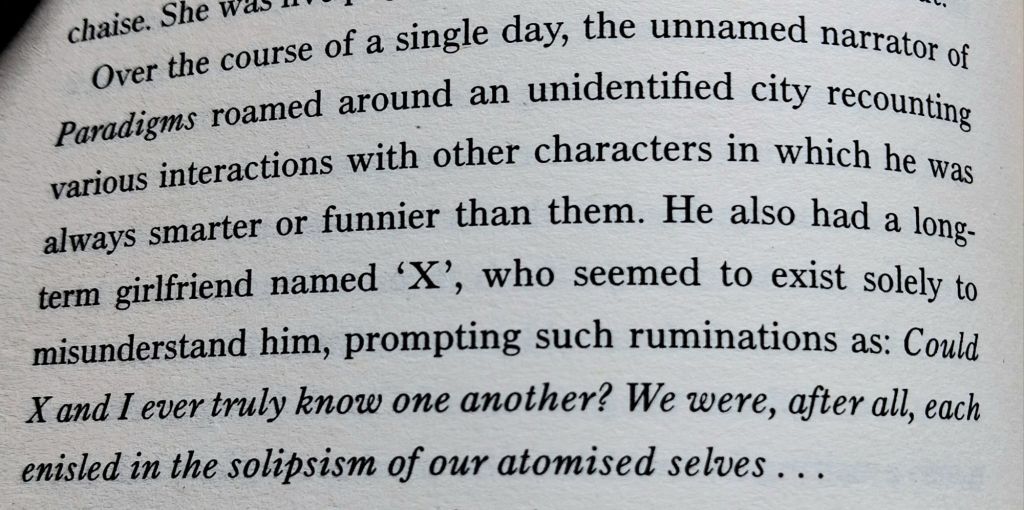
It is no accident that, presumably not having found a name for his unnamed narrator’s girlfriend, he calls her ‘X’, the first recourse of a mathematician for the name of a quantity variable, where quality is irrelevant, just as it is for the woman he writes about. When he reacts against Joey’s slight critique of his style, he accuses her of jealousy because she is not named in the novel, though written during the time of their ‘seeing’ and having regular sex with each other. But the name ‘X’ has another resonance.
Much of the story relates to Sarah, whom neither Joey nor we ever see, and whose dumping, Chuck has not even told his brother, Matt. When Matt asks about how he’s ‘doing’ (‘Sarah-wise and everything’) , in order not to look selfish because asking Chuck to dog-sit for him and his wife, Chuck is thrown back on seeking information in his email history on the breakup, reading her last email in which she mentions her surprise and that ‘the real you I’ve loved for years is going to come back’, we know that probably neither had known their ‘real yous’ ever. [12]
Moreover, when we first hear of Sarah we hear not her name but Joey indicating to him that she has picked up that there must be an ‘ex’ (the ‘name’ of the letter ‘X’):, to which he responds: “my ex, yeah,” he said. A pause. ‘Ex-fiancée’. [13] When Joey becomes history – his last ex! – he often thinks of either woman as his aim for the future until Joey sees him after the breakup Chuck sitting in a pub in the self-same seats she once sat with him with ‘the woman Chuck was talking to’ who, from a photograph in his flat she identifies as ‘Sarah’. It is, let’s face it, quite clear, that whoever X is that ‘X and I‘ are truly unreal as the description of their being together: ‘each enisled in the solipsism of our atomised selves …’. Thus is Chuck’s writing evaluated not only as writing but as writing about a life to which he never gets close enough to know. He is, that is, a bad writer! But writers can equally, whether clearly differentiated between those with promise and those without as are joey and Chuck respectively to use non-writing criteria to evaluate each other. In everyday conversation writers might characterise each other in stereotypical ways ignoring the reality that writing skill and values are not acquirable by all. When asked what he writes about, Chuck fobs Joey off with: ‘Like, people. Relationships. Change. You?’. what follows is the stereotype of a conversation between people who talk as if they did not know writing was not a mere pastime, but hard work – harder certainly than copy-writing.
“I don’t know,” she said. “I guess the same as you. The good old universal themes. Nothing amazing though.”
He said he doubted that. In return, she said she was sure his writing would be great and reiterated that she was eager to read some. [14}
In effect Calder ties his writing, as a result, to something somewhat different from the ‘good old universal themes’ as if the topic of writing came from past literature. Much of Calder’s novel deals in detail with how ‘work’ can structure and sometimes de-structure life, the latter hinting at the destructive influence of its forms, such as the growth of gig economy barista enterprises, the one that Joey has to leave her old relaxed one replaced by a Gail’s (in real-life perhaps a Costa) and the spread of artificial cultures aimed at maximizing profit known as Human Resources (HR) Management and ‘best practice’ like the use of Moleskine as a requirement for workload management (all words from the Blair era in particular), represented by people like Madeleine, introduced to Chuck by Senior Manager, Eva:
… He’d never known anyone from HR to sit in a performance review before; his legs felt briefly weak. “Are you – Is this a new best practice thing?”
“Not exactly,” Madeleine said, glancing at Eva.
Eva opened her Moleskine to a page bullet-pointed notes; clicked her pen. “We’e just, sort of, trying to figure out where it is you’re at.’ [15]
About the latter, there are very funny scenes, with a tragic overtone and a kind of air of common experience, which few of us have not experienced, as Chuck’s work-life is destroyed on being restructured, and becomes a much easier prey to his alcohol abuse. Joey’s life at Gail’s Coffee might slip down the same path were it not that she now knows how to appreciate her own written work and develop it, stopping using relationship as a projection of her dreams.
The misdirection of dreams directly into life is not necessarily into the romantic type that Joey is eventually healed of by Chuck’s chaotic life without relationships driven by emotional and ethical intelligence as well as working structure. There is a failed knight of the holy Grail, a Parsifal perhaps, in chuck, whose ‘only source of light’ inside his room at home is ‘his phone, which picture the novel describes as like ‘a vigil’.[16]
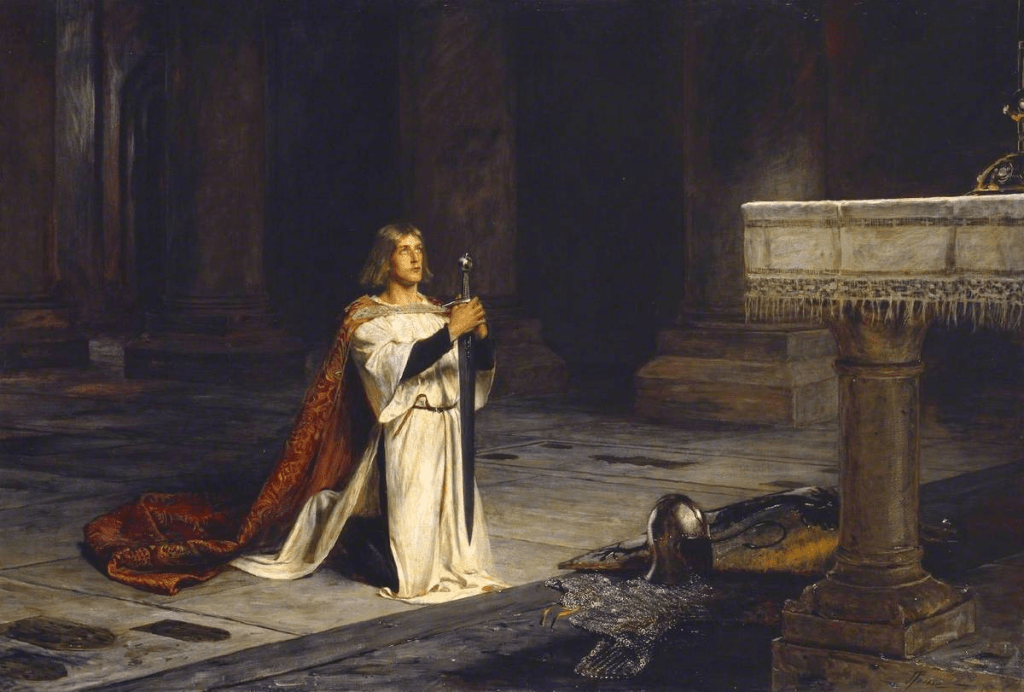
Waiting for Joey to reply, as a knight awaits God’s instruction at a vigil overnight, he ‘almost preferred that she hadn’t replied yet. Something to dream about’. But what a paltry dream to hang one’s lifeline upon, perhaps worse than more fully developed romantic narrative that Joey has. In Chuck it leads only to him proving himself sexually after his initial failure and returning to an adolescent version of himself – the dream of many men I have known. Joey ‘stirred a feeling of possibility within him – reconnected him to his younger self; his dream’. [17] When he does in fact dream of being ‘a child at his parents’ house’ it is of a ‘steep hill’ he might not be able to climb with the the prospect of ‘a large black cuboid box’. In his dream this thing is an ‘obelisk’, with its phallic potential (for the provincial Victorians raised obelisks not let them lie, as on The Embankment) but in fact possibly a coffin. [18]
That last possibility certainly fits with how Chuck begins to think about dreams as his life is forced to confront truths like the fact he is a better copy-writer than a writer of novellas (he has learned to read his own work as he thinks Joey did) and by looking for a sexual life that was just chasing a dream about his capacity for a sexual life. This theme starts from the beginning when Chuck having told Joey that he ‘did write. I used to’, hears her speak his thoughts : “but then you gave up on your dreams and now you just go to work all day and feel like something’s missing’ [19]
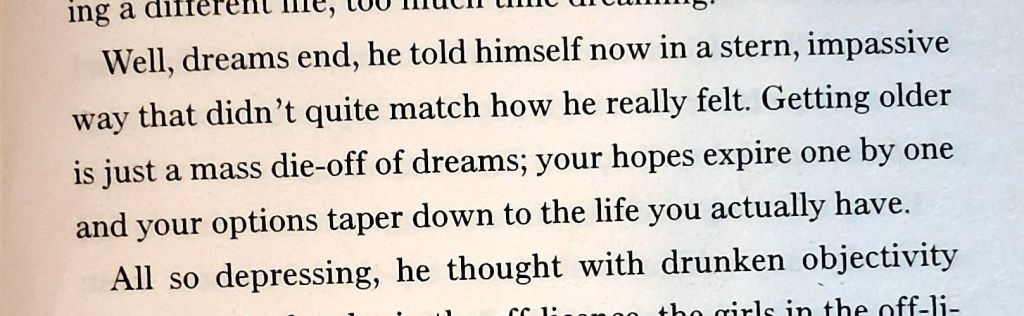
Although more to say about this skillful novel, not least about age and ageing, for it is written as by a master and perhaps truly that is so (usually we have to wait a career to be achieved to find out out), my blog was really about lyrics I remember, and I am convinced now that my feeling about the lyrics of ‘I want to be happy’ fit the novel’s greater achievement and psychological grasp of the nature of how people balance dream and work, dream and ars longa in vita brevis. In the novel music is often in the background in bars and it gets louder but is not remembered for its lyrics. Perhaps the earworm in ‘I want you to be happy’ is precisely that ancient lie so often repeated that thinks it is an expression of love rather than expression of demand and emotional imperialism. Read the novel. It is woorth it but please don’t think about the song lyrics – that’s done, as soon as someone tells you not think about something, than all you can think of is:
Bye for now, with love
Steven xxxxxxxxxx
[1] Susi ferrarello Ph.D. (2023) ‘I Want You to Be Happy: Is happiness an obligation that keeps us from being just ourselves?’ in Psychology Today (online) [Posted November 1, 2023] Available at: https://www.psychologytoday.com/us/blog/lying-on-the-philosophers-couch/202311/i-want-you-to-be-happy?msockid=02192a5dc46d6948199d3d6ac5376885
[2] Jem Calder’s (2026: 216) I Want You to Be Happy London, Faber.
[3] Ibid: 72
[4] ibid: 18 – 19 for the whole episode
[5] ibid: 216 – 217
[6] Ibid: 130
[8] Sam Leith (2026) I Want You to Be Happy by Jem Calder review – romance for the terminally online in The Guardian (Wed 20 May 2026 07.00 BSTShare) available at: https://www.theguardian.com/books/2026/may/20/i-want-you-to-be-happy-by-jem-calder-review-romance-for-the-terminally-online
[9] Jem Calder, op.cit: 253.
[10] ibid: 114
[11] my photograph of detail from ibid: 200
[12] ibid: 87
{13] ibid: 40
[14] ibid: 76-77
[15] ibid: 137
[16] ibid: 69
[17] ibid: 75
[18] ibid: 82f.
[19] The quotation above is from ibid: 7. what follows is my photograph of a detail on ibid: 225


2 thoughts on “As I read Jem Calder’s celebrated novel ‘I Want You to Be Happy’, Ella Fitzgerald’s best-known lyric sung through as if it has lived with me forever. This is really a blog on that novel.”