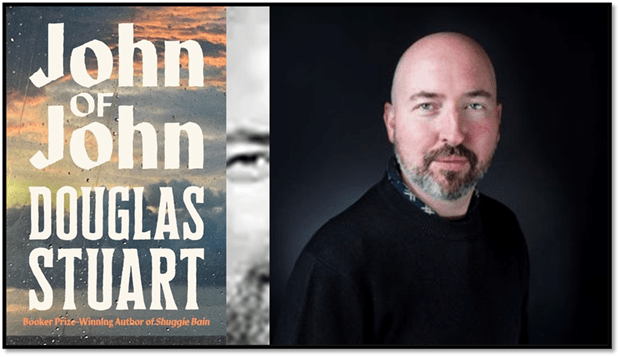
Self-confidence is an illusion, as the best novels tell you. Try for resilience and the drive to move on. First of all think more deeply about what selves are. ‘The Guardian’ entitles its review of Douglas Stuart (2026) ‘John of John’ with the sentence ‘No man is an island’, but the reference to John Donne belittles a work in which islands are not only a metonymy for alienated isolation and loneliness but also a container for non-communicating multiple selves of the same kind.
Self-confidence is an illusion, as the best novels tell you. Try for resilience and the drive to move on. First of all think more deeply about what selves are.The Guardian entitles its review of Douglas Stuart (2026) John of John, London, Picador with the sentence ‘No man is an island’, but the reference to John Donne belittles a work in which islands are not only a metonymy for alienated isolation and loneliness but also a container for multiple non-communicating selves of the same kind.[1] Each island might be like a black box containing within itself another version of another loneliness that operates externally and internally within the whole structure. It would show a better knowledge of the novel to quote Ella, the eponymous protagonist’s maternal grandmother: ‘“Islands within islands”, she muttered, “within islands, within islands”’.[2] Though perhaps an extract description of the Hebrides, for the novels setting is one island amongst other ‘islands within islands’, in its context it speaks out the complexities of alienation, anomie, and loneliness. NB: CONTAINS SPOILERS.
Douglas Stuart’s new novel has been well received on the whole but rather grudgingly by Yagnishsing Dawoor in The Guardian, who ends their review doubting its artfulness, aesthetic achievement and subtlety, saying it ‘leans heavily on melodrama and sensationalism as a shortcut to tragedy’. In case you were in doubt that Dawoor is trying to lower the quality rating that ought to be accorded to the novel he adds that in its final drawing to an end it is ‘eventful to a fault and surfeited with pathos: we have a pregnancy; an attempted shotgun wedding; a death and a momentous departure from the island’. Before the reader can object that events like weddings, pregnancy (in any serial order) and death are far from uncommon human events and that calling what happens in the book ‘a shotgun wedding’ is not true to the history the novel refers to nor the tone of the novel itself, Dawoor gets in quick with this damning couple of sentences which patronize both the book and those readers who might like it inordinately, to the point of ‘cherishing’ its central characters:
While this book will not appeal to those with a low tolerance for excess, diehard romantics will find much to love; I see Cal, John and Innes – knottily entangled and imperfectly endearing – being cherished with readerly devotion,. And that is no small feat.
Moreover, I think Dawoor misses the sheer and deliberate overturning of romantic tropes by humour, whether that of the otherwise dour characters or the narration. For instance to refer to a ‘momentous departure from the island’, suggests that Dawoor missed the moment in which Cal tries to over-dramatize the significance to his father of him leaving him for college and then being forced, as he feels it, to face ‘the burden of returning’. Innes tries to normalize the emotions that Cal refers to by reference to the circumstance of being ‘an islander’:
“I think you’re being a little unkind. We’re islanders. We’re built for leaving. We’re made to be left. It’s nothing new.” He pinched his cigarette between his fingers. “But I can’t imagine how it must feel to raise a child on your own and then have that child leave. Can you?”
“I didn’t leave him, I left home.” He put his pint on the table with more force than he intended. The lager jumped and the men watched the foam slide down the glass. “And he left me first. He looked at me and he looked at Jesus and he chose Jesus. …”.[3]
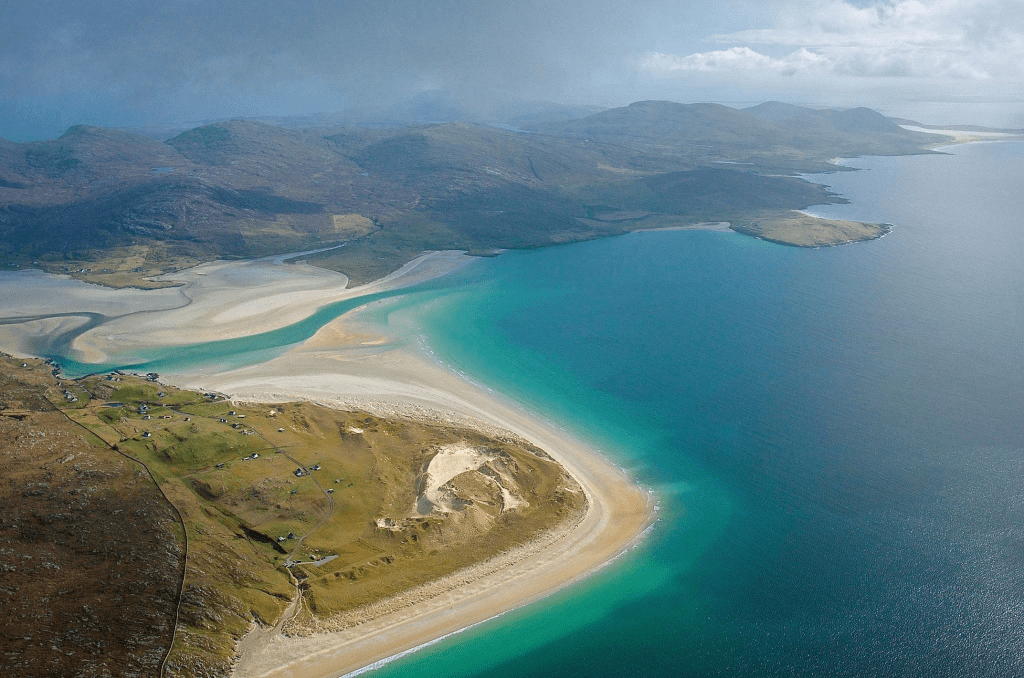
The isle of Harris
Try as I might I don’t sense the style that I might call ‘sensational and melodramatic’ here. There is something militant against romanticism and the sensational in the words depicting the two men interpreting, or perhaps just looking, at the foam that runs down Cal’s pint glass, as he processes the depth of feelings of abandonment all three men might be sharing at the same moment, Both of the two men there feel ‘abandoned’ by John, but abandoned only in the context of a circumstances of an island life – Innes evokes the effect had on the people it contains of the margins of a small island remote from contemporary mainland or mainstream ‘modernity’ and ‘reality’, whose main means of sustenance are dying. They are barriers that traps them within it bounded by a sea of unpredictability onto which those people, once they break boundaries, are cast; either because of felt or real ejection by the narrowness and exclusivity of its limited values or who eject themselves onto those seas that hold back and distance that otherness of mainland and mainstream contemporary experience. This may be a matter of taste and I am happy for Dawoor to consider my taste that of a ‘diehard romantic’, though I have evidence otherwise.
As for the novel’s quality, the critic I agreed with most is Nichola Sturgeon, former First minister of Scotland (the piece was written before her ex-husband’s recent sentencing for embezzlement of their shared political party, the Scottish Nationalist party) reviewing it in The Observer. She writes:
At first glance, it seems to tread a similar path to the books that came before (Shuggie Bain & Young Mungo – see my blogs on these linked to each novel’s title in this parenthesis). Repressed sexuality, loneliness, strained son/parent relationships, the soul-crushing impact of poverty – these are all central themes.
First glances, though, can be deceiving. John of John takes us, literally and metaphorically, to very different places. In fact, in my estimation, it leaves Shuggie Bain in its shadow – a feat many would have thought impossible. This is a richer and more multifaceted novel than the previous two. It is a feature of its complexity and nuance that it manages to be both a darker, more disconcerting read in parts and also one that strikes a more powerfully optimistic note.[4]
Moreover, there is in Sturgeon’s take much of the complexity of nuance that surrounds stories of familial physical abuse, community reputational abuse and peer teenage sexual abuse. John’s violence to his son is often extreme and linked to the repression of the content of the identities that hide themselves from each other. But Sturgeon notices, as readers really ought, that the drama does not stop at the three men: Cal, John and Innes. She picks out material as troubling that I found troubling too but not exactly in the same terms as does she, but near enough, when she writes of the ‘book’s other core relationship: the bond between Cal and his childhood friend, Doll Macdonald’. For me it arises when, on returning to the island, Cal returns the hurt he feels at Doll calling him dismissively a ‘college boy’, with a forced memory of the state of their earlier relationship, one of which we as readers still have no real knowledge, which feels to me brutal:
He turned back to Doll. “I’ll suck you off. If you want.”
Their eyes locked and then quickly broke away.
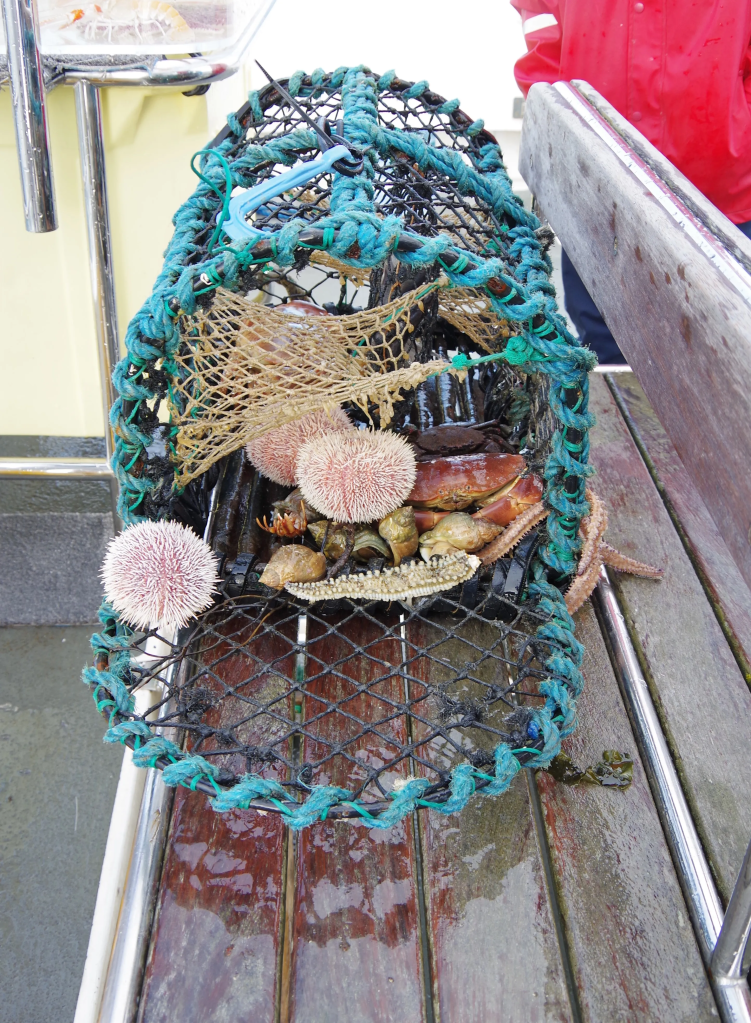
Doll seemed pained as he turned to the creels. The morning’s work was done, but he would wait for Cal to be gone before he ever came ashore.[7]
Sturgeon says, perhaps of moments like this:
Over the course of the novel, Doll, a fisherman, descends deeper into alcoholism and mental illness. That the two boys often had sex together when they were younger is not in doubt. What is much more ambiguous is the extent to which this was consensual on Doll’s part. The spectre of coercion and abuse hangs over their friendship. It makes for uncomfortable reading at times and it certainly complicated my views of Cal, but the account of this relationship, and the space Stuart gives us to draw our own conclusions about it, is one of the novel’s great strengths. Literature, after all, is a place to explore rather than shy away from the dark undersides of human nature. [4]
Among the passages Sturgeon refers to is probably that wherein Doll discovers his parents’ ‘Christian version of the Joy of Sex’ which Cal uses ‘to talk Doll into fucking him for the first time’ in which both ‘assumed roles, like working men setting up to complete a job’, to which Doll ‘always gave in with a tired huff and a flick of his blue eyes’. The suppression of speech and gentle bodily contact and the one-sided orgasmic release of such sex is not what Cal wanted but all he could persuade Doll to ‘grant’, pretending ‘he was doing Cal some favour’. Whether this is about ‘human nature’ or that mix of nature and nurture that forms masculinity as a means of partial human identification bolstered by the strategies of ‘rape’ (or forced consensual agreement) is another question. When Innes gets John to have sex with him, after he has allowed John to tacitly search the house for feared witnesses to the act, is by getting John upstairs to perform a ‘two-man job’.
I think Sturgeon rather over-emphasises the’dark undersides of human nature’, and underplays the ways in which masculinity can become a means of dehumanizing temporarily bodily contact in very many contexts, in the fear of being ‘touched’, in the sense of the ‘kisses, or with caresses, or with tender words’ Cal misses from Doll’s use of him as ‘a collection of replacement parts’ for the women Cal feels he would rather favour sexually, other being equal. [5] Yet after sex with the racy Shiv Malone much later in the novel, he uses his body to tenderly reheat Cal’s body, for ‘the contented warmth of him was deep and even’ with his his thighs ‘pressed into Cal’s lean buttocks’. He does this because Cal had been left outside while Shiv and Doll had sex and drunkenly slept on afterwards without remembering Cal outside in the cold Hebridean winds. Moreover he tells Shiv that Cal ‘is good at keeping secrets’, one of the many ways both young men refer back to their earlier sexual relationship without fear but in coded words so only they and the reader understand their drift. [6] There is here something complex that is not simply abuse of Doll by Cal, though it might once have been that as younger experimental teenage male sexual development, or vice-versa, something the novel knows to exist under the myth of the masculine.
Why Dawoor gets the novel wrong is, I believe, related to the fact that he sees the island as merely a metonymy of isolation in the way John Donne does (and the title to their review in The Guardian suggests that too, as I have said already). The novel is set on a barren part of the Isle of Harris, given the fictional name of Falabay, with its one single coastal ‘ribbon road’ linking and separating several homesteads, both with whitehouses and blackhouses (the latter being the remnants of the older familial house), as in Peter May’s Hebrides novels. I will come to the reason I want to nuance the island metonymy later – as a symbol of infinite regression to deeper layers of isolation, some plainly existential and full of angst.
The novel is strangely obsessed with the sterility of backward-looking island life. It does not apply to some, like the former Glaswegian Ella and her daughter, Grace, who is Cal’s mother, who has many children once she leaves John and John of John that they seem born to a man she does not particularly love from a habit of fertility. Very early in the novel, John awakes in the dark to the demands of his day, watching the lighting up of a window or two in the few whitehouses he can see from his home’s perspective. The light of single-person homes is followed by the event of ‘Donnie Macdonald’s croft’ being ‘sparked to life’: ‘It was the last croft to contain any children at all and for that it glowed brightest against the black’.[8] Is this not only a light in the dark but the whitehouse, the symbol of Hebridean present life glowing against the ghost of the blackhouse – the house once inhabited.
Yet it is the fate of that family’s children that will mark the darker tone of the book with one child dying of a blend of hopelessness, whiskey, and desire for speed in a place where nothing should move fast, and the other leaving in what the islanders think is disgrace. That neither we, nor she, think it a disgrace is only because we too see salvation only in the mainland however unsettled one’s place might be and however compromised by migrancy salvation is. Forgive the spoiler, but it is Doll who dies – in circumstances which might amount to a suicide. But, as I have said, there is too much nuance to come to this conclusion, especially in tying it to supposed abuse by Cal, as Sturgeon perhaps does, whilst we should acknowledge that some sort of abuse may be in that relationship, as part of growing into different versions of masculinity on both sides.
From the beginning Doll is a kind of analogue to the sea that surrounds and defines islands and the quietness (and lack of speech about anything significant) on them to which one becomes accustomed in Cal’s admission that the joint effect (of the sea, the quiet and Doll) is what on the mainland he has missed and misses as he returns and which he had at the same time dreaded and now actively dreads. Returning on the ferry, where he meets Innes, long before he falls for Innes only afterwards to learn that that particular older man and potential lover is his father’s secreted (mostly against Innes’ will) lover already, he lists Doll amongst those thing things missed and then again, in the exact same list, but this time of things dreaded.[9] On the boat a woman reminds Cal that Doll will be pleased he is back, but more so, his sister Isla (named with a name once used for men, like all Scottish islands, after Islay) for the islanders have long linked the two in expectation of heterosexual marriage, without a thought of a potential union between the two boys. [10] Meanwhile, once home we see Doll’s absences at church on the Sabbath recorded by Cal’s father, the Church’s deacon, on a chitty of absences, the first sign of his growing reputation that he ‘is ‘rotting away with the drink’. it is a warning sign confirmed by Doll’s mother’s report from the parish gossips of him being ‘drunk at three in the afternoon‘, his public reprimand by Reverend Rose in church for his ‘infernal drinking‘ (John’s words), and later, incontrovertibly, by autopsy with the recorded state of his ‘liver‘, which is said to be like that of much older drinking man. [11] The purple of diseased liver is to be a metaphor throughout of decay, though in Ella’s case it is a colour painted on her feet with make-up in a ploy to get Cal to return to John.
Seeing Isla again for the first time, who has remained as ‘flat-chested as she always had been’ like a boy, and, apart from skirt too short for the Calvinist parish she is a part of, wears ‘her father’s moth-eaten Fairisle’ (how often islands characterise the men and women) and Doll’s ‘old work boots’ together with the filth she accrues from having a bath in the same water after he has bathed. All this reminds Cal of Doll’s manly size – too big for most bath’s he suggests – yet there is’ in the novel, a push- pull towards Isla – not that she herself encourages it, except as a means of linking Cal back to her mother and brother – that re-evokes the attraction Cal had always felt for Doll.
Doll’s mother sees the lad shivering in ‘bagged-out underwear’ which was translucent with damp’, when she forces him to wash himself out-of-doors. It’s a moment of sheer sexualised appreciation of a ‘real man’: ‘Yet as she hurried to cover him with towels she felt a surge of maternal pride, for her son was an impressive specimen, a real man, stronger and from what she glimpsed now, better endowed than his father’. [12] There is something of a great white hope figure in Doll – a man sufficient to revive the flagging islands – but coveted only by Cal, despite all Doll’s efforts to look and smell something more than a ‘fisherman’ to ‘the young women’ in his church. Doll’s story is tragic but has more to do with the desire of almost everyone to get away from the way the sea moulds its men, in images of the insular and untouchable, forever cut away from the saving grace of the ‘eternal feminine’, as Goethe called it in Faust.
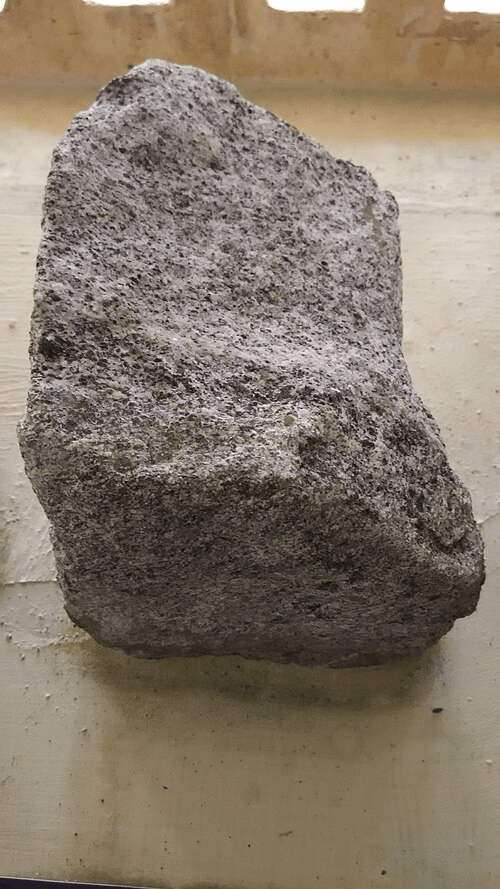
This theme arises early in the novel when Cal with his father reflects on the fact that the stone of Harris contains anorthosite, found only there, abundant especially in one particular quarry, and on the moon and the subject of sexual-romantic mythology, that explains the basis of his alienated loneliness, that associated him with the femininity of the Moon as a symbol:
John had once told Cal that the Moon and Earth were joined as lovers, and that when they parted, this quarry is where the Moon kissed the Earth goodbye. There was a sprinkling of garnets on the hilltops and these were the tears of the Moon, fallen back to Earth. As a boy, Cal had pored over images of the Moon and wondered about the loneliness of that. [13]
For his twelfth birthday, his father had saved up and bought him a high-resolution atlas of the moon. All the lunar seas and mountains, all the promontories and rimae were laid out and labelled by NASA. Cal had pored over it obsessively, until one night he finally found the island, Insula Ventorum. Despite his father’s protests he knew a little Latin, and after he confirmed it in the appendix, he raced downstairs and declared they had fallen from the moon. Harris was in fact lunar, and perhaps that is why he felt so lonely. This here was the proof, Insula Ventorum, The Island of Winds.
This is rich in every way. In classical mythology, The Island of Winds is the home of Aeolus, and that God is met there by Homer’s Odysseus, another male bearing the ‘burden of return’ on him. The island is a place of balance like the balance of ‘missing’ and ‘dreading’ the sea, quiet and Doll in Cal as he travels on the Skye ferry to Harris. Balance is the nature of Insula Ventorum (NASA uses Latin for its moon geography in this case) as a mythology website tells us, explaining its relation to the role of seafaring in Greek life:
The Isle of Winds is described in myth and literature as a mystical place where all the winds are kept in check. This island represents not just a physical location but also a state of mind regarding the unpredictability of the sea. In ancient texts, it is often depicted as a sanctuary for sailors seeking refuge from storms. / Symbolically, the Isle of Winds illustrates the dual nature of navigation—both a place of safety and a potential source of peril.
In John and Cal’s Gaelic-mediated mythologizing, the Moon is the feminine that has left behind its denuded male but is also a principle of uncertainty, change and unpredictability. Contrary to that is the masculine mythology that silences, suppresses and causes deep rage in the desires of the men of Falabay (at one point expressed as ‘the loch-deep rage of the islands (the lochs of course being sea lochs (treacherously deep inlets and bays), makes them incapable of tender or sexually romantic speech or of recognising the flexibility required by change and happenstance. [13] Yet it is Doll alone who suffers the severest brand of this burdensome hardness. Call thinks that rather than being that hard male principle left behind by the Moon’s departure, he has ‘fallen’ from the moon, and that his loneliness is that of the androgyne, rather than that of the man left behind by female desire.
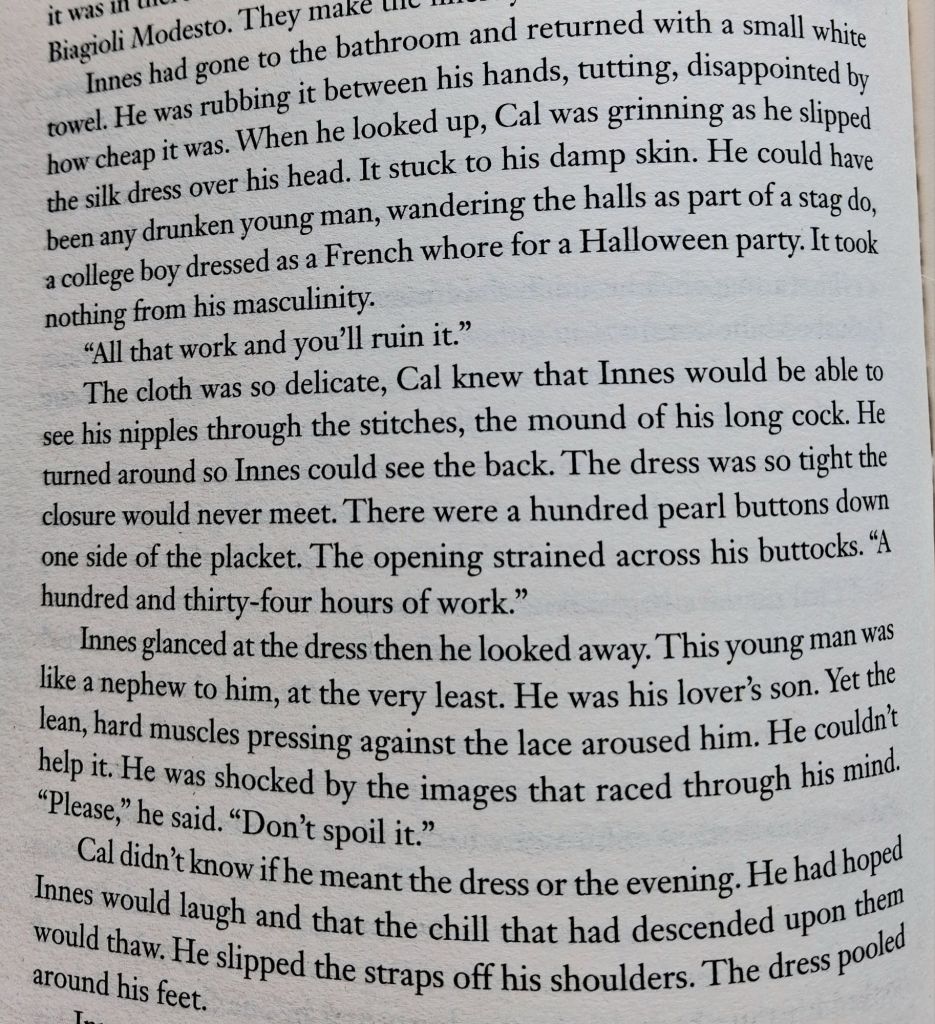
Androgyny accounts for the capacity of tenderness in men. John and Innes are peculiarly mixed-up lovers, trapped in secrecy, but they are capable of tears when reading Wuthering Heights together, lying in an embrace on the moors where they are found by John’s wife, who leaves John, we discover, in the hope that John and Innes will form a union in her absence. [14] But they don’t and can’t. Nevertheless they are more fortunate that Doll. And Cal too can play with the appearance of femininity (such as coloured hair dyes) despite the fact that he knows that his father will call him an ‘abomination’, quoting verse of Deuteronomy (chapter 22 verse 5 in fact) in support which rules out cross-dressing: ‘The woman shall not wear that which pertaineth unto a man, neither shall a man put on a woman’s garment: for all that do so are abomination unto the LORD thy God’. [15] Yet when Cal sets out to seduce Innes, he does so by covering his naked pallor in a feminine silk garment designed by himself at textile college that nevertheless does not detract from his masculinity of this drunken college boy dressed in drag look, nor evoke any comment from Innes except on the quality of the textile work and silk material that might be ruined, although in the minds of both males there is the silenced nuance of desire. [16]
This is very fine queer erotic writing – sexuality playing in the gaps created around strained and over-decorated plackets and openings or closures – the ambiguous naming of these playing into playful sexual dynamics. Yet we never have articulated the ‘images’ in Innes’ mind, nor any clarification of what the ‘it’ is that he doesn’t want spoiled. It is this longing to speak what must not be spoken that Dawoor probably sees as the material of the ‘romantic diehard’, and indeed, it sometimes has that feel if you take some metaphors out of the context, such as the sound of the male flock in Church ‘bellowing across the limitless distance, begging to be heard’. But this would be romantic only if it were about the forlorn and lost men of the island singing to their lost or yet-to-be found lovers. Except it is about ‘dark-suited’ dour Calvinists assured of grace singing loudly. It reads therefore as bathos not pathos. And yet, it contributes to the island imagery – of voices calling out to be heard but who aren’t and become accustomed thence to silence, which applies to John, Innes and Doll. For Cal the loud voices represent what island culture does to male desire, ‘swelling the space’ with adoration for a non-existent God. It is a reminder that he must stand his ground in the island, lest like all other islanders he is nibbled away by relentless tides of a surrounding and forbidding sea that tries to diminish his coastal margins: ‘If he didn’t stand his ground then John would scrape at him like the tide until Cal became a shoreline he no longer recognised’. [17] That simile is a rather hidden one in which the island is implied only by its tidal shorelines. Nevertheless it is not only father, john, who might change him, but his own attempts to bellow across seas to distant islands. Sometimes this is done so humorously (and not in the manner of romantic diehards, where Cal finds ways to represent his dick so that it is to be desirable to a distant queer man, Billy, and fails miserably (the funniest moments in the book being about his knitted cock-sock (in lieu of Genet’s reference in Our Lady of the Flowers, as read by Cal, to use of traced versions of engorged penises by prisoners). [18]
The reference to Genet is not the only one to prisoners (or sailors – the other metonymy) – as a metonymy for queer men – for spaces are described as ‘prisons’ without the word being used, though ‘trapped’ is. [19] Cal may feel the the ‘cavernous space diminished him none’, in reference to John but that ‘space’ is again that imagined by the holy of the Church. The truth of the island church are the chains kept to tie up the recreation ground swings and roundabouts and which John, and John of John Cal does when he does the Deacon’s job for him, and worn by these men around themselves like Jacob Marley, as Cal ‘rattled like some gaoler through the gloaming’.[20] What imprisons is the inability to speak, as a counselor called Gregor tells John, not of the meaning of John 21: 17 but of the ‘real; thing you would never tell your friends’. To Gregor alone he says in so many words that he has loved his neighbour up the road, Innes, since he was 14 years of age, for his ‘kindness’; “It was such a rare quality in a boy”. [21]
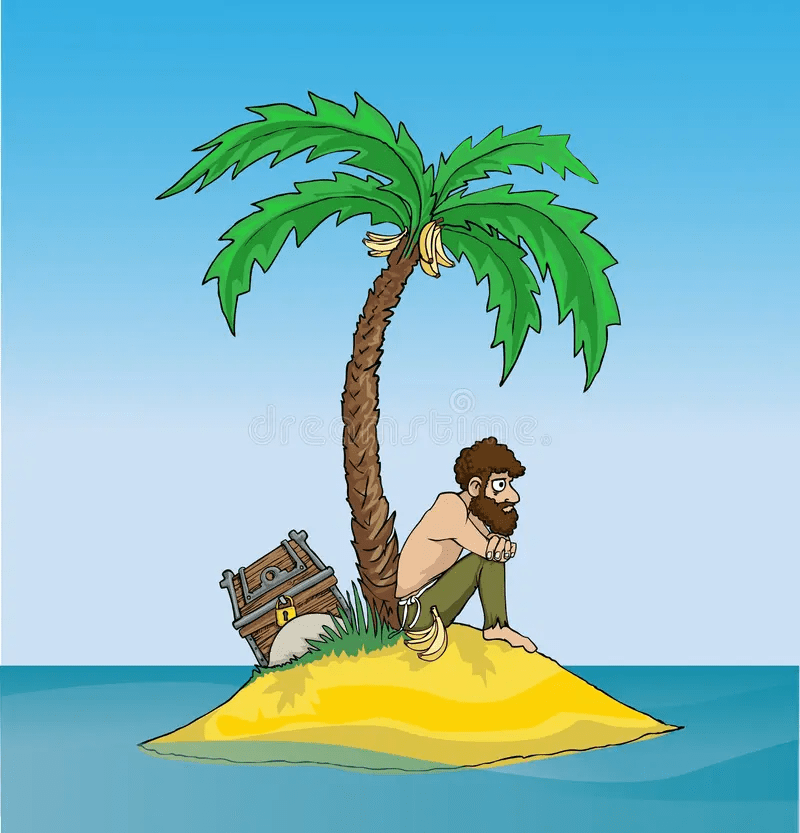
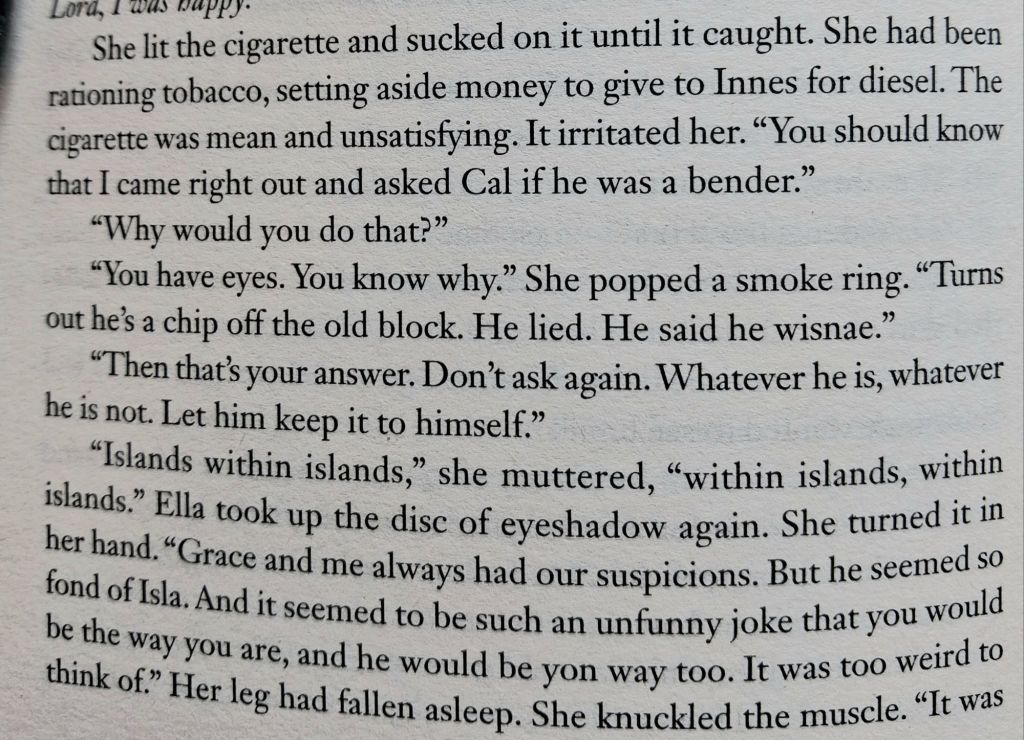
What has all this to do with title quotation about ‘islands within islands within islands’, said by Ella, the eponymous protagonist’s maternal grandmother: ‘“Islands within islands”, she muttered, “within islands, within islands”’.[2] As I said, in the title, although this is perhaps an extract description of the Hebrides, for the novels setting is Harris amongst other ‘islands within islands’, in its context it speaks out the complexities of alienation, anomie, and loneliness. It is worth looking at in fuller context – hence my photograph below, for it comes from a discussion with John about whether he or his son had ever spoken to each other about their certainty of being able to love sexually and romantically only men: {2]
In the novel, we see Ella ask Call that question and feel, I think, a little shocked at his denial. [22] The idea of ‘islands within islands within islands… and so on ad infinitum) refers precisely to that kind of embedded non-communion within the island about anything other than the Christian Gospel and adopted Old Testament values, notably the body – which is (very strangely the meaning John tells Gregor he actually gets from John 22: 17). The idea of two men intimately related each with commonality of relationship and yet unable to tell each other something fundamental to how they would desire to love their earthly lives in their bodies, suggests not only islands with a group of islands but islands that co-exist inside each other: in a theory of infinite regression into isolation but also into refuge from responsibility (maintaining islanded life in too many domains of one’s life). WE stay in islands for security even though that also traps us. The unpredictable though must be faced. John and Ennis become voluntary outcasts, or at least Ennis does. The puzzle of the novel is that Cal, whilst saying he wants his father to bring Ennis home to live together, knows that this would be done in a self-defeating way, with each man wearing images of denial of their union. It is only by becoming outcasts that they might learn to love each other and themselves (or at least that is the case for John) by not returning. Hence he communicates to Ennis to ensure that both will, if they stay together, will do so as migrants exiled from Harris, and perhaps Scotland as a whole. What of Cal? His resolution of John’s dilemma creates a new one for him living in Falabay with his grandmother as, we have to infer, an openly gay man with enough resilience to the unpredictability of changing world and seas to find a love of his own, or not!
Bye for now
Love Steven xxxxxxxxxxxx
[1] Yagnishsing Dawoor (2026: 51) ‘No man is an island’ in The Guardian (Saturday supplement). The review title is actually a reflection on mortality and communality from Donne’s devotional literature, the passage reads in full: “No man is an island, entire of itself; every man is a piece of the continent, a part of the main; if a clod be washed away by the sea, Europe is the less… any man’s death diminishes me, because I am involved in mankind; and therefore never send to know for whom the bell tolls; it tolls for thee.”
[2] Douglas Stuart (2026: 372) John of John, London, Picador,
[3] Douglas Stuart op.cit: 278f.The reference to ‘the burden of returning’ is ibid: 5. John thinks of Cal returning as that of the ‘prodigal’ son in bid: 17.
7 thoughts on “Self-confidence is an illusion, as the best novels tell you. Try for resilience and the drive to move on. First of all think more deeply about what selves are. ‘The Guardian’ entitles its review of Douglas Stuart (2026) ‘John of John’ with the sentence ‘No man is an island’, but the reference to John Donne belittles a work in which islands are not only a metonymy for alienated isolation and loneliness but also a container for non-communicating multiple selves of the same kind.”





7 thoughts on “Self-confidence is an illusion, as the best novels tell you. Try for resilience and the drive to move on. First of all think more deeply about what selves are. ‘The Guardian’ entitles its review of Douglas Stuart (2026) ‘John of John’ with the sentence ‘No man is an island’, but the reference to John Donne belittles a work in which islands are not only a metonymy for alienated isolation and loneliness but also a container for non-communicating multiple selves of the same kind.”