


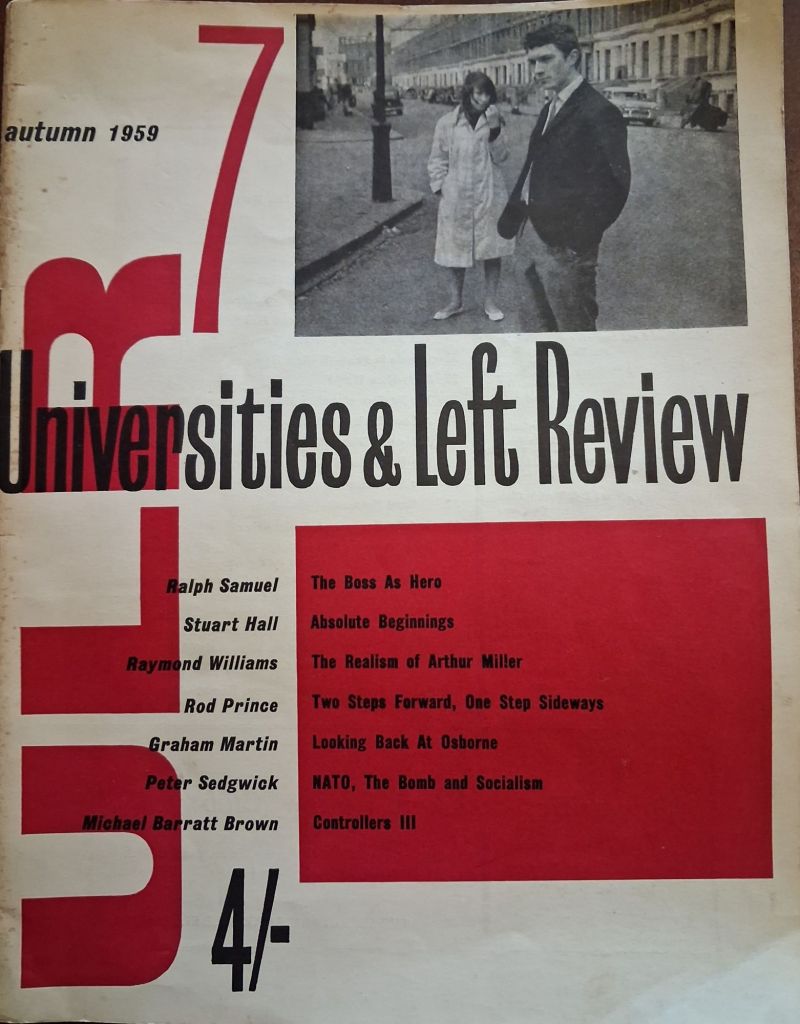
I was just nearing 5 years of age when this magazine came out, still sold in pounds sterling at 4/- [4 shillings (20p now but what a large amount then)].This was the last edition of ‘Universities and Left Review’ (ULR) which became, together with ‘The New Reasoner’, the ‘New Left Review’ (NLR) in its next edition.
Last weekend I visited The People’s Bookshop in Durham, and, with an enchanted frame of mind, bought a back copy of a magazine published on the near event of my 5th birthday. By the time I was 20, I still had no idea about it as part of the history of the British intellectual left that might have brought together the issues which engaged this twenty-year old at the level of confusion during the ‘best of times, the worst of times’. As we reach a time worse in every unimaginable way, with fascist forces infecting the working class of Britain, manipulated by smooth capitalist grandees, it seems urgent I tell that 20 year old that he deserves to be reunited to a history that would have sorted his confusion.
I turned 20 years of age in October 1974 (the 24th). I was presumably just beginning my second year of study of English Literature and Language at University College London. Yet the world seemed in turmoil. On the 5th October the Guildford pub bombings occurred and in October into November there were more bombings in London claimed by the Irish Republican Army (IRA) as their actions. There were exhaustive bag searches throughout London for entering buildings and Tube Train travel was considered precarious. On the 10th October, was an election called by Harold Wilson, which he won by a 3-seat majority only. I campaigned for Lena Jeger in the newly reconstituted Camden, Holborn and St Pancras South seat (sitting at her feet in election meetings) which she won again for Labour, although I had, even then grave reserves about the failure of the Labour Party to follow a radical agenda in government or to propose a future that seemed one aimed at addressing the true weaknesses of capitalism as an organisation of a political economy But I certainly was not very engaged in politics, although by then I was developing a radical queer perspective, active in UCL GaySoc and campaigning, festooned with gay badges. There were questions raised in staff meetings (or so A.S. Byatt told me) about whether I should attend lectures so festooned. It was the best of times and the worst of times – and Revolution seemed in the air, though I do not think my idea of revolution was quite as radical as it became.
After I left London and was heavily influenced by Eurocommunism- mainly through new boyfriends: first a London Jewish Communist at Cambridge who soon rejected me, and then, when I transferred to Leicester, an unattainable and lanterned-jawed young man from Nottingham studying Sociology in the third year at Leicester University and who got me to join the Communist Party in Leicester, on its Eurocommunist wing with a mindset that saw as a number one enemy the ‘tankies’, those who had supported the invasion of Czechoslavakia and still feted the Brezhnev -led Party in the USSR. Some of that changed when I met my husband, Geoff (still my husband – though of course we didn’t marry until 2006, after civil partnerships became legal in 2005) at Leicester who was a gay anarchist. Afterwards I settled into the Labour Party (by then back in London teaching at Roehampton Institute) and followed after me. Below there’s me as Secretary of the Bretford and Isleworth Party with electoral candidate, later MP, Ann Keen, Glenys Kinnock and my office assistant, Vanessa Smith.
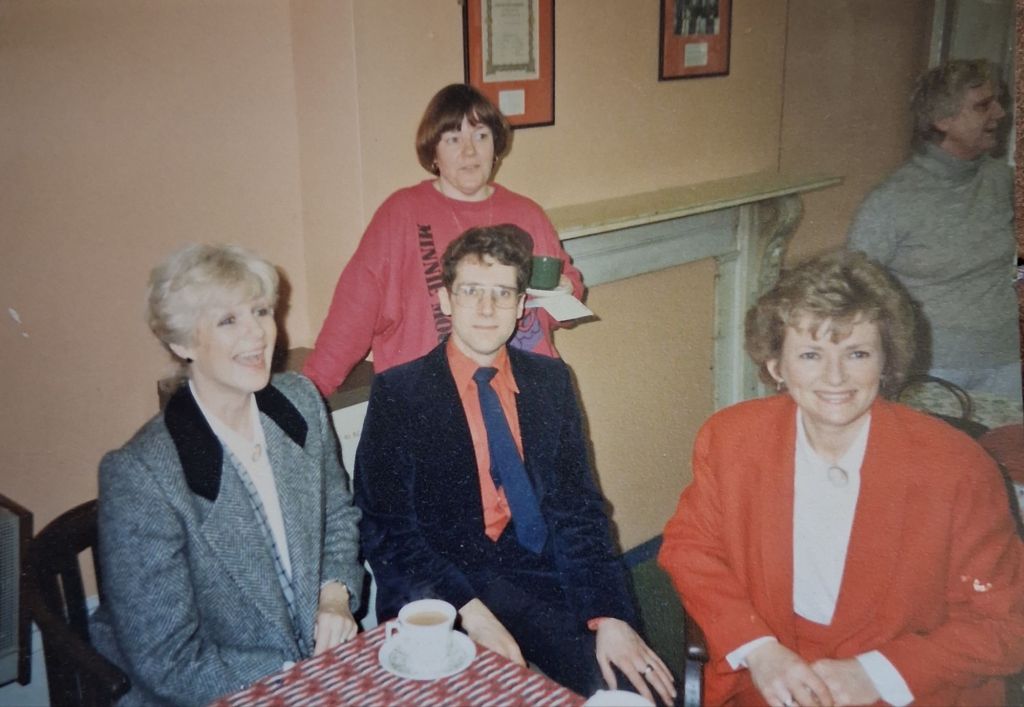
From left to right (not politically): Ann Keen, Vanessa Smith, Steven Bamlett (the younger) and Glenys Kinnock.
All that is gone now, and though I was involved in anti-fascist politics throughout all this, I despair now at the rise of a rancid right-wing hate that has become legitimized, and poses an immediate and present danger to civil liberties and human rights greater than we have ever seen, with vile riots and violence against the homes of asylum seekers in Northern Ireland.
The truth was that at 20 I was much more confused than I might have seemed. The reason for that was a feeling that the grounding of my increasingly left politics seemed to have no roots. Certainly not my parents, who largely voted Liberal (as many did in that part of Yorkshire). At school I joined the Liberal Party before I joined the Labour party, but even then my politics were a confused medley of liberalism and egalitarianism – reflecting the working-class roots of my wider family but not, as seemed the case, their political apathy. University began to change me but not clear up the confusion. In a sense I think that was because I didn’t then know that there were historical traditions that predated my political awakening – of which I was somewhat rumbustiously proud – that had someone told me then, as they didn’t until much later when I was in the Communist Party and attended schools run by Martin Jacques, then Euro-communist editor of Marxism Today.
The Universities and Left Review (ULR) was born out of a movement in the intellectual left – its heroes being academics and activists which we should mourn today (Ralph Samuel – whom I met when My husband went to Ruskin College in Oxford on a union-sponsored placement and who involved us both in the History Workshop Journal on a project on worker university level education in Swansea, Stuart Hall ( friends of mine at UCL in the year above me joined him at the later Birmingham Centre for Contemporary Culture) and collecting together so many important left voices (Asa Briggs, Raymond Williams – writing on Arthur Miller in this edition). They are all men you might notice which certainly declares a gap even there and then. But one thing grabbed me – a review by Stuart Hall of C.P. show’s Reith Lectures on the ‘Two Cultures’. Strangely I was aware of that controversial statement about the arts and sciences at school (whilst studying at A level) but from the right-wing perspective of criticism of Snow by F.R. Leavis, a malign cultural influence (antagonistic to the industrial working class (as if capitalist production values were their fault) that it took my whole first year at UCL of which to rid myself. If only I had read Stuart Hall’s words – as in the excerpt below:
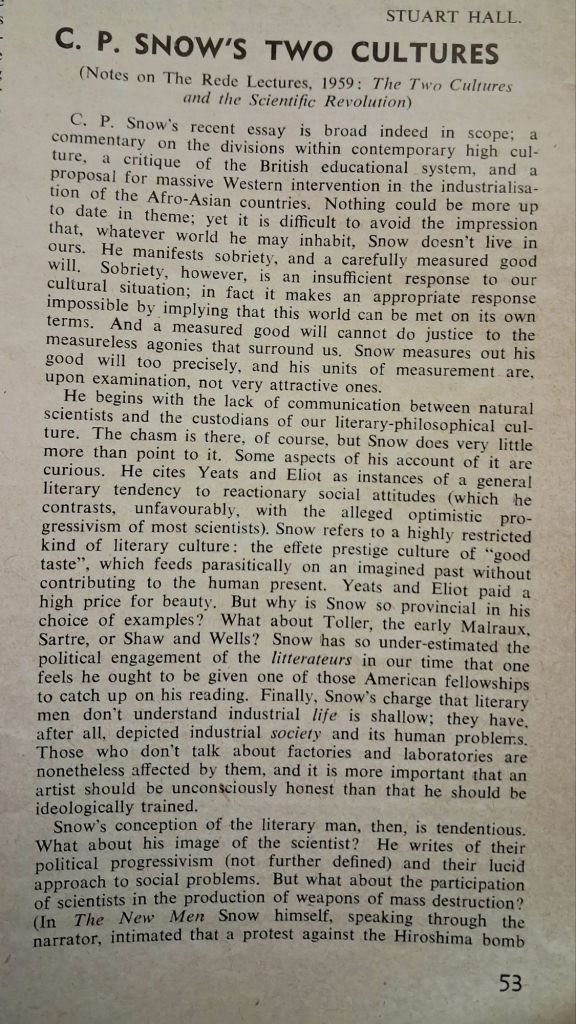
The tidy phrase: ‘whatever world he may inhabit, he certainly doesn’t live in ours‘, is one which fits the militant aggression to Snow from Leavis – based sometimes on his hatred of how the transistors of young workers infected his ears on the once- peaceful quiet of the ‘Backs’ and Meadows at Cambridge – from F.R. Leavis than it does the cosy metropolitan culture of Snow, The ULR, unashamedly the voice of the working class that was now entering in dribs and drabs into the university sector, was determined to show that ‘our world’ was the world of the young demanding a voice, and inventing newer cultural expressions – not socialist but expressive of the desire for change and the right to be a voice in it. Hall examines this is a multiple revi00ew of several book which he entitles Absolute Beginnings: Reflections on The Secondary Modern Generation. One of the books – the only one to get a near welcoming endorsement is Absolute Beginners by Colin MacInnes, but others were E.R. Braithwaite’s To Sir, With Love, an early engagement – though Hall cannot see it as engaging with much – with ‘race’ in schools, Journey Into a Fog by Margareta Berger-Hammerschlag (a tame attempt to show Art classes improved things for the working class boys in secondary moderns), and The Teenage Consumer, by Mark Abrams that lauded the effect of the teenage pound, as the ‘pink pound’ was to celebrated later by thinkers who felt progress was achieved by entry of the previously excluded into consumer capitalism. The photograpgs were commissioned originals
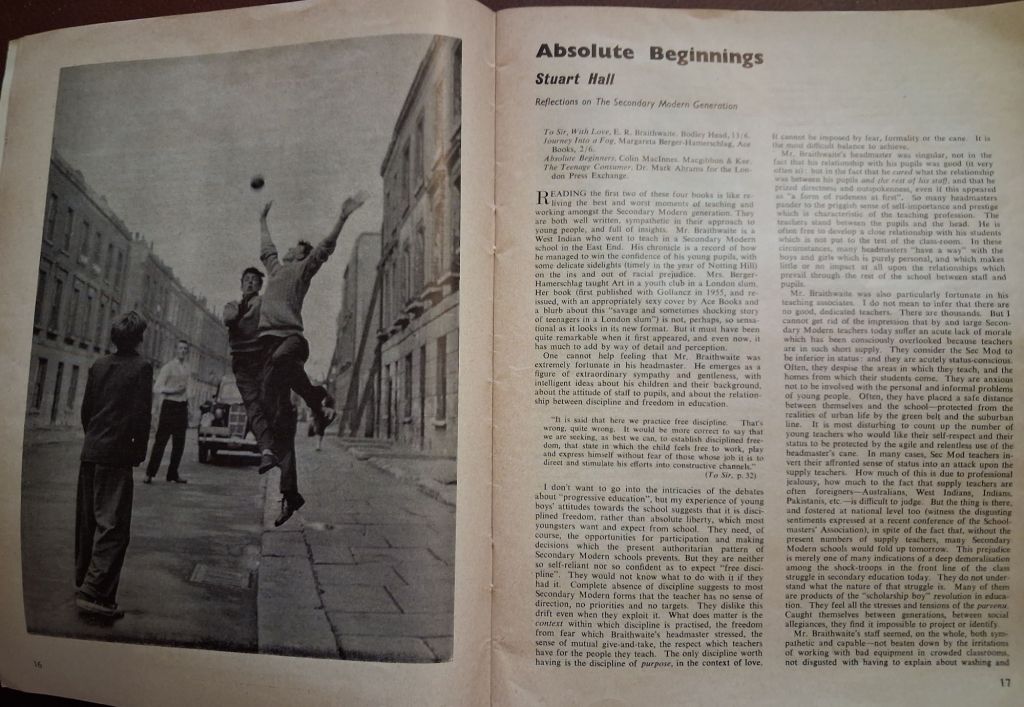
I was one of the very few working class boys of my generation to go to selective grammar school at 11, and I saw the issues that Hall talks about from the other side (the secondary modern was sited next to the council estate I lived in whilst i travelled by bus the ten miles and a steep hill walk to school) In a past blog (read it at this link) I recalled how I was bullied by the secondary modern students at 11-12, being ‘kegged’ to and from school. Had I read this I would have more certainly have understood why. Hall comments that: ‘The Secondary Modern generation are not only treated as if they are second-rate: they know they are being treaed in this way‘ (p.19).
It was a time when, only partly corrected by Barbara Castle’s introduction of a Comprehensive system but one that was rigorously as streamed as were both secondary moderns and grammar schools) a kind of problem of self-esteem based violence and rebellion was fostered by the institution and value systems that led to vicious cycles of disappointment with heavy consequences. Meanwhile leaving school at 13-14 led to a generation of boys inventing a new culture.
What would I tell that 20 year old? Your confusion is to be accepted, even though you were a net winner from selective education, your politics tear you apart because the belong to conflicting value systems. There are value systems worth adopting, they were there when you were going through the Oedipus complex (Lol). But we need to get a grip on how the present emerges from a violent past. How else will we live in a world where only the ‘worst of times’ signs come to the fore, and we are near a possible (nay, likely!) transformation to an authoritarian society where far right parties foster the violence in deprived communities, they will later use to justify massive repression and a new kind of social hierarchy with the lower orders silenced by policing and armies, already happening in the USA.
With loving sadness
Steven xxxxxxxxxxxxx

