


‘Build it and they will come’: But, since change is the only constant in our lives, never demand ‘loyalty’ from anyone in any context, just honesty and openness.
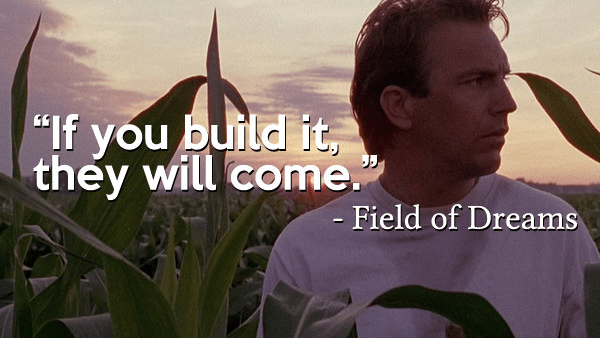
The website Idiom Origins has a brilliant page on the sentence I use in my title, ‘build it and they will come‘: discussing both its original source, which I thought I knew, and the fact that the phrase, as I remembered it too, is a misquotation from that source, which actually uses the prediction ‘build it and he will come‘:
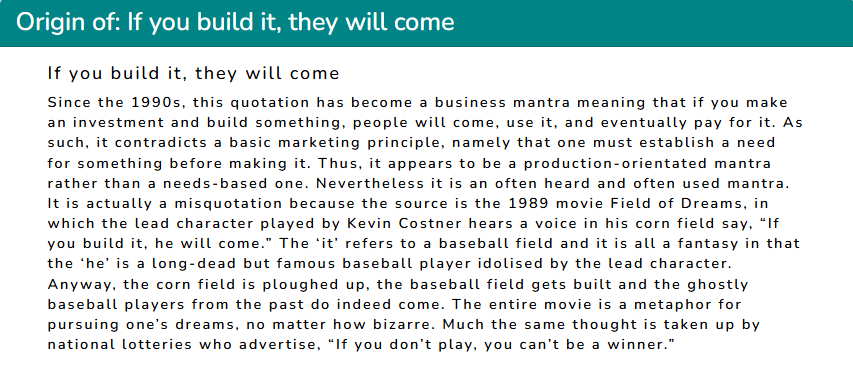
This phrase is misquoted (from its source in The Field of Dreams) in the meme selections on the web, from which I collected my flag-head picture, and, in the light of the explanation above, that fact suggests that the appropriation of the phrase in marketing parlance has had a profound effect on the how memory traces of ;sayings’ are held constant – the truth being that they aren’t because they flow into different forms: they are ‘Eterne in mutabilitie‘ in Spenser’s poetic phrasing of Heraclitus, adapted through Italian Renaissance Neo-Platonic revivalist thought. It came to mind because this prompt-question talks about ‘building’ subscribers to one’s blog that are ‘loyal‘. The implicit aim is that you want to write a blog series that will not only sometimes be read by some one, or some ‘few’ or even ‘many’, that will go on wanting to read your blogs as they appear, and that the proof of attainment is the maintenance of them in a growing number over time.
How are bloggers answering this? Are they going to answer in line with a ‘needs-based mantra’, showing how one writes that which people need, or, at least, want, to read – giving advise on the form and content that captures a readership and maintains it? It maybe that the idea of a built construction shows us that only those who ‘work’ at building each blog for its readability, or use prompts to invite readers first and foremost, are those only who should answer this question. Hence, since I want to reject the assumption that all bloggers blog in order to build a readership quantitativey assessed and maintain that readership as long as possible, I should have evoked the true quotation, ‘ ‘If I build it, he will come’. This focused on production- based construction where fulfilment of normative function is upset for the sake of building something good which you can only but hope will attract users of it. The Kevin Kostner character is not building for the sake of a large audience but for the fulfilment of a Messianic hope, though the ‘He’ he expects to come is an idolised basketball player not the expected Christ.
Now, WordPress seems to gear itself to creating bloggers whose interest is in maximising readetship and the maintence of that readership. My front page is a case in point [the screen shot below is my evidence]:
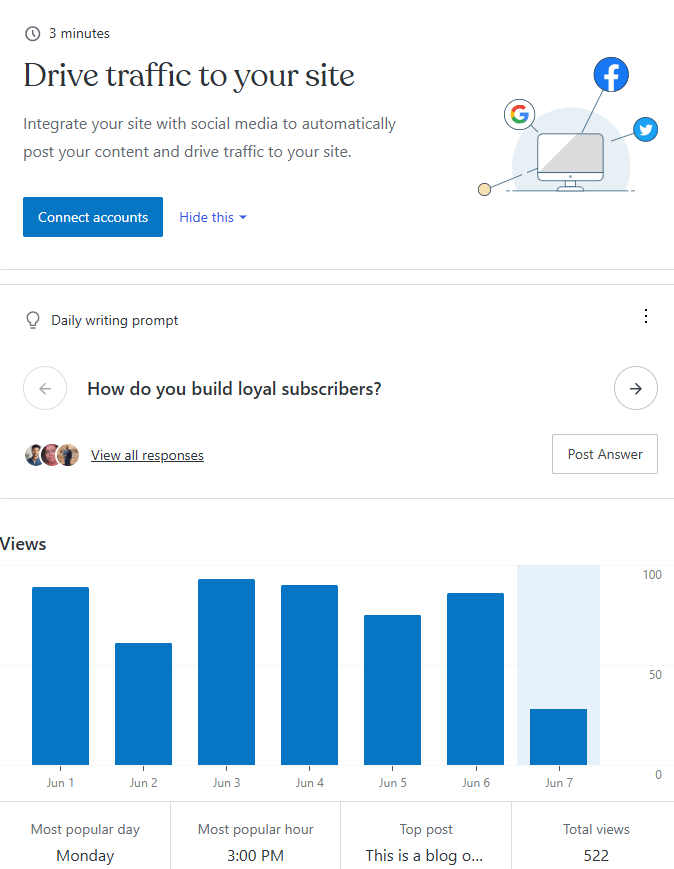
Notice the verbs, they assume my desire is to ‘drive’ readers who choose to look at my site, hence called ‘traffic’ not readers, and possibly pull in to linger longer and perhaps return at another time. Of course, we not only ‘drive’ traffic vehicles in two senses, we also drive, in the sense of ‘motivate’ trade, often also called ‘traffic’, to buy into, if not buy literally, our blogging service. It will be seen from the traffic operative this week on my site that if I were out for a large number of ‘visitors’ to my site, I fail. 100 is a good number for my site and it rarely rises higher, though it has in exceptional circumstances, such as when the author of the novel Martyr, Kaveh Akbar (see blog at this link), advised readers to check out my reading of his stupendous novel, for which I am eternally grateful.
Those readers didn’t not stay with me, nor did I expect them to do so, for the Messianic Hope of my blog building is to devise or build a space in which to learn about the things that attract me – in books, theatre, film, personal contacts and art – and why they attract me and hence about myself. I learn by relating those things to my belief and learning systems and their development, sometimes by expressing over-strong opinions. Learning is developed when people take the trouble to respond to query these readings, as in my recent Les Liaisons Dangereuse blog, (see – including feedback discussion – at this link) but this happens rarely, though some authors -well three of the blogs linked to their names [Derek Owusu, Tommy Orange, & Nicholas Shakespeare] have gratified me by responding positively to my readings, whilst not approving the blogs’ necessary veracity or perspicacity but certainly keenly pleased to be read with passion.
The hope is to learn and develop myself and the ‘He’ that I hope to come neither an ideal reader or venerated author but myself knowing, feeling and valuing life more than is usual for me, which can sometimes be at a low level as in most lifelong depressives, for whom constant learning during change is an absolute necessity. Hence, I suppose whether anyone reads me or not is unimportant, though I do value evidence of any communion of thought, feeling and values, though not of the sameness of these qualities but their diversity of kind and form. Hence, the word ‘loyal’ struck the wrong note. Querying the etymology of the word helped me to understand why. Here is tne Online Etymology Website‘s entry:
loyal (adj.): “true or faithful in allegiance,” 1530s, in reference to subjects of sovereigns or governments, from French loyal, from Old French loial, leal “of good quality; faithful; honorable; law-abiding; legitimate, born in wedlock,” from Latin legalem, from lex “law” (see legal). / Identical with legal, which maintains the Latin form; in most uses it has displaced Middle English leal, which is an older borrowing of the French word. For the twinning, compare royal/regal. Sense development in English is feudal, via notion of “faithful in carrying out legal obligations; conformable to the laws of honor.” In a general sense (of dogs, lovers, etc.), from c. 1600. As a noun meaning “those who are loyal” from 1530s (originally often in plural). [my bolding]
The words that define ‘loyal’ have an archaic feel that is explained here in the phrase I reproduce above in bold characters. The sense of expected dutiful obedience, as a feudal overlord would seems irreduxibly contained in tje word, whether it apples to a personal relationship or of political allegiance or citizenship. The common root of the word loyalty with legality also emphasises that the legitimacy of relationships of unequal power whete tne superior power of one person expects and has a right to constancy from the other whose power is considered inferior, once true of women in marriage, of the subjects of a feudal king, and of vassals to a tribal chief or lord.
Some writers, I have learned, expect vassalage from their readers as if the relationship had to be constituted in that disparity of power, reflecting one of capacity as a writer. I can see how that might come about in writers whose writing is the site of struggle with oneself and with the tradition of prior writing, as some writers made a point of often saying (W.B. Years for instance), and sometimes a reader will lay down allegiances nearly feudal to such writers, as I do with some. Yeats provided for me the explanation of allegiance to great artists in many poems but most in this one;
The fascination of what's difficult
Has dried the sap out of my veins, and rent
Spontaneous joy and natural content
Out of my heart. There's something ails our colt
That must, as if it had not holy blood
Nor on Olympus leaped from cloud to cloud,
Shiver under the lash, strain, sweat and jolt
As though it dragged road metal. My curse on plays
That have to be set up in fifty ways,
On the day's war with every knave and dolt,
Theatre business, management of men.
I swear before the dawn comes round again
I'll find the stable and pull out the bolt.
If writing tears body, mind and spirit apart, from and within each other, it does have a hold of power over anyone who is grateful for a writer that goes that extra mile of self-martyrdom to art. But that is rarely the case for bloggers: least of all myself. Hence I neither try to build loyalty, and fealty, or even large quantities of readers. If someone else reads me I am grateful but I do not expect it, nor can I demand it, of them.
Hence this answering blog.
With love ❤️
Steven xxxxxxx

