


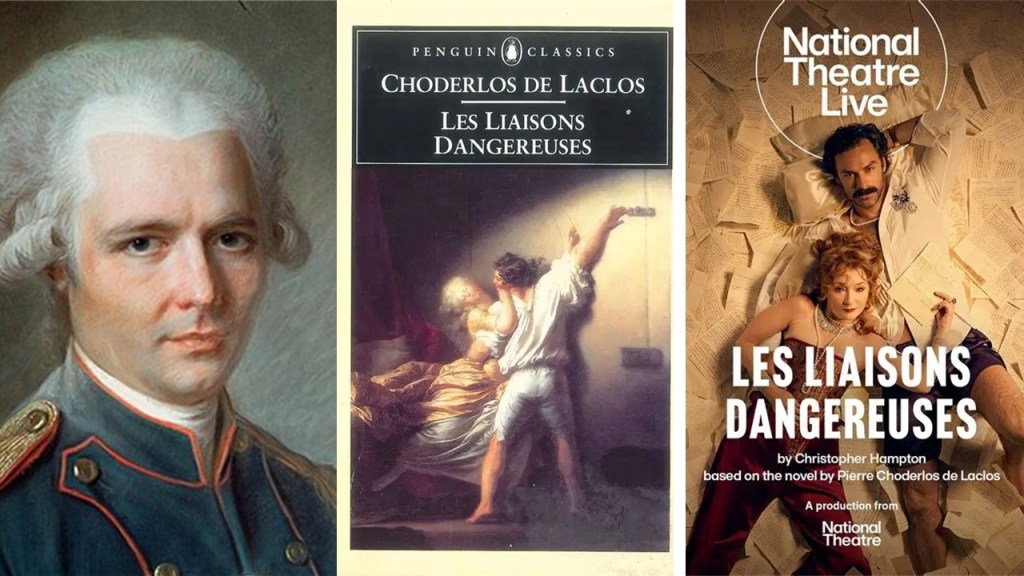
The French novel always went further than the English novel did, until the latter did it in ‘daring’ pastiche of the French in another art-form. This blog is my preparation to see the National Theatre live- streaming of Christopher Hampton’s ‘Les Liaisons Dangereuse‘, adapted from the novel by Pierre Choderlos de Laclos written in 1782.
The eighteenth century saw a flowering of the popular epistolary novel, although the form probably derived from Ancient romances. As a modern European form though it began experimentally, possibly directly related to ancient Romances without a third-person narrator with access to every point of view from each character in the novel, only to become favoured as a philosophical statement about the dangers or excitements following on by consciously denying an omniscient narrator, or anything like a moral arbiter and focus of evaluation of the ethics of individuals against a standard, as is implied (but not said, in Wikipedia’s brief history of the narrative form:
… The founder of the epistolary novel in English is said by many to be James Howell (1594–1666) with “Familiar Letters” (1645–50), who writes of prison, foreign adventure, and the love of women.
It has been argued that the first work to fully utilize the potential of an epistolary novel may have been Love-Letters Between a Nobleman and His Sister. This work was published anonymously in three volumes (1684, 1685, and 1687), and has been attributed to Aphra Behn though its authorship remains disputed in the 21st century. The novel shows the genre’s results of changing perspectives: individual points were presented by the individual characters, and the central voice of the author and moral evaluation disappeared (at least in the first volume; further volumes introduced a narrator). The author furthermore explored a realm of intrigue with complex scenarios such as letters that fall into the wrong hands, faked letters, or letters withheld by protagonists.
The epistolary novel as a genre became popular in the 18th century in the works of such authors as Samuel Richardson, with his immensely successful novels Pamela (1740) and Clarissa (1749). John Cleland‘s early erotic novel Fanny Hill (1748) is written as a series of letters from the titular character to an unnamed recipient. In France, there was Lettres persanes (1721) by Montesquieu, followed by Julie, ou la nouvelle Héloïse (1761) by Jean-Jacques Rousseau, and Choderlos de Laclos‘ Les Liaisons dangereuses (1782), which used the epistolary form to great dramatic effect, because the sequence of events was not always related directly or explicitly. In Germany, there was Johann Wolfgang von Goethe‘s The Sorrows of Young Werther (Die Leiden des jungen Werther) (1774) and Friedrich Hölderlin‘s Hyperion.
Starting in the 18th century, the epistolary form was subject to much ridicule, resulting in a number of savage burlesques. The most notable example of these was Henry Fielding‘s Shamela (1741), written as a parody of Pamela. In it, the female narrator can be found wielding a pen and scribbling her diary entries under the most dramatic and unlikely of circumstances. Oliver Goldsmith used the form to satirical effect in The Citizen of the World, subtitled “Letters from a Chinese Philosopher Residing in London to his Friends in the East” (1760–61). So did the diarist Fanny Burney in a successful comic first novel, Evelina (1788).
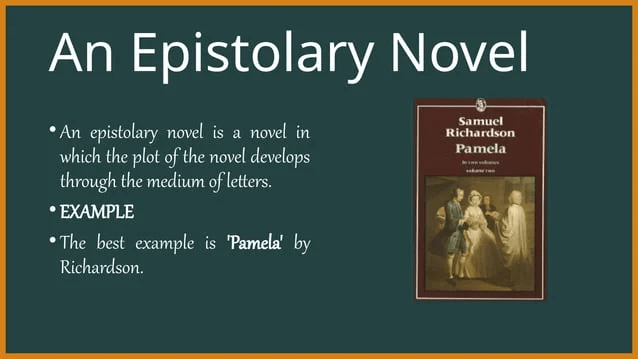
There is some sense of happenstance about the relationship of the novel form to its rejection of all-seeing and all-knowing authority, often found in the third-person narrator, who is not themselves a character in the novel. The fact that Pamela is satirised by Fielding, the master of omniscient narration by an authorial voice (in Joseph Andrews and Tom Jones), precisely by exaggerating the fictive nature of all unregulated subjective accounts (Fielding makes it plain he believe that Pamela’s voice in Richardson’s novel about her (Pamela) is as fulsome a ‘sham’ or fictional account divorced from reality as his eponymous character pastiche of her in Shamela). But whether there is a debate about the nature of social or divine authority implied in the contrast is uncertain (uncertainty being the key in epistolary accounts – a letter writer can only KNOW what they already know, experience or are told by others – each kind of which witness to events can be challenged by others for its claim to representing truth or authenticated reality. This form then must have been and was a gift to philosophically inclined novelists, like Rousseau, Goethe and Hölderlin. Likewise the origins of the novel in relation to the undersides of the culturally authorised in behaviour – secret sexual behaviour, prostitution, crime, and the exotic (in Fanny Hill for instance) may link to the kind of licence allowed when authority is undercut by behaviour meant to be entirely private and hidden in life from public gaze or evaluation.
Yet the English epistolary novel where sex is a factor seems to me tame (even Evelina, for Fanny Burney is raunchy by implication where Jane Austen never is – even in her epistolary experiments) and inclined to make the plotter a devilish role – an interesting model for the novelist whose work is a plotting of events in all cases – but one which is acting under cover, especially Mr B in Pamela and even Lovelace in Clarissa, though no-one reads the novels without unmasking the villainous rich and powerful sexual predators before the chief narrator – or epistolarist – does, whom is their intended rape victim. When the plotter is uncovered in English novels, it is when they are female – in Shamela notably but also Fanny Hill and Roxana. It seems that it takes mainland European punch to put plotting consciously at the centre of the epistolary novel and hence when I first came across Pierre Choderlos de Laclos, teaching it on an undergraduate course on ‘The Novel’ I felt I had in front of me something so richly and thankfully un-English (I cannot say un-British for the post-Act-Of-Union Scottish novel is also alien to the English in this respect) that I rejoiced in it. Coming across it in a framework of cognitive rather emotional absorption, I felt it great and wonderful – It is a feeling I don’t quite have now for it seems so much like the world of game-playing that is so prominent in this point of the twenty-first century, where the greatest nation in the world, the USA, is headed by a literal version of the Vicomte de Valmont, if without the universal sexual allure).
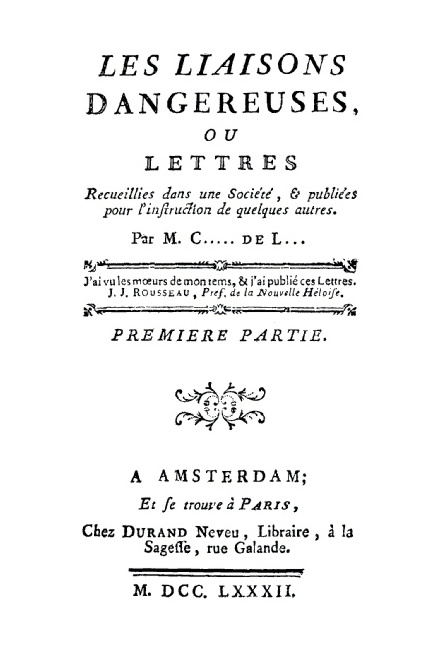
Yet I had rather that the cultural tradition had existed in England (and not just Scotland and Ireland) of cognitive genius shedding light on the unspeakable that gets away with it by ensuring its crimes remain unspeakable, because not seen – but if seen too wrapped in power for those lacking power and vulnerable to the other’s power to unwrap. It is not that the English novel is avoidant of sexual morality – after all Laclos, in his mock introduction to his own novel, uses Samuel Richardson as his model of the novel in which the voice of the immoral is allowed full rein (for moral purposes he asserts), it is rather that it uses so much ‘cover’ and ‘reserve’ – not about the subject of heterosexual sex but of power. In my view the lauding of the subject of ‘reserve’ is the essence of the English novel at its high moments, especially Jane Austen, whose subject is, so poften ‘reserve’ (embodied in Jane Fairfax in Emma, so ambiguously). The issue in Pamela and Clarissa is sex and sexual virtue but but acting as a mask that puts in reserve the more important subject of power differentials – of class, status, the role of service in economies of class and sex/gender inequality. Not so Laclos: his novel (see above) his dedicate to the philosopher of reason and which became read as the precursor to the ‘freedom’ of the French Revolution supported by Laclos, the Jacobin friend of Danton. When Valmont responds to Merteuil’s first letter and her ‘order’ to him that he avenge her on the false Gercourt, who gave up Merteuil in search of an ideal ‘blond’, settling on Cécile de Volanges, now 16 and out of the convent, is all about not sex but power differentials, hierarchies of those differentiations (in the missions of the State, its armies and the Church) and politics associated with but not the same as sex – to be in love with despotism is a very real state in Laclos’ France, himself a convinced Jacobin and anti-royalist.
Vos ordres sont charmants; votre façon de les donner est plus aimable encore; vous feriez chérir le despotisme. Ce n’est pas la première fois, comme vous savez, que je regrette de ne plus être votre esclave; et tout monstre que vous dites que je suis, je ne me rappelle jamais sans plaisir le temps où vous m’honoriez de noms plus doux. Souvent même je désire de les mériter de nouveau et de finir par donner, avec vous, un exemple de constance au monde. Mais de plus grands intérêts nous appellent; conquérir est notre destin; il faut le suivre: peut-être au bout de la carrière nous rencontrerons-nous encore; car, soit dit sans vous fâcher, ma très belle marquise, vous me suivez au moins d’un pas égal, et depuis que, nous séparant pour le bonheur du monde, nous prêchons la foi chacun de notre côté, il me semble que dans cette mission d’amour vous avez fait plus de prosélytes que moi.
Your orders are enchanting, and your manner of giving them still more delightful; you would even make one in love with despotism. It is not the first time, you know, that I regret I am no longer your slave; and yet, monster as you style me, I recall with rapture the time when you honoured me with softer names. I have often even wish’d again to deserve them, and to terminate, by giving along with you an example of constancy to the world. But matters of greater moment call us forth; conquest is our destiny, and we must follow it: we may, perhaps, meet again at the end of our career; for permit me to say, without putting you out of temper, my beautiful Marchioness! you follow me with a pretty equal pace; and since, for the happiness of the world, we have separated to preach the faith, I am inclined to think, that in this mission of love, you have made more proselytes than I. [1]
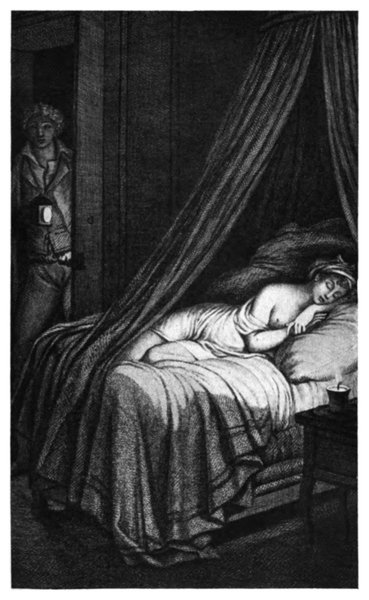
Valmont uses his well-oiled key, provided by Cécile, to enter her bedroom.
And likewise, though ‘reserve’ and ‘secrecy’ is often evoked, it is more obviously to show how it operates as a means of the assertion of power from below against a felt power from above, notably in Cecile – a novice (just out of a convent so the metonymy is more real) , whose power comes from achieving further independence as a result of approaching adult from her mother – secrets abound, even in furniture that can be locked:
Maman m’a consultée sur tout; elle me traite beaucoup moins en pensionnaire que par le passé. J’ai une femme de chambre à moi; j’ai une chambre et un cabinet dont je dispose, et je t’écris à un secrétaire très joli, dont on m’a remis la clef, et où je peux renfermer tout ce que je veux. Maman m’a dit que je la verrais tous les jours à son lever; qu’il suffisait que je fusse coiffée pour dîner, parce que nous serions toujours seules, et qu’alors elle me dirait chaque jour l’heure où je devrais l’aller joindre l’après-midi. Le reste du temps est à ma disposition, et j’ai ma harpe, mon dessin et des livres comme au couvent, si ce n’est que la mère Perpétue n’est pas là pour me gronder, ….
Mamma advises with me in every thing; she behaves to me no longer as a boarder in a convent. I have a chamber-maid to myself; a chamber and a closet of my own, and a very pretty scrutoire, of which I keep the key, and where I can lock up every thing. My Mamma has told me, I must be with her every morning at her levee; that it would be sufficient to have my head dressed by dinner, because we should always be alone, and that then she would each day tell me what time I should come to her apartment in the evening. The remainder of my time is at my own disposal; I have my harpsichord, my drawings, and books, just as in the convent, only that the mother abbess is not here to scold.
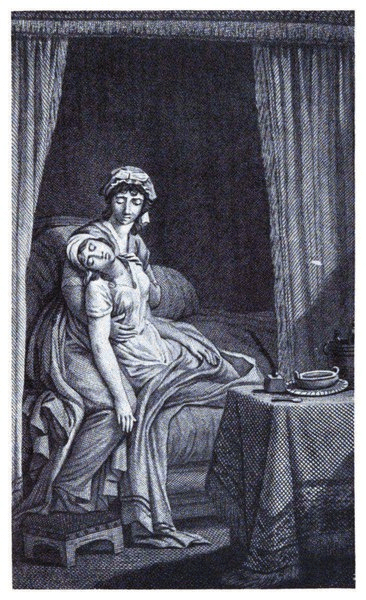
The death of Mme de Tourvel in a convent
The forms in which Cecile has gained access to power are restricted ones which maintain the power of the Mother overall, although they allow some minor consultation, although hardly over everything as Cecile says. She has a personal servant and can reserve control over parts of her own life S by the use of the means that keep correspond and liaisons secret, even if these take form only in letters. It is a shame that the English translation uses scrutoire, a writing desk from a word also in French rather than, as they would in the eighteenth and early nineteenth century ‘secretary’, from the French ‘un secrétaire’ (in both languages it could refer to a writing desk and a person charged with one’s private affairs). The function of writing furniture was not only to write correspondence but to store it, often in secreted apartments of the desk, under lock and key. Secrets too reserved power that might facilitate behaviour not otherwise allowed. Everything to do with sexual liaisons in this novel is also related to transactions mediated amongst power differentials – of class, sex/gender, age, social authority and money. This book goes further because one of its big secrets is that Cécile and Valmont respectively use each other’s naked bodies as writing desks to write letters to a third person in their relationship – in the case of Cécile, the letter she writes is from dictation from Valmont and full of sexual puns, secreted from those who do not see how the letter is composed. The audience are in the secret but the recipient of the letter is not.
I am preparing to see, with hubby, the National Theatre live streaming of the play which they revived this year wherein Lesley Manville, who played Cécile de Volanges in the 1985 version now in 2026 plays the powerful, but more vulnerable than she at first knows – even to Cécile de Volanges, Marquise de Meurteil. This is a play I have never read nor seen before, to my shock – since Hampton’s play on Verlaine and Rimbaud’s love life, Total Eclipse, is one of my favourite modern plays. Drama, unlike the novel has no very clear problem with the omniscient narrator that came to characterise the novel developed in the eighteenth century from the masterly Fielding, but it, like the epistolary novel must run foul of the fact that characters of unsound moral thinking expound their immorality without marking out to the naive that their thinking is immoral and dangerous at the worst, or amoral and neutral to positive personal development in the young and impressionable (not necessarily the same). That Cécile learns that it is possible for women to talk about sex accurately, and worse, enjoy it in unusual variations of possibility of performance, was once thought shocking enough, but even now the book could be accused of an over positive regard for rape – the use of power and strategy, if not violence, to gain consent that would not be otherwise given.
Is it possible then in the ‘Me Too’ age that that the central role of rape and the special privilege given to powerful men (and women for some few women have that power now) to use rape in this drama could be as controversial as in the late eighteenth century and connect us to the debate on the Epstein files. Cécile, weirdly and disturbingly, gains power over both Valmont and Merteuil because she learns the power of editing what is to be known – when she publishes Merteuil’s letter, she omits those that incriminate her as a sexual plotter with an eye to power in society and over certain men. Is it fair that she succeeds? Is it wrong that her success takes the edge of the fact that it is the patriarchal order that should most be held to account for the use of power to rape? All these questions matter? I will try and survey my feelings as I watch the screening. Valmont and Cécile gain power over Merteuil because they deny her the right to keeping her own sexual longing for young Darceny a ‘private matter’ and because she loses ‘control’ over that which should never be ‘beyond my control’ for a woman, for they have no residue of independent social power in eighteenth century France on which to fall back.
In his introduction to the play Hampton writes of the difficulty he had persuading the Royal Shakespeare Theatre to perform his play for long and within a large audience-capacity theatre. They, from the first felt that a novel that was about dual protagonists that do not meet but only write from a distance to each other was unplayable. This issue Hampton solved by ensuring that the content of the letters is exchanged at meetings where private (secreted conversation) can be had between them. Hence the dual; plotting of the two rapes in the book – of Cécile by Valmont on the request of Merteuil in order to get revenge on Gercourt who has given her up, and, of Valmont of Madame de Tourvel, the wife of a legal official of the state, by Valmont, challenged by the exceptional moral cast of her beliefs and behaviour. They come together in novel and play by Merteuil’s linking them with a bet that links her promise of a renewed sexual affair with Valmont if he succeeds with Madame de Tourvel and then seduces Cécile. Hampton very much complicates the sequence of these events, allowing them to grow from the characters interactions such that Valmont’s motives for having Cécile deflowered before Gercourt gets are heightened by his own interests at getting back at Madame de Volanges, Cécile’s mother.
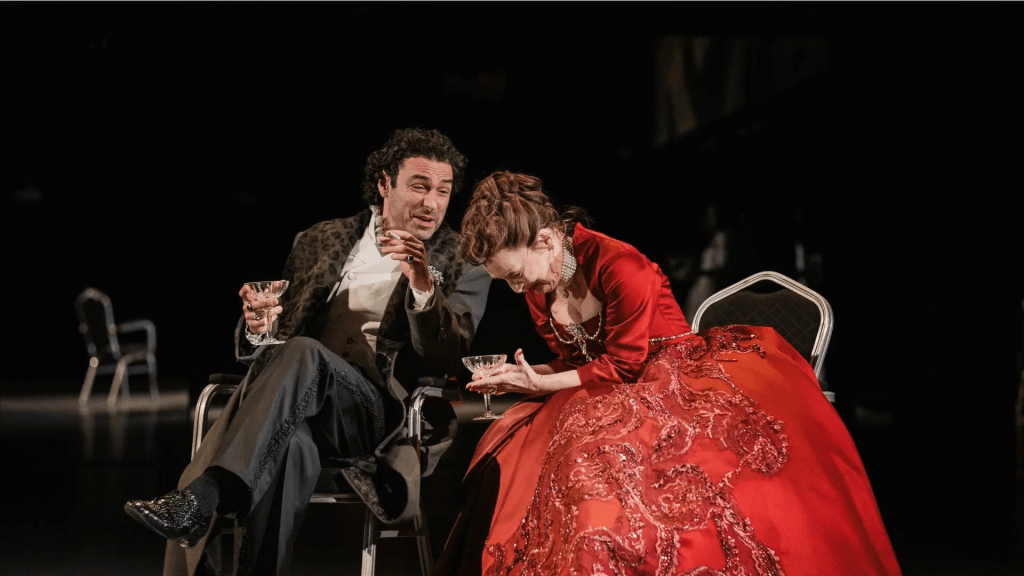
Valmont (Aidan Turner) & Merteuil (Lesley Manville) in front of an audience together.
The play is never the same as the novel however, not because of differences in plotting, but because the plot develops necessarily in vivo when the pair of plotters meet at respective venues in which their numerous victims’s fates are being decided. There is such a difference of both pace and agency in this, but also much less control accorded to the plotters, who are not only narrating what they have plotted and its planned sequel but having to prosecute their plans on stage. The joy of the novel is in the reader feeling that they are reading what they should not – for letters are ‘private matters’ but in seeing people who want them to be there to see them succeed because they are conscious of themselves not as epistolary stylists but as performers speaking in public. For that reason Hampton imports theatrical metaphors. In Scene Eight Valmont and Merteuil discuss Valmont’s success in raping Cécile and making the girl see that she might like the new experience. We have seen this scene before they speak of it, but they move on to Merteuil accusing Valmont for, given that success, for his ‘extraordinary dilatoriness’ in raping Madame de Tourvel. In his defence Valmont tells her that the joy of sex with another is in having it when the defences set against it happening are at their greatest and when we self-consciously watch it moving to its denouement as on a stage. The point is that sex is a theatrical event played before and audience to keep the tension of moving by ensuring that for Tourvel ‘every step she tries to take away from the inevitable conclusion’ (that is when she orgasms with Valmont mutually) ‘brings her a little nearer it’. And then note this exchange:
VALMONT: … Hopes and fears, passion and suspense: even if you were in a theatre, what more could you ask?
MERTEUIL: An audience?
VALMONT: But you: you’re my audience. And when Gercourt is married and Madame de Tourvel eventually collapses, we shall tell everyone, shall we not? And the story will spread much faster than the plot of the latest play; and i have no doubt it will be much better received. [2]
Just as the novel is a novel in letters about the power of letters by virtue of their writing for on audience of one, secretion or publication to other audiences, Hampton makes his version about the power of drama as a mode of understanding power between human actors, in reality and the theatre, such that the audience is put in the invidious position of being there desiring what they ought not to desire – the fall of women from active virtue to dependence on patriarchal strategy, at least as long as their attraction to those patriarchs persists. Laclos has his Merteuil fall foul of facial disease as well as social degradation and exclusion. Hampton has her humiliated by Cécile’s ability to be more in control of how plots work in drama than she. Thwe latter tells the former that it is she who has published the letters that have hurt Merteuil. This follows from the puzzled older sinner. It’s brilliant drama and theatre. [3]
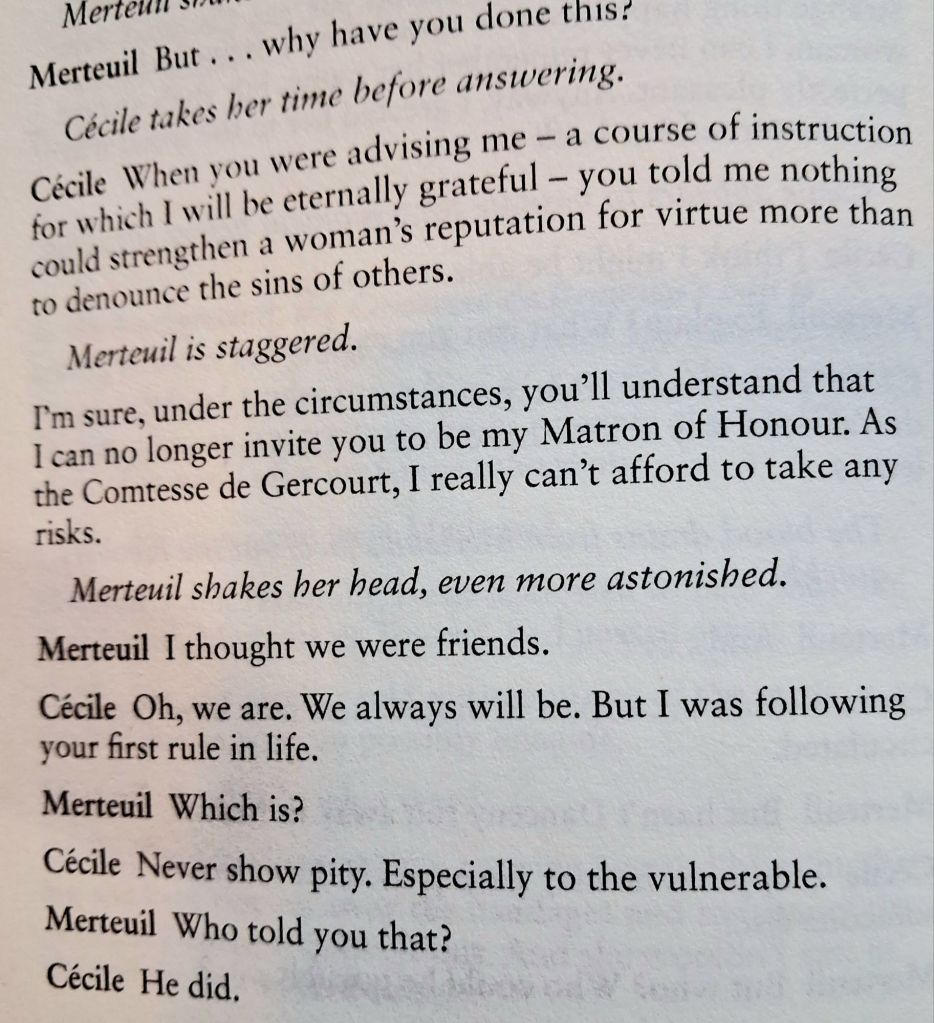
I am very much looking forward to see just how much theatre muddies the moral waters of the Epstein scandal.
With love
Steven xxxxxxxxxxxx
_____________
[1] The French text and the English translation, under the awful title Dangerous Connections, are those available for free download from the Gutenberg Project. For the French text see Les liaisons dangereuses by Choderlos de Laclos | Project Gutenberg & for the English (the translation isn’t good as my examples here show) is at Dangerous Connections, v. 1, 2, 3, 4 by Choderlos de Laclos | Project Gutenberg.
[2} Christopher Hampton (2026, revised edition: 59-60) Les Liaisons Dangereuses, from the novel by Choderlos de Laclos London, Faber.
[3] My photograph of extract from ibid: 108


Enjoyed the post (I’m a great fan of the novel!), but where is the Valmont/Tourvel rape? You could make a case for it in the novel where Tourvel collapses into Valmont’s arms in something like a faint (though my reading is that she sort of wills herself into a stupor because it’s the only way she can give herself to Valmont). But certainly not in the play! And Valmont consistently insists that Tourvel must give herself to him not only consensually but with full awareness of her surrender.
By the way, I saw the play in London last week. I’m not sure how I feel about the resolution with Cécile supplanting Merteuil. But the production is great — the use of dance is amazing.
You might be interested in an essay about the book and its adaptations I wrote a few years ago:
https://www.thebulwark.com/p/love-and-libertinism-the-endless-fascination-of-dangerous-liaisons
LikeLike
Thanks Cathy for your comment. Yes, I agree that I use the word too loosely and I think your reading brilliant and accurate. This is my first reading of play without having seen it. I will look again after seeing the production because I do think you are right to look for a nuanced reading of the relationship, with a stress on the potential for more unvoiced psychological interior emotion reactivity between Valmont and Tourvel. I should have wrote more tentatively in the light of my newness to the play and the ages ago reading of the novel. But thank you so much for taking my reading seriously enough to correct it. I will read your essay and learn before I revisit the play after seeing it. This helps me keep my learning alive. Necessary for old fellas like me. You also make me look forward more to the streaming. X
LikeLike
Thanks very much! “Rape” is a tricky concept to apply in the 18th C context because the rules regarding consent are quite different; it was a normative expectation among both women and men, for instance, that “no” means “keep trying” and that first-time sex will be preceded by verbal and perhaps even mild physical resistance. In 1782, a man who stopped when the woman said “no” would not only never have any sex, but would be regarded as hopelessly inept by the women themselves!
By the way, as I say in my essay, the existing translations of Liaisons are all frustrating. The P.W.K. Stone one is obviously much better than the late 18th C one, but it’s also full of archaic word usage (like “you set at aught” instead of “you care nothing for”) that can make the reading a slog. It’s especially ironic since the French of Liaisons is not archaic at all, except for a few words here and there that have gone out of use or whose meaning has evolved. The two new ones (by Helen Constantine from the 1990s and Douglas Parmé from I think 2000?) I think go in the opposite extreme of trying to modernize the language so much that it feels jarringly anachronistic; e.g. Valmont’s “Vous êtes bien mauvais sujet” to Merteuil–basically “You’re such a terrible person,” meant as a compliment of course :p –becomes, in Constantine’s translation, “You’re such a bad girl.” (Which is all the more unfortunate because the original is not only gender-neutral but egalitarian in that, in another instance, Valmont also applies the term to himself in an ironic comparison: “Really, you’re a hundred times more of a terrible person than I am, and I would feel humiliated if I had any vanity.”) And Parme translates Merteuil’s “Vous m’ecrivez tant de folies” (“You write such follies”) as “You write such dotty things…”, which makes her sound more like Bertie Wooster’s aunt than an 18th Century French noblewoman. He also gives Valmont some lines that sound jarringly crude (e.g., “that hellish fury” re Volanges becomes “that obnoxious old trout”).
By the way, not to tout my own work, but if you are thinking of rereading the novel I recently finished a new translation which I will be working on getting published sometime soon; I’d be happy to share a preview!
Anyway, I’ll leave you on this note — oh, and just one more thing I wanted to point out: Gercourt doesn’t leave Merteuil to marry Cécile, he left her at some unspecified point in the past. (In the novel, you may recall, it’s made clear, in a footnote, that Valmont and Merteuil’s sexual involvement began after Gercourt left Merteuil for Valmont’s then-mistress, the “Intendante de ***” (i.e. the wife of an “Intendant,” a high-level administrative official. It’s also said that this happened “long before” the time frame of the book–so, probably a few years earlier.
LikeLike
Again grateful. I am not sure I will re-read the novel. I never set targets for myself now I am in my 70s. But please let me know when your translation is out, because it may/ will change my mind, provided I am still around when it comes out. X
LikeLiked by 1 person
Gotcha, will keep you posted!
LikeLike