


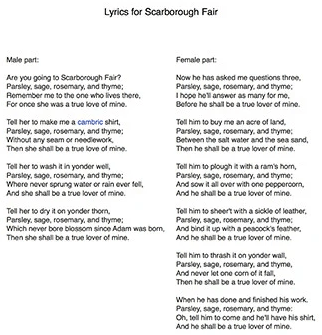
The song that lifts the mood today ought to be Scarborough Fair
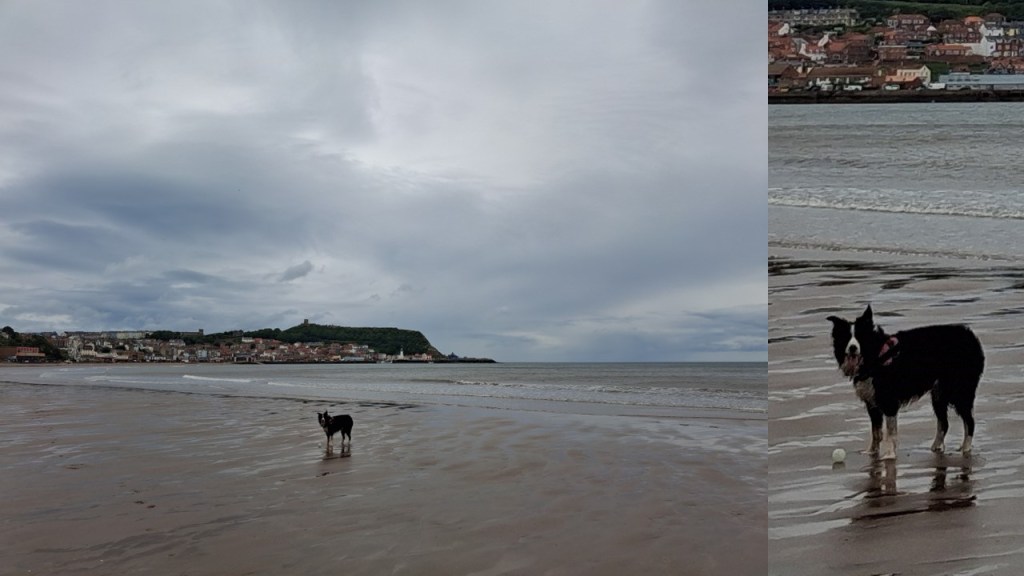
Baz on Scarbough South Bay beach, the dog-accessible portion. Once he had been there he wanted to be absolutely nowhere else.
Obviously the song that I use to answer this prompt question is not chosen for either its relevance or appropriateness to the question itself. I choose it because I am in Scarborough for a few days with my husband and dog staying in a cottage that is too high on the hill of the Old Town to be ideal for persons of our age but nevertheless pleasant.
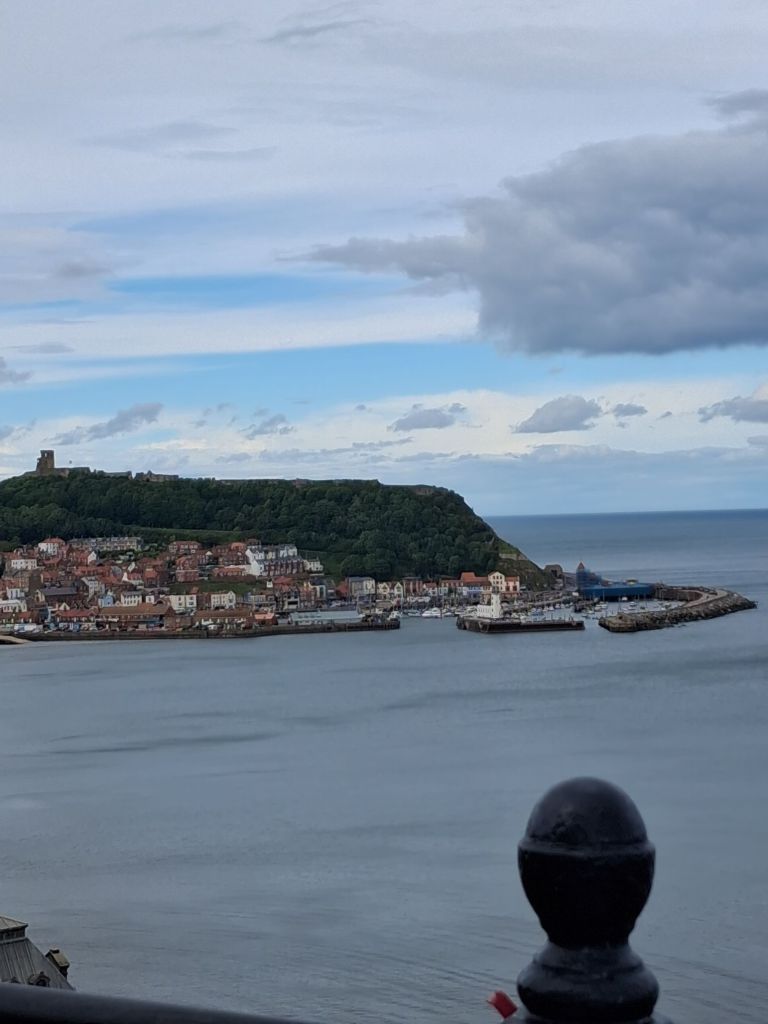
Overlooking the Victorian railings from the Esplanade on Southcliffe towards the Old Town that climbs steeply up the Scar to the Castle fron the harbour, hence our reservations to its suitability. This was Thursday and the weather had turned to being highly variable, though at 5.30, it was breezy, warm and pleasant, though I was by then so tired.
Some think the old medieval song bearing the name Scarborough Fair had no specific relation to Scarborough since versions exist set in other areas; it being at base a kind of Gothic romance song, in which love is described from the position of both a man, who may be dead, and a girl who knows that, if she marry, she must do so with attention to having a secure life and hence a practical hard-working man not a fiction of romantic and charged erotic love. And a song that sings of the impossibility of ideal love is hardly likely to.lift your mood, as likely as the aged funicular railway lifts on the South Bay of the scar might lift many people. But, hey, they do!
Our three day break from home was not intended for those heights anyway of abandonment to erosion or sorrow but for restful pleasant days only. After a sweltering week at home the week preceding this, a fairly sunny, but not unbearable day of sun got us here on Tuesday last but gave way to spells of cold storm on Wednesday, though not until the evening.9
Wednesday morning though I was up so early that I was walking Baz on the South Cliff Gardens in pre-breakfast sun, though Baz kept up a constant whimper to head for the sea that he seemed to feel must lie behind the barrier that the most South-Western railway lift of the southern scar represented so avidly did he head for its tunnel ahead of us:
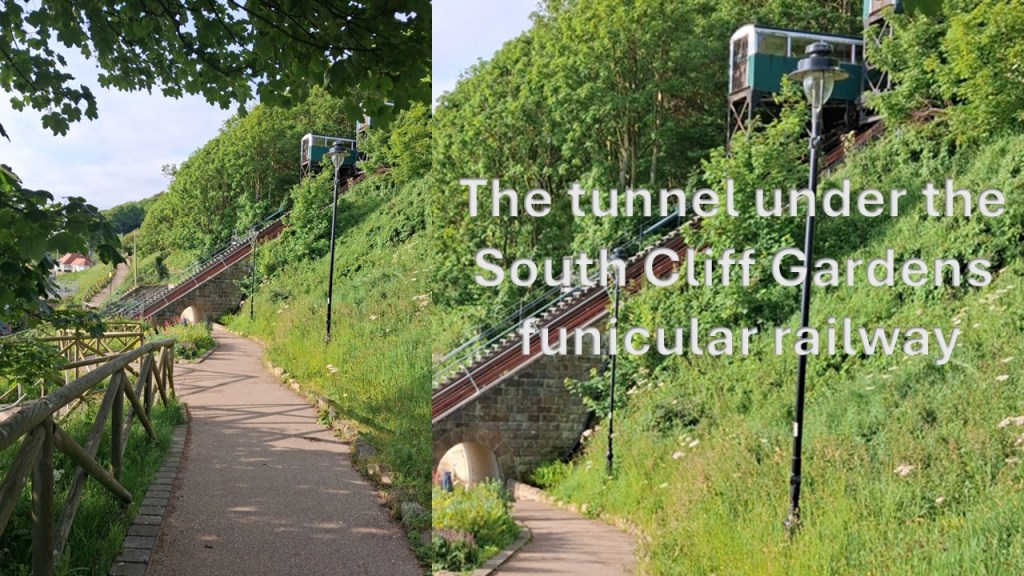
I sensed disappointment when he had to sniff around as I sat in the Italian Garden, mourning its long lost water features. But by then it was still only 8 a.m.
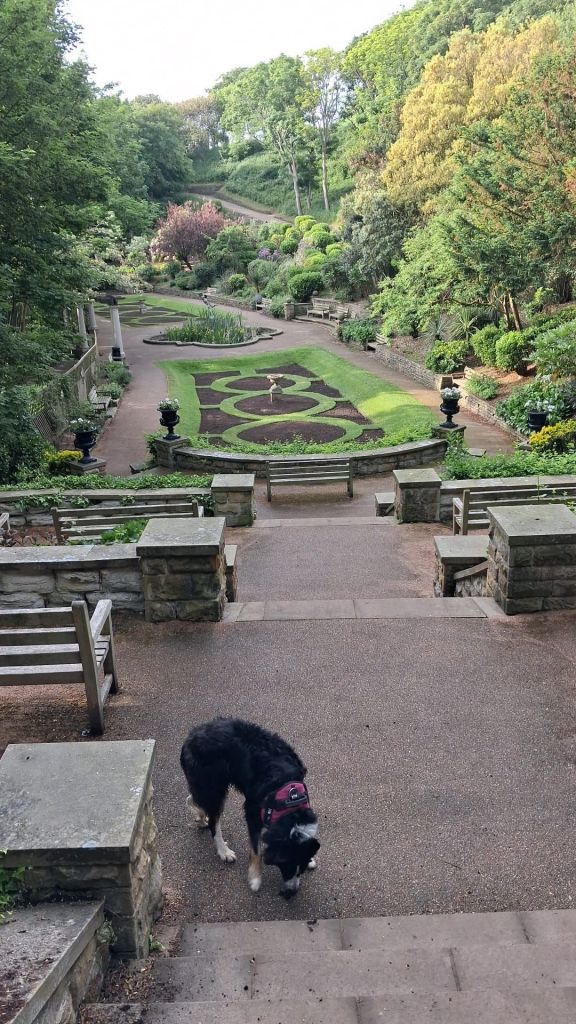
After trudging back and puffing up through tbe Old Town to our holiday home, we did the whole thing again, for only then was the tide low enough to allow more beach for Baz to frisk upon, which he did. I collapsed rather, after that, spending time in a bath with a book. The evening had already been planned by us before we arrived. Fortuitously, I discovered the two Yorkshire theatre companies, domiciled in York, had created a show entitled Queer Spaces, that was holding its first night, the second was at York Theatre Royal, at the Stephen Joseph Theatre in Scarborough.
By the time we left for the theatre, it was pouring and had been since the weather broke near the end of our last Baz beach outing. Baz needed a comfort walk so I took him up St. Mary’s Walk, on which we were staying, to the grounds of old St. Mary’s church. As he chased his ball in the car park, I sneaked a look at Ann Bronte’s grave, which I have not sought before. In the upper park of the car park, which was all graveyard once, it still stands guard to the least known of the Bronte sisters, the writer of The Tenant of Wildfell Hall and Agnes Gray, neither very great novels but very readable, and, as they say, significant witness to the nature of nineteenth century feminism.
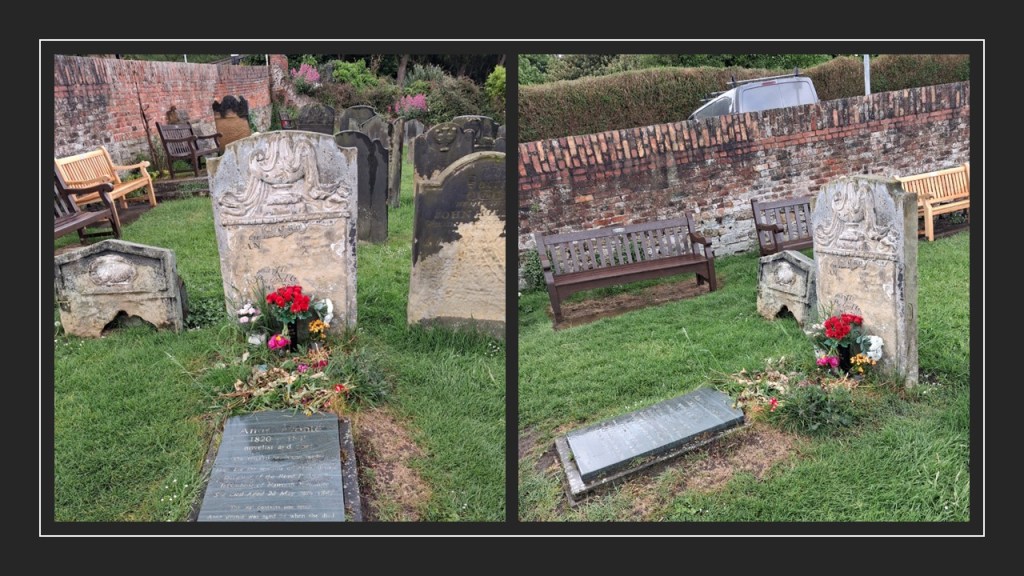
I could not work out if thoughts of Ann Bronte had any associative power to smooth the transition, and force Geoff and I forget the rain as we walked through the New Town to the Theatre. There certainly are queer spaces (when the term is thought of as meaning ‘norm transforming alternative places’) in the work of the Brontes, even Anne, the least queer of the sisters in many ways, and certainly the evening was as little intended as simple entertainment as were the sisters’ works.
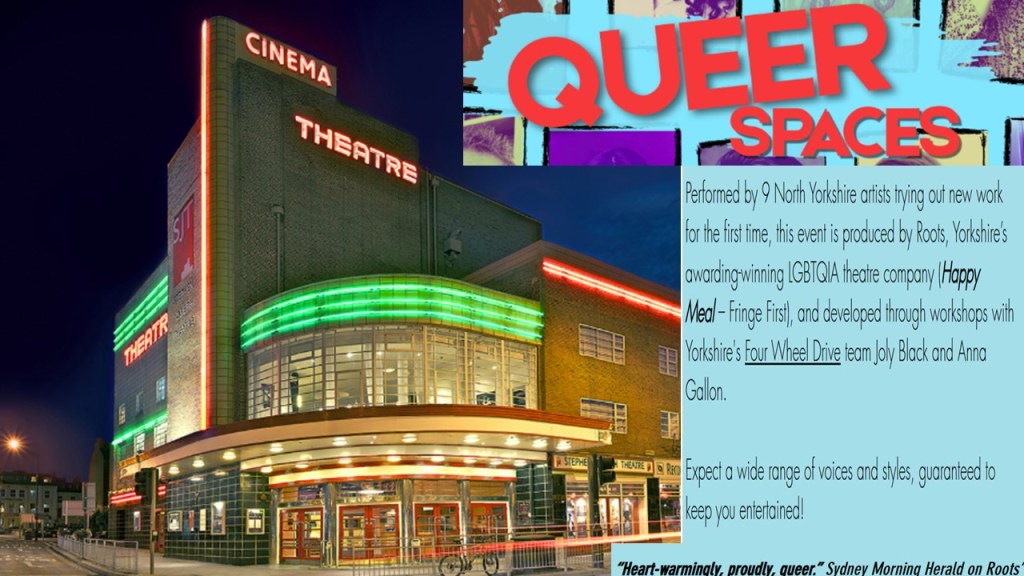
For this was not a cabaret evening as I had wrongly anticipated but an evening of theatrical readings from texts by the performer- author or read by a performer (in one case two performers) from a script (sometimes non-attributed). The texts were commissioned by the theatre companies, Roots and Four Wheel Drive, and edited collaboratively for staging purposes. All of the performers and writers identified as queer and variously otherwise across a range of sex/gender, sexuality, class, race, age and other variables. Here, by the way, below are the performers seen during the evening. Some were intensely personal such as the monologue that turned to rhymed verse by trans woman, Sam Porter; some a mix of true history and melodrama, with in the case of Lou Dunn, a pastiche of both Jekyll and Hyde and the story of Theseus and the Minotaur, with a point about conversion therapy.
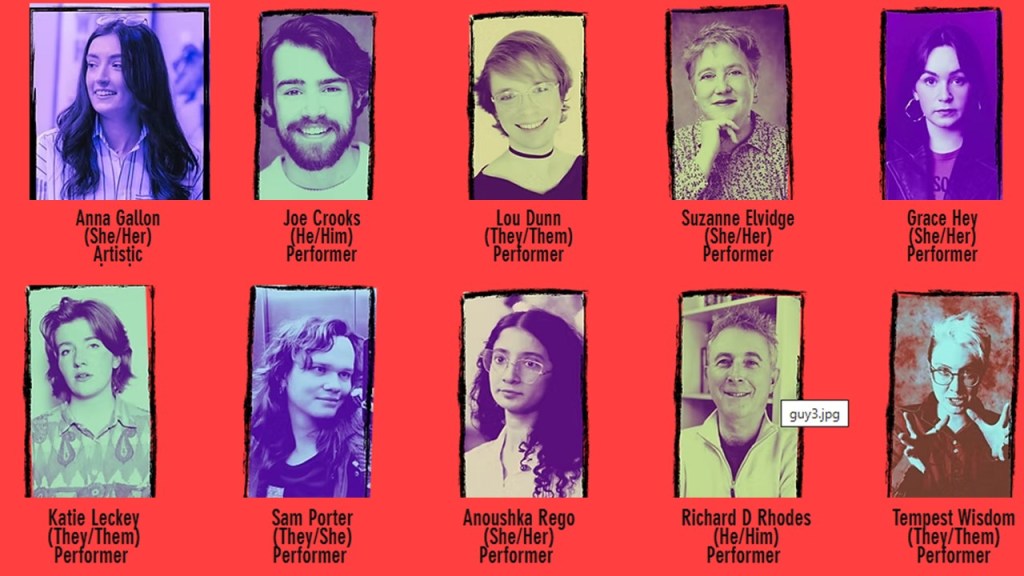
Joe Crooks was an inevitable favourite for us, because the queer space we call a coming out story became not a celebratory space but a dangerous one, wherein unresolved identifications act out from a young vulnerable schoolboy as projected oppression directed at adults thought capable of looking after themselves, like the boy’s ‘queer’ and colourful new headteacher.
No story disappointed though audibility needed work in one case either by the performer or equipment provider. This was an evening to remember with love.
I should have left my panorama picture till Thursday as the light shifts between the shots collaged below show. But we go home tomorrow, Friday
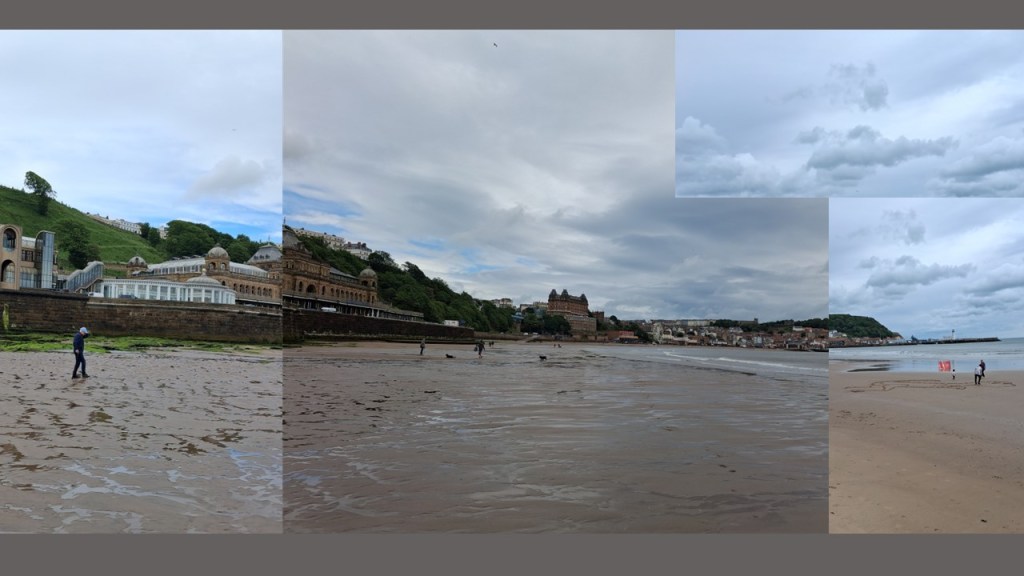
As I think about Scarborough Fair, I think of the fact that this song is not a lifter of moods because no song so edged by guarding the need for realistic prosperity can be. But like the woman in it, Scarborough today has the world about it too much within it. Poverty and the effects of addiction and social neglect are more its themes today than ever I saw them before, despite the effects of posters born out of positive psychology. Scarborough was once so grand that now its ragged decay speaks over the attempts to talk it up. I found tbis rather a drop in mood rather than the reverse.
Bye for now
With love
Steven xxxxxxx

