It’s fairly clear that the prompt question intends to imply a limit on how widely we interpret the term ‘technology’, which Wikipedia defines across its wider uses thus:
Technology is the application of conceptual knowledge to achieve practical goals, especially in a reproducible way. The word technology can also mean the products resulting from such efforts, including both tangible tools such as utensils or machines, and intangible ones such as software. Technology plays a critical role in science, engineering, and everyday life.
In order to answer this question, it is demanded that we stick to the most frequent uses of the term outside of specialist uses (such as in the philosophy and practice of science and technical manufacture of goods) leaving solely ‘the products resulting from such efforts, including both tangible tools such as utensils or machines, and intangible ones such as software’. That would give us a lot to things to work with in our answer but it would rather reduce the scope of trying to work out out how and why the product chosen is likely to exist for the next twenty years. Moreover, the existence of even ‘a piece’ of technology is a problematic notion not unlike that chestnut of philosophical questions about the substratum of metaphysical philosophy called ontology, known as The ship of Theseus . Theseus’ paradox, the other name of the question, is itself an examination of how ‘a piece of technology exists’ : a ship being, without doubt, both designed and made by the application of knowledge and skill (τέχνη [tékhnē] as the Greeks would have called it and applied it widely, even used by Greek dramatists to talk about the making of plays).
A ship is designed using knowledge of the nature of the components that make up the reasons why both seas and atmosphere behave as they do, to name only the two obvious areas of which knowledge is required to build a thing that does the thing ships are intended to do. But ships are not just built once and endure forever – their parts fail or decay and must be replaced, often in piecemeal. Theseus’ paradox is precisely the question of when in this process Theseus’ ship still remains that ship or has become another thing,
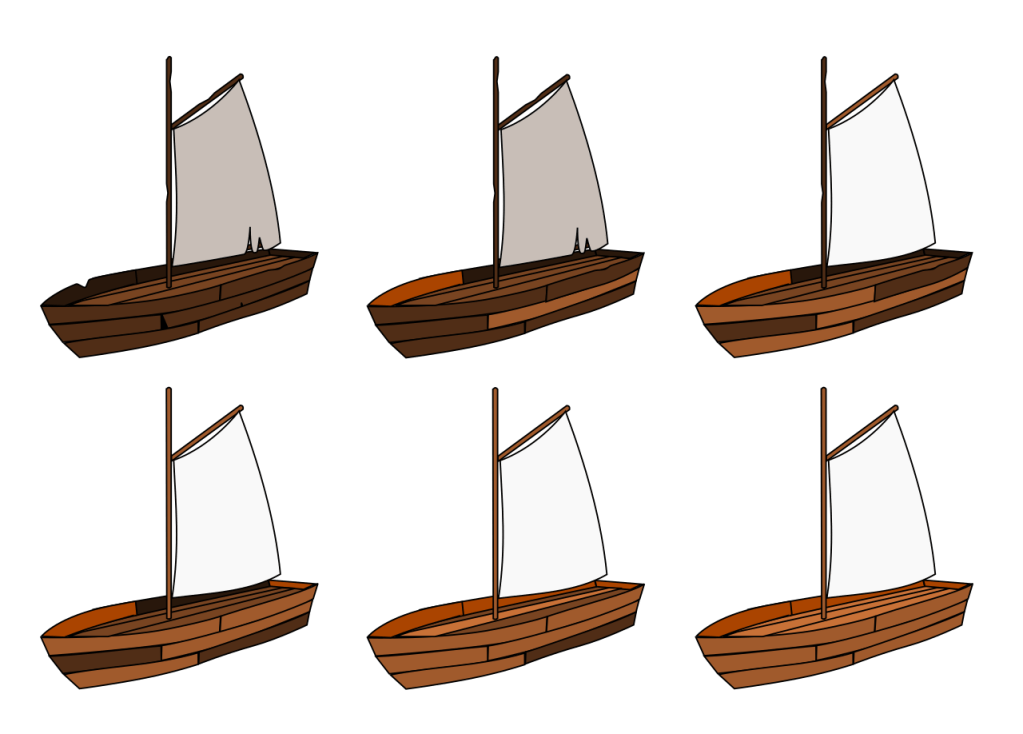
‘As the parts of the ship are replaced, the question remains as to whether it is the same ship throughout’ by various makers (Ship outline by Yosemite, edited and coloured by Belbury) – Own work, ship traced from from File:Gaff_Sail.png, CC BY 4.0, https://commons.wikimedia.org/w/index.php?curid=163138131
A ship is a refined piece of technology. To say Theseus’ ship will exist in twenty years is already a problem of ontology, especially when knowledge bases change so that it is understood ships might be made of previously unthinkable materials such as metal, or be driven less by prevailing wind or the power of men wielding oars but by engines driven by steam and fuelled by new energy sources, and so on. Is a modern aircraft carrier deployed by the USA in the Gulf, the continued existence of a warship owned by a political leadership, which is after all what the ship of Theseus is imagined to be, probably a trireme.
It is for this reason that I reject the idea of querying the durability of the existence of any ‘piece of technology’, for I do not know of any, including ‘the wheel’ that does not change its nature in time in response to the continued application known as technology in its more conceptual sense or ‘the application of conceptual knowledge to achieve practical goals, especially in a reproducible way’. Even repairing an old piece of technology is unlikely to be not just repair but an ‘update’ as well, based on advances in knowledge and praxis (practice informed by theoretical knowledge), which in the case of pieces of software, for instance, can make the new piece unrecognizable from the old, To illustrate tbe latter point to myself, I remember how the software Operating Systems that enable computing (such as DOS-5 originally) have in twenty years have involved such massive change that I could not truly call them ‘the same thing’.
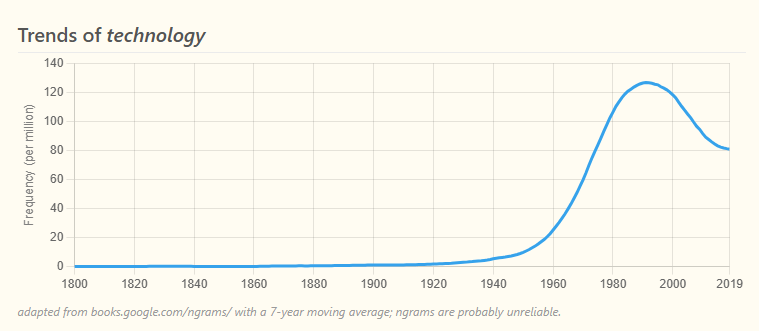
Yet it is likely that the fact that many now use the word technology to apply to its products in the original sense of the term, explains the look of the Google n-gram used by Online Etymology Dictionary, Even given the famous limitations in validity and reliability of n-grams, what we see here fits the experiential awareness of most of us – though of us ‘oldies’ more than young people. Frequency of word use rises from just before the date of the Second World War (wars giving rapid boosts to the need to achieve refinement in things such as weapons and weapon defences – as witnessed by drone technology in recent warfare in Ukraine and in Israeli stealth warfare against occupied land, and other entities known by them as ‘threats’. It rise exponentially to the 1990s, fuelled by its promotion by Labour governments in particular – Harold Wilson’s ‘white heat of technology’ speech – and the technocratic reform of governmental processes by Tony Blair’s New Labour experiment. That it calmsdown from the 1990s may be interpreted tentatively as habituation to technological change.
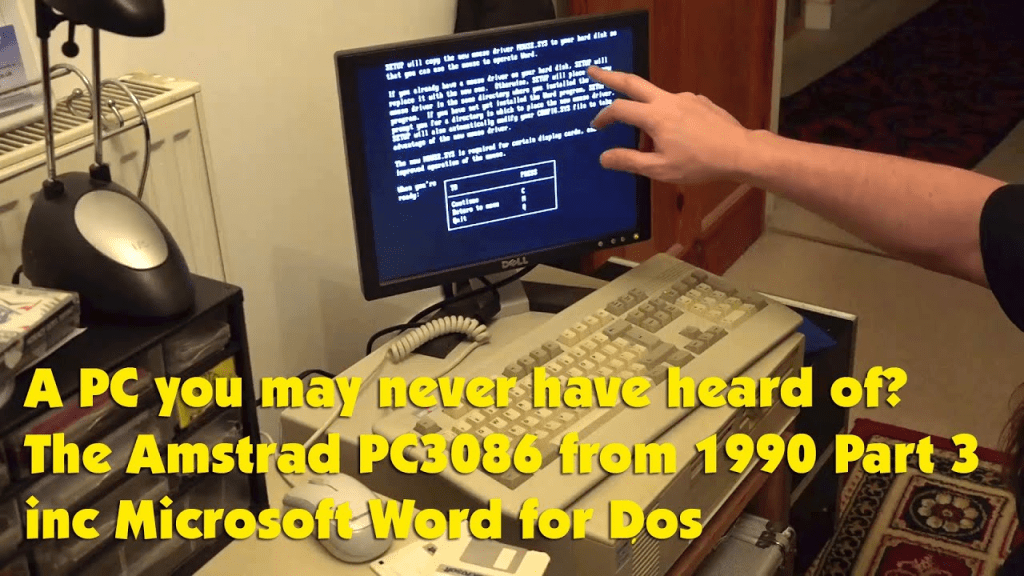
We need to think outside the idea of ‘pieces of technology’ to understand the endurance of even such ‘pieces’: whether in manufacturing tools for industrial processes or commodities, such as televisions and computers, or intangible ones like software, which become less and less understandable to those without the technological knowledge the more they advance. For instance, when I used the old Microsoft DOS systems on my Amstrad I understood much more about how they function than it is possible for me to know now,
So let’s stay with the wider, older term and trace its own development etymologically, with help again from the Online Etymology Dictionary. Here is the flow-chart graphic it gives explaining that development:
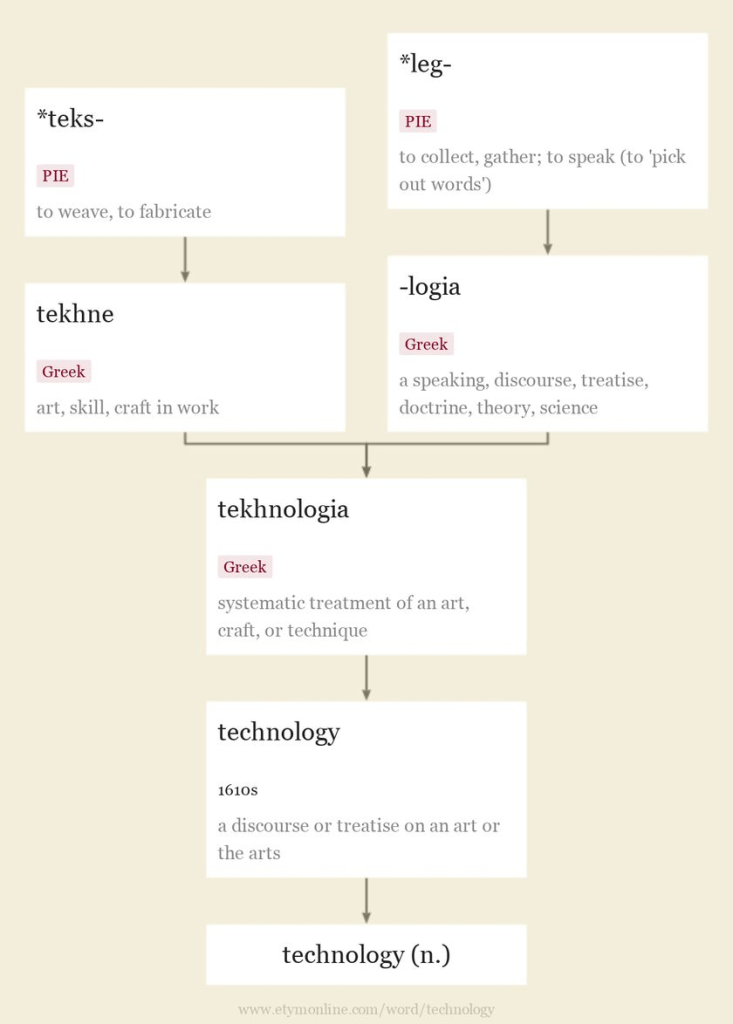
There is a certain beautiful simplicity about the development of the word up to its first recognisable usage to moderns in the seventeenth century in English, and in the United Kingdom, which preserved the idea of a body of knowledge that can be spoken and / or itself technologised into the form of a published text. However, there is a beautiful eassiness in seeing from the discursive version of that in the dictionary how the word technology original related to the term ‘textiles’ (itself a name for a product and its technology from the sound of the Proto Indo-European (PIE) root, ‘teks’ preserved in the Greek and by transliteration into modern of the ‘ks’ sound in an English alphabet into ‘tex’.
Looked at from the point of view of technologies as discourse, their durability is both more and less certain, for the use of the word has itself been technologised. This occurred in the work of Michel Foucault, who uses it to mark a change in the nature of knowledge such that it has become a technology, tied to function, especially production that can be applied to abstract ideas like identity. Foucault speaks of the ‘technologies’ of self implied in discourse from a wide range, from the rise of tje professional to sexuality. Norm Friesen extends that notion to the use of strategies of ‘confession’ in social media, giving as he does so a useful definition of Foucault’s concept:
Foucault defines technologies of the self as “reflected and voluntary practices by which men not only fix rules of conduct for themselves but seek to transform themselves, to change themselves in their particular being, and to make their life an oeuvre.”
https://firstmonday.org/ojs/index.php/fm/article/view/6750/6300#
If we agree with the right of Foucault to thus extend the implied definition of ‘technology’ in which selves and lives are the piece of technology evolved, I think the ontological problem survives. Is self a tbing that will endure for sure for another twenty years or will it be so changed by revisions that, even if it looks the same when we use it in discourse, it is another thing from what it was altogether. By them AI will have so rebuilt the idea of self that some of us will feel archaic, for AI is a whole bundle of technologies that mimic processes so fundamental to being that it will be difficult to tell the embodied process from the nature of the human, a question the Turing test first set into life, naively then, not so much now. As for tbe Turing test, think about what it implies about the nature of interaction as the equivalent of a peocess that is as ‘real’ as a product of technology:
The Turing test was designed by Alan Turing to assess a machine’s ability to exhibit intelligent behaviour equivalent to that of a human by imitating interactive dialogue. In the modern version, a human evaluator judges a text transcript of a natural-language conversation between a human and a machine. The evaluator tries to identify the machine, and the machine passes if the evaluator cannot reliably tell them apart. The results would not depend on the machine’s ability to answer questions correctly, only on how closely its answers resembled those of a human. Since the Turing test is a test of indistinguishability in performance capacity, the original (verbal) version generalizes naturally to all of human performance capacity, including nonverbal (robotic).
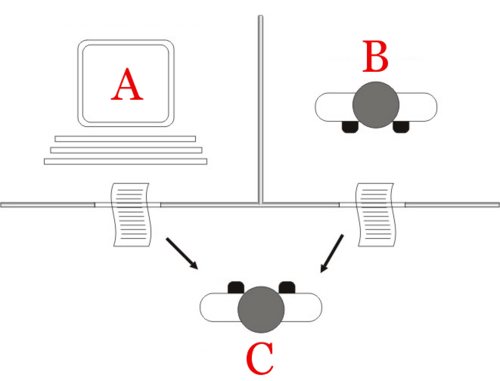
Player C, the interrogator, is tasked with determining which player – A or B – is a computer and which is a human using only the responses to written questions
The issues behind the Turing test ate many and, to be fair, it does not equate an interaction between two human beings with that between a machine and a human being as being as ‘real’ as each other. However, it does suggest that the reality of a interaction we see or hear (or otherwise sense) occurring can only be as ‘real’ as it seems to the participants and witnesses thereof. That being the case it is as true to say that the processes underlying a conversational interaction are as mechanical in process as those of machine and human. Tbis is a conundrum investigated by Kazuo Ishiguro in Klara and the Sun (see my blog at https://livesteven.com/2021/03/10/what-you-dont-like-are-sealed-black-boxes-okay-lets-open-them-once-we-see-inside-well-learn-reflecting-on-the-inside-of-a-black-box-in-kazuo/ )..
That’s all I have to say. Bye for now
With love
Steven xxxxxxx


One thought on “In order to answer this prompt, we need to think outside the idea of ‘pieces of technology’ to estimate the endurance of even such ‘pieces’: whether in manufacturing tools for industrial processes or commodities,”