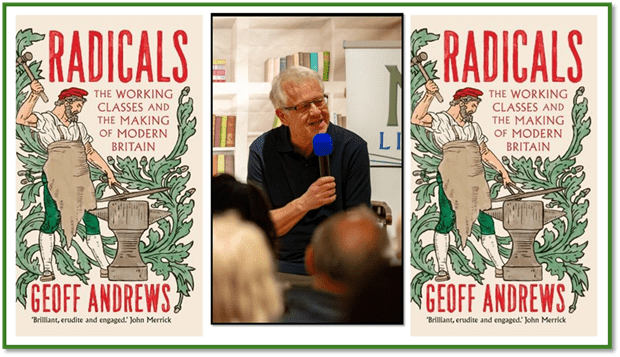
This blog reflects on why I enjoyed Geoff Andrews’ 2026 book ‘Radicals: The Working Classes and The Making of Modern Britain’, and why, perhaps it is a as deeply flawed a book as my enjoyment of it.
This blog reflects on why I enjoyed Geoff Andrews’ 2026 book Radicals: The Working Classes and The Making of Modern Britain, New Haven & London, Yale University Press, and why, perhaps it is a as deeply flawed a book as my enjoyment of it.
I did, despite its portentous title, Radicals: The Working Classes and The Making of Modern Britain, enjoy this book and I think this is because it recalled so many discrete moments of my life in its subject matter that I have decided, despite longing to, to narrate more fully. So there will now be forthcoming stories of attending a Euro-Communist focused Communist Party of Great Britain (CPGB) Summer school in Toddington of all places led by Marxism Today’s Martin Jacques. There’ll be none either of going, with Geoff my husband, visiting Swansea to read the notebooks of miners learning about Dietzgen in lieu of a then unavailable translation of Marx, at the Central Labour College (CLC) in order to deliver a group article on that phenomenon guided by Raph Samuels in Ruskin College for the History Workshop. Raph is a man who appears a lot in the book. I enjoyed the book however precisely because I bathed in those now vague fragmented but deeply valued memories.
My conclusion about this book however is that it fails to address its topic and that, in some ways, is equally an autobiographical jaunt for its author. One critic, on what I once called the Trotskyist left, in a blog addresses the problem thus with a conclusion with which I totally agree but with some arguments with which I definitively do not agree (having been Euro-Communist and still inclined to its openness) . For instance, it is crass to describe Andrews’ limitations of those of an ‘academic-left background’, which involves too many discriminations one needs to make within that concept, just as it is a misreading of the book to say that it is aligned with the now defunct movement of Eurocommunism, or to ‘identity politics’, against which latter concept, on lines suggested by Eric Hobsbawn, Andrews is specifically negative (and I think wrong):
The key question about Andrews’ framework is: what does he mean by “radicals”? This term is not neutral or straightforward; it reflects a political choice with significant consequences. Andrews’ academic-left background often treats “radicalism” as a broad concept that blurs the important line between reform and revolution. This view groups together Chartists demanding votes, trade unionists advocating shorter hours, Fabians promoting municipal socialism, suffragettes, Eurocommunists, and current identity-politics activists as part of a single progressive tradition of popular radicalism. In this perspective, the working class is seen as representing a democratic, rights-based politics aiming for inclusion and reform within the existing system, rather than its revolutionary overthrow.[1]
Nevertheless the blogger above, named only ‘freerein61’, is surely right that the term ‘radical’ is as ‘free-floating’ as the chemicals it also names. By the end of the book, the content of the term remains vaguer than at its start, and although I do not think it does not conclude about what a ‘radical working class ethos’ represents in quite the stable way freerein61 suggests (it is never that well-argued, even in strictly academic terms), their conclusion might as well stand. There is, after all, no sense of what the role of the working-class might be, or if indeed it exists in any pertinent way in politics, in the future of Modern Britain. The case against the book is made more fairly, and yet more damningly, by Phillip Green in The Morning Star, in saying that most of its historical content is second-hand yet selective, with glaring omissions(‘niggling failings’ is what Green calls them, although I think they may be more than that), and not ‘radical’ in any way at all. He entitles his piece: “Sorry, but this isn’t radical’.
THE title holds great promise, but its contents hardly live up to it. It is largely an eclectic mish-mash of widely known historical movements from the Chartists to the modern day, offering no new insights.
….
The book takes us on a rather well-worn path through the significance of Chartism to the establishment of the Fabians, the SDF and ILP and the key role played by worker education.
In his conclusion, he rightly focuses on the fact that the working class(es) today bear little resemblance to that of the heyday of Britain’s industrial revolution and even that of the early 20th century.[2]
Unfortunately, I think this is the last word on the book – not so much because it is derivative, whilst claiming an innovative approach, but because it maintains an argument at such a level of cloudiness partly by ignoring more detailed evidence and more thorough research and more balanced judgements about the significance of certain facts, such as the writing of, that would expose the contradictions of its approach. For instance, his stress on the writing of Joseph Wright in early chapters is of interest but rendered significant in a way it was not, after the fashion I think of F.R. Leavis in his promotion, only in his early career admittedly, of George Sturt. Wright becomes the representative voice for Andrews of working-class radicalism, without any justification of that in what we usually regard as evidence in critically aware history. Surely Green is near the mark in describing Wright, as an:
obscure late 19th century working class writer and activist. While Wright is clearly an interesting and neglected figure, capturing Andrews’ interest, he is hardly significant in terms of the historical development of the working class.
However, without a doubt, Wright has a voice that mirrored other working class witnesses, but not one which renders others with a difference of content and tone insignificant, even among the characteristic aut0-didacts, amongst whom Andrews places him in order to centre his argument on wide-ranging liberal education being at the focal point of a working-class ethos, an ethos owing as much (as the old argument so often goes and bearing some partial truth) to working-class religion, especially Methodism, and to Matthew Arnold’s vision of a culture of ’sweetness and light’, about whom the evidence id more partial.
When I try to summarise the books arguments I come up with a number of binary oppositions which alone sustain it. For Andrews, the word ‘ethos’ is central but very vaguely defined – bearing in it attitudes to leadership and loyalty as much as to the pursuit of education. Against the fuzzy boundaries of this ‘ethos’ are binary opposites, operating in different contexts. Chief amongst those latter is the essential of ‘class consciousness and its link to struggle’ that is what English Marxism oft comes down in Andrews’ view, but also (despite freerein61’s misreading) is ‘identity politics’, seen as adjunct to radicalism, which for Andrews it was not historically nor ever can be, though his point is truly that of Hobsbawm. Both, by the way, are rather selective as to their evidence for that, either from bias or, as Green thinks regarding Andrews, under-research. Setting ethos alongside ethical values (the links to Leavism without Leavis’ right-wing bias are clear to me if unstated overtly) also pits both against what Marxists call ‘theory’ and ‘praxis’ (practice informed by theory). Moreover if set against work in-class consciousness, the book sets itself against specific working-class culture and ‘collectivity’ in favour of ethos, using this bias fo favour the pursuit of ‘one culture’ that transcends class (as in Arnold and Leavis).
It is likely that Andrews would argue that his critics read the nuance of his arguments as if they were dogmas, and he might have a point – the book is well written and carries you along so that joy, like that I had in it, is likely for some who know the contexts addressed and have feelings about them, but sometimes the ‘niggling failings’ mentioned by Green are not so niggling. Let’s take, for instance, the import in the argument of working-class auto-didacticism which is stressed sometimes (but remember that nuance) instead of collective educational projects – even though those are mentioned (such as CLC). Green makes this point however:
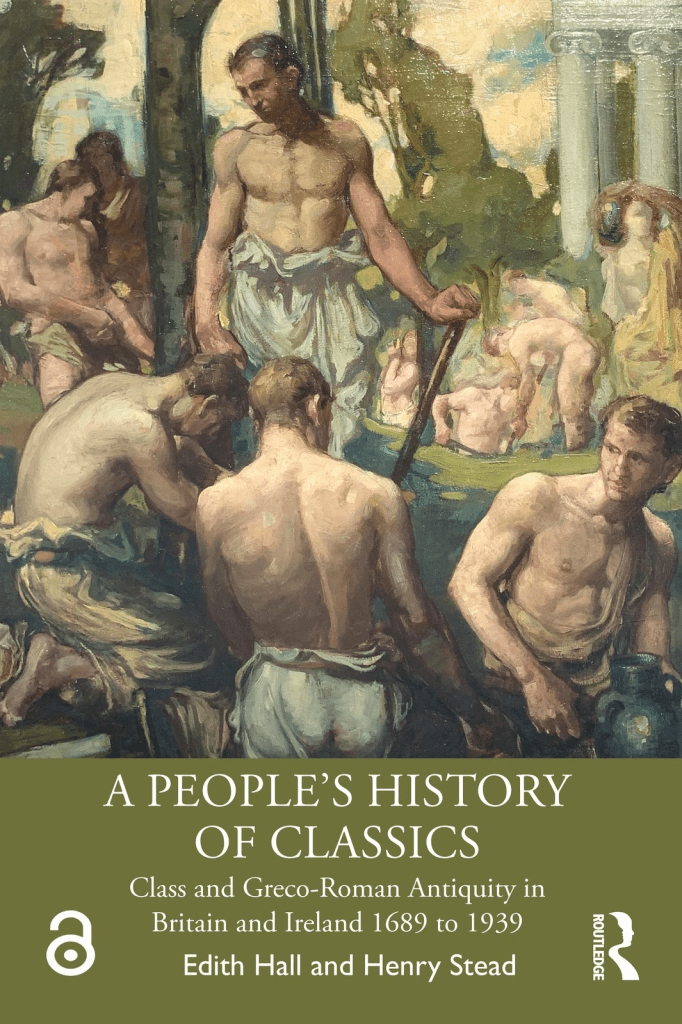
Andrews writes at length about the importance of 19th-century working-class auto-didacts and how this educational movement impacted on the development of a working-class consciousness. Surprisingly, in this context, he doesn’t reference the seminal work by Edith Hall and Henry Stead, A People’s History of Classics, which explores in great detail the influence of the classical past on the lives of working-class people from the late 17th to early 20th century and whose voices have been almost completely excluded from previous histories.
Hall and Stead examine working-class experience of classical culture from the Bill of Rights in 1689 to the outbreak of World War II. Their work reveals a deeper understanding of what these cultural interactions signified to the working poor: from the promise of social advancement to covert and overt class war.
I think, by the way, that Green is right to show that there is respect for ‘working-class consciousness’, for the nuance of the argument that ‘ethos’ predominates over class culture is necessarily contradictory in historical accounts. But he is also right to show that an account that fails to address the scholarship of Edith Hall and Henry Stead is a deficient scholarship, and impoverishes the historical range and meanings in working-class educational projects. That book Green mentions is a wonderful one as well as a scholarly one. I wrote a blog on it that you can see at this link. The import of its omission is that it allows Andrews a romanticised view of the auto-didact tradition – based on the motive -force of individuals and constitutive of the ‘ethos’ he tries to evoke as a political argument against a Marxist theory of history and class. It is not that he avoided the book because it contradicted him – the range of issues in the motive for working-class education were too wide, but they cannot be understood merely as ethos.
In this light too we can critique the rather waspish chapter that attempts to challenge the ‘myth’ as Andrews sees it of the classic status of Robert Tressell’s The Ragged Trousered Philanthropist, which Andrews claims to have shown at the end of Chapter 4 on the book to contain only a ‘mystical, minority vision of the cooperative commonwealth: only socialists, with history on their side could deliver it’.[3] That rather cursory dismissal is not based on great argument, and makes a lot of assumptions of who can be described as working-class and why. Green is surely correct to point out the ‘patronising’ nature of some of those arguments – the ones picked out being that, for instance, of Andrews ‘questioning the ‘proletarian authenticity ‘ of Tressell’s book, citing his birthname against the author:
on the basis that its author Robert Noonan was the son of a privileged South African couple. Jack Mitchell, a university lecturer and authority on the work, is also described wrongly and condescendingly as “an archetypal CPGB functionary.”
I think that might be more rude than patronising and moreover not the way to argue a case of such weight to some in family traditions of socialism. For instance, freerein61, who critiques Tressell more vigorously than Andrews, in their case for ignorance of Marxist theory, says nevertheless that none of the critique from their own version of the past:
diminishes the book’s significance. The Ragged Trousered Philanthropist has remained in print for over a century. Generations of British workers have read it as a revelation, recognising their own lives, exploitation, daily frustrations, and humiliations, all expressed with pinpoint accuracy. It has been handed down from worker to worker, from parent to child, like truly essential books are. During the 1984-85 strike, the Miners’ Union recommended it. Shop stewards have referenced it, and workers encountering socialist ideas for the first time have discovered a connection between their personal experiences and Marxist theory.
This is the book’s deepest achievement: it demonstrates that socialist consciousness is not an abstraction imported from outside the working class by intellectuals, but something that emerges from the working class’s own experience when that experience is honestly confronted and honestly named. Tressell wrote it not as a middle-class observer of people with low incomes but as a worker who was himself one of the “philanthropists”— who endured the same conditions, performed the same labour, and drew from that experience not resignation but revolutionary conviction.
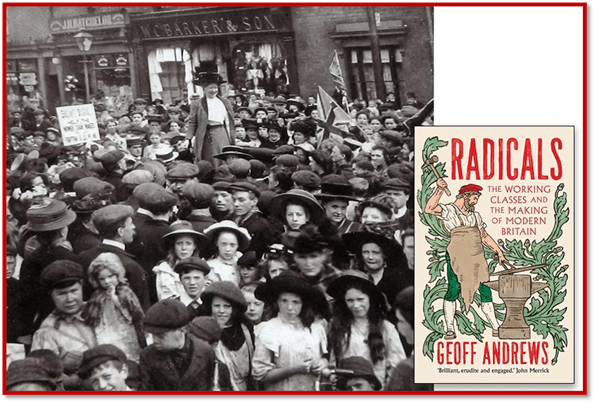
That is a much fairer assessment. Moreover, in telling working-class history Andrews is selective without really telling us this is the case. To this failing, Green attributes ‘under-research’ but sometimes I wonder if the omission isn’t strategic and aimed at making carrying the point about ‘ethos’ over class -consciousness and struggle, and over notions of cultural identity more clearly. Green points to omissions that show a failure to assess the significance of some events over others, making much of the failure to address the struggle of ‘true radicals’ like Mary MacArthur, as shown below in the photograph he shares alongside his review:
Book picture from the Morning Star, with book cover, under which John Green claims it shows a’ STRIKING OMISSION (illustrated by the photograph): True radical Mary MacArthur addresses the crowds during the chainmakers’ strike, Cradley Heath 1910 [Pic: Edwin Beech/CC]’
That this is not mere selectivity from the record is shown Green argues from the ‘niggling failings’ in the accuracy of the account. MacArthur is not just omitted, it is as if, in Andrews words she never existed. Here is what Green says:
Writing of the match girls strike of 1888, he says that it was the first strike organised by women “and the next one would be 80 years later at Ford Dagenham,” ignoring the successful 10-week strike in 1910 by women chain-makers in the Black country. The caption on a photo misidentifies Jayaben Desai, leader of the Grunwick strike.
Green compares that to the omission from a list of ‘working-class dramatists in the late ’50s and ’60s’ the ‘key figure of Arnold Wesker’. He goes on to say that these are ‘perhaps not significant in the whole context but are a sign of sloppy research’. But I wonder if the specificity of this omission has more than poor research behind it, for I have no doubt that Wesker would have understood something we now call ‘identity politics’. I feel this more over a moment in the discussion of the liaison between middle-class radicals and workers, and the role of Penguin Books in the 1930s as publishers of texts more easily available to workers he mentions ‘another Lane and Williams initiative, Penguin New Writing, under the editorship of John Lehmann, found new avenues for a younger and radical readership in the early years of the war’.[4]
He mentions Penguin New Writing without really attributing significance to the significance of the kind of alliance it represented. John Lehmann was a man who blended interest in working-class consciousness and writing with that of people also under-represented in the mainstream. As well as promoting story-writers of working-class life like Sid Chaplin, writing of mining in the North-East, he published material from openly queer writers like Ernest Frost in that collection. But into that well Andrews will not step, whilst approvingly quoting Hobsbawn’s view in the 1960s that the development of ‘identity groups’ on the left was ‘exclusionary’, a view not unlike that of the current Reform Party of the Right.[5]
From the point of the view of probably irreconcilable different both left reviewers I have mentioned berate Andrews for his placing of the radical in a container that can only be buried in the past. Both look to the duty of socialism to seek means of reconstruction, understanding how and why capitalism has inserted itself into an acceptable means of delivering benefit to the working classes in their own minds. Like them this angers me about Andrews book, despite the sincerity of his appreciation of values I recognise and condone. But everything is no longer as it was – that’s the burden of the book’s song, even the Open University to which Andrews had alliance, and which forms part of his story relating to what he calls the auto-didact tradition. But, as he points out, the OU survived Thatcherism by changing its nature as an instrument of social mobility, and in that light acceptable to neoliberalism, and now is difficult to distinguish from any other academic institution. But it never was auto-didact orientated. It always over-prescribed instruction, unlike Raph Samuels who is a true hero of this book, as is Stuart Hall.
But though this book was a pleasure to me, those who still struggle with the inheritance of working-class culture deserve better as a means of refreshing their pride and acknowledging their pain. Reading it, one senses that, since all is right for Geoff Andrews in his retirement, there is nothing left to do. There is. Too much – and it will, it must start soon before it is too late, for the planet itself could yet give up on what capital continues to subject it to, egged on by growth-mongers even on what they call ‘the left’ and as representing Labour.