


The answer to whether one is a ‘lifelong learner’ is the title of the latest novel by Kae Tempest, namely ‘Having Spent Life Seeking’: as for what we seek to learn is it this? – ‘How to get by without ever getting anywhere, when getting through a minute was infinite; but every ending achieved was still only the beginning’.

Kae Tempest has obviously spent his life seeking, although what is sought and whether it is nameable is less clear than the fact that seeking must occur nevertheless, with or without an answer to that question. Let me assert first of all that the reason this novel speaks at all to me is because I think of lifelong learning as lifelong seeking, even for a clue for what it is one wants to find or find out through that process. Learning is, I think, a means of ‘getting through life’ until it forces an end, a querying of how the experience of a life and of time might have a shared meaning, rather than be permanently experienced as at odds, in statements that query whether what passes for living in time is ‘a life’, has the value that naming it thus suggests, but isn’t rather just a process of ‘getting through’.
To seek instruction and to learn is a formalisation of ‘seeking’ without a nameable purpose. Lacking that kind of purposive end, it always feels as if it might be a never-ending process, except that our lives experience time only through a knowledge that time ends – for each of us individually at least. This is why I use the unreferenced quotation in my title, although it feels appropriate to acknowledge the whole passage it comes from, which comes as the prose changes register as it tries to describe how to get through a prison sentence as the hero of the =novel Rothko, knows they must:
Cruel as time became, they set themself against the fade and tried their best to get their head down. They had a reason to keep going. They had something to become. … They learned the power of routine. The strength of clear instruction. Learned the books, the looks, the crooked method by which people functioned. How to get by without ever getting anywhere, when getting through a minute was infinite; but every ending achieved was still only the beginning. And soon they learned to count the time in blame. They had been left behind in life, and really someone had to pay. [1]
Now I admit this is a queer view of what learning might be, in a world where it, like much else, is mechanistic and merely process bound with the pursuit of clear goals at its end, such that that end becomes the end of learning, its purpose. In the novel, it applies perhaps only to what serving time in prison might men – learn not only getting by, but getting through and measured only by survival. But I think it applies to much more than literal prison, but also to other ways in which life becomes an enclosed space.
The reason however that I am approaching the novel so obliquely and with this prompt question in mind is that, having found my experience of the novel a queered one, where much in it proposes questions about how linguistic style relates to meaning, and both relate to experience that feels validated by our belief in something behind it – some sense of lived life, and yet finding myself angered by the only review of the novel I can find which clearly stems from similar feelings but immediately uses them to negatively critique the novel. The review is by Shahidha Bari in The Guardian and begins thus:
Kae Tempest’s new novel is dedicated to “you”, the reader. It also comes with a plea: “Be gentle though.” But to whom or what should we be gentle? The book or the writer? Having Spent Life Seeking is Tempest’s second novel, arriving a decade after his first and following a period of considerable personal change, including gender transition. Perhaps inevitably, it is a book full of struggle and soul-searching. It is also painfully earnest: an enervating read with an exhausting intensity that neither relents nor resolves.[2]
Following the link that is in The Guardian will take you to a review of the first novel written by the author under the name Kate Tempest, and links you more certainly to the fact that the sex/gender transition in Rothko in this novel, from non-binary to trans man, is analogous to Kae’s transition. Bari assumes this inevitably means the novel be ‘full of struggle and soul-searching’. But it is clearly a struggle that Bari feels hard to validate as the stuff of a worthwhile novel, which somehow cannot be, as Bari describes it, ‘painfully earnest: an enervating read with an exhausting intensity that neither relents nor resolves’. The assumption is that ‘people’ may undergo experience that is to them feelings and thoughts packed with intense meaning, with little release from that feeling, but that, if we are asked to read it as an account in a book, such experience is invalid for that purpose – for reading material must learn when to, even if temporarily, let go of its reader, by change of mood and tone perhaps, and to propose some ending that ‘resolves’ the tensions it has created in readers.
I have to say that I rejected those assumptions almost with anger whilst still feeling that I knew why Bari felt the book to be problematic as a ‘read’, although not at all agreeing with her description of ‘the melodramatic register of the book, which is all grand passion, big trauma and heroic self-discovery’. Melodrama suggests a lack of exploration of what true emotion might be; a point Bari registers as the book lacking ‘any convincing sense of interiority or reflection’.
In Bari’s view this infects the settings of the novel: ‘Edgecliff, the bleak and bluntly named fictional seaside town in which the book is set, mirrors the novel’s own grim emotional terrain’. In my view, this might be unfair, especially when classic novels have far blunter names, such as Mr Rochester’s Thornfield Hall (a field of thorns rather than roses of romance, especially for a vulnerable penniless governess) in Jane Eyre, or worse still, Bleak House (since you can’t signify bleak prospects more clearly). And it infects characterisation – these cuts being less than kind, even if they were valid and accurate, which I don’t think they are, here talking about Dionne, with whom Rothko falls in love:
Dionne herself is thinly drawn, a cool girl carrying tarot cards, a Rizla-rolling version of the manic pixie dream girl, tasked with redeeming the hero. Later, Tempest writes that “Rothko escaped their body when they vanished into Dionne’s. Her pleasure was their victory over the world that made them ashamed and never enough.” But here’s the problem. Rothko has no distinguishing qualities of their own other than their gender dysphoria and unhappy childhood. Is a person only the sum of the things that happen to them? And is the solution really as simple as reviving a teenage love affair?
The worst feature here is that it is clear that to Bari Rothko is little more than commonly used label used to invoke medical and counselling assistance for trans people, a diagnostic label Bari – or someone else at The Guardian – got damningly wrong as revealed in the online version of the article (she wrote “gender dysmorphia” rather than “gender dysphoria”) in the first version of her review, suggesting a lack of the appropriate learning in the field she uses to condemn the book. Whilst Bari’s description of Dionne is of a stereotype, it does not follow that Tempest’s is especially the passage of description of her that ends in the sentence: ‘Hard as nails and soft as spring and there she was’, which mixes cliché (‘hard as nails’) with something that isn’t (‘soft as spring’).
Most of all, Bari insists Tempest’s incapacity with true emotion infects her prose, Bari insists, which increasingly through the review the academic reviewer condemns at deep level:
Tempest’s prose is markedly lyrical throughout, as though he were determined to wrest beauty from the jaws of gritty realism. The issue is that his realism never feels real. Take Rothko’s jailtime, which is given thuddingly clunky treatment: “Jail had been a hard place for hard people who had seen hard things.”
If that is harsh, it is followed by harsher: ‘Part of the problem is that Tempest’s prose so readily slips into verse: fragmentary, sometimes facile’. I will give my own view of the quality of those changes of register throughout the novel, but let’s take one example of how Bari dismisses the prose style without considering how it works. Bari says: ‘Lines like “Days went by in a daze of Dionne” might work in a song but are mortifying as a sentence’. In my view, sentences rarely can be judged out of context, though in some cases they are admired as such – in say George Eliot, Henry James or Marcel Proust – but in this case Bari wrests the sentence from the paragraph that shows how that sentence works, and would even justify its song lyric quality, hardly inappropriate when you are talking about teenage grasp oof the world: [3]
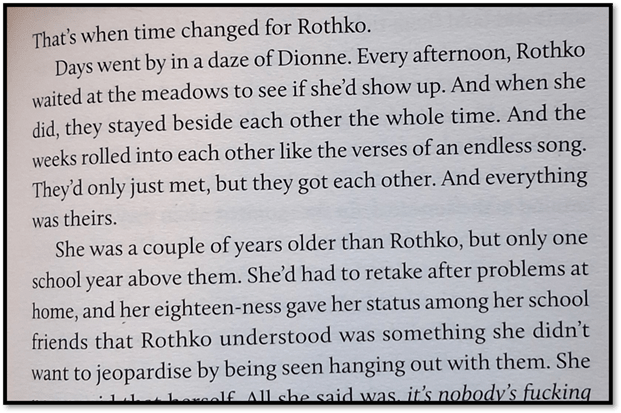
This is essential to the theme of the book which is about the experiential feel of time as it passes, that comes to a cris when near the end of the novel, with Rothko having near completed his transition psychologically is caught at a moment thus: ‘Time was pounding in his ears’, where the pronoun matters in determining the sense of the whole. In the passage quoted time and change appear to collide in new regulation of the former, wherein ‘weeks rolled into each other like the verses of an endless song’. Suddenly putting the infinite into the finite of time is no longer a problem, though the resolution is teenage and naïve to say the least.
The exaggerations are those of teenage talk, phrases like ‘the whole time’, which express what time feels like not a serial grasp of real events. The days are what are in a daze not Dionne but the two hardly feel different, or did not at that time. That is why ‘time changed’ not Rothko, in their mind. In my view this is clever prose, whether I like it or not .And what makes it so is he mix of discourses about passing and past time here – amidst teenage preoccupations about age and status, such as ‘eighteenness’. What makes it poignant is that we will later discover that it is Dionne’s struggles with heteronormativity and homophobia that really causes the distance between the putative lovers.
But there is an another ‘element of the novel’ too that Bari finds deficient in this novel – plot and storytelling. Bari says with some truth that; ‘Tempest structures the novel simply, with a long flashback bridging the past to the present and filling in the backstory’ but without linking this to other ways in the subject of time matters in the novel. What Bari finds wrong is that the plot, in her view, is really not plot at all but an obsessive desire to add to the literature of ‘trauma’, making it clear that such the processes involved in the story of experienced ‘trauma’ may be of value but not as story:
Trauma, of different kinds, is the book’s primary concern. But trauma in itself doesn’t constitute a plot. And it doesn’t follow that cataloguing the traumatic events of a life would be the best way to carry a reader into the experience of it. When Rothko descends into addiction, Tempest writes: “Rothko came to and the whole world was carnage. Monsters in the dark sniffing canisters of varnish.” Rather than elevating the prose, the rhymes feel glib and the sentiment vague, shorthand for an unspecified intensity: “They wanted things they couldn’t name; they wanted rest. They wanted change.”
But that is only so if you refuse to deal with every paradigm of plot the novel uses other than the timeline of the experience of trauma in different characters. There are many of these: not least the nostos theme / plot – the search for and return to a thing recognisable as a ‘home’, pursued by many more characters than Rothko. That theme itself is a means of addressing time as experienced as memory of quest and has been since The Odyssey. It manifests itself without overt display in Tempest’s novel – in innocent phrases like this at the opening of Chapter 9 of the book section called ‘Day One’; ‘Rothko was heading home’.[4] The theme appears with as little show at the opening of Chapter 9 of the second section entitled ‘The Old Days’: ‘“That you home?”[5] When Rothko re-unites with Dionne in the third section entitled ‘Today ‘it is expressed thus: ‘“I feel at home.” Rothko pulled back to look at her. “Seeing you again.” / “Me too.” …’[6] Set not as binary but a difference to home is the idea of transience: “Transient people, from all over the world, who had, in one way or another, been burned by the fire out there’. Those are the people who, in jail, ‘had never known safety in their lives outside’.[7] Between transience and security is the homecoming, different for different people at different times in each of their lives and thence continually requiring to be learned, unlearned, relearned and then learned more deeply.
Nostos is a journey in time and space that is far from straight on and easily navigated, rather it seeks to experience time as an opportunity for change and ultimately resolution into some timeless solution. I think that I know that Tempest intended this because she ties the homecoming, however metaphoric that is, to the idea of Atonement: the process of returning to be ‘at one’ with the ideal from which one has wondered (the word derives from ‘at-onement’, the process of becoming One again with that one has been separated from or in exile from, sometime the Father, and in Christianity mediated by Christ. Bari does not see that the structure of the novel is not only about shifts in time (‘flashbacks’ in her terms) but about the revaluation of time, where change happens not only in time but to time as it circles back on itself. The end of the second book is the end of a poeticised form of narrative, using the poetic means of epic, assonance, alliteration, internal rhyme and which gathers itself to a processional return in what becomes at one is Time itself: [8]
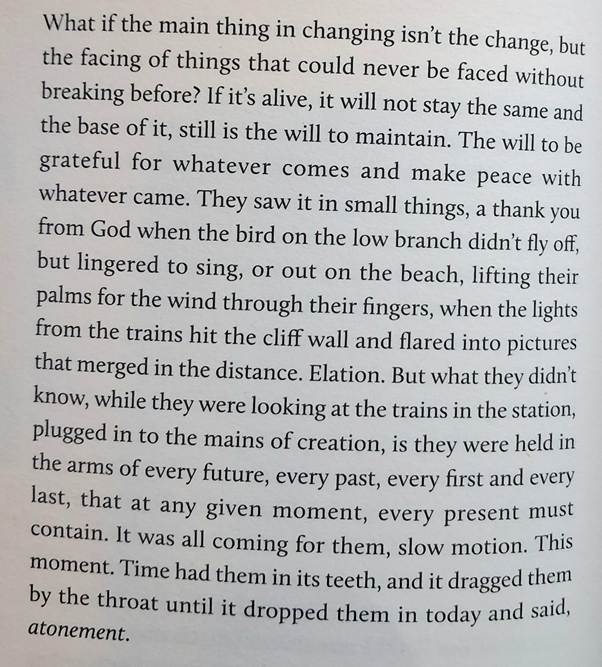
‘At-one-ment’ is how I was taught that word in school, and I rather like it. This novel takes the use of the word a lot further than most, even Ian McEwan’s Atonement. It drives it, for instance back to its roots and very different development as theology in Judaism, raised first by Ezra, who has taken on the role of father to Rothko. The Judaic doctrine differs because, unlike Christianity, atoning for sins against another person cannot be done through God, asking him to take on the sinful nature of man as Christ did, but must also pay its debt to the person. This is how Ezra uses with it Rothko, then described as daughter, who Ezra feels he has sinned against by omission of care, like the time when , her birth being difficult, he celebrates with a prayer ‘he used to say on Yom Kippur’, of course, the Jewish Day of Atonement with God and the community of others, ‘asking for atonement’. He does it again after they, the non-binary Rothko, has passed out under a mass of drugs. It is to Rothko he asks forgiveness because he had been guilty of ‘succumbing to confusion’ in his love for his child’s development through time, then repeating the question to God: “For all these sins, forgiving God, forgive us, pardon us, grant us atonement”.[9]
Atonement and nostos can be one and the same. Ezra, even if wrong-headedly for he mistakes ‘home’ as if it were a house appointed to bourgeois standards, constantly strategises the return to him of Rothko, as does Meg, her mother, in her confused way. Meanwhile Rothko remains lonely midst all this proffered community – the confusion being about who is my community in which I am at one. Ezra chooses a very old-fashioned way among Jews (but not only Jews) to express his love and oneness with Rothko: he ‘always sent money on Rothko’s birthdays’ . And he sends it with hand-written ‘prayers in gold envelopes’: ‘Hebrew on one side, English on the other. It was his way of maintaining a relationship’.[10]
Ezra was clearly not a thoughtless choice for his character’s name for The Book of Ezra in the Torah is the book defining, almost legalistically both the doctrine of Atonement and treating it in terms of a homecoming, for it established that the debts created that required atonement were debts of and to individuals as well as to God. Even the sacrifices made showed that atonement could not be won for everybody mortal, as Christ did by His sacrifice, but by the whole community and by each individual. The text I have linked to fills out the fact that The Book of Ezra, and particularly Ezra 8: 35 grounds the circumstances of the Jews returning ‘home’ to Jerusalem, in that they ‘seek reconciliation and covenant renewal before any further work or settlement’ in ‘atonement theology’.
Why this model of a homecoming as atonement and becoming at-one again with the past, God and the whole community is chosen I have not worked out, though I think it has a great del to do with how the best model of community in the novel is that formed by the ‘transient people’ and LGBTQ+ gathers in ‘Debasement’,[11] and, of course, especially trans people (the wonderful Fletcher for instance) where Rothko finds his home, together with Dionne. Atonement and homecoming clearly resonate with ‘coming out’ narratives, whether as a lesbian, in the case of both Dionne, and the much more significant journey of the once violently homophobic, Angel Douglas. A central episode is where Angel spits at Rothko. You have to have a good memory of and in time to connect that with the fact that later, but lot earlier in the organisation of the out-of-time story Angel sort-of atones for her homophobia, though not yet to Rothko who was its victim. When Angel’s girlfriend, Trish condemns homophobes:
Angel rolled from her side, onto her back. “I was homophobic”. Tone dull as she confessed it, holding herself when she spoke. Hand under her armpit, close to her heart. “I spat on someone once. On a bus.” Trish winced. Angel nodded. “for kissing her girlfriend.”[12]
A lot of the energy of the writing goes moreover into a way of writing out sexual encounters with honesty as well as passion and without shame for their viscerality, such as the description of cunninglingus.[13] Writing about the embodied details of sex is not, of course, usually the sign of a homecoming, though in this novel one of its patterns of learning is about the power of touch between bodies and it is this sense that passage may be regarded as a consummation. Touch is literal but it is also, when mutual, the means by which the bounded loneliness of bodies is transformed into communion. I could write forever on touch on this novel, but look at how it binds itself into these passages on loneliness in this novel. The first passage is about Meg, Rothko’s mother, and her primal loneliness. It seems the extreme standard of what loneliness means:[14]
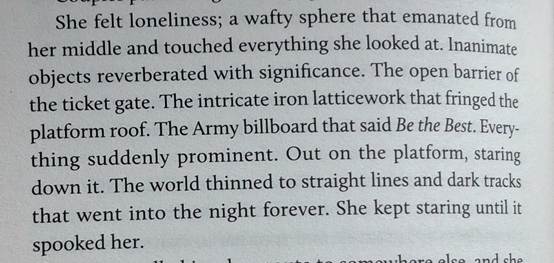
Loneliness is a projected feeling in and of the body that makes objects in the external world take on the symbolic meanings that loneliness prompts, but it does so by touching them in order to make them feel different. The symbols are weirdly contradictory – suggesting invitation and direction onwards in an increasingly abstract way but refusing to share their meaning with reciprocal animated feeling, for being inanimate and lacking an answering interiority is their only nature. This passage reverberates in me as I read statements such as that by Bari that the prose of the novel has not ‘any convincing sense of interiority or reflection’. For that passage is the reflection of lonely interiority turned outward. It makes me wonder which novel Bari read.
That loneliness Rothko feels in Edgecliff. Edgecliff is a deliberately chosen name for the emotions of those with already spent interiority which they quest for there. Despite Bari’s superiority about the poverty of its naming, Tempest makes this clear in a brutal revelation of the strategy of its naming, which I find halfway between verbal joking and symbols that alone suit the kind of stark realism of the phenomenon. Tempest’s words play games with the fact that you fall from the edges of things, cliffs spectacularly:
In Edgecliff, it wasn’t too far to fall from drinking to drunk. Or past drunk to the harder, thicker, dirtier afflictions that linger at the edge of sessions’.
No doubt Bari feels that proves her point but some readers read more in pursuit of what lies beneath than Bari does. When Edgecliff is described the failure of interiorising is entirely a psychosocial product of the existential loneliness fostered by class divided society:[15]
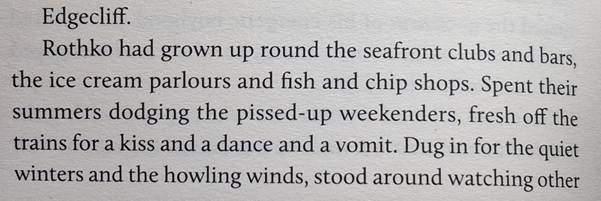
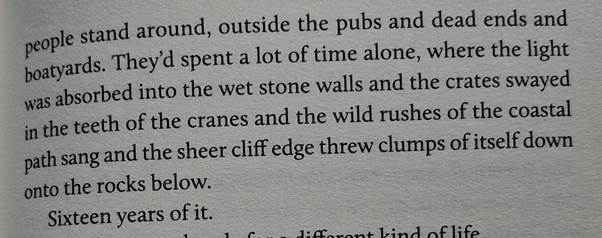
That prose-poetry is one again of failed interiority as a redemptive prose saved by external touch revealing itself in suppressed images of suicide (with another play on Edgecliff in the ‘sheer cliff’ which ‘threw clumps of itself down onto the rocks below’ and id dominated by people who experience time as ‘time alone’. Again, this seems to me good poetry, but I doubt Bari has read its models – in Edmund Spenser for instance.
The novel moves to community as a recovery from ‘Debasement’, the name Fletcher gives to the LGBTQ+ venue The Basement, where community revives from the margins.[16] But it moves there slowly. The reason we know it has not been achieved in Rothko’s youth when she first discovers a community that contains the then closeted Dionne, is that it is a space where nobody touches anyone else, other than functionally. It is a sad passage to end on, but much of the novel, and I would say of life, is. We need to recognise that it is not a club for the entitled only to pronounce upon in their chosen media:[17]
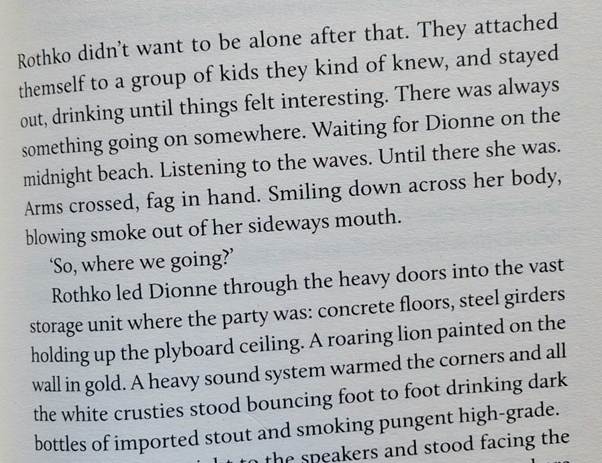
Attachment to a group you ‘kind of knew’ is not unusual, nor the need of alcohol to prompt interior response. The heavy externality of the club décor reveals that trait of the surprised lonely in a crowd and the division of people into unenterable unacceptable groups of others – like those ‘white crusties’ who no hip teenager can be seen with. Even the descriptions and perspectives that look down and across and express themselves from corners and margins are brilliant. I find that prose magical and beneath it some interiority sings, in for instance: ‘Listening to the waves’.
I chose to do this blog on this prompt question to express something like the internalised pain I feel about the entitlement of newspaper criticism like Bari’s, which uses its position of empowered discourse to damn that it does not understand and will not learn about. There is very little ‘lifelong learning’ in The Guardian critical group. They have done with all that learning and just want to impress on others the weight of that past learning. To be a ‘lifelong learner’ is to be open to things that confuse and surprise you by not answering meekly to what you already know. Please read Kae Tempest. You don’t need to be ‘gentle’ as he asks if you don’t want, as I am not with Bari, but do consider whether there is something in things that contradict your expectations that you might learn.
PS. I wanted to mention the dog, Don, for he is a favoured character. But read it, if only for him.
Bye for now
With love
Steven xxxxxxxxxxx
[1] Kae Tempest (2026: 247) Having Spent Life Seeking London, Jonathan Cape
[2] Shahidha Bari (2026) ‘Having Spent Life Seeking by Kae Tempest review – painfully earnest tale of trauma and transition’ in The Guardian (Tue 28 Apr 2026 09.00 BST Last modified on Tue 28 Apr 2026 16.30 BST) available at: https://www.theguardian.com/culture/2026/apr/28/having-spent-life-seeking-by-kae-tempest-review-painfully-earnest-tale-of-trauma-and-transition
[3] My photograph of Kae Tempest, op.cit: 153
[4] Ibid: 93
[5] Ibid: 211
[6] Ibid: 267
[7] Ibid: 47
[8] My photograph of detail from ibid: 250
[9] Ibid: 169 – 170
[10] Ibid: 77
[11] Ibid: 253
[12] The spitting is described ibid: 206ff, but mentioned as early as ibid: 100, in this quotation.
[13] Ibid: 278
[14] My photograph of extract from ibid: 54
[15] My photographs of extract from ibid: 146 – 147
[16] Ibid: 253
[17] My photograph of extract from ibid: 175


6 thoughts on “The answer to whether one is a ‘lifelong learner’ is the title of the latest novel by Kae Tempest, namely ‘Having Spent Life Seeking’: as for what we seek to learn is it this? – ‘How to get by without ever getting anywhere, when getting through a minute was infinite; but every ending achieved was still only the beginning’.”