


Does the spirit need to keep alert or care less about what must happen and sleep more deeply!
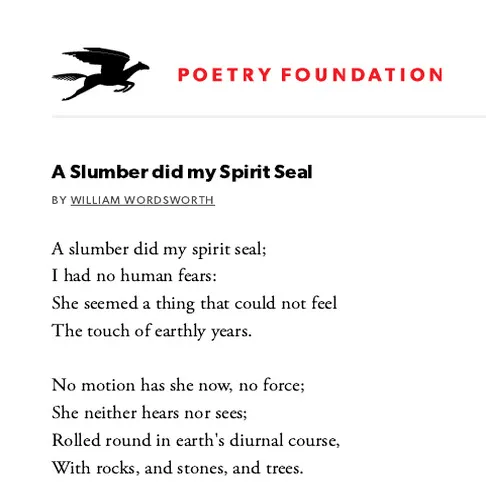
Let’s take advice from Wordsworth about the attention we give to the mutability of things in the world and how it affects our sleep in his most haunting of the ‘Lucy’ poems, A Slumber did my Spirit Seal . It is a poem that though only deceptively simple, invites some discomfort that people sometimes try to locate in its word associations. I can never forget now a beloved English teacher in secondary school when i first read this asserting that the word ‘seal’ carried association to the word usually spelled ‘seel’ and used to describe the old practice of sewing shut a young and flighty falcon’s eyes until it it was domesticated.
Strangely enough it works in terms of the wider meanings of the poem – medieval falconers seeled the birds eyes to reduce its anxiety to the state of being tamed to human uses, before removing the threads that bound its eyelids together, allowing the bird to now act appropriately, using its natural hunting instincts and alertness to its enslaved status. But I wonder if the violence of the image works in the local sense required in the first two lines of the poem, in which the alliteration aims to soothe the attention to sleep rather than enforce it physically. But is it sleep that seals the spirit, for ‘slumber’ even from its origins, is a sub-category of sleep to which ideas of light or fitful versions of sleeping are mainly associated rather than deep (non-REM) sleep as we might call it now.
Sealing meaning ‘closing up’ an object, such as a box, chest, or even a letter, until deliberately forced open comes from the used of wax to seal a document to keep it secret in transit with wax, the name itself deriving from the embossed design, often bearing the identifying insignia of the sender or authority of the document writer’s role or identity, used to press the wax down to form the seal. But in Wordsworth it even floats through from the stamping process involved in its etymology – the ‘spirit’ is ‘sealed’, in the sense of being enclosed and contained, although even then the metaphor is a distant one – the spirit is ‘sealed’ not because it is shut into anything but because it is acted upon by sleep. But wait! ‘slumber’ is not sleep, even in etymologically, as in the Online EtymologybDictionary:
slumber (n.): mid-14c., slomber, “sleep, repose,” from slumber (v.). Earlier noun was Middle English slume “a drowsy state,” from Old English sluma.
slumber (v.): mid-14c., slomberen, “doze, drowse, sleep lightly,” an alteration of slumeren (mid-13c.), frequentative form of slumen “to doze,” which is probably from Old English sluma “light sleep” (compare Middle Dutch slumen, Dutch sluimeren, Middle Low German slummern “become drowsy,” German schlummern “to slumber”). With Germanic verbal suffix indicating repeated or diminutive action (see -er (4)).Frequentative on the notion of “intermittent light sleep.” Of things, “be in a state of inactivity,” by 1580s.
If the violence of embossing or of enforced eye closure with thread haunt this, they haunt in the way that we are always under threat of waking in our lightest sleep modes, but they don’t linger – the point of Wordsworth’s lines is that in looking and reflecting on Lucy, his spirit is inattentive to anything that might disturb it, however present that threat remains. Of course, no-one reads ‘I had no human fears’ as if it was meant by the lyric voice – it is an assertion full of doubt of itself, doubt that emerges in the next line when the voice in retrospect admits that Lucy only ‘seemed’ untouchable by mortality. But think of the words ‘that could not feel’: for a moment before the enjambment operates we sense Lucy as a human without feelings, but particularly feelings, as the enjambment runs-on arising from external touch. This is another haunting idea behind the poem, the longing that Lucy might respond to ‘touch’ though she does not, and it is presented as a thing that calms the fears of the lyric voice.
As the second stanza moves from past reflection to a continual and continuing present, Lucy’s death means that not only feeling is absent in her but all human senses (‘hears and sees’). And then the violence of the presence of her body, unfeeling and insensate as it must be, as she has become an object with other objects, but note with objects that rhough incapable of motion from one place, still living, ‘trees’.
A Slumber did my Spirit Seal

A slumber did my spirit seal;
I had no human fears:
She seemed a thing that could not feel
The touch of earthly years.

No motion has she now, no force;
She neither hears nor sees;
Rolled round in earth's diurnal course,
With rocks, and stones, and trees.
I barely comprehend how great this poem feels to me: replete with the unsaid, the omitted and worse, the nearly said but unavowed and horrific in violence of feeling sealed in its rhythms and metre. But the second stanza appears to mimic acceptance of mortality, and obedience to the course run by cyclical time in what we call nature but something that includes hard bruising things like rocks and stones.
I will never know if Wordsworth is telling us that the unsealed spirit must live in perpetual vigilance, our attention fixed in the things animated only by the turning of the earth, and thus without care because without hope for what is human. He may be saying that insensaye to inner and outer world, we fall into the most deep sleep where even dreams may not trouble us. For will we sleep more deeply if we accept that care is a thing that ails us even in light sleep and that beyond fitful slumber and consciousness of the senses ourselves, we sleep because we neither care nor attend to the troubles of tne diurnal course.
What do you think?
With love,
Steven xxxxxxx.

