Describe a failure that, looking back, was actually one of the best things that ever happened to you.
View all responses
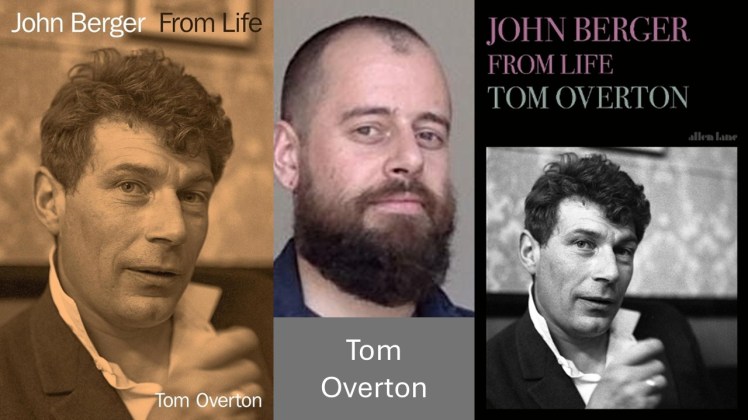
This is a blog based on reading Tom Overton (2026) ‘John Berger: From Life‘, London, Allen Lane : Part One: Finding helpful failutre in the scope of great lives.
Failure is a term that, like others has a rich history as a term. Here is the Online Etymoloy Dictionary’s history of it:
Fail (v.) c. 1200, failen, “be unsuccessful in accomplishing a purpose;” also “cease to exist or to function, come to an end;” early 13c. as “fail in expectation or performance,” from Old French falir “be lacking, miss, not succeed; run out, come to an end; err, make a mistake; be dying; let down, disappoint” (11c., Modern French faillir), This is from Vulgar Latin *fallire, from Latin fallere “to trip, cause to fall;” figuratively “to deceive, trick, dupe, cheat, elude; fail, be lacking or defective.”
De Vaan traces this to a PIE root meaning “to stumble” (source also of Sanskrit skhalate “to stumble, fail;” Middle Persian škarwidan “to stumble, stagger;” Greek sphallein “to bring or throw down,” sphallomai “to fall;” Armenian sxalem “to stumble, fail”). If so, the Latin sense is a metaphorical shift from “stumble” to “deceive.” Related: Failed; failing.
Replaced Old English abreoðan. It is attested from c. 1200 as “be unsuccessful in accomplishing a purpose;” also “cease to exist or to function, come to an end;” early 13c. as “fail in expectation or performance.”
From mid-13c. of food, goods, etc., “to run short in supply, be used up;” from c. 1300 of crops, seeds, land. From c. 1300 of strength, spirits, courage, etc., “suffer loss of vigor; grow feeble;” from mid-14c. of persons. From late 14c. of material objects, “break down, go to pieces.
There is always room for the kinds of ambiguity in uses of the term that come from its different roots in other languages and their routes towards English, which accrue other meanings. There is a vast difference however between a failure used to indicate, as in the ‘PIE root meaning “to stumble” (source also of Sanskrit skhalate “to stumble, fail;” Middle Persian škarwidan “to stumble, stagger;” as argued by one authority to the end-related derivation from Latin, that leaves it meaning ‘be unsuccessful in accomplishing a purpose;” also “cease to exist or to function, come to an end;”. What the Dictionary calls ‘a metaphorical shift from “stumble”’ is actually achieved by seeing failure not as an event to be overcome along our way, wherein we all ‘stumble’ sometimes to something final or ‘end-related’ and definitive.
WordPress often invites you to write about failure and many do so to try to diminish or negate the idea of failure, as a thing to be forgotten in the process of ‘moving on’. Yet I have accepted the challenge many times when it has been asked of us, largely to invoke a poem I love so much, namely Robert Browning’s Childe Roland To The Dark Tower Came, of which every stanza is a meditation on failure in different guises. Let’s take Stanza 4:
For, what with my whole world-wide wandering,
    What with my search drawn out thro' years, my hope
    Dwindled into a ghost not fit to cope
With that obstreperous joy success would bring,—
I hardly tried now to rebuke the spring
    My heart made, finding failure in its scope.
Nowhere does poetry express ‘failure’ as an aim that can come to seem more urgently necessary to invoke in the kind of quest for meaning lives can become than in the the pale image created herein of ‘success’, a kind of wild hope fit only for the very young and not yet disappointed. Maybe that is the case because, for Roland the knight, failure is a true end, in almost every sense of the word ‘end’. Let’s state some alternative meanings of the word as Merriam Webster Dictionary gives them, for all of which there could be justification in that poem in interpreting the lines from it, proceeding those above: .”.. Yet acquiescingly / I did turn as he pointed; neither pride / Nor hope rekindling at the end descried, / So much as gladness that some end might be‘. Try applying all, each in turn, of the word’s given meanings from Merriam Webster to those lines. Here they are:
a: the part of an area that lies at the boundary
b(1):: a point that marks the extent of something
(2): the point where something ceases to exist (e.g. world without end)
c: the extreme or last part lengthwise : tip
d: the terminal unit of something spatial that is marked off by units
e: a player stationed at the extremity of a line or team (as in football)
2a: cessation of a course of action, pursuit, or activity
b: death, destruction
c(1): the ultimate state
3: something incomplete, fragmentary, or undersized : remnant
4a: an outcome worked toward : purpose (e.g. … the end of poetry is to be poetry …—R. P. Warren)
b: the object by virtue of or for the sake of which an event takes place
5a: a share in an undertaking (e.g kept your end up)
b: a particular operation or aspect of an undertaking or organization (e.g. the sales end of the business)
6: something that is extreme : ultimate —used with the
7: a period of action or turn in any of various sports events (such as archery or lawn bowling)
The point Child Roland makes about failure is that it defines an ‘end’ that completes or finishes something in the way success never quite can. We have to be careful with our terms here. After all, if failure is only a stage in working towards later success (and it invariably is in most success stories, a ‘stumble’ along the way), it is not (in the end) really deserving of that name, and in many ways, we ought to use it only when failure is the end of attempting, however many times, to succeed, and when we no longer seek to complete the task at all or cannot do so, perhaps because we die in the process or as a result of the process. Clearly it is only because Roland fails in every sense of meeting his purposive end that he can be said to have failed AT THE END, the only place you can fail perhaps – to become amongst the ghosts of the dead failures he sees surrounding him at the end of his quest.
For many reasons death is often equated with ‘failure’, not least in the now worn-out medical model of the physician or doctor’s role, and this makes Berger’s veneration, almost in the very space in communal social life where religion once stood, of the life of community-based doctors the more important. The key book is the wonderful A Fortunate Man, although his work with Dr Iona Heath continued the motif. No true doctor sees death as an emblem of their failure, too easily equated with the inability to cure or redeem the physical body, or of the person who dies.
This idea gives me a way into Overton’s biography, for Overton treats, A Fortunate Man, as one of a trilogy of innovative biographies by Berger himself, apparently barely related at all to each other on the surface except in the near sequence of their order of writing, that form of a project, almost philosophical in intent, of what life means and how it can be evaluated as a project both of the liver of it and the observer thereof, from whatever distance, even those constituted by years of the passage of time since death or the mediation of the experience- in writing, drawing, or painting, all of which can be done, ‘from life’, this biography’s subtitle. In chapter 7 on ‘Three Biographies’ he calls the books at his centre, following his first three novels, ‘a sequence of three biographies’. The key point is how much they are a sequence other than in order of appearance, how much, that is, they are driven by a common theme about how to draw up and highlight a life into meaningfulness.
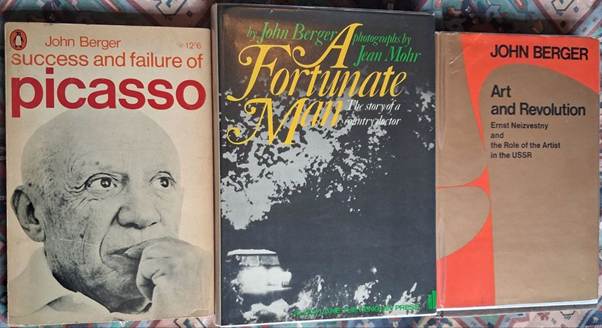
At their centre is the DOCTOR in A Fortunate Man, based on John Eskell, Berger’s own family doctor, but named in the book as John Sassall, though Eskell is the photographic model too for Jean Mohr’s extraording narrative photographs. Sassall is the ‘transformative type’ which, it is believed by Overton, Eskell wished very seriously to become through his involvement in the project and which some believe help lead him to his eventually completed suicide, an attempt failed in before to Berger’s knowledge. Berger was a man who changed theory into narrative and the theory of ‘unfixed transformation types’ was taken from the Marxist intellectual and literary critic, forever now tarred with links to Stalin, György Lukács‘ The Historical Novel. This book dealt with nineteenth-century European historical novels starting from the ernormous importance across Europe of the novels of Sir Walter Scott. There is sufficient explanation of the theory in Wikipedia, quoted below:
… While prior to 1789,[Lukács] argues, people’s consciousness of history was relatively underdeveloped, the French Revolution and Napoleonic wars that followed brought about a realisation of the constantly changing, evolving character of human existence. This new historical consciousness was reflected in the work of Sir Walter Scott, whose novels use ‘representative’ or ‘typical’ characters to dramatise major social conflicts and historical transformations, for example, the dissolution of feudal society in the Scottish Highlands and the entrenchment of mercantile capitalism. Lukács argues that Scott’s new brand of historical realism was taken up by Balzac and Tolstoy, and enabled novelists to depict contemporary social life not as a static drama of fixed, universal types, but rather as a moment of history, constantly changing, open to the potential of revolutionary transformation.
The move from fixed to transformational types, who need not be as ‘revolutionary’ as the changes through which they live, might explain many novels but for a Doctor, it involves a new relation to the cycles of life and death previously the province of afterlives promoted in redemptive religions (personally I think we some sense of this in Wuthering Heights). Berger took Eskell’s genuine interest, not uncommon in the period, in the psychodynamics of General Practice promoted by Michael Balint, particularly in his 1955 The Doctor, His Patient and the Illness. As a transformative type, the general practice (GP) doctor matters because he serves a community in change (personal, social, historical) around issues of life and death, as Berger says in a passage Overton picks out as that which ‘most obviously sets out what he hopes to achieve in his writing’:[1]
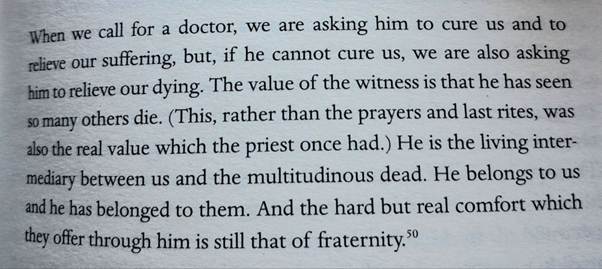
Do we, however, achieve a moment of recognition of the reason people so often equate life with success and vice-versa in the peculiar way in which death is regarded as the ultimate failure in modernity, failure of cure in the doctor, failure of the functions of self in the dying person and the visible failure of body systems. We seek not success as such in staying alive but ongoing life itself in which to define, meet and maintain our goal driven projects and desires. Failure alternatively is a negation of life that might as well mean ‘death’, if it can’t be ‘forgotten’ / ‘repressed’ and moved on from. In this configuration of feeling, life is the reward of our attempt to achieve the grace of well-being, death the sign of our disgrace and the total sum of our ill being. Yet is it really a solitary standard of what it means to achieve continuity of life, especially if death is the end of all preferred self-identification?
In recent times, philosophers of identity have turned against the notion of a continuous sameness we call identity in in the consciousness of life-forms. Derek Parfit argues that continued existence is never the end of identity but its achievement in the continua of all life in its essential otherness to the individual and to standards of homogeneity, but one which selves to have contributed and leave remnant signs of their contribution within that which does in fact continue. I think this is near Berger’s view of life identity, it inheres only in the wholeness of life, not in any one part, such as the ‘little’ individual’ consciousness. Hence, I would argue, lies the reason for Berger to write as Overton names them ‘a sequence of three biographies’, or three ‘lives’ more accurately of transformative types.
Let’s return to Picasso because this ‘life’ raises the issue of failure most pertinently, being entitled Success and Failure of Picasso. The important and daring was ‘failure’ in relation to Picasso. Overton brilliantly points out that though Berger’s treatment of why Picasso, acknowledged ‘genius’ for a long time by the time of Berger’s book was very much his own developed thesis, it owes much to a book thirty years before, Proudhon, Marx, Picasso: Three Studies in the Sociology of Art by Max Raphael. Overton cites Raphael’s point that ‘the need for a new, integral work of art adapted to a new social order, makes itself felt in all his creations. But all the convulsions and all the spiritual sufferings of a bourgeois genius will be inadequate ty meet the need’.
There is something like an accusation that the failure can be laid at the door of Picasso himself. What Berger developed from Raphael, however, was more a condemnation of the class who patronised Picasso not the painter himself, using a method of analysis Overton traces to Frederick Antal, , with Berger saying explicitly, and unlike Raphael: ‘what is in question here is not the personabilities of Picasso but, who is by far the most gifted and eminent artist of our day, but the general historical fate of the European Bourgeoisie’. Moreover, even more perceptively Overton tells us that the title of Picasso ‘life’ is ambiguous in relation to failure. Did Picasso fail his age in not seeking genuinely a ‘new social order’ (merely joining the Communist Party of France (PCF) did not fill the bill) or dis the bourgeois social order so encapsulate and drain him with vapid praise that it failed him primarily, his own failure being merely a consequence of that gross absorption.
Picasso failed insofar as, …, he was an artist without a province. He was constantly searching in the art-historical canon for a tradition, though he was more likely to try to outdo the dead than seek companionship with them. But, finally, the ‘of’ in The Success and Failure of Picasso is ambiguous: it leaves open who is doing the failing.[2]
I have not dealt with why the word ‘province’ is used here. Briefly Berger conceived as each and every present life-form as the meeting point of a vertical line, and an horizontal one. The latter represented geographical space, overlaid by various determinants of the meaning of space: cultural diversities, familial networks, nation, provincial identity both urban (or metropolitan) and rural, politics and governance). The former was the line of time ascending from the past and ascending projectively to the future. Was Picasso so deracinated (more strictly de-provinced) by his ambition and the bourgeoisie’s will to cast him into the genius of especially remarkable commodities (but those nevertheless) Were there better things to do with a line to Velasquez than to compete with him?
And then we need to consider the third life, that of dissident Soviet sculptor Ernst Neizvestny, called in brief Art And Revolution. I have long felt this book a disappointment, partly because in looking to find success in this artist that Picasso failed to achieve (Dr. Sassal achieves it but only in a small provincial manner as a country doctor of a Chekhovian type), Overton tells us Berger himself failed to point out that Neizvestny was man he failed to recognize as an artist with ‘a poor visual sense and a clichéd imagination’, Of course Overton also hints that Berger may have realized that by spending so little of the book on the art and much more about the changing nature of the world order towards a competitive capitalist (and state-capitalist in the USSSR’s case) imperialism and the need for rt primarily to address this as he would turning more and more to the issues of settler colonialism and the imperialist drive of monopoly capitalism.[3]
To underline his point about the Idea that lives were best seen as shaped as transformative types by global economic and political forces, where failure itself can be as or more significant than success, as in Picasso’s case – the failure was only visible because of the greatness of his personal successes, Overton considers during this chapter, Berger’s take on the death of Alberto Giacometti’ on 11 January 1996. Here, more than in Picasso was an artist defiantly the opposite of Berger’s successful representative type. His only message was that the social realm changing over time was irrelevant, It is only when he died, Overton shows us, that Berger rated Giacometti’s achievement, as a type whose very greatness was that he could only make art that showed that he was himself the focus of the vast social alienation in capitalism where artworks merely witness the absence of meaning in such great artistic lives, but only when these lives were over.: ‘Because Giacometti did not believe in society, he made his figures during his lifetime “for himself, as observers of his future absence, his death, his becoming unknowable’.[4]
This chapter so investigates the consequence of failure in life that it sets it up as achievement in itself, that when it does not illustrate types in transformative change, creates an artist figure, who, once dead, is the grandiosity of failure itself, a kind of Shelleyean Ozymandias.
I intend to close this part of my consideration of Overton here. I may come back to this to talk about another area where Overton shows Berger prescient of social change. I intend at least a Part Two on how his concern with death related him to the early days of the HIV pandemic in his great late novel To The Wedding, when diagnosis was a death sentence as it no longer is. Overton opened my eyes to how great Berger is on this.
But there is room for a Part 3 too on the motif of homelessness and migration, for no-one attempted to understand that subject as he did.
But that’s all for now.
With love
Steven xxxxxxxxxx
[1] Quotation and my photograph of Tom Overton (2026: 151) ‘John Berger: From Life’, London, Allen Lane.
[2] Ibid; 142.
[3] Ibid: 156
[4] Ibid: 155.

