What’s the best beach you’ve ever been to?
View all responses
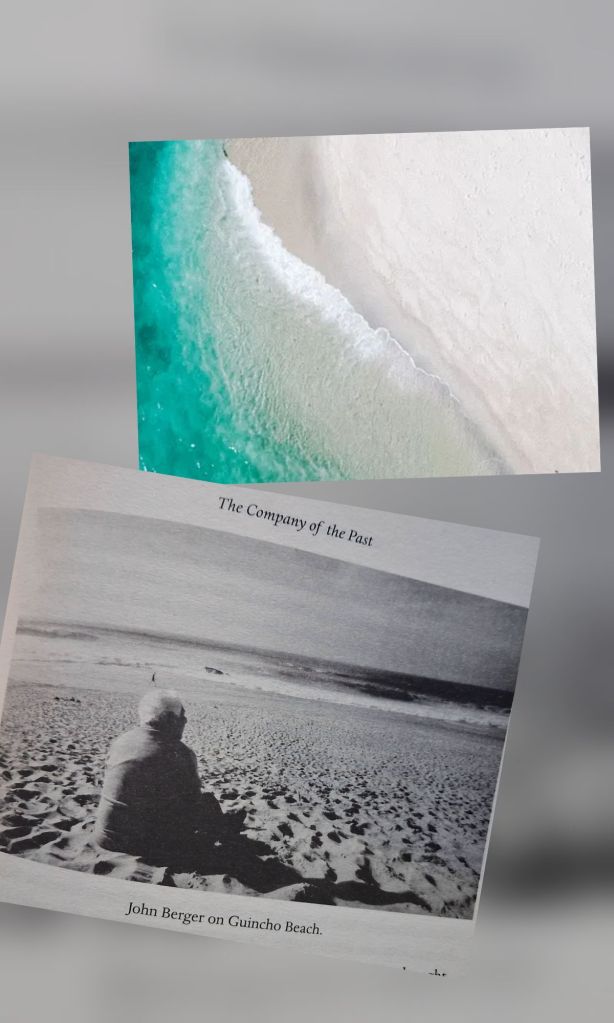
The art of visualizations and guided imagery are often thought of as the crowning triumph of those sham disciplines of positive psychology and self-help therapy, convincing us that we cn shape our neurons into utterly positive responses by suggestion alone. No doubt that is because they are not only easily learned but they require only descriptive elaboration of an initial idea to develop rather than nuance in thought and writing. In the ‘real’ experience is gritty with contradiction, incapable of entirely removing loss, stress or pain.
Visualized and guided imagery is in fact the only home of the ‘best beach you’ve ever been to’, a beach in the imagination, where refinement of the excess of sensation drowns out the complexity and contradictions of some sensations that are picked up in the body from numerous receptors never entirely in our control. Take a real life example (at this link), which comes clean at the end with some clarity about the fact that the last place you would ever use a ‘script’ evoking a beach, is on a real beach shared with other life-forms, human or otherwise, and sometimes keen on biting and nipping you, or where the environment and climate follows determinations beyond your control existent in the past, present and presages of the future.
Dr. Prentiss Prince guides us, or the students he claims to serve with easily accessible therapy, over the beach only to deceptively drop us or them back into our or their armchair(s), which take on, he belives, to our senses some of the qualities of the imagined beach, and its furniture, that he has already evoked:
Guided Imagery: The Beach
By: Prentiss Price, Ph.D.For a few moments allow yourself to take several nice, long, deep breaths. Notice the cool air coming in, filling your lungs, and the soothing warm air going out. Just let all your thoughts float away as you bring your attention to your breathing … in and out. You might mentally scan your body and notice if you’re holding any tension in your muscles. If you are, just gently let all that tension melt away with every out breath…. bring your attention to your breathing, in and out…. in and out… let yourself feel more and more comfortable sitting where you are.
In your mind’s eye you see yourself descending down a long, narrow, wooden stairway towards a beautiful, inviting beach. Your bare feet feel the rough weathered steps, and with each step, you feel more and more tension gently melting away from your body. As you continue down the stairway, you notice how the bright white sand stretches down the shoreline as far as you can see. The ocean is a deep shade of blue with the fine white crests of the waves sweeping towards the shore. You reach the end of the stairway and step down, sinking into the warm soothing sand. As you rub the sand lightly between your toes, a soothing sensation of relaxation gently melts through your entire body. The
roaring sounds of the sea’s surf, the waves crashing over each other, calms your mind and allows you to feel even more relaxed.You begin walking slowly towards the edge of the water and notice the warm sun on your face and shoulders. The salty smell of the sea air invigorates you, and you take in a deep breath… breathe slowly out… and feel more relaxed and refreshed. Finally, you reach the water’s edge and you gladly invite the waves to flow over your toes and ankles. You watch the waves glide smoothly towards you, gently sweeping around your feet, and the trails of sea water that flow slowly back out again. The cool water feels soft and comforting as you enjoy a few moments allowing yourself to gaze out on the far reaching horizon. Overhead, you notice two seagulls gracefully soaring high above the ocean waters, and you can hear their soft cries becoming faint as they glide away. And all of these sights, sounds, and sensations allow you to let go and relax more and more.
After a moment you begin strolling down the beach at the water’s edge. You feel a cool gentle breeze pressing lightly against your back, and with every step you feel yourself relaxing more and more. As you walk down the beach you notice the details of sights and sounds around you, and soothing sensations of the sun, the breeze, and the sand below your feet.
As you continue your leisurely walk down the beach, you notice a colorful beach chair resting in a nice peaceful spot where the powdery soft sand lies undisturbed. You approach this comfortable looking beach chair, then you sit down, lie back, and settle in. You take in a long deep breath, breathe slowly out, and feel even more relaxed and comfortable resting in your chair. For a few moments more, let yourself enjoy the sights and sounds of this beautiful day on the beach. And, when you feel ready, you can gently bring your attention back to the room… still letting yourself feel nice and comfortable sitting where you are.
Copyright 2003, Prentiss Price, Ph.D.
Counseling and Career Development Center
Georgia Southern University
Statesboro, GA 30460-8011
(912) 681-5541
http://students.georgiasouthern.edu/counselin
Though Prince copyrights this many of its elements are not of his invention, and although configured in his own way, anyone with experience of the field will recognise so much from many other versions. Much of its effects are often the result of empty abstract descriptors with vague evocation and are repeated – like the transformations from the noun ‘comfort’, and the verbs ‘to rest’ and ‘to relax’ and ‘to soothe’, and the adjective ‘soft’. The use of breathing and walking mindfulness techniques is constantly invoked too. The extremities of your body – those whose senses contact the solid ground like the feet, or objects or materials like the hands (but the feet more than hands for this sensations can be remembered as uncomplicated unnuanced sensation more easily) are in play throughout as imagined routes to the netvous system.exyending to the real thing.
I use this idea for this blog because I am still working on my blog on Tom Overton’s life of John Berger, which is taxing me, and this gives me ‘time out’, though not in the simple-minded manner of positive psychology. However, it comes too from a memory too of a picture of John Berger in very much older age, from the biography by Tom Overton, sat on a real beach, Guincho Beach, west of Lisbon in Portugal. It might confront Dr Prince, if he is confrontable, with the solidities of real mixed experience – the only experience we want ourselves redeemed from into significance rather than in the glossed over fantasies of academic counselling departments with their reductive view of their ‘clients’, or less than true ‘therapeutic’ counselling psychologists.
Now a picture of that real beach produced as advertising copy may well be a candidate for Dr Prince’s beach:, though I expect some elements would be censored out – the evidence of dngerous seas, cliffs and high Atlantic winds, or, perhaps, even the threatening cloud over Sintra (a name so associated with the decay of the Portuguese Empire).

The Praia do Guincho with the Sintra hills to the rear from https://lisbonlisboaportugal.com/lisbon-beaches/Praia-Guincho-beach-lisbon.html
However a photograph taken in passing of one friend by another may not be as focused on persuasion of a future visit but instead on tbe memory of a present fast to fade into the past, as in that below, if not in internal availability for fuzzily plastic recall. (I would so prefer another word than that of, as a noun, ‘plastic’; that sea-pollutant and life-form killer.)
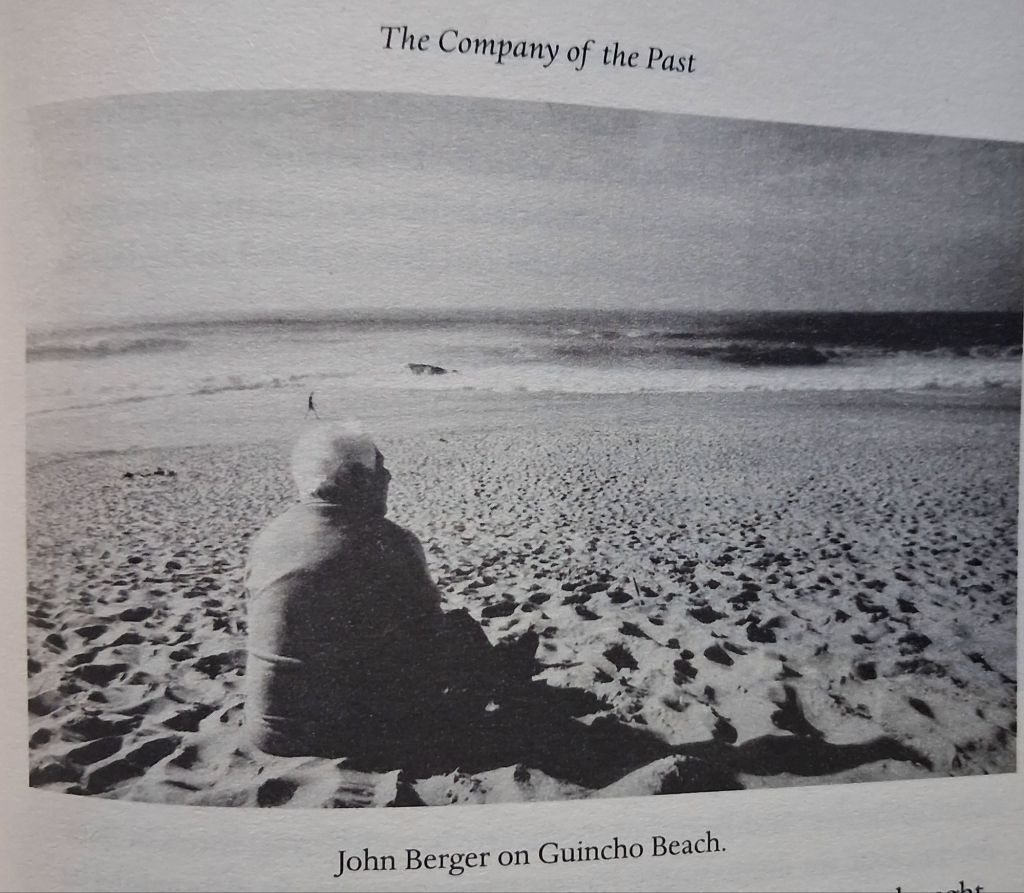
Many might call that a snapshot, taken without much care or attention. In fact, care guides it more than any other idea. And as for guidance around it, take the text surrounding it in Overton’s book, a prose so intense it shows guided imagery scripts in contrast to be what they are, a kind of deception of the senses and our memories of them. Note that by now Overton describes Berger entirely in the second person, ‘you’. It is as if all careful writing was an attempt at conversation, awaiting responses, as true counselling ought to be, also.
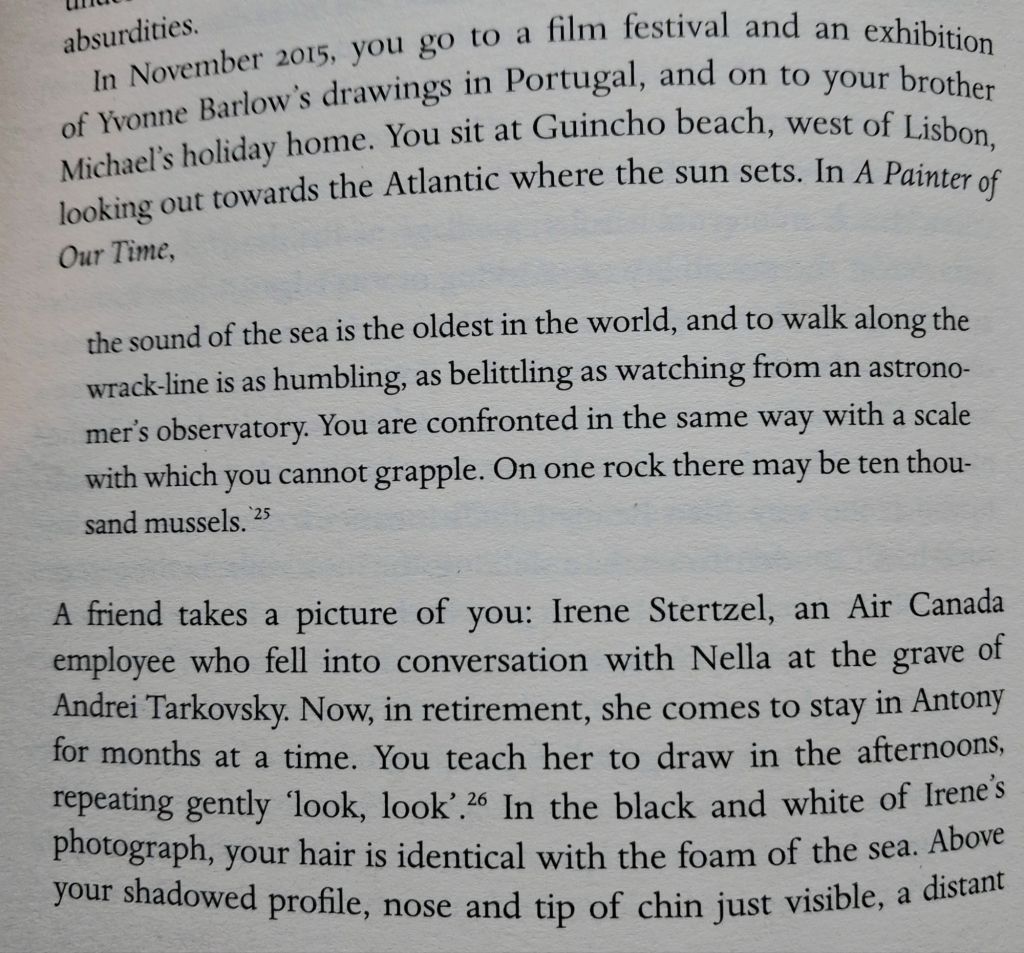
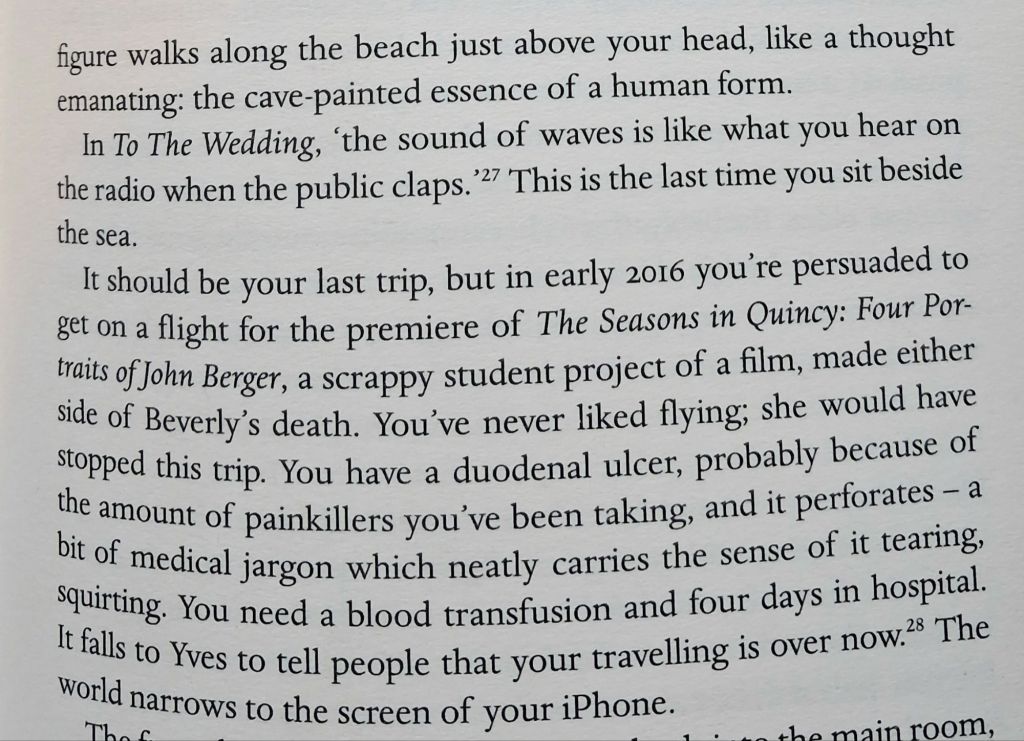
All that positive psychology avoids lives as they are experienced in those dying then lifting rhythms, before dying notes again show the feel of fine prose, and genuine feeling. Unlike the controlling enforcement of abstracted relaxation, good prose includes the methodologies which flash back and project in time and unite references to examples of distinct physical realities, here the sound of waves to different evocations of them at different times in a life. Those images enrich each other, with nuance (light and shade, life and death, and the realities to which we are guided in life-drawing), which is in part where I want to get to, a little way at least, in appreciating Overton’s biography when I approach it more as a whole in a later blog.
That beach is real and imaginary but in both cases it attests to the complexities not the reductive human-shaped forms of life, even those drawn on the walls of the caves at Lescaux. For that reason, that is truly the ‘best beach I have ever been to’. And the price of a book is so low compared to that of airfare to an imagined Nirvana, and its environmental cost very much lower, than for those summer tourists long to swelter in airless damp heat, and be murdered in a decorous way, still the envy of their friends.
Bye for now
With love, Steven xxxxxxx

