


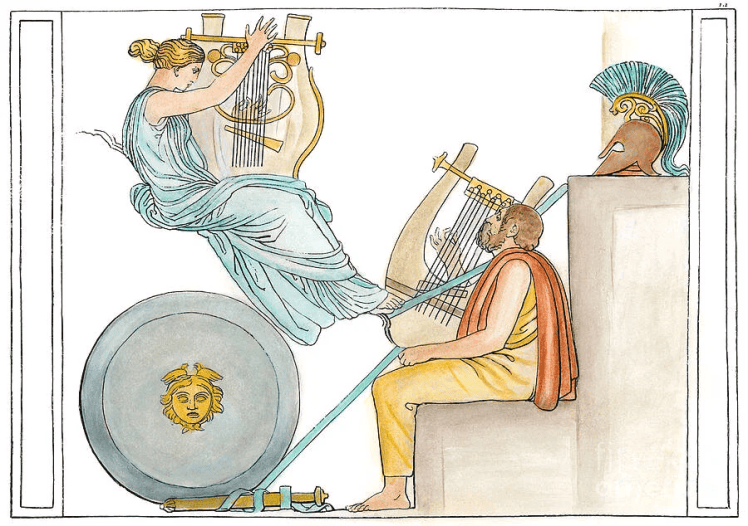
There is, of course, an important and inalienable link being writing and reading, for nothing that is written isn’t from its inception being read, even if only by its writer who assesses as they proceed that the writing is satisfactory to them or its intended audience. The standards of reading judgement vary of course and it is often the convention to discriminate them by a metaphoric binary of high and low, refined and crude taste, in which the writer aligns themselves withe the former alternative and against the latter, a trait picked up from Classical Roman poetry, constantly suffered with class consciousness. Here is John Milton’s famous take on it from Paradise Lost Book 7, as he reviews the writing he has written, which he names metaphorically as the song he has thus so far sung:
Half yet remaines unsung, but narrower bound
Within the visible Diurnal Spheare;
Standing on Earth, not rapt above the Pole,
More safe I Sing with mortal voice, unchang'd
To hoarce or mute, though fall'n on evil dayes,
On evil dayes though fall'n, and evil tongues;
In darkness, and with dangers compast round,
And solitude; yet not alone, while thou
Visit'st my slumbers Nightly, or when Morn
Purples the East: still govern thou my Song,
Urania, and fit audience find, though few.
But drive farr off the barbarous dissonance
Of Bacchus and his revellers, the Race
Of that wilde Rout that tore the Thracian Bard
In Rhodope, where Woods and Rocks had Eares
To rapture, till the savage clamor dround
Both Harp and Voice; nor could the Muse defend
Her Son.   So fail not thou, who thee implores:
For thou are Heav'nlie, shee an emptie dreame.
The binary here is between the heavenly voice of Urania, muse of the stars and all tbings ‘high’ and the Muse, whose content is that of the desires and human want, Erotica, not of the harp and voice and very low in tbe order establishing a pyramid to the heavens, ‘Bacchus and his revelers’, the Dionysian rabble that also followed Comus in Milton’s much earlier masque of that name. The poet torn in pieces, the process called sparagmos by the Greeks,the son indeed of the Heavenly Muse in Milton’s genealogy of poetry.
Milton’s whole point is that he feels the desires and wants of the world’s reader against him as they were Orpheus, unwilling to aspire to the highest, they grovel in the mire of a ‘good read’, or a Cavalier government, that which claims to answer to the most immediate wants of humans. Hence, he embraces isolation seeking ‘fit audience find, though few’, and in the interim, whilst that audience are yet unfound, sings to please himself, whose high standards are guaranteed.
Of course, I don’t identify with Milton. I don’t write what people, or at least many people, want to read, but that isn’t because I deem my tastes superior to the wants of others or my writing any good by any standard, Miltonic or otherwise. I just feel it is different from those that satisfy their wants, being too absorbed in my own (and that is a self-criticism), those which circle on my own learning, often at the cost of accuracy, but is shared only because modernity offers us an accessible platform on which to write.
To write what other people want is the cry these days even of instituational education, often with its own increasingly remote standards based neither on excellence or desire but that shifting standard of the bourgeoisie of tbe current time, appropriateness, as adjudged by tbe peers of teachers who populate that rank of teachers. It is a blessing to be removed from.what they want, which is what they have indubitably been taught and moulded to want.
Better the taste of tbe many than that middling (or middlebrow) crew. But to learn still demands we go further than uninformed wants to wants transformed beyond the immediately available, to some principle that infused our wants with a communication goal that is still aspiration to the better for all and based on the indirect want of seeking means for aspiration which is as inclusive as comprehensive but not without cost to anybody.
So I write to learn but not to influence and so want no readers who don’t want what I write, since I have no confidence in my direction or goal as a thing that is prescribed but only emergent from the process of the writing. And, if it is emergent just for me and anyone else, though few, that respond in any way to it, so be it. There are no certain guarantees of worth and value in the world and, in my view, no transcendent ones.
Bye for now, with love,
Steven xxxxxxx

