


Making time to fill with self-care
Leaves no time still to stand and stare: Help me W.H. Davies!
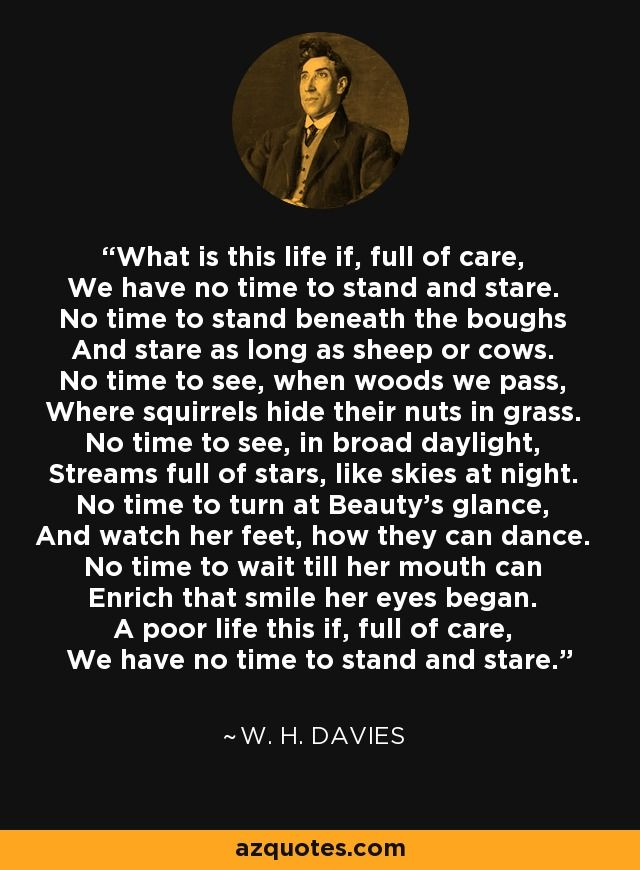
I have no great love for W.H. Davies’ poem Leisure, but it feels relevant to this question, opening up the terrible gap in time that cultural ideologies create around words so that a question like our prompt question can be asked: ‘How do you make time for self-care?’ How arduous it feels to ‘make time’ in order to do, whatever we take that kind of word-play ‘self-care’, to mean – how much once we have decided on its meanings and practices it sounds like work of some kind, having devised them with intent, to implement them. How little does self-care vary from self-interest in most explanations of it? This is so much the case that taking time to self-care, scheduling it, as it were, into our workload, is often disguised under natural metaphors the Australian internet mental health resource pack says that people who are carers for others in their role at work or home, need to think of themselves as a huge sheltering tree, whose support is limited if it depletes resources to enable its own growth or diverts those resources elsewhere. But the metaphor is flawed. Great oaks do not consider how to allocate their time according to a schedule or work at that allocation by reserving energy from others in their own interests, justifying it by saying to themselves – my interests are in the long term those that will ensure I can show interest in others and care for them because I took time to care for me. Only humans turn their allocation of resources to themselves into a plan to be implemented and then implement it.
There is little difference here between the descriptors ‘selfish’ and ‘self-caring’ despite the many care-based web-pages dedicated to say there is. Of course in some of these web-pages the self-care intended is a kind of disciplined back-step from ‘care’ and ‘responsibility’, often advocating some kind of meditative use of time, although it doesn’t take long for that same linked web-page to link you to a commodity that the writers want to sell to you, obviously linking at least their work and self-care simultaneously to self-interest. As a past care-orientated professional in a number of domains, paid workers have often urged me to take time for myself forgetting my responsibility for others whilst forgetting that they as often refer to time when I, and they, are being paid to help others, not always handsomely but usually much more in some system of remuneration for being open to others than the people I am helping, who do the same because they must.
Moreover, when justifying time out for oneself, those care-practitioner managers were more often justifying a two week (or more) holiday in the Caribbean than the time they also took during work time to meditate. Rather than be honest about self-interest in a system that justified that in terms of taking time off the paid were more than equal than those unpaid others, for which life was continuous hustle and hassle. There is as always an issue about the meaning of words behind this. Let’s take the complicated etymologies behind the word ‘care’, where at least two distinct histories ate involved. One of these is the notion of ‘care’ as a burden of human life regardless of work in which sickness, accident, death, mourning and unfulfilled, and even idealised poverty that some remedy is sought such that the cause of complaint may be nullified in effect: of a plaint or complaint about the existential nature of life itself without that remedy. The other is the act of protecting someone or something from such ills and nurturing it. As the Online Etymological Dictionary says, these meanings may stem from different words that still create further nuance from their parallel histories.
care (n.):Old English caru, cearu “sorrow, anxiety, grief,” also “burdens of mind; serious mental attention,” in late Old English also “concern, anxiety caused by apprehension of evil or the weight of many burdens,” from Proto-Germanic *karō “lament; grief, care” (source also of Old Saxon kara “sorrow;” Old High German chara “wail, lament;” Gothic kara “sorrow, trouble, care;” German Karfreitag “Good Friday;” see care (v.)).
The meaning “charge, oversight, attention or heed with a view to safety or protection” is attested from c. 1400; this is the sense in care of in addressing (1840). The meaning “object or matter of concern” is from 1580s. To take care of “take in hand, do” is from 1580s; take care “be careful” also is from 1580s.
The primary sense is that of inward grief, and the word is not connected, either in sense or form, with L. cura, care, of which the primary sense is pains or trouble bestowed upon something. [Century Dictionary]
care (v.): Old English carian, cearian “be anxious or solicitous; grieve; feel concern or interest,” from Proto-Germanic *karo- “lament,” hence “grief, care” (source also of Old Saxon karon “to lament, to care, to sorrow, complain,” Old High German charon “complain, lament,” Gothic karon “be anxious”), said to be from PIE root *gar- “cry out, call, scream” (source also of Irish gairm “shout, cry, call;” see garrulous).
If so, the prehistoric sense development is from “cry” to “lamentation” to “grief.” A different sense evolution is represented in related Dutch karig “scanty, frugal,” German karg “stingy, scanty.” It is not considered to be related to Latin cura. Positive senses, such as “have an inclination” (1550s); “have fondness for” (1520s) seem to have developed later as mirrors to the earlier negative ones.
This is an explanation that, like those of Coleridge, in Byron’s estimation in his dedication to Don Juan, of the Laker poet ‘taking wing’ by ‘explaining metaphysics to the nation’, one hopes that someone will hereafter ‘explain’ that ‘explanation, in both cases. But, as I see it the issue is that though ‘care’ is the thing that makes life hard and engenders complaint from the sensitive, it can also be making effort to remedy situations and persons from the effects of those things that bring about the first kind of care. Now I think this matters in Leisure. The first line seems a ‘plaint’ or complaint of an existential kind, saying directly that life is of unknown meaning or value and perhaps of none, if it is ‘full of care’ (grief or other cause of lament. Only when we take into account the next line do we see that there is a remedy that might make life sustainable and have meaning and value. That remedy is to find time to ‘stand and stare’. Now this remedy is not the same as that proposed by self-care – I imagine if it did it might read:
What is this life of work and care,
If there's no time left to self-care.
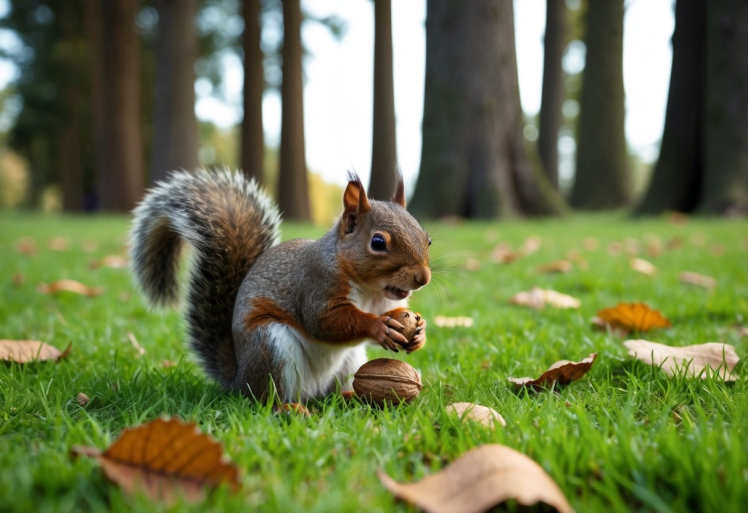
But it doesn’t. The choice of ‘standing and staring’ is made because it is an period of inactivity in which nothing is done that has any value at all, rather than the hard work of reading your self-care manual, applying it to your life by a time of reflection, planning a strategy of self-care and implementing it. Instead just ‘stand and stare’. That the task has no value is revealed by the examples. sheep and cows do indeed spend a long time ‘standing and staring, but isn’t that because we domesticate them in fields with barriers to their freedom and intend to slaughter them for meat or use them in a way that they did not choose. And though we do not work when we watch squirrels live their life, even all the myriad of schoolboys (it was always a boys’ poem) who tittered over these lines in twentieth-century classrooms as I did at fourteen and fifteen (I can’t imagine it being read out to them now) because it referred to ‘nuts’, who wouldn’t tell you either from the squirrel’s survival perspective or their own obsessive that the care of ones nuts is a very serious business indeed and not just like ‘standing and staring’. Now Davies as a poet knew that dancing feet were a thing of beauty in a poem because of the work of metric feet like those in these iambic tetrameter couplets, but you can’t forget that Davies is actually also saying that he is looking at a beautiful woman (‘her feet’ gives it away who because she smiled at him is fair game for him to apply his mouth or whatever to hers. This is about self-interest this poem – it shows the life of nature is hard except for animals we deliberatelt make passive to exploit them, and women we convince to be the signifiers of whatever heterosexual gypsy men (Davies wandered the country as a pretend gypsy) want to take from them, with no word of consent needed from their mouths, except that these men can interpret as they wish.
I think the rot starts in this poem when it moves from stating a fact, that life is full of cause for existential lament to making ‘care’ something to do with the need to work purposefully. And it does that by linking it to the idea of ‘time’ either used for a means or in idleness (for some at least – the poor squirrel is stressed about his nuts). People use ‘business’ (the work or the fact or appearance of ‘being busy’), Menzies Lyth argued in a study of nurses in a large hospital as a defence against anxiety they otherwise feel about their sense of role or personal inadequacy or worthlessness – the existential crisis itself – making the claim to ‘being busy’ a means of not confronting and not evaluating their anxiety and acknowledging its role in their personal and work lives.
Davies is no great poet and, in this poem, I think he stole one of his poorest rhymes as he uses it (pass / grass) from a stanza of Andrew Marvel’s The Garden; a stanza that makes it clear that idle time and retirement has its dangers too:
What wondrous life is this I lead!
Ripe apples drop about my head;
The luscious clusters of the vine
Upon my mouth do crush their wine;
The nectarine and curious peach
Into my hands themselves do reach;
Stumbling on melons as I pass,
Insnared with flowers, I fall on grass.
For Marvell, words like ‘fall’, especially where apples play a part recall the life of sin that followed the Fall of Humankind and that meant that idleness in Eden was always a lie in postlapsarian times, and would have as many consequences to us as action without some kind of grace to give it meaning. Marvell is locked up (‘Insnared’) and lost in the grass which is what ‘all flesh is’ according to 1 Peter 1, 24: ‘For all flesh is as grass, and all the glory of man as the flower of grass. The grass withereth, and the flower thereof falleth away’. Note how Marvell uses ‘pass’ to describe a journey of obstacles and barriers, totally absent from Davies. In Davies too the rhyme, is used to give the squirrels somewhere quite in-efficacious to ‘hide nuts’ if you need them for yourself later: ‘No time to see, when woods we pass, / Where squirrels hide their nuts in grass‘. It is clear that the rhyme is there because he needed one for his couplet and Marvell provided it, supposedly on a similar subject, but that if Davies knew anything about squirrel caching methods, he is n’t using the knowledge here.
But it is a pleasant enough pastime that poem. Why not stand and stare like cows and sheep if it helps you forget the existential chop exists for us all, and perhaps our nuts as well. So read it again below. But be aware that looking to self-care is a job of work and not like enjoying if you can an idle stand and stare pretending you are just noticing – which isn’t only what Davies is doing. He uses what he notices, especially in women, to his own advantage. The poverty addressed in the final couple is remedied by riches he aims to steal from ‘Beauty’s glance’, like any other rapist.
What is this life if, full of care,
We have no time to stand and stare.
No time to stand beneath the boughs
And stare as long as sheep or cows.
No time to see, when woods we pass,
Where squirrels hide their nuts in grass.
No time to see, in broad daylight,
Streams full of stars, like skies at night.
No time to turn at Beauty's glance,
And watch her feet, how they can dance.
No time to wait till her mouth can
Enrich that smile her eyes began.
A poor life this if, full of care,
We have no time to stand and stare.
With love Steven xxxxxxxx

