


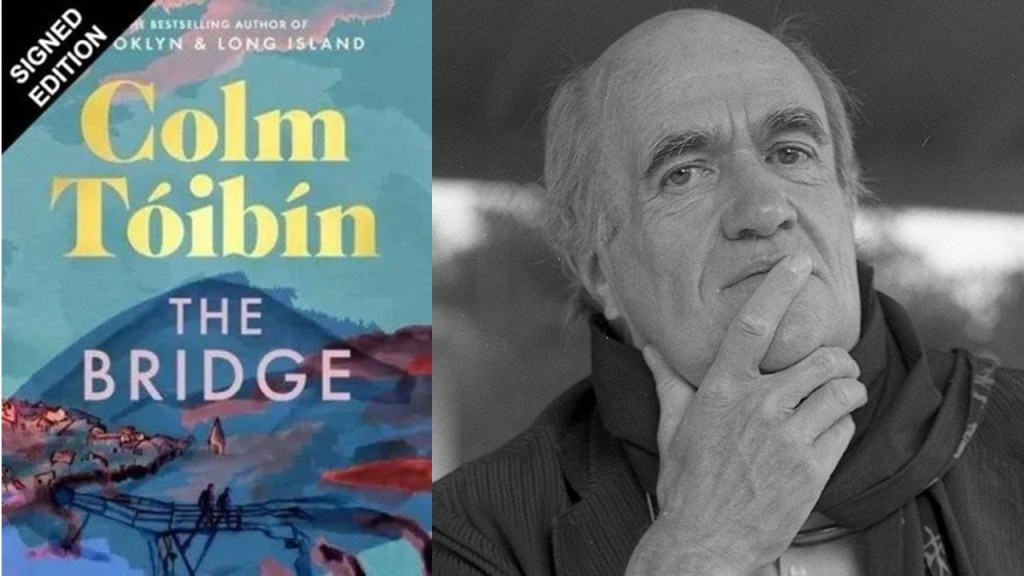
Colm Tóibín is a true writer of the heart but not from it, except in as much as hearts seem to beat on when there reasons for doing so, in the myth that the heart is the centre of emotional attachments or longing for such have not yet been initiated or have long gone. Later I quote a moment where in a guarded time Miquel grasps Manolo because he feels entitled so to do where he could ‘feel the sweat on Manolo’s shirt and he could feel his heart thumping’. In the language of sex/gendered possessive pronouns, there is no saying which man’s ‘heart that Miquel feels thumping – Manolo’s or his own – and the repetition of the verb ‘feel’ ensures that both possibilities remain conceptually open. But there is anyway a difference opened up by the word ‘feel’ which applies to both awareness of touching something material or to emotion. Feeling ‘sweat’ is different per se from feeling a thumping heart because the term ‘heart’ has been allowed to signify the centre of emotions as well as a material organ that beats the louder and faster in physical excitement. Something of that is what I mean by saying this writes is ‘a true writer of the heart but not from it, except in as much as hearts seem to beat on when there reasons for doing so, in the myth that the heart is the centre of emotional attachments or longing for such have not yet been initiated or have long gone’. Hearts beat alone not only in unison: they are the evidence of personal survival.
I have always loved the ‘novella’ or story, The Long Winter, which sits in my library now in three forms – the story it wanted to be in the volume Mothers and Sons and in the Limited Edition from Tuskar Rock Press, the author’s own imprint now gone, and which came out before the short stories. In Mothers and Sons, which title names what is very much one theme of the story, as it is of the novel, Nora Webster, following it, A Long Winter is no longer forced to be seen as a stand-alone ‘novella’, a form of writing that Tóibín defines as ‘something that no one wants’ in the afterword to the third publication of it in 2025 as a neat small volume by Picador, which I bought recently. {1] But it also shows that its focus is somewhat other – still locked in how men see the role of mothers in their own development, especially emotionally.
I bought the new publication, despite duplication, because it is the same format as its new ‘sequel’, a problematic term for The Bridge both is and is not such a thing though it takes the central characters, whom are still living, forward in time and event. It is not just a sequel because it can be read very satisfyingly alone, and, in this way it perhaps softens the terror of having to confront the fact that its hero Miquel has a life that feels as if it exists outside one volume. Alexandra Harris, reviewing it brilliantly in The Guardian says she too finds it satisfying alone but that in re-reading the initial story (she recommends that it feels as fully satisfying to read after The Bridge)it suggests the possibility for a ‘further installment’ : ‘Any change would be welcome to lift Miquel from stultifying conditions, though it’s unlikely to offer much relief’.
Twenty years ago, Colm Tóibín published a steadily desolating novella set in the high villages of the Catalan Pyrenees. A woman walks out of her house and her life, starts along the mountain road and disappears in the snow. Her son Miquel, failing to find her body, waits through the dark months for the thaw. A Long Winter … followed Miquel through dramatically extreme circumstances and patient endurance. It was told with the most restrained prose ever likely to be employed for a son’s view of vultures circling a corpse.
Now, in The Bridge, a single year has passed in Miquel’s life and he is eking out an existence with his hurtful, unyielding father. The sheep are grazing their high summer pastures; a side hustle smuggling contraband brings in a little much-needed cash. In the bare conditions of the lonely farm, any warmth of feeling is a kind of contraband smuggled in by night; love between men is doubly illicit. The grave tenderness that grows between Miquel and his father’s maltreated servant Manolo gives The Bridge its emotional centre. These young men salve the emptiness with a few quiet words and touches. We sense their youthful beauty and resilience, their suppleness in a place of fixity. [2]
The growth of bodily need for Manolo in Miquel starts in The Long Winter, though Manolo is only rather mechanically responsive to Miquel’s need, first expressed bodily in one of the long desolate walks, far from the gaze of others, from the village back home. It is a passage full of the silent presence of the problems of self-justification aroused by felt need and the felt contradiction of showing need as in many ways both insecure and exploitative. It is moreover to stretch a point for Harris to say that this novel has become a novel of ‘love between men’ (even in The Bridge, where it comes as no surprise to me that, dismissed from the house by Miquel’s father, Manolo quietly marries a woman and settles down) even though it is about things that are felt to be ‘illicit’. It comes as no surprise because Manolo, though warmer to Miquel and more likely to share at least somethings with Miquel when they talk in the same bed nightly before finally going to sleep in separate beds in the same room intended for brothers, is, in my reading still very much like the character in A Long Winter, conscious of the distance in class and entitlement to ‘belong’ there is between him and Miquel. Here is the passage where need first is expressed in the first story:
Miquel looked around him and knew that he could embrace Manolo for as long as he pleased on this empty road and could hold him as as closely as he wished. He put his arms around him and felt the warmth of him as he moved his hands under his jacket. He could feel the sweat on Manolo’s shirt and he could feel his heart thumping. He pulled at his shirt and then placed his hands on the warm skin of Manolo’s back. Manolo hunched towards him, letting their bodies lock, he buried his head in Miquel’s shoulder but he kept his hands by his sides as though they were stones. [2]
There is something quite characteristic in Miquel’s survey of the scene and its link to his ‘knowledge’ (since this had never happened before that that ‘he could embrace Manolo as long as he pleased’. There is something that speaks of the unequal power between them in that phrasing that isn’t just referencing the opportunity to act other than one might in public because unseen. However, there is also something equally characteristic of the other man here in the the association of Manolo’s emotional states with the act of locking and stones. Manolo in my reading is impervious to any access to his emotions or even the show of reciprocal touch through the hands of of pretending to such engagement.
My best guess at why that is at the time of reading first in 2006 was that Manolo, an orphan institutionalised and then farmed out into service of the needs of hardened families who are resentful that he must be fed without his body yielding saleable meat unlike their smallholding animals, has long disassociated sexual pleasure from emotional warmth, tenderness and anything approaching illusions of love and romance. But my thoughts here were and are all a guess. We are too locked out of Manolo’s interior to know, although The Bridge speculates somewhat about the life of men reared like him to live by what assets they found themselves to have. In it, we know Manolo once worked as a servant cleaning around the ‘single beds’ in the ‘grim dormitories’ housing the men working at the hydroelectric plant, and that there may be stories to tell of how he lived his life there, amongst men deprived of women even when they went into the local towns or villages since: ‘Local girls were wary of outsiders, as were their parents and priests’. [4]
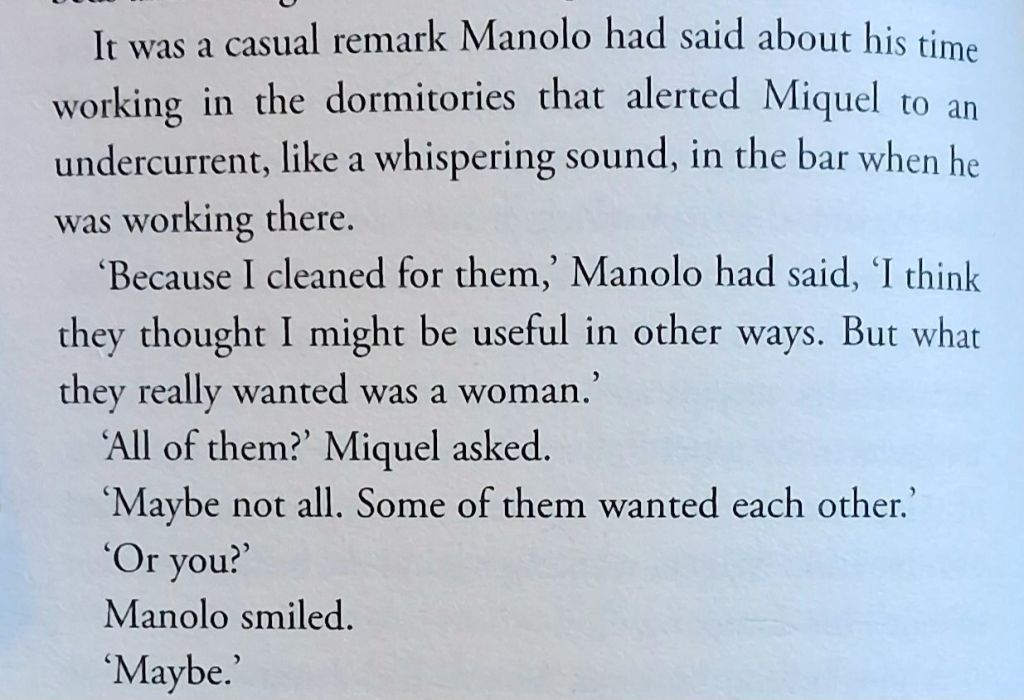
Manolo can hold back as much with a smile in his new life with Miquel as he once did by showing no emotion at all in a more stone-like manner. But the interesting clause in this passage is the simile of what it felt like hearing Manolo say this: ‘like a whispering sound in the bar, when he worked there’. To say this is about illicit love too it is to misrepresent the way male sexual desire is treated in both novels, there is something that isn’t spoken of aloud but whispered and remains a secret amongst men regardless of labels assigned to sexuality, for which sex divided from ‘love’ (whatever is meant by that by the many who speak of it including myself) is perhaps more the norm than the intention to form visible social bonds or even quiet substitutes for them that are undeclared in public. I would love to validate Harris’s view that the ’emotional centre’ of the novel is the ‘The ‘grave tenderness that grows between Miquel and his father’s maltreated servant Manolo’, but I can’t!
Yes, there is tenderness but there is also a relationship framed by power differentials, and mediated by temporary ownership of bonds and the ease of their dissolution. One should be able to say this without implying that there is nothing real and credible that grows up between Manolo and Miquel in this novel, but to make it a ‘centre’ is too strong and too driven by ideologies regarding the meaning of emotion and sensation across sexual encounters. Despite insisting on how the Manolo-Miquel gives ‘shape to the rest of the encounters that she names in this paragraph, Harris hits the mark better regarding the novelty of The Bridge in a rather different paragraph of her review, which describes the novel’s genre, as an exploration of the meaning of male sexuality irrespective of other meanings itself, better without pretending that if a novel has a ‘centre’, it is always a soft centre, much as I revere softness too. Sometimes novels are very hard indeed and horny in their focal points and their relationship to emotion more difficult to assume or see as constant. Harris says:
In fact, and with a fullness that’s striking in this novella of watchfulness and withholding, Miquel enters into a varied erotic life. Visits to the local town bring assignations. A later relationship between cellmates is extraordinarily vivid as Miquel seeks to “assuage his hunger by biting Odo, chewing him”. But it’s the lost, interrupted love of Manolo that gives shape to the rest. [2]
Hard appetite is the metaphor here and the fat unattractive body of Odo, a man imprisoned for murder for life and thus who has given up all sense that sex for him will ever be with women, or Llorens who superintends the shower room, is at much about shaping this hard lesson as Manolo’s gentle and soft persona and fresh beauty. Yet Llorens also provides the most empathetic terminal care to Miquel’s father that would not have been his lot in formal care. Hardness and softness oft mix but not necessarily for these men around sexual love. Miquel is equally hard, seeking warmth only in the cold solitude of a mountain wilderness, and finding it even in the bar in the village, in its manager, Ferran, whom he fools around with in the bar after cleaning up or from the ‘whispered’ hints exchanged between men in the bar, that even lead to assignations that Ferran organises for him. In both novellas, there is the same intriguing policeman engaging with Miquel in an eye-quest of each other’s bodies during the different police duties in each novel that goes no further but is clearly not related to love, other than in a potential never tried.
If we look back to that first encounter with Manolo, there is, as I have suggested, somewhat of a tie of sexual availability of the other to power and opportunity and mutuality is not always suggested. And when Tóibín speaks of his first story qualities , he says intriguingly: ‘If there was a gay man in the story, his sexuality seemed to lead to dull disappointment rather than excitement’. Comparing his story to Annie Proulx’s story as it appeared as the movie (note there is a film of A Long Winter now so we can make a better comparison soon) Brokeback Mountain, he says ‘like hers, my story is all mountain but, unlike hers, there was hardly any brokeback’. [5] It’s a sneaky point because maybe there is a love story in Annie Proulx but what Tóibín refers to is the visual sex scenes in the film. In the end, I think the difference is that both novellas are one man’s story – not necessarily a ‘gay man’ but a man who finds his mind entirely fixed on sex with men, in which love may happen but if it does it has to be accepted as multiform.
These are stories, I believe, of the lonely survival of one man through episodes of difference from the most stark kinds of loneliness. I believe that more having read The Bridge because so many incidents are about Miquel’s potential in ‘carrying on’ after contingent discovery of the otherwise un-readability of the world around him. He is only in it a short time, but in the new novel the most ‘central’ character’ (in a relationship in which Miquel shows at his characteristic unseeing) is Animo, a donkey, though in the novel mainly as a mode of transport and service of labour. The Long Winter involves many attempts to travel in an old jeep that, most of the time prove unequal to Pyrenean snow conditions and have to wait, like everything in the stories (like the vultures and the snowbound dead) for more clement weather conditions thawing the landscapes.
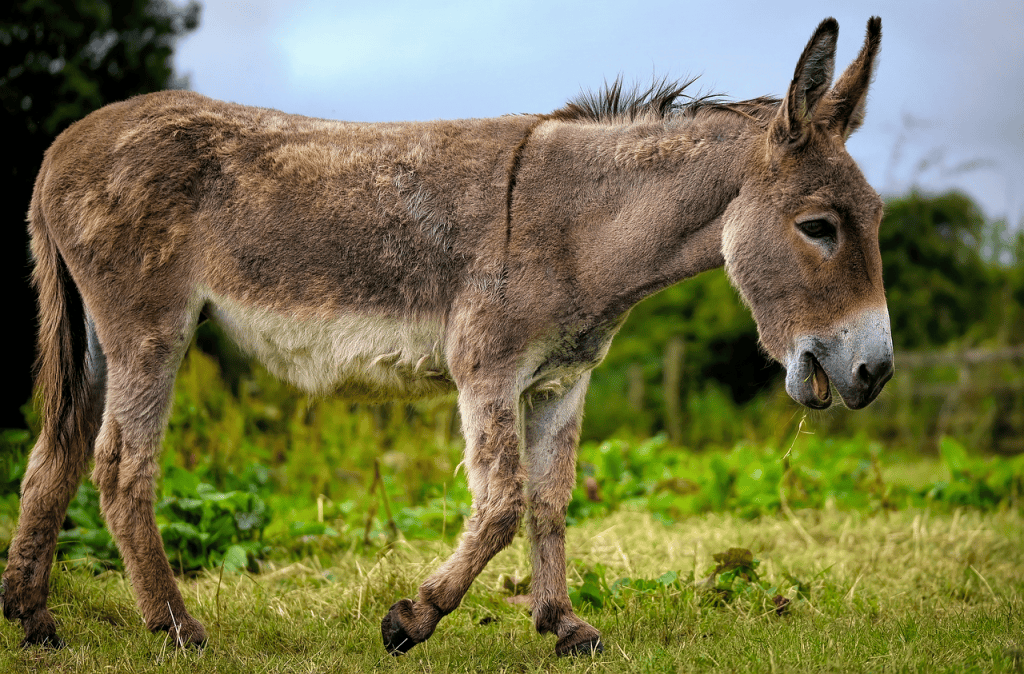
At the beginning of The Bridge, Miquel’s hard-to-guess father has disposed of the jeep and relies on the family donkeys, not mentioned in the first story specifically and certainly not as characters, but here both the father and Miquel have their own donkey. Miquel’s is called Animo, as already named above. It’s worth thinking about that name: here is a useful summary of its meanings in Spanish from the source linked here, although its useful to note that idiomatically it can mean ‘Come On, get going‘ (useful to say to a donkey, or ‘Cheer Up‘, facile to use with Miquel):
Core Definition and Primary Meanings : Ánimo functions as both a noun and an exclamation in Spanish, carrying several interconnected meanings that all revolve around the concept of spirit, courage, and encouragement. As a masculine noun, ánimo refers to one’s state of mind, mood, or emotional disposition. It encompasses the inner strength and determination that drives a person forward, especially during challenging times.
The word also represents courage, bravery, and the mental fortitude needed to face difficulties. When someone has good ánimo, they possess a positive attitude and the willingness to tackle problems head-on. Conversely, when someone lacks ánimo, they may feel discouraged, dejected, or unmotivated.
As an exclamation, ánimo serves as a powerful word of encouragement, similar to saying come on, you can do it, or cheer up in English. This usage transforms the word into an active force of support, making it one of the most uplifting expressions in the Spanish language.
Etymology and Historical Development: The word ánimo traces its roots back to the Latin animus, which referred to the soul, mind, spirit, or life force. This Latin term carried profound philosophical and spiritual connotations in ancient Roman culture, representing the essential animating principle of human beings. The connection to the Latin anima, meaning soul or breath of life, further emphasizes the deep spiritual significance embedded in this word.
Throughout the evolution of the Spanish language, ánimo retained much of its original meaning while adapting to express the particular cultural values of Spanish-speaking societies. The emphasis on community support, emotional expression, and collective encouragement found in Hispanic cultures has shaped how ánimo functions in modern Spanish communication.
During the medieval period, ánimo appeared in Spanish literature and religious texts, often describing the spiritual state of characters or the moral courage required for heroic acts. This historical usage established the word’s association with virtue, determination, and moral strength that persists today.
If anything the relationship between Miquel and a spirit of determination is as broken as that with the donkey, when, in his absence the donkey is sold and shipped to a butcher. Miquel is spying on the policing of the new bridge for his father ostensibly prior to shipping contraband but also used as an opportunity to have sex with a stranger in the village – a man from the hydroelectric plant hoping for such a chance and who has eyed Miquel – arranged by Ferran. But he does not guess his father’s duplicity (again – surely the evidence was long there) even though warned but not in so many words by Manolo who suggests Miquel take Animo with him to the village because ‘he would not want him to be tied up for a day or two in a strange place with no shelter’. [6]
Whether right or wrong, Miquel rarely thinks long enough or deeply enough about others. When in prison, he is visited by Manolo whom might have represented his courage and spirit of life had he not preferred secret liaisons more with many men in secret, who tells me he now works in a bar, has a ‘girlfriend’and hopes to marry. In his cell, locked up, Miquel remembers he never asked Manolo to say more about his life or his girlfriend, and suddenly elaborates a fantasy of what Manolo is thinking about Miquel in as as cold and distanced a way as possible:
It struck him that now at this moment Manolo was elsewhere – at the bar or meeting his girlfriend. He had done his duty. He could think about anything except Miquel, who was locked up again for the night. He must have viewed Miquel standing up and returning to the body of the prison with relief. He could go then. He could wander back into the world, walk on whatever side of the street he wanted, go to bed when he wanted, sleep with someone he had freely chosen. He didn’t have to put much thought into where Miquel would go, how he would sleep, who would share his cell. [7]
There is a reversal her – no longer is Manolo the servant but the freer man, but Miguel so inhabits what he believes is Manolo’s viewpoint, one so selfish that it must exclude Miquel, it actually tells us much more about Miquel than Manolo, who had taken those freedoms whilst Manolo lived in a house and in a bedroom never his own but that made available to him as a wage-slave. And I find that idiom interesting that Miquel uses to think of Manolo being able to ‘walk on whatever side of the street he wanted’, even perhaps that one Lou Reed described as ‘the wild side’. And Manolo it seems has chosen the heteronormative route. This is all so queer – so flexible, but is also entirely self-serving, a prison of character type Miquel would find it harder to get ourt of than the cell holding him and his father, and Odo for whom he has learned to have appetite. Where is Miquel’s Ánimo. Will it return in another story. Indeed was it ever there or do you take your chance being loved by him who may be little different from his father after all, as Jordi, his brother, seems to think, who is certain both Miquel and his father allowed his mother to go absent too easily (and of course they both did, though Miquel could blame his father alone): Jordi insists “I would have found her if I had been here”. [8] Though he may be wrong about that, he is not wrong about Miquel’s refusal to look over any kind of distance and imagine another as they deserve to be imagined. That’s love, after all and Miquel imagines Manolo with the only drive he has – that of self-interest.
Of course a third volume of the story would be welcome. This is writing and story-making of the first order. It is just that I, after ending it, may regret ‘The Bridge’ for raising the hope that ‘A Long Winter’ for his queer hero, Miquel (the finest of them all) never ends, and consequently that we will wait for him to change in vain.
Bye for now
With Love
Steven xxxxxxx
________________________
[1] Colm Tóibín ‘Afterword’ (2025: 136) in Colm Tóibín A Long Winter London, Picador, 127 – 137.
[2] Alexandra Harris (2026) ‘Review: The Bridge by Colm Tóibín review – betrayal and survival in the High Pyrenees’ in The Guardian [Wed 2 Sep 2026 07.00 BST Last modified on Wed 2 Sep 2026 07.31 BST] Available at: https://www.theguardian.com/books/2026/sep/02/the-bridge-by-colm-toibin-review-betrayal-and-survival-in-the-high-pyrenees
[3] Colm Tóibín (2025: 114) A Long Winter London, Picador.
[4] Colm Tóibín (2026: 22) The Bridge London, Picador, including my photograph of a detail therefrom.
[5] Colm Tóibín ‘Afterword’ (2025: 136-7) in Colm Tóibín A Long Winter London, Picador, 127 – 137.
[6] Colm Tóibín (2026: 7) op.cit.
[7] ibid: 87-88
[8] ibid: 18

