


‘Be ready for the duplicity of adulthood and adults’ is my advice and it continues thus; ‘and if you can, learn how not to collude whilst you learn, as you must, to survive’. This blog is a reflection on the film ‘Bad Apples’ (2025) directed by Jonatan Etzler and starring the very wondrous Saoirse Ronan.
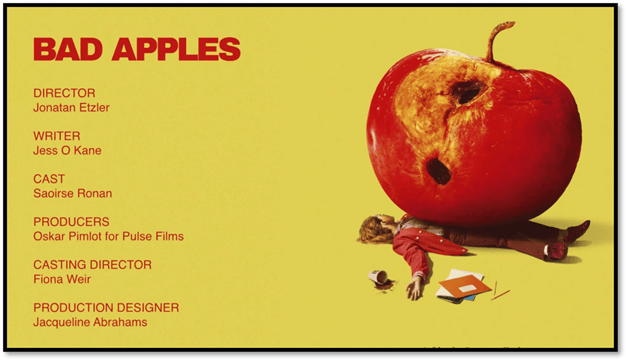
There are very misleading hints in the publicity infographic shown above. In it, a female teacher identified by semi-conservative coiffure and clothing and dropped schoolbooks, writing implements, and a spilt machine provided cup of coffee, is the victim of an apple dropped upon her that is rotten and holed to the core. There exists a narrative in social.life that sees society as na naturally ordered transition from grateful soft childhood to a hard and realistic but fair and just adulthood,, whose role is to guide children to that self-same identification. The disruption of that narrative, people within this paradigm believe, is the existence of ‘bad apples’, fruit already corrupted even before it was plucked to fulfil it’s function.
This is the context in which and to which Etzler’s extremely off-centre film Bad Apples makes its points about a dark and sinister version of what adulthood and the institutions supporting adulthood, such as schools really are, might be. If we think of the infographic again we should consider, after seeing the film itself, whether Saoirse Ronan’s portrayal of primary teacher, Maria Spencer, is of a victim exactly
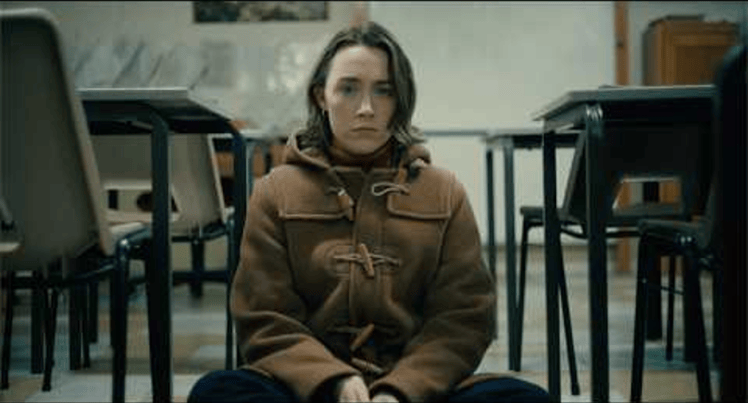
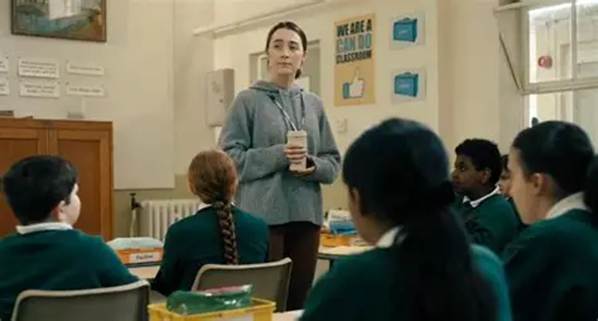
It is a difficult question on which to decide on an answer for, in other ways Ronan ensures we see Maria, the mousy teacher seen above sitting at the level of the school desks and in a child-like dufflecoat and .ore like a child in perceived vulnerability than an adult, as having the potential of being a serial killer with the capacity of living a double life, marked entirely by complicity with a well thought plan based on the principles of might is right and the tyranny of the majority will.
In a sense Maria seems born out of the worst kinds of magical thinking of no-doubt real teachers who might like to imagine a world where they could just get on and teach with all the excellence within them were it not for the challenges faced by people at the margins of the included, parents like the Amazon-like goods deliverer Josh Weller (Robert Emms), a victim no doubt of the gig economy no less tha the protagonist of Ken Loach’s Sorry We Missed You (see my blog at this link), and their children neglected for those reasons, like the wonderfully cast Eddie Waller as Danny Weller.
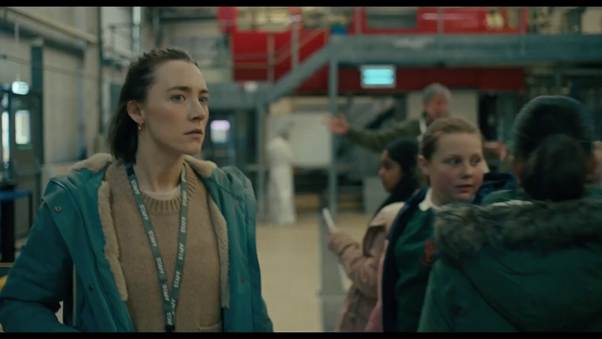
The opening scenes must ring bells with anyone who has actually ever taught, even the panic Ronan brilliantly projects in the photograph just above. In these scenes, she visibly feels the panic of having lost the naughtiest child in the class who is known already to be the culprit of disrupting the commercial processing of apples on the factory visit by throwing a trainer into the assembly line before we even know it to be him as an audience by seeing him shod with only one of his trainers. How any teacher seeing this could not recall guilty moments of wishing some young pupil ‘disappeared’ and no longer a problem to them escapes me. But Maria is in no way shown as an excellent teacher (were any of us), only one who ticks the boxes (problematic students being absent) of an almost ludicrous stereotype of an OFSTED inspection and even more stereotyped comically-rigid school inspector.
There is in the duration of the film something of a tragic hero in Danny, whose inarticulate state broken only by regular sexualised swearing and threats of violence, against females of whatever agel or type of vulnerabiliry to male aggression. Danny, however, is performed with the kind of vulnerability we see in the incel male child of that wonderful, and more realistic series about the nature of disruptive masculine stereotypes in the TV series Adolescence (see my blog at this link).
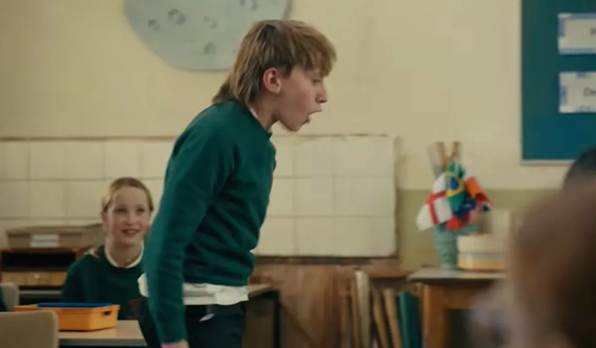
The most vicious example of Danny’s misogynistic violence occurs out of sight though we hear it happen, as in Greek tragedy, where Danny throws the sinisterly motivated young girl Pauline over a stairway banister breaking her arm. Did we not spend so long disliking the Pauline (her crush on Maria is increasingly seen as sinister as lesbian crushes are so often in film tradition, which the young Nia Brown so brilliantly plays), we would find a victim here too. But if so her backstory as we pick it out is an adult imposed loneliness too not unlike Danny’s. In a scene designed to feel sickly Pauline asks Maria to sign the pot-cast on her arm as the the very first signstory there. Maria prints her name but without the requested endearment that Pauline also desired. However, that name remains the only name ever signed on the cast. Clearly, by whatever social or auto-mechanism Pauline is engineered into isolation.
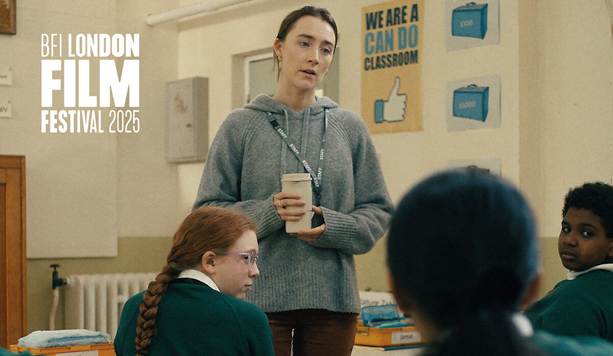
Maria stands by the side of Pauline, who turns as if her body were automated to attempt to copy Maria’s, as begins using her skills with her class, her wall festooned with the usual propagandised guff about ‘Can Do Classrooms’.
Like Danny too, Pauline is neglected by adults as well as children, but this time not because of parental poverty but because of her parents, who make their money from.processing apples in the factory we saw in the opening scene, being too absorbed in vulgar social and adult-sexualised parties and their businesses to attend to their child’s need for love and care. Both she and Danny are at the margins of peer acceptability as both are of parental care for different reasons. Unlike Pauline and clearly because of differences of parental class and relative access to resources, Danny is neither articulate nor literate (we get to learn) and we do, if we allow it as we watch, feel the pain of being unattached and not belonging to any institution from family to education that claim to be givers of care. It is clearly this that leads to his grossly abusive behaviour (like the literal tethered underground existence Maria creates around him as if a metaphor for his life in the ‘real world’, in her house, whose dimensions shift as the castles of Gothic villains). If we learn into Danny’s feeling, we maybe understand why to him everyone is a ‘cunt’ and a ‘bastard’ and no one really and truly cares, for thy don’;t except in conditions of imprisonment and restricted action.
It is a problem in the film after all whether Pauline is right when she tells Danny, once incarcerated and harnessed down in Maria’s basement, that no-one cares about him now that he have decided he is not only ‘missing’ but thought dead. If Pauline is right, and she understands adult duplicity better than most, then Maria’s substitute and fairly believable care and catch-up schooling for him whilst she has him locked in a harness intended for pet gorilla’s in her dark Gothic basement and increasing his freedom only by the length she adds to his tether, is horrifically cruel and will never liberate Danny. Danny may (but herein hands an even worse spoiler than those already committed by me) only dig himself up and out of the burial in which he is intended to stay confined.
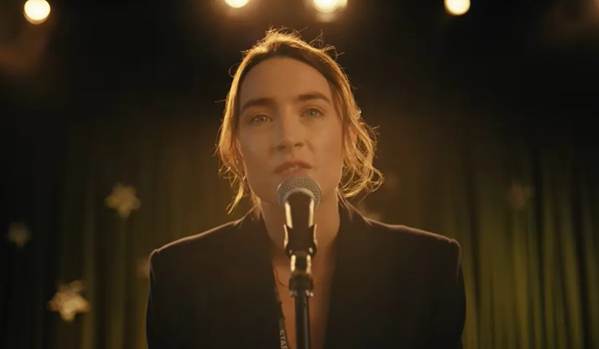
In truth the film really validates this view – that dead Danny can be an honour to a school, the community it serves and his hopeless Dad, that saw him when alive as a problem to be eradicated at best. Here (in the photograph above this paragraph) is Maria – now Deputy Head, under (literally – we see her being fucked in the staff room under the desks by him just before her scene awarding the Danny Weller school award below) the new Head (Jacob Anderson as Sam), who – once her faithless lover shacked up with another teacher – has now returned to her arms given that Maria is seen as a saviour of the school and has new self-esteem (and represents a more credible investment). People look after themselves in the most convenient way possible it seems, feeding myths of can-do communities and individuals at all levels provided ‘problem’ or ‘challenging’ children and adults failed by the system are left out of sight or mind – metaphorically or really dead. The only person to actively stand against the eradication of Danny from the record is the old Head (Rakie Ayola as Sylvia) whose fate is explained away by Sam as having moved to a new appointment elsewhere, leaving room too for a suspicion that her leaving the school was perhaps to a more permanent place of rest. As I think back on the film I wonder if Sylvia was the best you can get in a bad and corrupt world like that of the represented community of Ashton Brook.
The leader of that adult community soon becomes Frank, Pauline’s Dad, and the owner of the apple processing factory that processes bad as well as good apples, played convincingly by Sean Gilder. Frank is a good entrepreneur but a bad person – using sexual threat as a second language, even to Maria when she returns Pauline home to him while a rowdy and vulgar party is in process and Pauline gets forgotten. It is him who convinces the community in the Parent Teachers Association that they are better off with Danny incarcerated and thought dead, and who clearly arranges for Sylvia, the Old Head to disappear from the film – by fair means or foul – for she still believes that it is part of the teacher’s role to include and work with challenging learners. He had despised his daughter Pauline and named her as ‘weird’ to Maria, but once she has spilled the beans about Danny manages to get her aligned to the school with less strangeness about her and more of adult duplicity. Now much of this can only be done because this film sits in a strange mash-up of genres, but nearest to horror-or-murder-thriller-comedy (using the metaphors of horror and so on in comic way to make a conceptual breakthrough in the representation of adult life in the light of adult behaviour with children. Leslie Felperin in Hollywood Reporter called it: ‘A black comedy that’s more of a charcoal than a true, pitch-dark Vantablack’ but notes the innovation likely to follow from the newness of the entry into making it of persons fine-tuned into dark Scandinavian models, including:
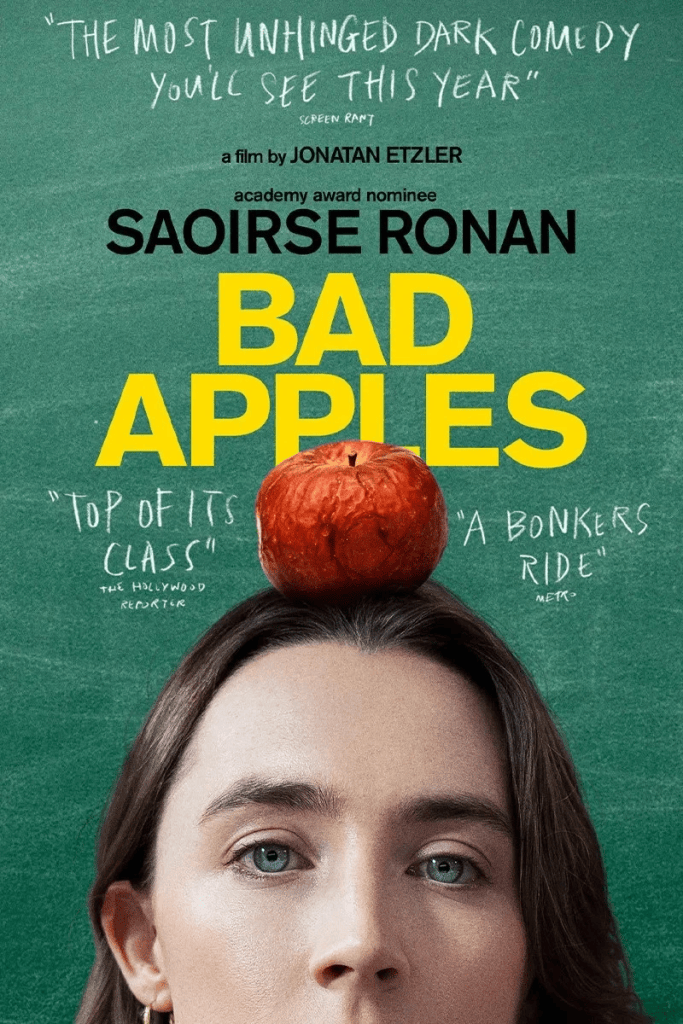
Swedish sophomore director Jonatan Etzler (One More Time) making his first English-language feature, and screenwriter Jess O’Kane, adapting Swedish novel De Oonsade by Rasmus Lindgren. [1]
Yet according to Felperin, there is a clear in the entire management of a film that insists that we need to find it difficult to relate to as to real people, at least insofar as those ‘people’ are ‘big people’, adults. After saying some fine compliments about the highly nuanced performances by the child-actors, they go on to say:
So far, all that is almost all moderately credible, although as a parent and a former school governor myself, I can attest that most schools and local authorities would more likely put the blame on Sylvia the headteacher for this situation. In the real world, she would, or should, be trying to get Danny transferred to a school that could meet his needs or even seeing if the child could be taken into care, instead of putting the onus on hapless Maria.
But Bad Apples is clearly not really interested in pedagogic realism. Instead, it starts out as a faint satire on the perils of permissive, child-focused education before making some even stranger, darker turns as the situation evolves. [1]
There is something so beautifully naive about Felperin’s advice to headteachers about how such a case as Danny’s, or Pauline’s when she starts attending class in an evening dress blackmailed out of Maria, would really be handled in modern English primary schools, but no real understanding of why the child acting is so good – since it exposes some widespread adult pretensions about caring for children, their own or those of others. Yet, Felperin despite this does get that the adult material of the novel feels weird and out-of-the-scope-of-any-kind-of-realism for a reason and gets that this reason is based on some investigation of the presumptions of modern post-capitalist societies:
Like a mad sociological experiment trying to test the principles of Jeremy Bentham and his belief that the “greatest happiness of the greatest number… is the measure of right and wrong,” the film follows things through to a logical but bleak conclusion. It’s at this point that the casting of the usually so likable Ronan really makes a difference as the dark turn of events forces the viewer to question their sympathies.
That fits so well (precisely and correctly) in the film although I see such conceptual story-telling more favourably than Felperin does. Another critic, Guy Lodge in Variety, also shows how we, at the end the film, are left wondering about the society we uphold as adults might be less than honest or wholesome, when he hugely praises the nuanced shifts of the performance of Danny, he seems to point to something in the adult characters (here I’d omit consideration of Ronan, who is never quite the terrible thing that is an adult in the film till the end) that is answering to an agenda about the meaning of grown-up living::
When in the realm of the grownups, however, Bad Apples plays broader, safer and altogether less believably, albeit not without stabs of cynical truth. Less honest and more suggestible than their children, adults tend to plump not for the fairest solution to a dilemma but the one that inconveniences the fewest among them — so the film ultimately says, though it requires an almighty number of procedural blind spots to reach that conclusion. Ultimately, this odd, wicked little amorality tale winds up siding with no one: The children are indeed the future, we’re left to conclude, but will they make it any better than the present? [2]
Do films first have to be indebted to ‘pedagogical realism’ or true to the processes adults use in moments of doubt? I suspect not, for else they limit the kinds of lessons they can transmit to us, some of which must disrupt, as much as Danny and Pauline disrupt (although Pauline gives in to the group at the end),the thing we call social norms that shape social processes of inclusion and exclusion.And I think there is a point that Lodge makes too that shows something disturbing in the film that must be addressed – how is it’s potential to look as though it supports extremes in punitive treatment of children (that may lie underneath every adult who fears how the child-like disrupts settled norms) and engages adults in enjoying this uncomfortable feeling’s projection. Lodge says:
… Films that visit harm upon underage characters are never the surest of sells with general audiences; that goes double for films that invite us to wonder, at least fleetingly, if the kids had it coming. Still, at least one scene of malicious child endangerment in “Bad Apples” was met with raucous audience applause at its San Sebastian premiere — as good a sign as any that Etzler’s warped, needling and sometimes bitterly funny second feature …will find its own cult.[2]
But are all cults healthy or aligned with the intention to critique unhealthy forms of adult authority, as I think this film intends so to be and do? Do some cults rather bolster up unhealthy forms of adult authority, as seems the function of the move to the right in educational aspiration under potent and pernicious socio-political groupings like Reform, Restore and so on. The idea that ‘bad kids have it coming’ was also popularised after Adolescence, although that drama had a very responsible realism about adult processes.There is some sense of the beauty of adult authority adopting a childlike view in the picture of the early Maria below, though with the solution she’s found to Danny not being there already sets her on the road to collusion with the dishonest.
But the wonder of Ronan’s performance is that she shows how ‘adults in responsible jobs’ often feel, and can’t help but show their feeling, when challenged by that which makes responsibility deeply uncomfortable at other times, as in the still below:
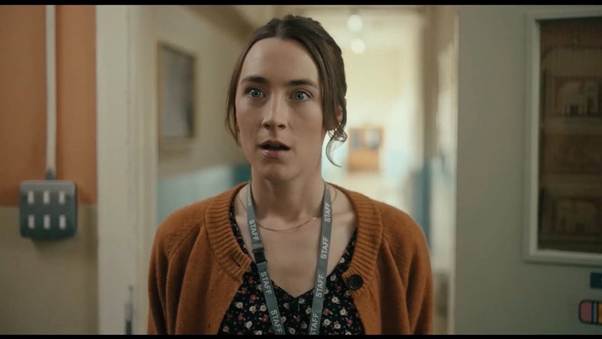
Those moments – sometimes called impostor syndrome – sometimes speak to truths about the impostor that adults are in social and work roles of care and control (teaching, social work, and healthcare). My own feeling is that we should be more correct in showing that they show us warnings about the misuse of authority and power when under stress than dismissing them as the ‘nerves’ of a ‘novice’. It is when adult roles harden around us that we are dangerous and this film shows that very well, like a modern moral fable that is open to all kinds of reading and viewing.
That’s all for now.
With love
Steven xxxxxxxxxxx
_______________________________
[1] Leslie Felperin (2025) ‘Bad Apples’ Review: Saoirse Ronan Plays a Tired Teacher Battling a Difficult Student in a Sharp Dark Comedy With Shocking Twists in Hollywood Reporter (online) [September 7, 2025 9:00am available at: https://www.hollywoodreporter.com/movies/movie-reviews/bad-apples-review-saoirse-ronan-1236363893/
[2] Guy Lodge (2025) ‘Bad Apples’ Review: Saoirse Ronan Gets Zero for Conduct in a Very Dark Classroom Comedy’ in Variety (online) [Sep 24, 2025 8:41am PT] available at: https://variety.com/2025/film/reviews/bad-apples-review-saoirse-ronan-1236525985/

