If the salary was the same, what job would you be doing right now and why?
In Dean Atta’s first novel intended for adults, ‘Big Man’, the protagonist, Big, explains to new entrants to his profession of Diversity, Equality, and Inclusion (DEI) workers and consultants why he is doing the ‘job he is doing right now and why’, without mentioning salary: ‘Big told the twentysomethings he enjoyed being freelance because he was neither a boss nor an employee’. [1] This blog is really about Dean Atta (2026) ‘Big Man‘ London, Cipher Press.
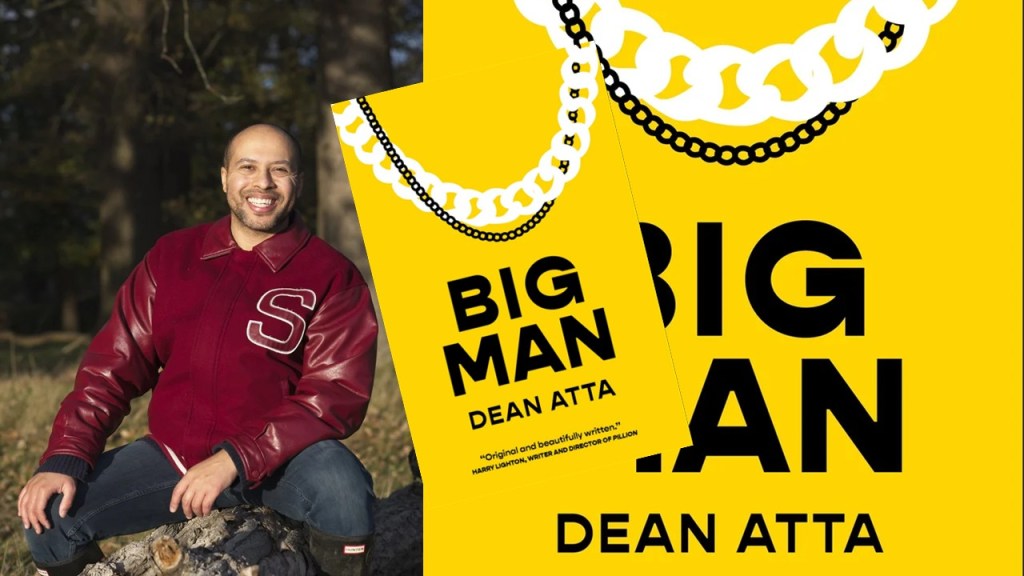
Ah, jobs! I am retired from work now and the question is as they say ‘academic’, meaning, in most people’s minds something that has no practical relevance whatever. Of course that strikes a chord with me because my jobs – the way I have earned a living over various phases of my life – although they have been varied – have been in a considerable proportion of the years I had available for work, I suppose, filled up in ‘academic posts’, first in English Literature, then as a teacher of various branches of Psychology and finally in professional Social Work (and once Department Leader). The latter role as an ‘academic’ meant I had also have to have spent years in forms of social care and health work as a registered Social Worker. Those were the years when I had some choice and might even have been able to negotiate over ‘salary’.
However, there were other times when after various forms of crisis in my mental health I had no such power, where attempting to get a job in anything (I remember one where the interview as a care assistant involved mainly showing I could clean various substances from a wheelchair and NOT getting the job) was the first often impassible hurdle. And indeed, I could even empathise with the employer as I sometimes fell into catatonic states where being asked to move or speak was an impossible task. Of course, all those temporary period hurt when recalled in memory despite the fact that, for most of the time, I could, as they say, handle myself.
But life prospects didn’t feel my entitlement in the way it seems they did for my peers in grammar school in the 1960s: in my mind where I achieved at all it was by bypassing constant dis-empowered feelings that became the mindset of performance and which seemed located in the circumstances of my early life as a son of the working class. The drive drive to get out of the drudgery to which work was reduced for working-class then was a resistance to the stoicism of my parents of living a steady life with a good job better paid than theirs but not one actively chosen by me. If work threatened to be just a means to get the wherewithal to live, attaining opportunities to choose to make it otherwise was the first priority. Sometimes, the greater landscape of fear I inhabited was the dread of having to take a job that tied me to tedium, despair or being unable to exercise autonomous moral choice over what I was doing, of which the worst image was of someone forced to take employment in an abattoir and taking the life of other sentient beings in order to earn my own living. Of course in the very low paid jobs that I was forced to during periods of crisis – I was a care assistant in various domains (mental health residential, learning disability supported living and older people) – there were moments that gratified, but only when I didn’t feel that I could perform only as a cog in a plan of the ‘management’ of someone considered otherwise challenging without their choice being severely limited by the control implied by ‘care’.
And some of this came back as I read Dean Atta’s Big, though Atta’s struggles usually exist under the surface of a determination to find life positive, which I don’t share. Maybe the issue for Atta’s protagonist, Big and perhaps for me, is all about the interplay of power and vulnerability,, dependence and independence, dominance and submission and all the range of potential states that exist in the continuum of states, often ones that mixture of free-flowing diverse states of sectional being, in-between as well as inter-mixed all of the false binaries that mask the struggle underlying the enforced separation of binaries like black and white, male and female, big and little, … and boss and employee. A guest teacher, consultant or invited guide (or mentor) is not an exempt category here, as is not being aged fifty in a group of twentysomethings in other ways where the binary old and young is exposed as the mask of the fluid state of time in lives. Many temporary states of being assume position of power and authority, only to drop them when they bind you into a fixed role. :
Big told the twentysomethings he enjoyed being freelance because he was neither a boss nor an employee. [1]
Being neither ‘boss’ nor ’employee’ is only one example of binding binary definition of one’s power and extent of responsibility even in this sentence. Constantly, in the novel, Big’s very name is another such potential index of position in a hierarchical binary, as is his paradoxically boyfriend’s name, Little, who otherwise has more wealth, job status and social stability than Big, a working-class, mixed race man with mental health problems, working in the gig economy of DEI consultancy. The best example is here, which states with Big’s reflections on Little breaking an expensive ‘Byzantine gold chain’ bought for him as a gift by Big:
Big decided future gifts would be reasonable. Books. Knickknacks. Tickets to shows they go to together.
Nothing too expensive, Big thought, he doesn’t know how to take care of things.
Big feared that Little wouldn’t be able take care of him in the dark times should they come again. It wasn’t Little’s role. Big couldn’t rely on Little in that way.
Big hadn’t longed for a boyfriend like Little. Big had wanted to be the little one. Instead, he’d become the Big Man. If only on the surface.
This passage is characteristic of Atta’s prose in fiction. Apparently, transparent and simple, the relation between paragraphs is diversified between expected flow of sense and disruptive reversals based on a change of attitude or even of subject matter. Thus a thought attached to the idea that Little is careless of ‘things’, like decorative Byzantine chains, passes to thoughts about the need within relationships for mutual care and fears of its absence on Little’s side. Thinking back to times of disabling depression and anxiety undergone by himself, Big wonders if either he or Little see ‘care’ for Big in these times as part of a boyfriend’s role. Deciding the answer to this dilemma is bound up with, it seems, Big’s core beliefs about what each man wants in chosen relationships, and the issues those ideas imply about the concept Big has both of himself and of Little. Eventually the lucid prose is seen to hide complex shifts of meaning about complementary roles in relationships: is the caregiver the big one in a relationship, and, if so, why does someone forced to identify with the Big Man decide that all along he had wished to be the ‘little one’:’Big hadn’t longed for a boyfriend like Little. Big had wanted to be the little one. Instead, he’d become the Big Man. If only on the surface’.
The many shifts in that short passage depend on how we read through and alongside it shifts in the thinking Big applies to himself, in order to decide first, if he is the big or little one (physically or metaphorically – and in which domains of either category) in the relationship. And then to decide secondly what his judgement of that issue means about his satisfaction in such a role allocation as he thinks there is already existing, or about his desire to change or reverse that allocation of big and little, power and vulnerability. Moreover, even if either of these issues are resolved, we are not to be made sure whether the relative size comparison proposed by their name ‘labels’ is actually only a surface phenomenon and not true in any ‘deeper’ way. We trip up on metaphoric paradigms here – as in deceptively complex prose we often do, without it (as George Eliot and Henry James do, advertising itself as such a prose).
This is why it matters about the naming of the main characters which so mirrors the use of names in art and fiction for children, with which genres of writing Atta has hitherto been associated. Later, in Big Man, we find there is nothing childlike about the naming process. Big is given that nickname, which by then we know it is, by Mother, the American Black trans woman and, once a drag queen identifying as non-binary who adopted ‘boys’ (actually all young men) and pl;aced them under her ‘care’, although that care did not necessarily exclude having sex with them if they gave consent. When we learn the story of his naming, Big is thinking about the ‘white lie’ he told Little (who is white), saying the name ‘was given him ironically because he was the shortest of his friendship group in the first year of secondary school. We shall see white and black – and other binaries such as ‘fat’ and ‘thin’ – as problematic in this novel too: hence the phrase ‘white lie’ used by a brown man to a white man is not an innocent one. It isn’t only that the name explanation given in the ‘white lie’ wasn’t ‘true’, it is also an evasion of entitlement from an intersection in power relations, where, in some cases, a big black man might have more entitlement than a truly ‘little’ white man. In fact, though Big may have been ‘little’ as a schoolboy, it was only in the sense that ‘he tried to make himself small and unnoticeable at school’, so that he could guarantee on any straight peers NOT searching out his status as ‘gay’, since being the only black boy made him vulnerable enough already. So what of the ‘true story of his nickname’, on this hangs a tale of Big’s life, which I don’t recommend you read in the photographed passage if you at all feel queasy about hard-faced descriptions with blunt sexual parts and acts named as bluntly as it does unrelentingly with to-the-point unliterary vocabulary of one version of what male gay sex can be (with its ‘other’ in-built binary for some: ‘tops’ and bottoms’ for those respectively who were the pentrator and penetrated in anal sex, with a third category of ‘flexible’) even after Mother’s making of that name for that reason on the first night they’d met, which was when they had sex:
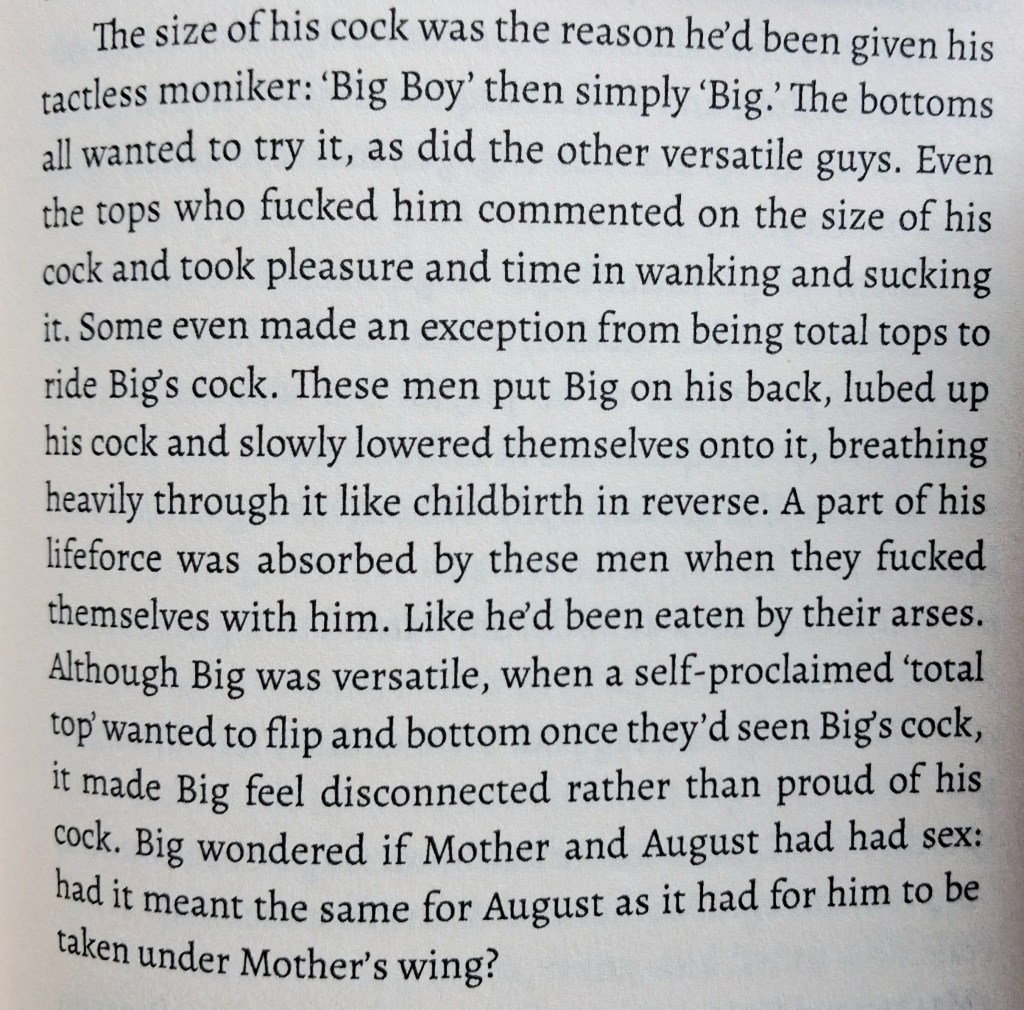
The explanation here ought to make us think of how Little got his name, if it is a nickname and we aren’t told that, but apparently it is not for the obverse reason of how Big got his name, for we are told Little is gratifyingly well-hung. It is another way in which language using antonyms (binaries) is disabused of the efficacy of their effect of there being only two types of one thing – boss/employee, big/little, fat/thin, top/bottom and so on. Antonyms after all only exist as a paradigm in the language of naming – reality is always diverse, not the equivalent of that sign systems that provides names.The complement to that in the novel is family names where words available in the language of biological family, family extension or limitation in different cultures and concept of the chosen family all intermix together with variations between biological and chosen categories of sex/gender. Mother might have been called so as a drag queen but her complex transition surgery complicates all this. Aunties are a cultural or biological network factor in Jamaican origin families, like that of Big and Big Bro, even though Doorstep Dad is only just a biological name turned into the social reality of a man who is on the threshold of lives.
Family names create not only labels but invoke behavioural, emotional and cognitive assumptions , often about the quantity, quality of proffered care, especially in certain circumstances around birth, nurture, and death, and in the reminders of mortality in sickness or ill-being. They are ones that Little renounces, for instance, by refusing marriage to Big. There is more to be said about family names but I won’t do there and rest on the interpretation of their use by the writer, Eric Nigalle Charles, in Writers’ Mosaic, who merely suggests fruitfully that name labels, even family ones, are neither good nor bad, except as each person in the relationships implied in the name find them fruitful to them and not just to some wider abstract interest – like cohesion or economic viability and growth. He starts by referring to Gran – a very fine character indeed:
Big’s grandmother, reminiscent of Peggy Mitchell in her fierce candour, represents a voice of unapologetic truth. Yet Big himself lacks that same confidence. Instead, he is introspective, often retreating into his own mind, burdened by labels he neither chose nor fully accepts: Black, queer, dyslexic, mentally ill, working-class. His reflection that he does not need ‘any more labels’ reveals the weight of identity in a world eager to categorise. / … /
Ultimately, Big Man is a novel about identity and connection. Beneath its exploration of trauma and self-discovery lies a deep tenderness, a belief in companionship as a form of survival. In a world often defined by division and toxicity, this novel reminds us of life’s quieter truths: that stories can emerge from anywhere, and that love, however imperfect, remains essential. [2]
The basis of my agreement here is I think on the view that identity and connection (a rather better word than relationship and that favoured by E.M. Forster (‘Only Connect’)) are cognate terms in which relativity has a wide interpretative value – we are authentically what we are in relation and connection to others. Hence that difficult moment above when Bif feels disconnected to his cock’s size nd what it contributes to his identity, which is precisely nothing. How then does that relate to valuing being neither a ‘boss’ or an ’employee’? It relates because like other binary options it closes choice to certain things humans need in relationship to each other, placing individual autonomy more on one side that the other, but actually reducing whatever autonomy both boss and employee relatively have – they both demand following a script where the connection between people has fixed characteristics. It may be the same for other binaries, including Big and Little, where vulnerability and power is the prerogative of one side only. In fact Big explores this through the binary in sex play known as Dominance and Submission (D/s) in order to discover that he needs abandon inflexibility in his wants even in that regard, and accept submission sometimes from the scripted Dominant partner. Likewise, in learning how and why rape in sexual relationships is not a connection but a disconnection: ‘Big felt nothing. His mind was guillotined cleanly from his wretched body’. [3] The disconnection is described alongside the moment when he released Doorstep Dad was more doorstep than Dad, where all that can be said is ‘YOU NEED TO LEAVE’. [3]
What Big learns is that all of life need not be as bad as its worst parts, and that what matters is not just self attempty to take on a role first and foremost and working only within his boundaries. When he looks at his texts, he validates them by making connection back: @he needed love and there it was – too undaunted for him to ignore anymore’. He says very shortly after to Little in a text: ‘…, it’s not about me anymore. I’m part of something bigger now’. [4] In order for ‘Big’ to be ‘part of something bigger’, he has to give up every pretensions that relate to others only through binaries based on him – Big with Little, dominance with submission and so on – and only connect. That is the reason that the book starts as it does with a summary of Big as a network existing in time and space – an oak, as described again beautifully by Ngalle:
an oak tree, sturdy, scarred, shaped by storms, and bent by external forces. He isn’t merely surviving; he’s been moulded by hardships, firmly anchored and quietly bearing the weight of time, holding a history that’s often hidden. “If Big were a tree, he’d be an English oak with nearly fifty rings in his trunk. The conditions for his growth haven’t been perfect, but he’s weathered well”. [2]
I enjoyed this book but as yet I have nothing more to add. Ans as for the job I’d want to be doing – well the circumstances of post-war retirement scripts has taken this out of my hands and I’ve allowed it to happen. The work of connection however never stops thought at %o, Big and Dean Atta see it more in terms of networks of people than I do, where community remains an abstraction yet to be achieved and mainly where I am aware of others ‘moving on and away’, like Time, for Time is away. Never mind I have my husband – Big / Little – that’s for you to guess!
All my love
Steven xxxxxxxxxxx
______________________________________________
[1] Dean Atta (2026: 17) ‘Big Man’ London, Cipher Press
[2] Eric Ngalle Charles (2026) ‘Big Man; A deeply tender and sharply funny look at identity and connection’ in Writers’ Mosaic (online) (13th May 2026) available at: https://writersmosaic.org.uk/reviews/big-man/
[3] Dean Atta, op.cit: 115
[4] ibid: 286f.

