


In lieu of a literary dinner, consider what literature is? ‘I made a point to say this loudly, as I didn’t know if I were speaking or thinking and yet it was clear she could her me regardless of whether the words were, in fact, coming out of my mouth’.[1] The status of words and names as thought, spoken, repetitively chanted, written, or a mixture of all these things continually refigured means we don’t really know what kind of thing Helen of Nowhere is, let alone whether it holds its value as a reading experience? This is a blog on Makenna Goodman (2026) Helen of Nowhere London, Fitzcarraldo Editions

Why not use this prompt to reflect on Makenna Goodman’s contribution to the Booker longlist, though not because I imagine Goodman as the kind of person I would dine with. As far as her book is concerned, I prefer I think to keep to my own judgement and those of such friends who will read it. No-one has offered yet, but anyway, the idea of literary chat over dinner appalls me and perhaps does Makenna,
Emily Hall, a fiction writer with a PhD in the subject, is quite clear about what we read when we read Helen of Nowhere. I her review, she says: ‘Makenna Goodman’s Helen of Nowhere is a comedic indictment of male entitlement’. There is lots of evidence to back up that statement in the book itself but, if that is what the book is, then it surely lacks value as a work of fiction, being rather a programmatic statement of a certain type of feminist ideology. However, even Hall who chooses to open her review with the sentence above, has to find other ways by which to evaluate the novel. In her next paragraphs, she says:
Although this rich novel is steeped in literary history, readers need not know all its references to enjoy it. Its title evokes Helen of Troy, the archetypal beauty at the center of the Trojan War, and its story parodies the Iliad, the ancient epic of that war. Man considers himself to be a fallen hero, and he wants to be important again. In addition to these classical allusions, the novel is self-reflexive. Man is a writer, and he ridicules the novels that women write, especially those featuring unreliable narrators and competing “true” accounts of events.
The irony, of course, is that Man is an unreliable narrator. …[2]
Critics are paid (or if not paid, credited as route to academic tenure) to evaluate works of fiction and have to justify this with credentials that show a comprehensive range of literary knowledge, but neither in close detail nor in its wide sweep is it possible to find a story in this book that in any way ‘parodies the Iliad’, except in the inevitable recall in of the name of the supposed cause of the Trojan War, Helen of Troy, whose capture (though she seems willing to be thus captured in Homer) by Paris makes an excuse for warfare entirely concerning the men who ‘own’ the women that cause wars. But, as for story, the nearest analogy of any significance is the parallel marital bed and living-room couch of the characters called ‘Man’ and ‘Wife’ with the ‘built-in couch’ on which Helen sits with her three-legged dog which surely recalls the marriage-bed crafted by Odysseus for himself and Penelope, and used by the latter to test the former’s identity on his return home to Ithaca.

Frederick Leighton fully sexualises this bed and represents it as a site of male temptation, with a tree trunk resembling the shaft of an erect male phallus and surrounding, whilst she vulnerably sleeps with a young man to represent sexual temptation and a hound to represent loyalty.
However, that ‘built in couch’ – Odysseus’s was carved from an olive still a living part of their palace’s structure – was designed and crafted by Helen in Helen of Nowhere, who made furniture and excepted in her manufactures only mirrors as not being furniture but rather supports to forgetting the external world in a supported fascination instead with self. Indeed the passage in Helen of Nowhere, in making furniture the gateway to memory is very much playing games with The Odyssey, and if with a female Greek, Penelope not Helen, though Penelope did not craft the marriage-bed, her husband did.
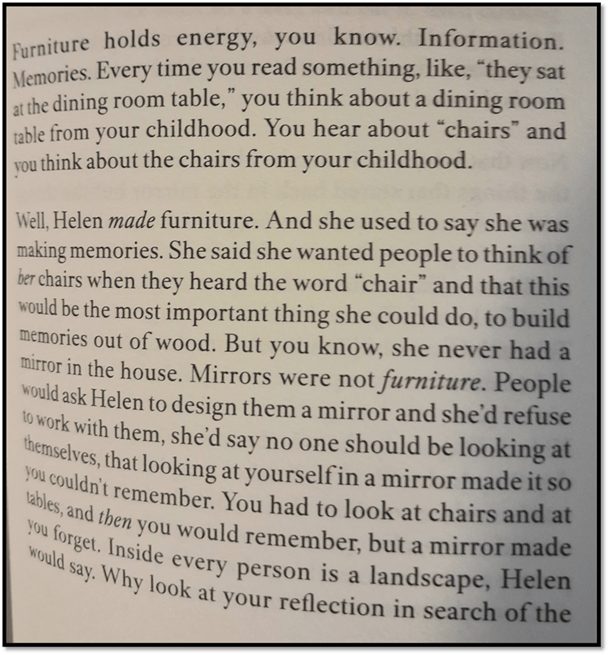
My Photograph of detail from Makenna Goodman (2026: 57) Helen of Nowhere London, Fitzcarraldo Editions
‘Well, Helen made furniture’, is a sentence in which the relation of women to making things is valorised, just as the refusal of mirrors is the rejection of that other male model of femininity – Tennyson’s The Lady of Shallot whose crafting requires a mirror to reflect the world as imagery. My hope is that Goodman embraces these associations and their difference from the evoked models. After all, it is not just because the older woman, or spirit (or whatever) of Helen (itself a play on the fact that the Greeks had two versions of the Helen of Troy story where only a false image of the woman was taken to Troy whilst the real woman hid in Egypt – a legend that Euripides based his play Helen upon). Yet if this is the case, Goodman (the name itself is ominous allegorically) also plays games with a reader about the two kinds of book her book might be, for Man’s is told by his academic rivals that there are two such types – one requiring the recall of other books in order to be understood, others just allowing the reader to enjoy them because, and perhaps solely because the ‘move people’, although the verb may have a range of meaning (cause emotion, motivate, …).
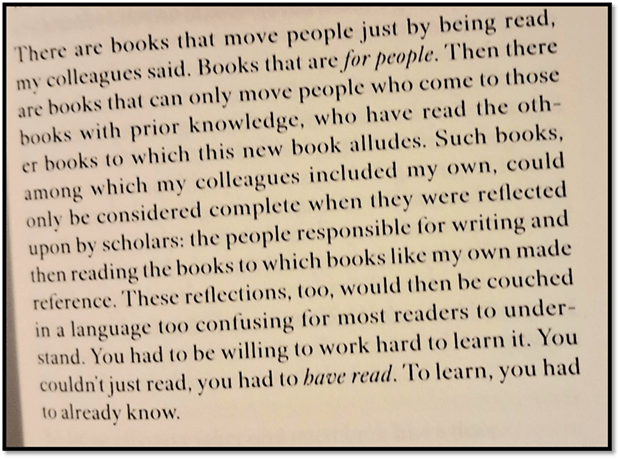
My Photograph of detail from Makenna Goodman (2026: 27) Helen of Nowhere London, Fitzcarraldo Editions
In a book so reflexive that it becomes about books as well as a book, it is difficult to see anything solid such as parody, for everything can query its own authenticity, even the words on the page. Hence my title quotation:
I made a point to say this loudly, as I didn’t know if I were speaking or thinking and yet it was clear she could her me regardless of whether the words were, in fact, coming out of my mouth’.[3]
This book from the beginning plays games with what it is, its haecceity, were it possible for it to possess such an irreducible thingness. There is a list of characters, which a modern novel or play might have, but on the next prefatory page there is a list of 6 ‘Acts’, as if it were definitively a play, though there is no reason that the term ‘acts’ might be used philosophically to name a central behaviour or stories of such as in the Acts of the Apostles. But the play paradigm helps us to see the sectioning of the work as along the lines of which characters ‘speak’ in it: though the concept of a character speaking is a far from realistic description of how written texts work, for text need not have voice and, if they have it is an imagined voice – in all its characteristics, such as in the ‘volume’ of sound the voice emits – and indeed the book continually posits that words are as much sound as semantic units when spoken. The Realtor (maybe a person who organizes the ‘real’ as much as one who has agency in selling houses) tells a story of being a typist for a great man who never repeated himself and her constant shifts from interpreting the dictating words, which then, for her, required translation or other editing to letting the words remain as meaningless sounds, using not listening ‘to what the man said’ as a means of avoiding that man’s ugly meanings. His speech became a ‘melody’ counterpointed by the tapping of her typewriter.[4] Hence when above the narrating male says he speaks ‘loudly’ we read it alongside the illusions of speech in varied forms it allows, especially when we are tld these words might not even have been voiced at all but merely mentalised and, perhaps, passed on by telepathy – so easily arranged in fiction if not in life.
Scenes in words then about the treatment of words (even their typing pre-printing) are part of the novel’s reflexivity, to which I must return. But at the centre of all the novel’s questioning of itself and the, sometimes, illusory components of which it is made – ‘characters’, acts’ and so on – is the Helen figure, the only one with a name that is not merely a category, often a gendered category. Yet what is Helen? The Realtor, in whose form apparently Helen first arrives is ‘an entity beyond ownership’ Neither owning nor owned and hence not ‘of Troy’ but ‘of Nowhere’, but it is also made clear that the Realtor’s Helen, who is inconsistent – rejecting the Realtor’s approaches in her narrative, but at the moment I’m instancing now realised in the realtor because ‘I am a body able to embrace her’, as if she were the partner in a lesbian fantasy as well as a ‘pure’ spirit. ‘To me’, the realtor says: ‘Helen is an entity that pure consciousness, beyond form’.[5]
Later, in ‘Helen and Man’, where Helen might be the realtor but ‘didn’t look exactly like the realtor, and yet there was a strange resemblance’ (so your guess is as good as mine in this numinous mix), but who also recalls to Man his Wife on their parting often dissolves into abstractions of memory and:
fear of whatever Helen, whatever she was that was possibly here to injure me, or possibly here to rob me, someone who had been watching me sleep, who had broken into the house, or who had been there all along.[6]
The syntax here strains so that we do not even know if it is querying the ‘thisness’ of Helen, her motives or her ‘acts’, which are contradictory if not alternatives and it is not certain they are alternatives. An ethical puzzle as well as a material one, ‘form’ and nature are complex and words lose their context. In the paragraph below, that precedes the words immediately above the term ‘assisted living’ suddenly is no longer a category of social care alone but a description of what supports the notion of life in Helen, if anything:
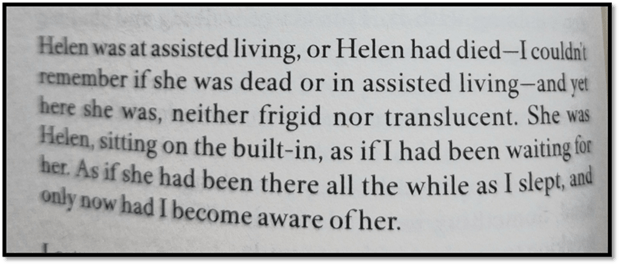
My Photograph of detail from Makenna Goodman (2026: 100) Helen of Nowhere London, Fitzcarraldo Editions
The sense that Helen may be a ghost as well as a fantasy actually again suggests that the model of her as Helen of Troy is later than Homeric, and that her disputed location and nature is from other sources. Writing of the sources of Euripides play, Helen, Wikipedia says:
About thirty years before this play, Herodotus argued in his Histories that Helen had never in fact arrived at Troy, but was in Egypt during the entire Trojan War. The Archaic lyric poet Stesichorus had made the same assertion in his “Palinode” (itself a correction to an earlier poem corroborating the traditional characterization that made Helen out to be a woman of ill repute).
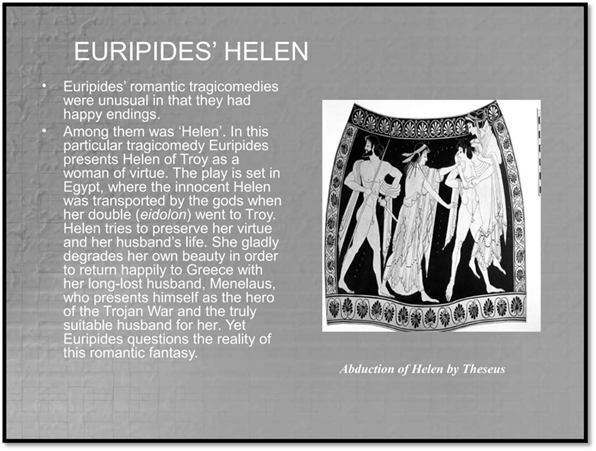
The nature of Helen in fact was widely disputed, but what fascinated the Greeks was her dual, perhaps multiple ‘realities’ as an aesthetic creation which made the study of her obsessed with the idea of the ‘image’ (‘Ancient Greek: εἴδωλον ‘image, idol, double, apparition, phantom, ghost‘; plural: eidola or eidolons’) which is it difficult not to see employed by Goodman too – it is the term employed by Euripides. Helen is a doppelgänger of the Realtor (where ownership and selling come into their likeness), The Man’s Wife, and, of course, the Man. She hears his thoughts and imitates his moods and outbursts for they are already him and her.
But I think it goes further than that. Helen may mirror Helen of Sparta and Helen of Troy (the ‘same’ person translate by two kinds of feminine possession) but also the false image (εἴδωλον) of either of them or their ‘doubles’ – a method used by A.S. Byatt in her 1990 novel, Possession). Moreover, in Euripides version, she uses the fact she is a literary εἴδωλον (a character in a play and indeed conscious of being the creation in this as Euripides’s version of more than one Homeric personae. This allows her to invoke, as Euripides does says his modern commentators, the capacity of Helen to ‘be regarded as a version of’ (in Peter Burian’s words) Calypso the evoker of false images, Nausicaä, the type of women ‘approached by a rough and dangerous-looking stranger’ and, given what I said earlier of this type, ‘an unlikely Penelope’: employing ‘deception and cunning to deal with her difficult situation’.[7] I want to labour this point not to castigate Emily Hall for oversimplification of the echoes in the novel but to insist that she gets the tone of the fable and the slipperiness of the character types, wrong in trying to reduce them to feminist dogma, which is pertinent anyway only when the characters are worthy of the kind of nuance expected in a more sophisticated story than a simple political allegory. Take how Hall characterises the story here:
Near the end of the novel, Man finally meets Helen, who appears suddenly at the house, like a ghost. Facing her, he purges his deepest fears, even though he’s not sure she’s even listening. He explains, “I was speaking inside of myself. […] But it didn’t matter, because the words existed, and they had a witness.” In the midst of discussing his feelings with this woman who may not be alive or even fully listening, Man realizes he hates his wife because she punctures his self-deception. He likens her to an oracle who “can reveal the meaning of life” to someone who doesn’t want to hear the truth. She’s found his Achilles’ heel, so to speak: she knows he craves approval and attention above everything.[8]
What a dull novel this would be if she is right and how poor a reading of what its words say would it be to be satisfied by describing Helen as ‘like a ghost’, which is only one of the possibilities of which an εἴδωλον is capable – omitting phantom, double, image, figure, character somewhere between self and other. And then to turn into feminist finger-pointing at the deficiencies of Man (as a character and genus representative) is even more simplistic, though such finger-pointing is allowably there.
All this misses the reflexive concern with what elements of fiction do, even down to ‘words’ themselves as I have spoken about already in relation to written-spoken words. For what ‘words’ are, is an ongoing query – for if real (in speech), or imagined inner, ‘sound’ placed into rhythmic passages, they are also what stains the blank space of a page with type or ink from a pen-in-hand. At one type, Man, recounting the reading of his words by Wife, talks of his achievement, which might also be a laxness (‘looseness’) of ‘letting my words take up space’, where words become a projection of some inner capacity or meaning or sound. He even spells that out to Wife a little lower down the page. He remembers:
She would say, “You’re hardly getting anything down on the page,” and, “You’re wasting paper, your handwriting has gotten so big.” It was my right, I told her, to take up space![9]
And if true of words in general, what of specific words attached to meaning or meanings, when you allow yourself to hear them, as Realtor doesn’t always as we’ve seen. Attached to this are debates about simplicity and complexity in written texts and the distinction between ‘constructs’ and the being of things named by word, and in one instance the power of a name that exists as a thrice-repeated conjuration. If I had to say that this concentration was purposive around certain key words, I would pick up the constant interplay of meanings about control and care in relationships, with the constant networking of phrases using those words, or cognate concepts – like those in social care and control – ‘assisted living’ being the best, where living is not only assisted or supported but controlled, and this is why Helen is said to hate it. When Helen describes a social thing ‘that’s closest to paradise’ in rural agricultural spaces, she describes those spaces filled with life and making the stuff of life where people ‘knew how to take care of themselves, …’.[10]. The realtor as she begins to show some of the intimacies, real or merely desired, that she received from Helen, the older woman in their relationship when the former ‘came here as a young woman’ and where Helen ‘took care of me, you could say, she taught me how to live’. Care extends in this example,; the realtor feels ‘empowered by care: ‘She gave me the power to do what I thought was best’.[11]
Man, in his paranoia talks, when he tells the story of his ‘cancellation’, in the modern sense of social ostracism, talks about how, in the circumstances: ‘You have to be careful these days. So unbelievably careful. Everyone’s on everyone’s case’.[12] It extends even to signs of loving (for love is another word up for interpretation in this novel) – Wife being an intellectual star herself is ‘fucked’ but only ‘every now and then’ with his eyes closed and thinking of a younger woman – perhaps a younger version of Wife.[13] Yet everyone, even Wife and Man, know that ‘care’ and ‘love’ are difficult to distinguish from their ‘performance’, wherein the truth and falsity of them may be hard to determine. When Wife queries him about how satisfactory his signs of love and care are (queried in quite complex sentences) he says to us as readers and as indirect account of what he told her – which is also an example of the networks in the novel that look at ‘giving’, ‘taking’ and ‘doing’:
I gave because I was generous and because I loved her, not because I wanted to appear to be loving, not because I wanted to trap her in a web of misery, but because I cared for her.[14]
Critical readers are not convinced by this masculine ruse, but I think they may miss out that this problem does cross sex-gender boundaries, even human-animal boundaries. Jo Hamya in The Guardian speaks of the mechanism of how this is done well, without the inevitably resting upon the obvious anti-male rhetoric in Emily Hall. The attention to the interwoven debates here is meticulous and respectful of what good writers do, which is always greater than to make an obvious point:
Man views a house in the countryside owned by Helen, about whose bucolic way of living he is taught by Realtor. Although she is now in a care home, Helen used to farm her land self-sufficiently. In doing so, she became attuned to a world of “natural” rather than human-made systems: “[t]here’s contentment outside of all that,” explains Realtor, now the dominant narrative voice. She can see the appeal this kind of ahistoricity or asociality might hold for Man. Still, she says, Man needs to restructure his ego and “come to terms with love” to truly heal. Helen could help. Man, somewhat aroused, agrees. At which point Helen’s spirit enters Realtor to discuss with him where his work and marriage went wrong. Reality dismantles.
Despite how fabular Helen of Nowhere seems in its progression, these kinds of narratorial shifts between Man, Realtor, Helen and ultimately Wife are dexterously, meticulously performed. They help enact a carefully negotiated dialectic: doing v taking, buying v selling, the individual v community, man v nature, dominance v support, masculine v feminine. Beyond its more obvious themes of misogyny and supplanted power, Goodman’s writing also asks worthwhile questions of us all. How much of living is predicated on a reliance on – if not exploitation of – others? To what extent is this bearable? How far does it delegitimise individual pleasure? What should “good” living look like? Where does the knowledge such a pursuit requires come from? Can it be, at once, wholly ethical and personally pleasurable? Each answer, naturally, depends on the privileges afforded a person.[15]
Here, I think, is feminist criticism that does not forget that the world is complex behind and at the side of patriarchy, making patriarchy however one of its standards of being. Moreover, it allows us to see that the issue of ‘paying attention’ and ‘taking care’ that resonate through the novel also resonate through its female characters in moments where issues of culpability and responsibility for one’s behaviour and attitude to others is manifest – in the Realtor, for instance, who disguises her needs and in Helen, who (though without malice) still falls foul of other’s accusations that she does not take enough care – in allowing young boys to see her bathing naked and in ‘neglecting’ (if she does) their safety as they swim in her pond away from their mother’s care. Moreover there are several ways of reading the chapter ‘Wife’ which posits whether writing means different things when its subject turn on sex/gender differences and, above this, what the sex/gender of the author of the writing is: its style is that of the thought experiment, starting: “Say you were a …’.[16] However, I can’t say I enjoyed that chapter.
The issue seems often to be again with the authenticity of thoughts, actions, speech, writing, and words in all of those instances< nothing exists that doesn’t not double in a potential false image _ care and love in particular, so that honesty and fraud, truth and lies are the least of the appearances of that problem, though they do appear – take the issue of what is a true and false ‘revolution’ and whether the latter exists to prevent the former.[17] And all of this relates to mirrors in the story. Helen hates mirrors but uses them incidentally as part of her project in hunting out insincere versions of otherwise true emotions, the Realtor says, or ‘honest’ people who use ‘honesty’ to avoid the suspicion of falsity or their primary need to ‘be noticed’, very much a theme for Man:[18]
Helen could see through those honest people right away, just by the way they glanced at their reflections in the window behind her when they talked.[19]
But words are fun too. This book is as careful in its use of dogs as is All Them Dogs by Djamel White (see my blog at this link), though less satisfyingly so. Dogs are crucial to moments of disclosure, such as the dog that Man harms that is owned and loved by his wife and her friends, ‘knocking the dog off the table. It ricocheted off the wooden bench’.[20] Is man’s unowned responsibility for this dog echoed in the damaged (‘three-legged’) dog that later takes part – if not in words) in the conversation about the divorce and other things with Helen.[21] Of course there is also that dog that lies between his legs whilst on the couch loving ‘Wife’. That is a complicated one. For amongst the caring words examined is the word ‘lick’. Right from the start we see Wife’s dog as a sexual rival: ‘Her dog enjoyed my spot on the bed’.[22] When we see the dog again, it is in his memories of using doglike behaviour as a sexual come-on to his wife before she was that:
I told her I was like her dog, loyal, devout. … I told her that, like her dog, I would lick her hello. I would lick her awake. I would bathe her, I would shelter her in my tongue’s old house.[23]
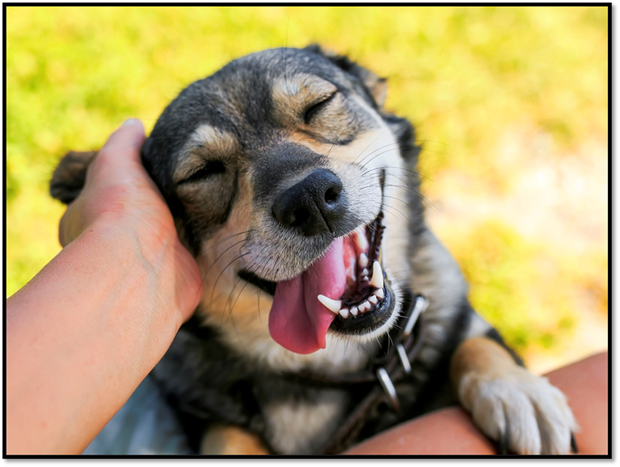
This may not be to your taste (I wonder about myself). But it matters! When Man returns to his wife whilst she is in bed, he goes under the covers and ‘licks’ her face (I can’t find the reference now) and though no other person commenting says this surely Man is represented as a dog ((‘She gave me dinner. She rubbed my ears for a while, on the couch’.[24]And in the most passionate part of the story, when he envisions the return to Wife that he will make, both the’lick’ of fiery passion and a dog are there;:
Water, I needed water.
The fire would consume her, it would lick her up and down like a demon.
But I broke free. I felt the dog at my feet, and then I was up lunging for the window. …[25]
Of course I think no account is complete without looking at the relationship of ‘taking care’ and ‘paying attention’ to why we write books – it is a major theme. Divorced from wife and academia, Man is in ‘the middle of nowhere’ (‘useless and vast’ as it is) where Helen, we have to remember derives. But he gets there because people try to teach him why he writes books and whether his reasons are authentic and authenticate his message, or indeed those of any book writer. This book can I think only be truly enjoyed if you see how much of Man’s autobiography is about the tragedy of the role of ‘reading’ in human lives. I won’t quote. It must be read. If you like it, there’s more chance you will love the book.[26] This book more than any other I have read has posed cognitively, but forcefully nevertheless, to think more about why I read than any other this year. Whether I enjoyed reading it< I am less sure and wonder at being proposed as a model of a Booker winner. However, I am glad I read it. And I rememember how I started this:
… anyway, the idea of literary chat over dinner appalls me and perhaps does Makenna,
With love (and bon appetit!)
Steven xxxxxxxxxx
[1] Makenna Goodman (2026: 106) Helen of Nowhere London, Fitzcarraldo Editions
[2] Emily Hall (2025) ‘Review: Helen of Nowhere’ in Necessary Fiction (online) [September 1, 2025]. Available: https://necessaryfiction.com/reviews/helen-of-nowhere/
[3] Makenna Goodman op.cit: 106
[4] Ibid: 44f.
[5] Ibid: 78f.
[6] Ibid: 100 – 101
[7] Peter Burian (2007: 10f.) ‘Introduction’ in Peter Burian (Ed & Trans) Euripides: Helen Oxford, Aris & Philips Classical Texts. 1 – 50.
[8] Emily Hall, op.cit.
[9] Makenna Goodman op.cit: 110
[10] Ibid: 49
[11] Ibid: 61
[12] Ibid: 109
[13] Ibid: 109
[14] Ibid: 111
[15] Jo Hamya (2026) ‘Review / Helen of Nowhere by Makenna Goodman review – a perfect fairytale for our times’ in The Guardian (Fri 6 Feb 2026 11.00 GMT Last modified on Fri 6 Feb 2026 11.02 GMT) Available: https://www.theguardian.com/books/2026/feb/06/helen-of-nowhere-by-makenna-goodman-review-a-perfect-fairytale-for-our-times
[16] Mackenna Goodman op.cit: 136ff.
[17] Ibid: 140
[18] Ibid: 87ff.
[19] Ibid: 43
[20] Ibid: 103
[21] Ibid: 112-115
[22] Ibid: 20
[23] Ibid: 35f.
[24] Ibid: 154
[25] Ibid: 132
[26] Read ibid: 24 – 25


5 thoughts on “In lieu of a literary dinner, consider what literature is? This is a blog on Makenna Goodman (2026) ‘Helen of Nowhere’.”