If you could switch to any career path right now, what would it be and why?
View all responses
For three hundred years a ‘career’ meant a mindless charge at full speed where destination didn’t matter. Now it is supposed to ‘mean’ the path taken in one’s ‘profession’. Has it really changed as a word? Let’s praise career deconstruction: my example, Catherine Howe, with a focus on her book ‘Halifax 1842: A Year of Crisis’, Breviary Stuff Publications.
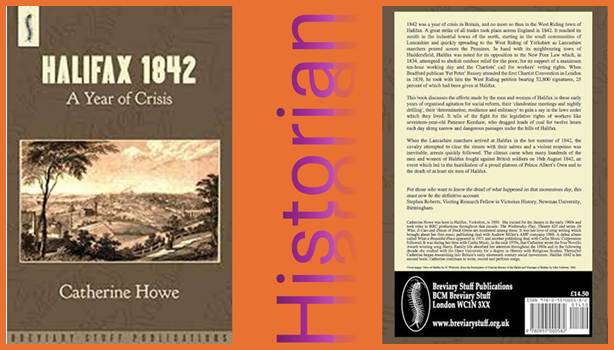
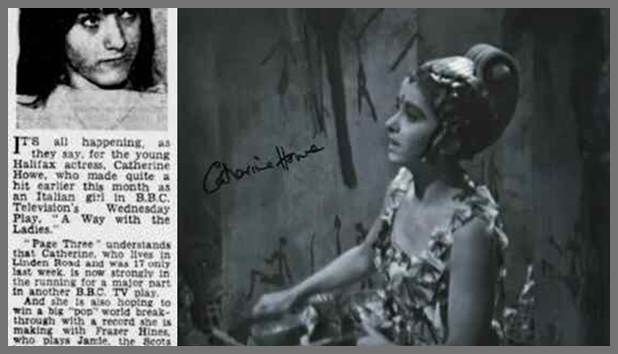
You could insist that the legend to this collage read as ‘Historian?’ But no profession should ntot be deconstructed. Bless the persons who do that for us, for me!
We could start by addressing the claim in my title first bout the word ‘career’. Let another trip from this blog to the Online Etymology Dictionary suffice!
career (n.): 1530s, “a running (usually at full speed), a course” (especially of the sun, etc., across the sky), from French carriere “road, racecourse” (16c.), from Old Provençal or Italian carriera, from Vulgar Latin *(via) cararia “carriage (road), track for wheeled vehicles,” from Latin carrus “chariot” (see car). The sense of “general course of action or movement” is from 1590s, hence “course of one’s public or professional life” (1803).
At my age my course is shorter and the destination not bound ever in a wheel, and, as for the ‘running’, I don’t career along as much as I might. Even during my adult life I have always had to describe my ‘career’ as chequered and inconsostent, not always through choice, slip between teaching and social work but at times in ‘downward drift’ as the health social psychologists say who aren’t careful with the hierarchical implication of words.But ‘deconstructing the unitary implications of the word ‘career’ is probably a good thing. When I left the Roehampton Institute after 11 years teaching there, other ‘leavers’ spoke confidently to the rather grim ‘party’ organised there, about the ‘arc’ of their teaching career, whilst I …
(aside):  What shall Stevie Bamlett speak? Live, not be silent.
Unhappy that I am, I cannot heave
My heart into my mouth about careers
At all, for what came was not that planned for.
But it has always seemed in the process always a mess that list of job titles following in succession in my own case, bearable only ‘recollected in tranquillity’, though that state is rare enough. Some persons appear to have too by some method that I am inclined to honour and praise deconstructed their ‘careers’, turning whenever to passions to speak for them ‘in different voices’ amidst the trot that follows the initial plunge into the horse race, and with one eye on one’s origin.
This blog is rally about a book I bought at the People’s Bookshop in Durham which tells its historical story interspersed with ‘careers’ cut short – the story of miners who died in the pits of Halifax unsung, or mill workers, and notably children whose ‘careers’ started at age six or before and ended before age ten, pushing ‘corves’ (waggons of coal) along seams too narrow for adults or opening doors for the corve huriers as they approached closed portals meant to stop the too liberal spread in the tunnels and seams of toxic or explosive gas. The book is Catherine Howe (2014) Halifax 1842: A Year of Crisis‘, Breviary Stuff Publications. One person’s ‘career’ told of in it, that of Patience Kershaw, and parts of her family, is follwed throughout in the book – its crescendo being interviewed as an infant by William Scriven for his reprt on the conditions of labour in the Northern mines (the 1841 Commission into Mine Labour and Conditions), finding Patience labouring mainly naked among boys and men (that fact taking up most of the horror of contemporary readers awake to the promulgation of vice), through to her ‘liberation by an Act of Parliament and to various jobs in mills at poorer wages and not much better conditions, through hopeless relationships with shiftless men and eventual death, at an old age actually, of a mental disease that was probably final stage syphilis from the sackless men in her life.
No one could calls Catherine’s Howe‘s life the illustration of a bourgeois ‘career’, though it would appear that her roots in the working class are ones she imagined herself into, from the basis of being a truly creative and curious spirit. She turned to the book after the song by Frank Higgins, based on the character, The Testimony of Patience Kershaw. But in Patience’s case ‘career’ is an unthinkable word. I stopped short of researching that for even imaginative identification with the working class feels to me an achievement that artists no longer aspire to. Even in my youth (Catherine must be just over 4 years my senior) , working-class parents looked for their sons, in particular, to take remuneration, rising through their lifetime hopefully, through ‘good jobs’ not a supposed line of advancement though the aspiration for stability that in some ways defined what a ‘career was ws still there, but for Patience, wage slavery, or slavery to the sex drives of others about sums up a career, though she may not all be victim, for her account to Scriven lives on in this book, as the signs of a life resiliently lived. But I wondered as I read this book about its author, Catherine Howe, who published it in 2014. My reserch into her life is too little to be even called minimal – only enough to register its diversity. Known as a folksinger her songs hark back to a community, as in the record cover below showing behind her, holding a posy of flowers, the b;ackened coal dust throttled streets of Halifax.
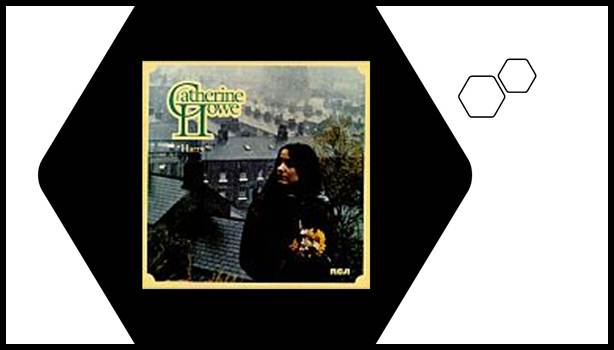
There is, it seems something that draws Catherine back to a communal past long before her part in it, which anyway is more an act of imagination’ of United Kingdom in internal exile – her parents were Southerners and she came to Youkshire, to Linden Road to a house overlooking Skircoat Moor, as a first generation resident. My grandad used to describe the rods up there as where the ‘knobs live’, meaning those above us in station. But what attracted me (and still does) to Howe’s book was its treatment at its centre of a ‘riot’ or ‘porising’ (the word choice matters) which was small victory of the working class of the Northern towns at Salterhebble Hill in Halifax, for my grandparents hailed from there and when I find them I buy pictures of it’s fascinating grimness, that I remember in transformation from steep slanting (cobbled, I think) streets rising above the itself rising hill that Salterhebble Hill main carriageway wes, up steep banks.
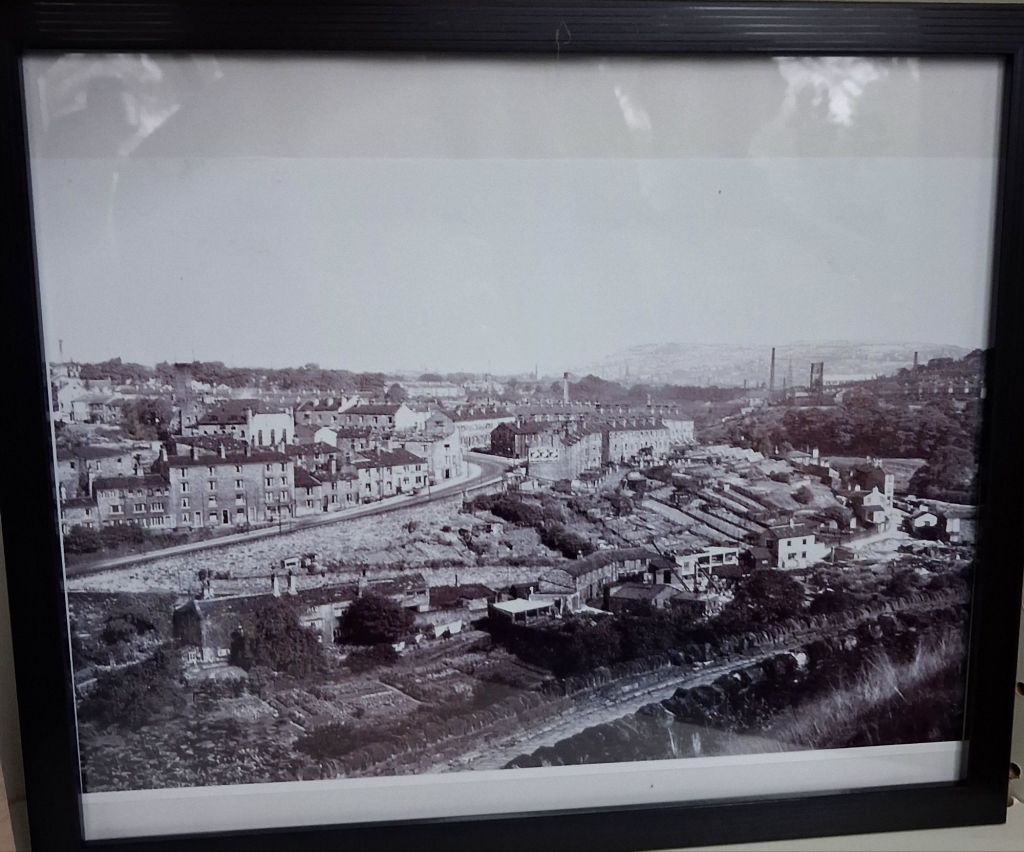
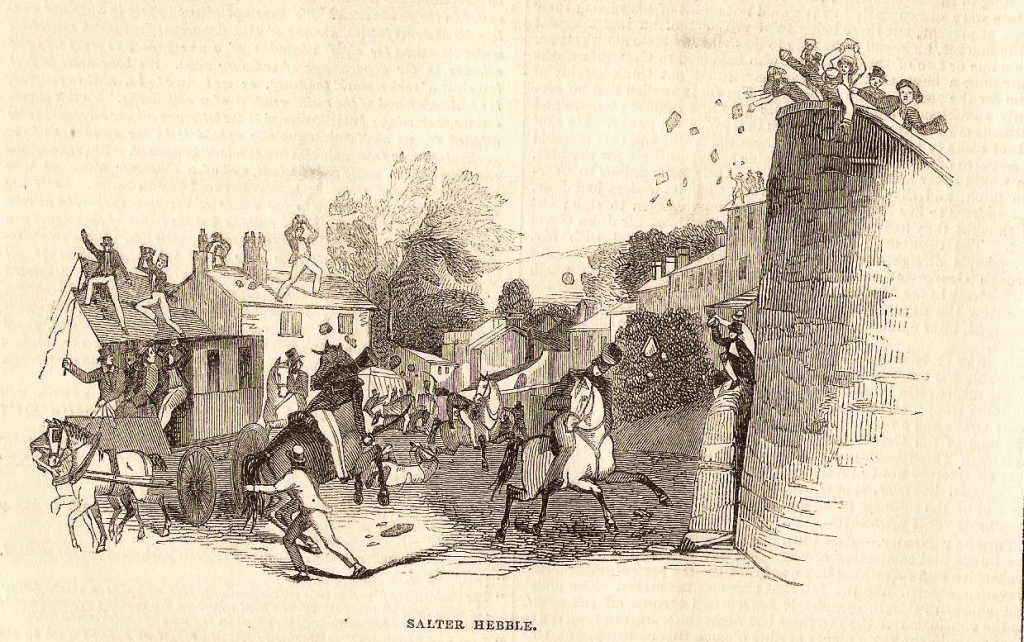
Howe describes them in 1842 from the point of view of Francis Grundy, an engineer working on the railway line that would connect Halifax to Manchester and Leeds. He had an office at the bottom of the hill when he saw hordes of workers, including miners (not previously part of any general uprising or attached to the Chartists behind the organisation of the procession of workers, reading to meet the hussars from Wakefield who travelled by canal here to the canal docks at the bottom of the hill. By my grandfather’s time, these had give way in part to the sewage works in which he worked when he moved to Salterbebble, living at that rounded house on the bend at the top of the hill above. What grundy saw of 1842 Salterhebble from his office was:
women as well as men … rushing along the various lanes over my head with arms and aprons full of stones, taken from the macadamized heaps of blue metal placed along the turnpike road.[1]
From protesthistory.org.uk/7-making-moscows-1839-48
The description of the attack of the hussars mounting that hill turnpike is one of the most fine accounts of a historical even I have read. That goes for much of the book that weaves the history of Chartism, trade unionism in its pre-history, mining and factory mill history into a constant pattern at a place where they met for the first time, and perhaps not again – as working class history followed later more controllable patterns within specific industries. Howe tells us this without overt comment though her offering of space to this and other forgotten marginalised voices is a political stancein itself, a shiftin consciousness from that enforced still in the status quo, where lives of the trivial rich are trivialised further to stuff the mins of those without sufficient sense of having a right to self-value.
But it can’t have always been that Catherine Howe wished to lead a career that deconstructed itself around the lives of marginalised others – in song and history. I found this except online from The Halifax Guardian, which writes of her at the age of 17 (it must have been about 1968. Local newspapers love stories of promising careers beginning where they can play with saying, ‘It’s all happening’ for a local young woman, and attest to a future career as an ‘actress’ (the belittling term used then) . Singing and acting here is enough to make the ‘pop’ with which the champagne cork of a career opens. The other photo in the collage is Catherine playin to Tom Baker’s Doctor Who, a role that preceded the Wednesday Play appearanc, in the 1967 Doctor Who story The Underwater Menace, playing a fishy goody named Ara.
Of course with those careers come gossip – largely circling around Catherine’s relationship with Fraser Hines. But to read Halifax 1842 is to discover something much better. A writer who tells stories not of the superficies of careers but the embedded nature of lives in social realities Patience is not alone in the roll call and, as a history, this story makes you feel as if you know some of the characters, even down to those factory owners of Halifax, who stood against their workers and traded in their lives – eventhey get portrayed with the kind of knowledge that allows us to know how they lived with themselves. Little maps of the areas of Halifax dealt with are wonderful as the story skits around and through the city in full glorious march of people wanting to be more than the fodder of bourgeois careers. Samuel Scriven is painted with a delicate brush.
I loved this book.
With love
Steven xxxxxxxxxxx
_______________________
[1] cited Catherine Howe (2014: 93) Halifax 1842: A Year of Crisis‘, Breviary Stuff Publications

