What’s a small, everyday moment that makes you really happy?
View all responses
When I notice why stories that sing exist is a small moment of happiness but not enough. This is a blog on Sebastian Barry’s 2026 novel ‘The Newer World’.Anthony Cummins reviewing Sebastian Barry’s 2026 novel The Newer World tells us that the writer’s ‘publishers originally advised him to abandon this novel, written in the voice of a freed black slave after the American Civil War’. Later he quotes one of the many summaries of his moral learning about human cruelty, including his own collusion with it, stated by Tennyson Bougereau, its protagonist as described above, and adds ‘Even just typing that line makes me grind my teeth at the novel’s confidently frictionless clemency. Maybe the publishers were right the first time’.[1] So much seems as if it might be missing from a novel that makes a critic react with a response that the novel were ‘better not to be born at all’, which Silenus told Midas that he thought the highest state of human happiness. In contrast Sara Collins says, and I am on her side: “Putting … arresting language into the mouths of “nothing people” makes it impossible to overlook them, as if only in fiction can they be given their due”.[2]
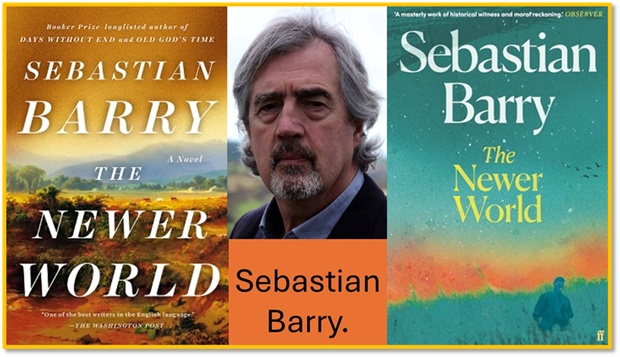
I have decided to approach Sebastian Barry’s latest novel, the third of his nineteenth-century USA trilogy, dealing with complicity in the genocide of the Native American population and attempted systematic degradation of its remnant through two of his critics, for they illustrate the divide amongst his would-be readers, either haunted by his sad elegiac take on humanity in some of most poetic of prose since the nineteenth-century prose stylists. Sara Collins describes his prose as a place wherein ‘language attains registers that can only be described as soaring; a vertiginous high wire of prose,‘ which is itself a fairly high-wire statement, though one that resonates with me. It is not that Barry is unaware of his heightened prose and pithy moral aperçus, that seem to stem from Emerson or Thoreau.
He does not name his hero accidentally, although the name in fact registers the tendency to name the love-children of European colonists by European names, often those of heroes of the white European middle class. Tennyson Bouguereau has a double-shot of European sentimental classicism – the surname (coming from his slave ‘father’ being that of the Academician whose classicism had that heavy sentimental romanticism that defied all strictures of the supposed taste they claimed to embody. The first name is that thought to be given by his biological father (perhaps) the tiny white colonel Littlefair, of whom Tennyson’s mother ‘used to say was a romantic sort of man and owned many lovelorn paintings, and was a follower of the poet Tennyson and his weepy poems’.[3] Is that why when Tennyson’s life-journey, and travel adventures, are compared to those of Odysseus / Ulysses, it is nearly always to ‘Odysseus weeping, weeping’.[4]
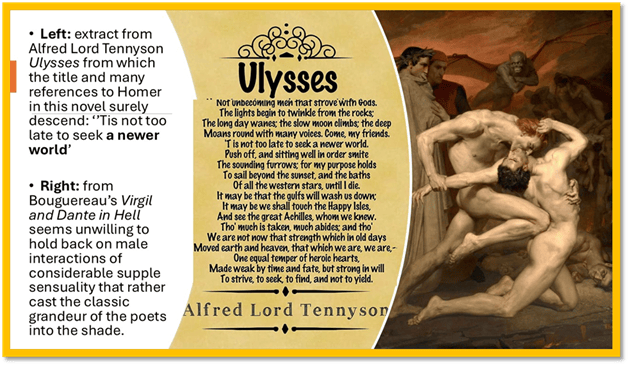
And like Homer’s Odysseus, for the most part a home-comer, than the sad venturer stressed by Temmyson, Homer is associate with the singer of songs amongst a body of whom Tennyson absorbs himself, and compares himself to an impoverished white Southern gentry (that of Lige – his former employer, Luther’s son):
A story like Homer’s of many gone out in ships, told on the air. A million Odysseuses. A million Penelopes. A million dogs called Argos, rising for one last time at the footfall of a master returning home at last. Lige was just a ragged man with his troupe of hounds. He had nothing of this, nor Luther. Somehow not all was lost in the general loss of how things were, for such as us. Everything was gone long since, we had to allow, but this last thing was left. Like a crazy whiskey distilled down to one pure drop that no human man can taste with joy.[5]
Weepy, elegiac songs – of loss of ll worldly goods and the fate of all migrants but nevertheless something that Tennyson believes he shares with art and artists, via his lyric voice, not unlike his namesakes if sometimes compared to stuff in the form of a reductio ad absurdum, like the reference to innumerable kinds of Argos the dog and that strong poitín of ‘crazy whiskey’ which, if it represent artistic taste, represents it as something ethereal, only because it is so heavily distilled a spirit and makes you very drunk as its form of ‘joy’. My point is that Barry is always undercutting – perhaps even undermining his own lyric tendency as a writer, but marking it as the sign of cultures too long despised and the consolations they take in a legendary and fabulous language of the past.
I think that is the point, when we return to our critics, that Collins gets about Barry’s art (that Cummins misses entirely), when she says:
He describes himself and Rosalee, enslaved orphans in childhood, “freed but not free” in adulthood, as “nothing people”. It’s reminiscent of Winona’s description of herself as “just the cinders of an Indian fire”, and Thomas’s of the ships bringing “ruined people” from Ireland to Canada: “The point is, we were nothing. No one wanted us.” The thing I like best about a Barry novel is how he gives a voice to the “nothing people” of history. It’s like pulling up a rocking chair on a shaded porch and listening as the narrator, usually in retrospective mode, attempts to reckon with what they did and what was done to them. It’s an astonishing effect, especially when you consider the near-miracles Barry performs with language. In his hands it attains registers that can only be described as soaring; a vertiginous high wire of prose.[6]
I think we dismiss the artifice in the attempts of salvaging self-esteem if we fail to see its beauty as a demonstration of taste in itself, baroque taste though it be, as comic and overblown as it is tragic, And likewise the fact that Cummins makes a lot of, that Tennyson’s morality is a thing of rhetoric and sentiment not politics and action, for in the latter domains he is entirely a colluder – even in genocide:
When his regiment hunts a Native American leader named Black Bear, Tennyson reflects that land in Dakota “was as normal to [its people] as a Tennessee farm had been to me … They had no true title to anything, said the army in Washington, so they must be stopped. Killed or corralled. But I am saying this, just for the record – Black Bear was free in his own mind, and his people were free.”
Yet the point of these books is our lack of agency in the face of power; Tennyson quickly reconciles himself to following orders. And though he nurses a kill list of his own, bent on avenging his murdered parents, the vendetta is only a tease on Barry’s part, as the protagonist’s desire to exact a measure of justice recedes unsatisfyingly in favour of turning the other cheek. “Why I was ever surprised at the cruelty of people, I don’t know,” he wonders. “Doesn’t it go with the territory of being this half-boiled thing called a human being?”[7]
It is a mean point, this one of Cummins’. For Barry sets out deliberately to portray people who don’t confront power, except in the privacy of their inner thought and feeling and in mythical and legendary stories (so much the stuff of Irish historical experience, so often played out in fantasies of the ‘halls of Tara’) and otherwise in accepting the lot of the migrant, forced to bed down with Satan sometimes in foreign lands, as is Thomas McNulty and Tennyson Bouguereau and become agents of settler colonial genocide. But then that IS the story of ‘nothing people’, those who, knowing their own powerlessness against the world, either live it in epic ancient days, or protest song, whilst sleeping with the enemy they would like to kill forever and ‘seek a newer world’. For the newer world doesn’t quite ever exist.
And we forget at our shame, if like me one is proud to name oneself queer that the Barry trilogy that stated with Days Without End, continued with A Thousand Moons (see my blog on it here), ends – for the moment, for a quartet at least may be designed – here. And like its predecessors, this book has a queer taste for the word ‘queer’ and the perspective on the normative the word implies, regardless of reference to sexuality. Certainly this novel reprises the story in little of the other two books – in little because the focus is on this character, Tennyson, in the background of the earlier books, particularly the cross-dressing ‘in disguise’ as the wife of his male lover, of Thomas McNulty and the life of he and John Cole led in a bar entertaining in drag before they became US Army soldiers killing ‘Indians’ but saving , adopting and deeply loving one Lakota girl child. But the marginalised groups of ‘nothing people’ investigated in this trilogy digs deeper than those who are politicised enough to know and defend their identity, as sometimes McNulty does, and often equally doesn’t. They include those who have not yet named their voice as being queer or any other name. For me, this is a beauty in The Newer World.
Are sexual identities clearly defined, as McNulty and Cole make theirs to be, even if not in declarations to federal agents? What of another intersection unexplored of black queer identity. It is a step that this novel does not take but posits in potential – but forever fails to express. Here is a section of the novel I love, when Tennyson later alone in the army, his friend George dead and buried, reflects on why, having established an ‘understanding’ with Minnie and had sex with her, he chose to leave the troupe of singers, of which they are part when his first male friend, George does (his singing voice lost to throat injury), rather than stay with Minnie:
‘…. All that broken insisting and choosing I had done at the time seemed a kind of folly now. I was shaking my head at myself.
I didn’t even know what it was George had been to me. I didn’t even know that. I hadn’t even told him those long reminiscences that lovers sometimes do. Of course I had gradually learned his history, in little parts, here and there
It hadn’t been about any of that.
It had been when I clapped eyes on him I felt glad. And that this coyote life was worth the effort. More than worth it. He made life seem sometimes joyous and particular and good, and opening my eyes in the morning I was oftentimes like a mere child, looking forward not just to the day, but to him. He was always just few inches away, likely snoring. Him just being there, that was it. And now he was not there. And never again.[8]
The mode of loving is again elegiac and ‘weepy’ like the poet he is named after. But it points to subtext about the discourse of ‘lovers’ that Tennyson is not even sure George was to him or not, in that sense surely like the manner of In Memoriam A.H.H., speaking to Arthur Henry Hallam, now dead. It is, as if the novel sees an unvoiced potential in the lives of George and Tennyson that it invokes precisely because there is no label for ‘what it was George had been to me’. Desire that aims only at presence , without sexual action, has no name: ‘I didn’t even know that’ ‘it’ which was George was to him says Tennyson. This is not because he represses the possibility of love between men, after all he was a close member of the family of Thomas McNulty, but that it was never allowed to be a thing known as such, but only experienced in wordlessness. Does it extend to any wordless category, for even his nominal father Charles Bouguerea ‘had a sort of is-he-isn’t he look to him, my father’, that applied even to the name given in the sentence – that of ‘father’.[9]
Sara Collins picks out a few sentences for admiration of Barry’s prose spoken by ‘nothing people’ to praise them. Namely these:
describing a reunion with his sister at sunset, after many years: “The harbour of my brave sister. The darkness growing in courage and, since it met no enemy, having its little victory everywhere. Pleasing darkness, in its way. There was bliss in those long moments”.
These lyrical moments are Shelleyan in their vagueness. Darkness is a term for obscurity of meaning as well as a time of uncertain sight, and in the section quoted by Collins refers to ‘darkness’ that is liminal between day and night, life and death, the stuff of fantasy. The ‘hours with his sister, like a day that is night: ‘rare, curious. Neither living nor dying. Ghosts in the half-light, maybe.’ [10] Critics like Cummins like things to be black or white, not liminal, like the dark in which the young children dream of avenging their mother, a difficult time, they tell us to kill anyone when you cannot see them. [11] Darkness is a place you seek when you enter into the lumpen liminal domains of humanity, such as Nashville is painted to be whilst George and Tennyson live there as co-dependent alcoholics, but does Tennyson half refer here to the liminal darkness of queer identities:
We took a room, such as it was, in very darkest part of Nashville, and it was a city in those times of many darknesses, as well we knew. But it had a certain safety for the likes of us – for such as the stevedores of New Haven, say, believed us to be.[12]
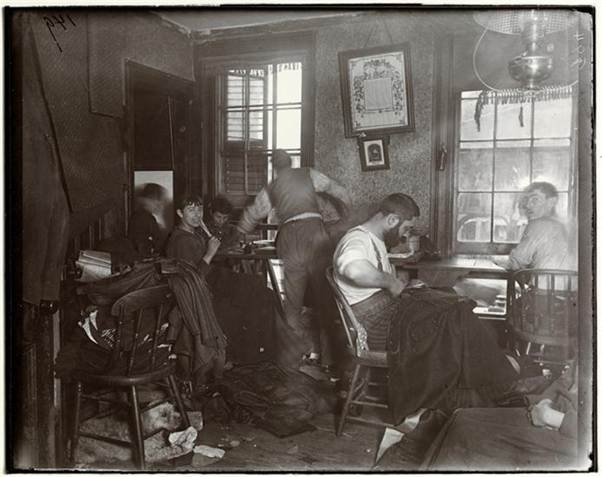
Poverty labour in nineteenth century Nashville A Ludlow Street Sweater’s Shop (1890) https://arthistoryunstuffed.com/wp-content/uploads/2015/08/a38f8f518be0da0aab1caa0edf06cd81e43ca3f4.jpg
Those vague darknesses are suggestive, as is the openness of the suggestion in what New Haven stevedores ‘believed us to be’., especially in a novel where so often ‘darkness is associate with the hidden, secret, elicit erasure and the erased, as in this early example of the oppression of the lives of working-class freed-slave children: ‘It was a darkness that could rub you out like the clouds do the wavering moon’.[13]. There is an especial dark when George is killed that allows Tennyson to believe him still to be alive and calling. Moreover, it is significant that Tennyson only tells the story of George to Rosalee, his sister, ‘in the full dark’.[14]Yet darkness is only one means that hides people ideologically reduced to ‘nothing people’ from being seen as anything of value. It may be a frightening thing ‘not to be seen’ in the world of beings, because we are socially invisible in the margins in which we live darkly, for some are seen as too small for notice, or to be offered the care and regard of others.
And on this Tennyson muses, finding solace in the fact that if the smallest of people go unnoticed and uncared for, within their own groups of identity and solidarity in fear of the other, those fears are ‘immense’ but commensurate with it are the immensity of their ‘faith in each other, as in Luther’s farm, the assembled tiny community feel threatened by resurgence of Confederate (or ‘butternut’ – for their queer uniforms) resurgence of power and hate::
How big are we in the world? … Here we are in great emergency, and we couldn’t be seen from anywhere. … So what price our fear, our faith in each other? Both were immense. Otherwise we were just six solitary souls, in our terror ranged like a choir along the old porch. The shadows keeping our position hidden. But eyes flicking, glances made, little shouts and proper orders, they made something different of it.[15]
The use of the word ‘choir’ here is fortuitous of the fate of Tennyson being bound to a band of singers, and its dissolution, yet its use in this passage to designate a spatial arrangement also indicates the words etymology for a space for ritual performance in ecclesiastical buildings, and in the Greek root ‘khoros / chorus’ for ritual dancing (see the entries for ‘choir’, ‘chorus’, and their interconnection to ‘chorus’ on this link to the appropriate webpage of the Online Etymology Dictionary). This idea of a chorus of the oppressed but still singing is something we will return to in the connection of marginalised communities to song, and the spaces in which song occurs – and the kind of exchange of gestures that could be considered dance above. And Tennyson struggles later actually to see again in memory his role in choirs: ‘ I can’t always see myself in them, not just exactly’.[16] But, at first, the issue is of visibility, for the references to it are wide-ranging, as in, for instance, the description of the events leading to Tennyson’s mother’s death, tied as it is to her rupture of the code that meant she must be the equivalent of invisible:
Have your clothes as clothes that no one looks at, don’t polish your boots, have your winter clothes and your summer clothes in a fashion that people are used to seeing, Used-to-seeing is not-seeing.[17]
The visibility of clothes is a theme after all, the ‘queer clothes of the early Confederate groupings for instance, McNulty’s cross-dressing for various reasons of both visibility and non-visibility – when in ‘pretence’ as John Cole’s ‘wife’.[18] Tennyson is dressed (and intimately washed clean first) by George into the dark but discarded clothes of English charitable well-wishers but, on deciding to return South he asks for the return of his ‘old items’ of clothing sh he looks the same invisible self though he does not feel it: ‘I slipped through the city no one looked at. Being what they expected to see, they didn’t see me. … But I didn’t believe I was the same Tennyson Bouguereau’.[19]
If you aren’t seen in certain ways, you also have a freedom to be, whilst people aren’t looking, different versions of yourself, and there is no doubt ibn my mind that Tennyson avails himself of that – and this even supports the queer readings of his unseen and unseeable life because hid in the obscurest of language. It is illustrated in the life of little Minnie, who uses her smallness to evade detection in the many versions of her own story she likes to keep in the air, even to use it unsuspected in person, if not as a group of black people, of having stolen tan English Duke’s bejewelled thimble inherited from his grandmother as an heirloom. We are never told she stole it, but in her greater age she gifts it to Tennyson. Minnie ‘showed her voice to the reverend and let the Fates begin to write her story on a bright page’. If you allow others to tell your story you can also tell many versions of your own, the above quotation continues with Tennyson doubting one story she told of her origins as a ‘true one’ but concluding: ‘It just didn’t matter. She had survived’. And then he clinches the truth that truth can be contradictory if one’s survival is all that you allow to be known of you, leaving much else unseen clearly: ‘The truth was I believed in all her versions’.[20]
This wonderful sentence about versions of old stories is a more distinct version itself of another theory of Tennyson’s life models that will link him to his namesake poet and to the role of myth and fable in the history of those oppressed into invisibility or misappropriation where others tell their stories (as of course Barry does, writing of queer men and women, Native Americans, black slaves and black freed slaves. It tickles me, for instance that the one line of poet Tennyson he quotes when he gets the chance to read him and ‘be tickled’’ himself is from Tithonus (although he does not name it) and is about the invisibility of the lives and deaths of the humble mortal compared to the eternal but still aging survivor who is the poem’s eponymous hero:
Man comes and tills the field and lies beneath.[21]
The telling of tales about the invisible, from the past or from the margins of the ‘known’ world is a theme from the novel from the very beginning, both in terms of the truth of events that have disputed causation, the basic story o which is often the establishment of who one’s father might be, as in Tennyson’s reference to the fact that in some story versions, things he significantly calls a ‘pretty legend’ he might be a Frenchman, ‘the legend of my pa’..[22] But the ‘legends’ don’t stop, varying sometimes with the teller, sometimes by the demands upon a story made by a listener’s desire to hear what makes them feel greater self-esteem. As always, Tennyson makes theories of these happenstance story-tellings, that dive deep into the reasons why ‘legend’ and ‘myth’ persist:
If I don’t believe all the things I heard about him, I like a legend the same as anyone. You don’t need truth to make a bible.[23]
If Bibles are legends, they might also be versions of the truth (as much as Minnie’s origin stories or those unspoken by George) or eve, let’s face it, lies, though more certainly fiction. Most of us rely if not on truth then the need to be ‘building a story’, which as Tennyson says of his mother’s stories of his Bouguereau father, ‘is not a story as good as the truth?’[24] Tennyson extends the theory around Minnie’s ‘versions’ of her autobiography: ‘She was a sort of legendary person without a proper listener to hear her legend’, whilst ‘I came out of a rough place and I had nothing of legend about me’.[25] But Barry makes that not so, even if has to appropriate stories from other cultures to make a nested legend of Irish and western queer exiles, and the voices of one ‘saved’ daughter of Native America, democratic leaning white Southerners, like Lige, and freed black slaves, seeking a freehold home. When Tennyson returns to Rosalee’s hut with all those memorial stories around him, in that place of ‘pleasing darkness’, that Sara Collin’s review cited: ‘we ate in a long silence. She lit a little rushlight. It was like a story in the Bible. Ancient days, Ancient matters. Is there no balm in Gilead?’[26]
The italicised quotation in the novel’s text is from the King James Version of The Bible, Jeremiah, Chapter 8 (in fact the final verse, 22) and it is a haunting version of what Zionism ought to be aware of, that the sins of Judah (of Israel) need to be atoned as much as those of the gentiles. Ireland, in our own time, has braved the undeserved taunt of antisemitism to remind Israel of that very fact while Palestinians are erased in the land of their birth, while the UK looked on and rendered another genocide of another proud people invisible. It is disingenuous of Anthony Cummins to find deficit in Sebastian Barry’s politics and political stand in the light of the record of the United Kingdom and its smugger writers.
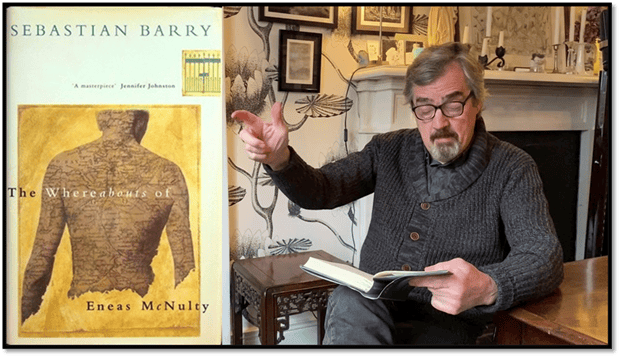
But I digress in defence of a nation of writers about the myths and legends of the oppressed that I revere (find among them also Colm Tóibín).It is no surprise that the Bible, the Old Testament in particular, is invited into the archive of legends, fables and SONGS of oppression or of the wars that engender oppression, sung by either side, as in the case Of Homer, invoked constantly as an analogue not only of the American Civil, over when this novel begins, and continuing in the eradication of Native Americans, and illustration of the endless cycling of wars in consciousness: ‘Every war is never-ending and then it ends. …’.[27] That is not unlike the endless cycling of the ‘last’ things in war in Sebastian Barry’s earlier legends of the McNulty family; from Eneas McNulty onwards, with its own echo of the Trojan War, there from Vergil’s take on it, with its own series of staying and leavings that make up The Iliad, The Odyssey, The Aeneid, and The Newer World. In the latter, staying and leaving as an issue prompted by war envelopes Tennyson, not only in his own life, but in that of George:
Even in those early days I heard so much from George about his army years that I felt I had ridden at his side. His memories were kind of becoming mine. Sometimes I dreamed dreams s if I was right inside his ancient scenes of war.[28]
Tennyson’s archaising phrase, ‘his ancient scenes of war’, seems to lift both voices into a history of far greater duration than their lives, and perhaps even their own memories, taking on the stuff of legend and fable from sagas, George has a possible Scandinavian heritage, but Irish, Biblical, Native American and the African origin of black slaves. And George is singer of songs, as Tennyson becomes and like the songs that make up the Old Testament and the chants of The Iliad and The Odyssey, or indeed ‘weepy’ poet, Tennyson’s, wanderers. ,
It is the commitment to the singing voice that Cummins as a critic of this novel deigns not to mention despite its prominence in theme and event. Even Collins doesn’t quite take the role of songs on board in relation to the voices of ‘nothing people’. Yet the world of everyone’s past is full of them: ‘Luther fetching up old songs from the deepest well of his memory’, from somewhere on Lige’s return from the bluecoat army that may have come from his memory of John Cole and Thomas McNulty’s days of singing songs from Uncle Tom’s Cabin in drag shows, and songs which George draws out of him again later are received by the choir he is to join as ‘lovely, deep, stirring singing’. But yet, he recalls that last singing not as like that sang in Luther’s farm but a ‘little, short song of no account that I had thought worthless because it was a part of me, a lost song of my mother’s. AS he sings with the choir, the history of those songs deepens even beyond his mother into ‘an old song’, upon the rendering of which ‘up rose old scenes in our minds, the labours of the field from sunrise to sunset, old summers’. Worth and value accumulates from songs of both war and oppression, such that even white audiences throw rotting vegetables at them the choir ‘knew our worth’. Feeling:
A sense that some power unknown might enter us in the singing of an old song, a torn thing we owned long ago, like the dirty straw on our pallets, the few oft-used things, tin cup, prized needle, old working-boots. : [29]
If songs associate with the old and unvalued and commemorate the places one had stayed in a while but had to leave, they also commemorate the dirt that can be cleaned off to reveal naked value. One of my favourite scenes in what I can’t but see as the courtship of Tennyson and George is that where George bathes the naked Tennyson, ‘not fearing to wash everywhere’, soon after their first meeting, as a symbolic baptism into his new choric life as a singing group of old songs, surprising Tennyson that a need be felt for he had already had his monthly bath. Thus handled, Tennyson feels like the ‘newborn’ his secular baptism seemed intended to make him, even in his ‘hindquarter, the capital of dirt’, which George washes too without fear.[30]
The value of the singers of songs may be a value and a freedom like that of the great Native American Lakota chief in the novel, as well as freed slaves, more in the mind than in the world of interactions between blocs of hard power against a softer humanity but it is ‘a kind of freedom’ as the novel often says. It is a visionary one that, in Tennyson’s mind causes him to dream of Winona as the ‘woman clothed in the sun’ of St. John’s Revelations, triumphing over the white devil who impregnated her.[31].Singing songs is the source of the lyric feel of this novel and what Sara Collins calls its ‘soaring’ registers. For Cummins, it is the sign of a writer who ought to leave singing appropriated songs of oppressed people to the people themselves, but, for Collins it is a wonderful thing – what literature is for, for it can only fire politics through dreams and their analysis. But some critics mistake literature for politics and, as a result, only see politics (of the rawest most simple-minded kind, in literature. Literature is a thing dealing with consciousness, for only conscious agents with the power of resistance can take up the political cause. It isn’t completed by change of consciousness. And if the ‘newer world’ is to arise, we ought to learn not to expect a book to pretend that it alone, without our hearts and possibly our bodies ion the barricades, can perform the things that make the world better. For me, this is a terrific book, but it us to us alone that great books can appeal to take up their political burden, and to Cummins too, rather than offering him the chance to sneer at a great writer’s aims.
With love
Steven xxxxxxxxxxx
[1]Anthony Cummins (2026) ‘Sebastian Barry’s freedom squandered’ in The Observer (Wednesday 9 September 2026) available at: https://observer.co.uk/culture/books/article/sebastian-barrys-freedom-squandered
[2] Sara Collins (2026) ‘The Newer World by Sebastian Barry review – a near-miracle of storytelling’ in The Guardian (Tue 8 Sep 2026 07.00 BST Last modified on Tue 8 Sep 2026 07.04 BST) available at https://www.theguardian.com/books/2026/sep/08/the-newer-world-by-sebastian-barry-review-a-near-miracle-of-storytelling
[3] Sebastian Barry (2026: 6) The Newer World London, Faber & Faber.
[4] Ibid: 137
[5] Ibid: 149
[6] Sara Collins op.cit.
[7] Anthony Cummins op.cit.
[8] Sebastian Barry, op.cit: 216
[9] Ibid: 3
[10] Sara Collins, op.cit. referring to Sebastian Barry, op.cit: 241
[11] Sebastian Barry, op.cit: 31
[12] Ibid: 164
[13] Ibid: 14
[14] Ibid: 204 & 242 respectively
[15] Ibid: 58
[16] Ibid: 151
[17] Ibid: 22
[18] Ibid: 38 & 63 respectively
[19] Ibid: 125
[20] Ibid: 142
[21] Ibid: 98
[22] Ibid: 3f.
[23] Ibid: 11
[24] Ibid: 19
[25] Ibid: 142
[26] Ibid: 242
[27] Ibid: 48
[28] Ibid: 150
[29] Ibid: 36,54, 93f., 95,101, 122. respectively
[30] Ibid: 88
[31] Ibid: 227


Loved how you traced the old songs in The Newer World, Steven. Books shift how we see things instead of replacing real action, and that part about “nothing people” holding onto story and song with so little room really got to me. Always love reading your takes on these.
LikeLike
Thank you, Odin’s Wisdom
LikeLike