How do you stay resilient in hard times?
View all responses
Resilient? I won’t give in to it entirely!
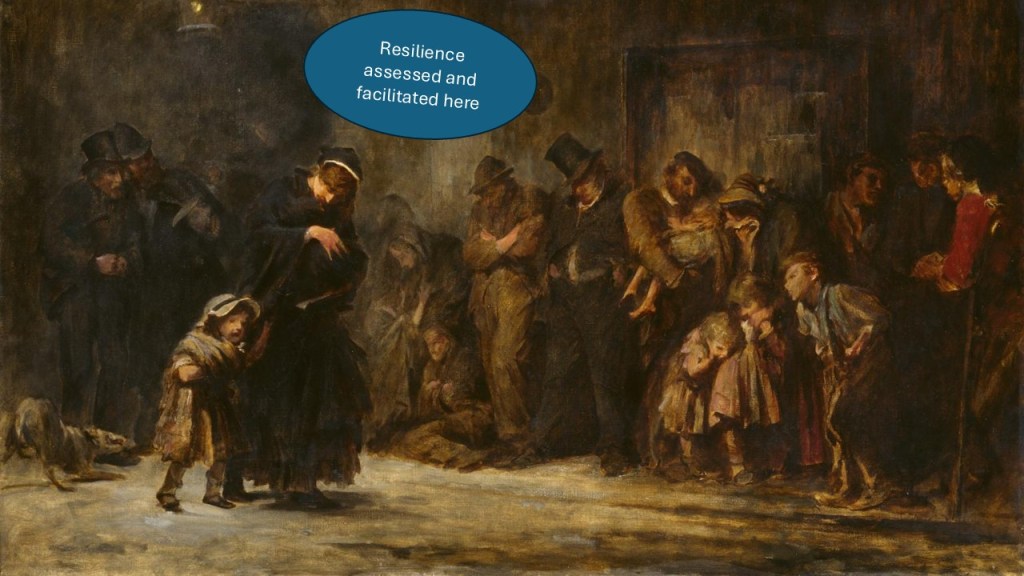
Luke Fildes’s famous picture Applicants for Admission to a Casual Ward, smaller version of the 1874 painting, held by the Tate Gallery (after 1908) with a cynical addition
Perhaps only Dickens, and only in the conditions of the nineteenth century, could write a novel and entitle it Hard Times. In it, he used the title term to describe ‘hard times’ for the emergent working classes in the North of England (possibly in Preston), during conditions of economic slump, not unlike Elizabeth Gaskell in Mary Barton referencing the ways in which workers paid the price for slumps in the cyclic operations of capitalism. She published Mary Barton in that year of European revolutions, 1848. Dickens knew of that novel for Hard Times was published in 1854. It was a useful strategy for nineteenth century bourgeois culture to show admiration for the fortitude and endurance of the classes whose suffering was not of their making (though of course they might by some responses to it make it worse (hence the rash of stories within those novels about the dangers of alcohol and the teachings of the Temperance Movement); for both stop short of envisaging a revolution that shifted power from the holders of it in the status quo.
Thus, Dickens also entitled Hard Times as such in order to characterise the hardening of bourgeois thought and feeling by the doctrines of Utilitarianism, applied in a hard unfeeling manner, and the threat to cultures that focused on soft skills springing from the imaginatin in passive reflection such as storytelling. Hence it starts with the teaching of hardness as a culture in schools – the educational theories of Gradgrind.
In the context of today’s usage of the word ‘resilience’, about which more later) you might think Dickens would find space to praise the ‘resilience’ of the working class, not only in admiration but also in class gratitude that they might suffer in silence rather than use the means the novel also points to – effective trade union organisation, strikes and control over the use of alternative labour (the issue of ‘blacklegs’ haunts both novels I have mentioned). I could think of no uses of the word (and having studied the rise of the word in twentieth century psychology, should not have expected it). However, I still asked the Bing AI function on my computer the following question, with its answer attached below. Although it uses only two sources for its answer, and largely relies on the first – it is linked in the reproduced answer below – the answer is compelling.
Does Charles Dickens Use the Word “Resilience”?
No — the word “resilience” does not appear in any of Charles Dickens’s novels or short stories.
Dickens wrote in the mid‑19th century, a time when the English language did not yet have a widely used, standardized term for the modern psychological concept of “resilience.” While the idea of endurance, recovery, and adapting to hardship was central to his themes, he expressed it through other vocabulary such as perseverance, fortitude, hardihood, endurance, spirit, or recovery
snugfam.com+1.
For example, in thematic discussions of his work, scholars note that Dickens often portrayed characters who “overcome trials” or “rise from adversity”
If you encounter “resilience” in a discussion of Dickens, it is almost always a modern critical label applied to his themes, not a quote or direct usage from his texts.
In summary: Dickens never wrote the word “resilience,” but his stories repeatedly explore the same ideas — the human capacity to endure and improve after hardship — using the language and vocabulary of his era.
The point made in the answer is largely, that though nineteenth century thought about those persons and animals suffering durations of oppression and hardship, including children – a stronger theme in Dickens’ oeuvre -, it used obvuously morally focused terms such as fortitude and patience to admire the resistance of such suffering to hard violent responses against those thought to cause the suffering, it didn’t really posssess the culture of the word resilience with all its ambiguities.
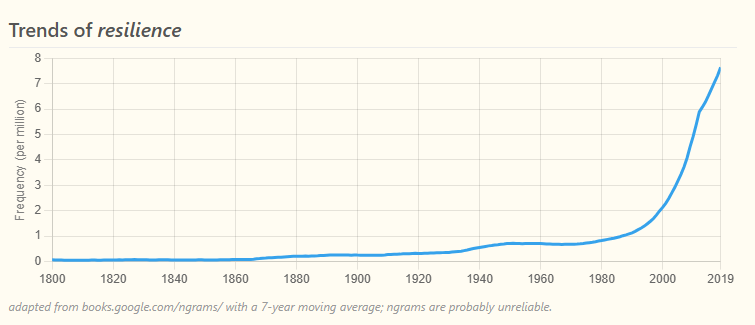
Although not reliable evidence, n-grams relating to the word show a similar story as in the one below from the Online Etymology Dictionary. It indicates usage frequencies of the word starting between 1860 and 1900, rising fairly evenly to 1980 and only taking a large leap upward thence forward. As capitalism, managerialism and admiration of resistance that is expressed only at the level of personal survival does the word take flight, possibly as a result of the growth of the sciences of social and psychological management – which is, after all, what sociology and psychology are.
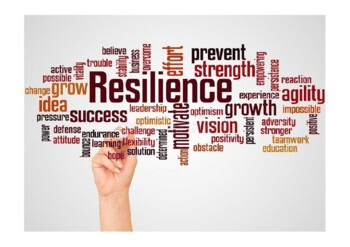
Let’s start from where we are in applied psychology, with a defintion from the appropriate web page of the American Psychological Aaociation [APA]. The page is full of links to all kinds of resources for those deemed to need resilience as a function of their psychosocial location or in the demands of a job role with those for whom resilience is encouraged as a salient feature of their management. Resilience is:
The process and outcome of successfully adapting to difficult or challenging life experiences, especially through mental, emotional, and behavioral flexibility and adjustment to external and internal demands. A number of factors contribute to how well people adapt to adversities, predominant among them (a) the ways in which individuals view and engage with the world, (b) the availability and quality of social resources, and (c) specific coping strategies.
Psychological research demonstrates that the resources and skills associated with more positive adaptation (i.e., greater resilience) can be cultivated and practiced. Also called psychological resilience.
Adapted from the APA Dictionary of Psychology
The trend in psychological discourse that led to tbis definition is very much a feature of psychology in the 1960s. Categories of psychological response become fetishised as strategies or skills that, though often admitted as having an inherited element, can be taught as acquirable behaviours,, fuelled behaviourally and cognitively in differing proportion s for different people. Unlike fortitude, patience, endurance or hardwood is not specifically an ethical category but one treated as a developmental variable, open to experimental manipulation as a result of different dependent variables.
Now the stress on resilience in psychosocial contexts is a very ambivalent thing, related to a swing of interests by psychologists and other ‘human sciences’ in general from issues of vulnerability to those of resilience, from the victim status of the marginalised, disempowered or otherwise oppressed to a ‘strengths model’, as it is called in social work and psychotheutic contexts, in which we address those aspects in the lifeworld, therefore ourside and inside the person interactively, that constitute survival and life-enhancement.strayegies and skills. Born from these were liberation movements in the situation of women, black and brown people, LGBTQI+ perspectives, disability movements and so on. These communal perspectives often spoke of strength together offering strength through tbe practices of identity.
On the other side of all of this is a shift in the professional models of address directed to those once known as vulnerable. Instead of active engagement with the person experiencing discrimination, oppression or pain of other kinds, the professional us asked to ‘facilitate’ stengths, empowerment and positive risk-taking at either and all the levels of work with the person, intetacting social networks, including those of communities of identity and chosen networks, and society at the level of political and ideological change. In social work this was called anti- oppressive practice aimed at structures of oppression in psychosocial network.
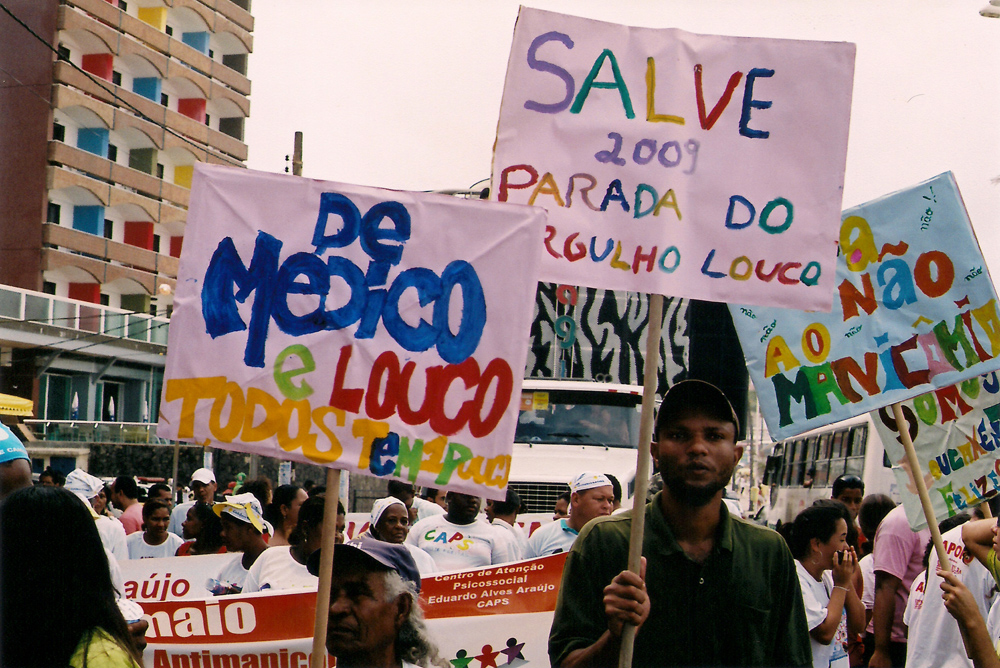
In practice, the above strategy often led to a laissez-faire attitude to people, and a mistaken view that all professional support id disempowering, driven by managerialist paradigms: patient, care and self management models predominately that were little more than paper exercises excusing non-intervention of empowered professionals into over-riding power structures, where the power of the oppressed was real but not sufficient to make changes alone. This is no where more prevalent than in mental health services, which accommodated themselves to survivor and recovery models but couldn’t conceal tnwir displeasure at the MAD and MAD PRIDE movements, seen as reinforcing ‘dysfunctional’ identities.
It appeared that what gave strengths to a person or group still needed a filter of scientifically professionalised (thus known misleadingly as ‘objective’) filter to assess its helpfulness. Much time is still spent by mental health professionals grooming ‘patients’ or ‘service users into amenable form, one in some way dependent on services even when these have no history of efficacy on well-being in the people they are supposedly directed towards, except in developing quiescence and acceptance of what currently is the optimal state of being for them, given that no change in the external environment is deemed at all possible, and sometimes none expected in the internal state too (I will never forget a mental supervisor saying to me when a student: “personally I don’t believe that mental ill-health exists, only warped cognition and poorly habituated behasviours’. Thast voiew is more common than is thought and is rarely shared as part of the therapy offered.
APA above prides itself in its definition of resilence on the belief that people must and can learn to adapt to inner and outer pressures and stress upon them. Note the primary means noted there, all of which are elements of Cognitive Behavioural Therapy (CBT), but often supplemented by a fake version of the Buddhist practice of ‘mindfulness, provided the CBT therapist has enough social work nous to include (b) here – the only one which changes the person’s world – though often by convincing them that their prior state was due to ignorance of already existing social resources, often skewed anyway to the needs of ideologically dominant groups – at its worst, white middle-class, cis and heteronormative males: ‘ (a) the ways in which individuals view and engage with the world, (b) the availability and quality of social resources, and (c) specific coping strategies. Most of the therapeutic effort will be channelled into assisting someone to ‘view and engage with the world differently’, accepting its standards of non-conflictual quiescence or patient waiting for better times based on trust of ideological projections that even the most oppressive soiciety’s have of their beneficial aims (even openly fascistic ones), aims we aren’t quite ready for yet.
I hope you take on board how divided a concept ‘resilience’ is – in some manifestations it is liberatory if attached to a framework of liberatory progressions in action, thinking and feeling – that, of course, are often uneven in their development. But in doing so, also take on board that when a professional working with you praises your ‘resilience’, they are most often praising your capacity for giving in to their view of the world, that is surrounded by defences of their interests not yours, and for not developing strategies of (effective) challenge – that is their effect is to trouble professional complacence and demand more of them from out of their selfish reserves. Of course, all this is so complex. All we can expect of professionals is a capacity to take perspectives that it is clear they rule out for their convenience (and for an easier life) rather than for your well-being. When I taught social work, maintaining ease in your own life was not the priority, though preventing breakdown was, but the liminal; area between these is wide than people think. In that sense I might prefer to have words Dickens would recognise and cultivate perseverance, fortitude, hardihood, endurance, spirit, but not perhaps ‘recovery‘, as colonised as it is today with professional gloss upon it, reducing its person-centredness.
So, I think I might pass on being asked to bolster resilience as my first objective, though it be required in tempering and smetimes temporizing the more ambitios goals I may have.
With love
Steven xxxxxxxxxx

