What life lesson did you learn too late?
View all responses
Yesterday, Geoff & I saw the National Theatre’s production directed by Sam Yates of Golden Boy. Here’s a second take based on a production that seems to promise that both Joe Bonaparte and Lorna Moon can learn a life lesson, though they learn it too late. After all Lorna does say that she can envision ‘ a city’ in which ‘happy boys and girls’ exist ‘who can : teach us the way of life’. But could they have learned it?
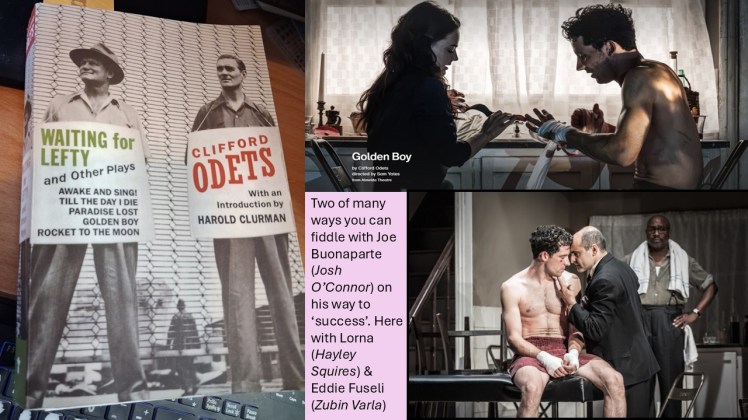
I wrote a blog on Golden Boy before seeing this production (see it at this link). Sam Yates’ version of Golden Boy imagines a scene that is not in the text of Odets play and is enacted simultaneously to the scene in which the call is received that sends the Bonaparte family to identify the dead body of Joe, killed in a car crash at speed together with Lorna Moon. It is a scene that plays out a happy family scene at a table with Joe as a young Dad and Lorna as Mum of a boy-child enacted by the silent boy, Yates has in attendance in many scenes and representing the early teenage lost child representing Joe at that age.
This scene, note, plays behind the scene (that one which Odets wrote whilst this is added for the production and presumably written for it) wherein the audience learn with Frank (on the telephone) reporting to his father that Joe and Lorna’s corpses , both killed in the road accident at speed, are awaiting identification. In a production where expressionist meta-theatre, again added by Yates and involving many media (inset stage music and staged scenarios that extend the naturalism into imagined outcomes, film, symbolic encounters with abstractions of fighting, and more than one double of Joe – as artistic violinist and lost boy, constantly contrasts with a play performed in Hollywood like ‘naturalism’. For me, most of this worked seamlessly and appropriately, except, that is, this scene of Joe, after his death, but a belated vision of ideal family life. It isn’t a straightforward scene, for both Lorna and the young boy leave the table – for entirely naturalistic reasons, but make that leaving seem a symbolic abandonment of Joe, sitting at the table still isolated and as conflicted as he has been throughout (again Josh O’Connor makes his face vocal in silence).
This added scene, hard to hear and obstructed in part by the sound and events of the scene in front of it, is no simple ‘lesson learned too late’ for Joe that a more ‘ordinary’ family outcome was available for him – after all who could believe it of a marginalised Italian-and-Jewish emigrant community from which Joe comes, or of a Newark girl forced to become the ‘tramp’ she despises being to secure a living. In the text, the only young married couple in it (Anna Bonaparte as was and her husband Siggie) has to live with the Bonaparte family unable to afford rented housing of their own.
Of course, in this production both Anna and Siggie are sacrificed to the pacing of Yates’ text, the yearning for capital for a taxi-cab business then gone, their other lines variously are given to Frank Bonaparte, rather confusing the idealism and political idealism of that character – a man chasing union strife across the country (like the trip to the troubles in the Texas tiles industry) could not be at the places nearer to the Bonaparte New York home this production puts their Frank, and this rather tarnishes the idealism of this type of the politicised altruist, even though acted beautifully and impeccably. There are issues about human nature missed. When Father Bonaparte returns a share of Joe’s fight prize money, Odets has it done via Siggie – which silently makes the point about the decency of that character as ordinary working class man who needs any money he can get, but does not take, offered or unoffered, this money as he might. Frank returning it is no surprise and weakens the drama around the valuation given to money in the play, I think.
But let’s return to the text of Odets’ actual play to see again the last we see in the play of these characters there, it lacking the scene I describe above – that of a happy family made by Lorna and Joe. See it below!
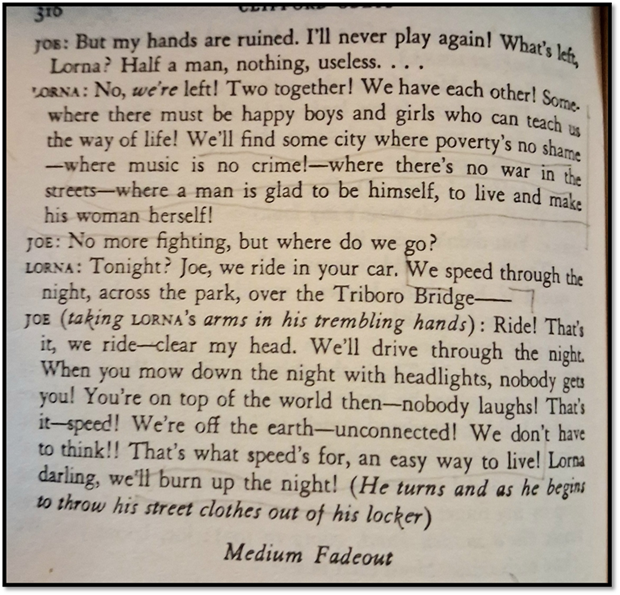
My photograph from Clifford Odets Golden Boy (Act Three, Scene II) in Clifford Odets (1993: 316) Waiting For Lefty and Other Plays, New York, Grove Press
There is some evidence here (in the original text) that Lorna may, at this point at least, be thinking of such an ending for her and Joe, but it is clearly not in any way thinking that shows her thinking developed beyond her socialisation in the hardest of lives lived by women, married or unmarried. After all, though she insists on a ‘we’ which draws Joe and herself into that word, it’s a ‘we’ that derives from a happy communal life in larger communities into which couple who seek both equality and unity can endure. She demands a society of ‘happy boys and girls’ to teach what it is to be a man so self-sufficient that it entails a desire to make any woman he lives with to be ‘herself’ as much as he is himself. The ideal society is an unlocated, as yet, ‘city’, that can’t be named as a guarantee of its probable existence – where shame isn’t visited on the poor, music is an acceptable way of making a living, even if in relative poverty, and there is no street war.
That Lorna only dreams of such a potential in life now is important. To that point her goals were entirely based on men about which very little could be hoped, in the way of a life where she mattered as much as the man in any couple. Women like Lorna with so little experience in the making of self-confident decisions (an inexperience illustrated throughout the play in her self-accusations in which she calls herself a ‘tramp’, derides the potential of life of any Newark girl, and descriptions of role models as parents in which women are reduced to abjection and suicide by men, do not draw men into a ‘we’ except by the operation of some fantasy in each case of the people constituting it. And the fantasy life evidenced in each of them is a very different and even contradictory type.
Moreover, if we turn to Joe now, men who want an ‘easy way to live’ (and find it in fantasies of speed and flying at a height) do not end up in happy families usually (or if they do only because they remain independent of its illusions that they nevertheless work hard to create. Hence, my doubt that this added scene does not truly contribute much to the play that enriches it. Hower I welcome contradiction in feedback from the others for the truth is it didn’t work for me because I did not understand its purpose in Sam Yates’ conception of the play.
But that said, this was a production in which I truly delighted, not least because it highlighted so clearly how much the drama of the piece inheres in language and linguistic paradigms. For instance, I had noticed in the play some clearly parallel uses of clichéd phrases that underlie, swathes of dialogue – my favourite being that we might phrase as the application of ‘give-and-take’ across different domains and art different levels of human activity. In boxing the capacity to ‘take’ summarises Joe’s skills at first, skills of defence and guardedness from hard punches received, but for Moody and Roxy such an ability in taking if he can’t give, for if taking names defensive skills, giving names offensive ones, and to Roxy summing up Joe in this respect , ‘A momma doll gives out better!’. The phrase is contradictory anyway as Roxy’s sexist language tends to be: for Moma doll’s give out anything but sharp attacking aggression and yet can still be an example of ‘giving’. For him. Explaining that to Mr Bonaparte, when he enters soon after, he says of Joe – to show ‘he won’t fight’ that a fight with offense is summed up like this: “You take but you can’t give’.[1]
But elsewhere the idea of social roles which sustain themselves in net take from others as opposed to those like Frank in net give, reverses the phrases’ meaning. If this is a story of a go-getter in Joe, it is one in a context where growing a society more aking to sharing, to giving and taking is its background, a just society . For instance in Act One, Scene 1, there is a significant play with the give and take binary in relation to the careers of young men, the choice of altruism in Frank, the play of give and take in Siggie contrast with Joe’s ‘gold bug’ as Frank calls it. For me, this was beautiful and makes sense of Lorna’s late conversion to a socialist society she doesn’t quite know she is describing, but which Joe never even reaches to the ability to describe.
That I felt this from this production, with no Siggie and an added scene that seemed out of step from the rest, is the more remarkable.If anything this play is still to me a play about a lesson learned too late by its characters. But how and why should I love to see that. It is, perhaps, because we all learn too late, for what lessons there are to learn would be very few if they could be effectively learned by only a few people. They must be learned by many, if not all – and a many ready to challenge the few who oft use their power, distributed in their favour, to ensure the lessons that would displace them do not in fact get learned. In a sense I learn this from great plays like this. Too late for me! But for humakind – one can only hope!
With love
Steven xxxxxxxxx
[1] Clifford Odets Golden Boy (Act One, Scene III) in Clifford Odets (1993: 254 – 258) Waiting For Lefty and Other Plays, New York, Grove Press.

