How do you define success in life?
View all responses
There is no doubt, of course, that money count is one, amongst other quantitative measures of success, as a generalised outcome of one’s achievements in life, but does the term ‘truthful success’ spoken of in Clifford Odets play Golden Boy point towards more qualitative outcomes equating with that outcome – things to do with the values systems we call ‘truth’ and personal or even spiritual fulfilment’? This is a reflection on the prompt question based on preparing myself to see Sam Yates’ production of Clifford Odets Golden Boy from the Almeida Theatre as streamed to the Reel Cinema Bishop Auckland on Sunday 8 November 2026, starring Josh O’Conner as Joe by reading the play and two reviews of it in The Guardian and the Reviews Hub
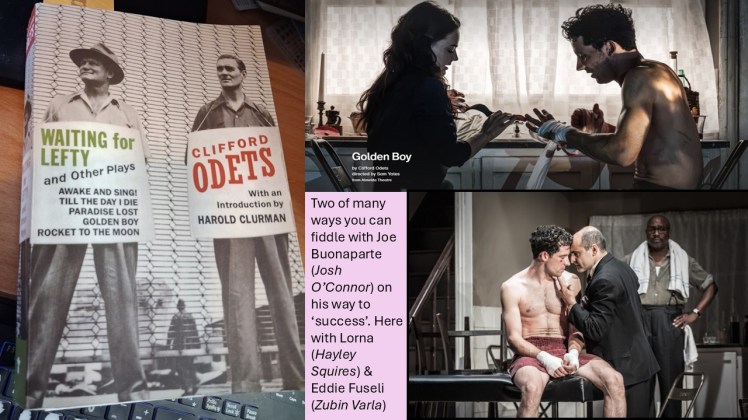
I chose to talk about Golden Boy in answer to this prompt, even though the nature of success is only superficially the play’s theme. A hint of that lies in the extract cited below In Scene V of Act One of the play, Mr Bonaparte, the father of Joe Bonaparte, takes into his confidence Lorna Moon, a women who often defines herself, in her lowest moods, as being a ‘tramp’ until, that is, she can persuade a particular older married man (a prize-fight manager called Tom Moody) to divorce his wife and marry her, as the only means of her finding security in the insecure world of 1930s USA. Bonaparte senior tells Lorna that he thinks his son Joe is caught in a dilemma, and describes that dilemma in rather stagey New Yorker’s ‘Eyetalian’ accent, saying ‘Joe has a dream many year to be superior violin’’.
He continues to ask if that was just ‘a boyhood thing’, that has been superseded by his apparent current adult ‘dream’, to find worldly success as a prize-fighting boxer, to the planned launch of which he is about to travel by train. He appeals to Lorna: “Maybe you are a friend to my son. Then I aska you, look out for him. Study him. Help him find what’sa right. Tell me, Miss Moon, when you find out. Help Joe find truthful success’. Mr Bonaparte believes clearly that some good success in life is ‘truthful’ whilst other kinds of success might contain lies and/or fictions that cannot sustain more than the body, if that. In contrast, Joe’s brother-in-law, Siggie (he is Jewish and the names is clearly Sigismund) claims that his ‘god is success’ and that if Joe becomes a ‘champ’ as a boxer he might make ‘enough dough to buy your sister’s boy’ (himself of course) ‘a new cab’.[1] For many people then all we need in life is capital to enable a decent living (as a taxicab owner-and-driver, for instance), especially amidst severe economic Depression. It is clear however, that Odets sees in Siggie an absolute standard of decency, although both he and his wife defend wife-beating as an element of that decency, considered an acceptable element to masculinity in the 1930s when the male role was considered a necessary discipline for the otherwise unruly and wandering nature of female desire, of which the nascent cinema was full of examples.
Joe becomes 21 years of age in the play, but he remains named as a ‘boy’, (even Siggie, you will see above, who works and is married classes himself as a boy) so the distinction between man and boy in this play is not one merely of age and biological development, but a more generous distinction, with a fuzzy boundary between them, of man and boy, a matter of qualitative distinction sometimes. In this play being a boy is a matter of hope (and sometimes fear) of later development of being a man of some type to follow. As a play of the period by a left-leaning writer, the play has its share of ordinary decent boys (the charming Siggie for instance surrounded by an aura of hopeful comedy), and even extraordinarily decent boys, like Mr Bonapate’s other, and older, son, Frank. These boys, with their hope for a free America bound in, are a mere background however for the ‘golden boy’ of the title. That does not mean they are not important.
Some critics of this production, viewing it as a revival of an old play (it was first produced in 1937) that suggests it being as relatively forgotten as it is today in the UK. Scott Mathewman, in Review Hub, for instance, says of the play’s overall feel, which he clearly finds not only dated but dramatically inferior, earning the category ‘melodrama’, this:
Around Joe revolves a large cast of characters that, while they may have felt fresh and contemporary at the time, now feel reduced to stereotypes, with so many similar characters created then and since. …
While the slate of characters may not always feel particularly original, an earnest naturalism from the cast makes it clear how Odets has come to be seen as a progenitor of Arthur Miller. ….
And as the melodrama hits its heights near the end of Act II, various characters collapse and wail in what could be outpourings of love, despair and loss of hope, but could just be an attempt to cover what is a sadly all-too-predictable narrative.
And that’s ultimately what keeps Golden Boy from becoming a classic of the era. While its story has much to say, there’s nothing particularly original in its moral or the way it’s been retold.[2]
Of what is made of the play by The National Theatre I have yet to see for myself, but there is something lacking in a take on the play itself that only looks for novelty of characterisation rather than specific meaning, either for its own ‘time’ as a play or ours. Let’s take the type that is Frank Bonaparte, a minor character but with a clear moral compass – born of the liberal intentions of his father, but clearly directed at an end, a specific kind of direction of ‘hope’. I think critics who refer to the ‘period’ qualities of a work of art, ought perhaps ought to have a slightly stronger grasp of ‘period’ than Mathewman does. Likewise, this applies to the more intelligent take on this matter by Chris Wiegand in The Guardian. Let’s take the features of this final paragraph of his, for it is rich in perception if lees so in synthesis of its ideas in ways that give the play the chance to be more than Wiegand’s preconception of it.
With Golden Boy, Odets moved from agitprop to melodrama and the play doesn’t fully succeed as a greater social tragedy either, even with the pointed observations of Stanley Townsend as Joe’s father and Richard Fleeshman as Joe’s union man brother. It’s a play heavy with death – even a violin case is called a coffin for a baby – and we hear a bloodlust roar of the crowd for Joe’s fights. But you don’t sense those other lives, across a city and a nation brought to its knees.[3]
Wiegand does make his grasp of Odets have definite socio-political significance, by implicitly considering his earlier work as agitprop, a term that, applied to drama, suggests a determinate political stance, as in perhaps Odets’ 1935 stage debut Waiting for Lefty. But Wiegand still struggles to see pertinence in the play’s claim for a grasp of larger issues that it might claim to have about wider issues of life and death in any period that can ultimately amount to ambition for staging tragedy or tragi-comedy, the tragic element being as meaningful for its time as Antigone is for that of Sophocles. As for the National’s version’s merit in presenting ordinary decency of different human and political meaning as Mr Bonaparte and his son Frank, I can’t comment, but in reading these characters evidently matter more than offering a background to the central drama, I think, though Frank’s domain of meaning needs filling out from the minor clues in the play that an audience in 1937 would not need to be filled out.
Joe is the first person to drop a clue of Frank’s role in the structure of the play’s themes, as he opens up a world that would be new only to the lumpenproletariat character repertoire of the play involved in arranging shows of public violence for a mass audience and a kind of gig-economic, even while New York was burning in significant political conflict. There is something gladiatorial about the function of prize-fighting in this play – a sop for the masses. Joe himself makes this point in Act 1, Scene IV, when Lorna holds out to him the hope of being rich amongst the few rich in New York as he dreams of having a car, as in Act One, Scene IV, Lorna points out to him that a prize-fighter can look to the stars: ‘Success and fame! Or just a lousy living. You’re lucky you won’t have to worry about these things’. The reason for that is still unclear, for Joe it is all about a boy’s toys vision: ‘Gee, all those cars …’. When asked to think about being rich in general Joe becomes cagey. Something in him resists that transition: :
LORNA: Lots of horses trot around here. The rich know how to live. You’ll be rich …
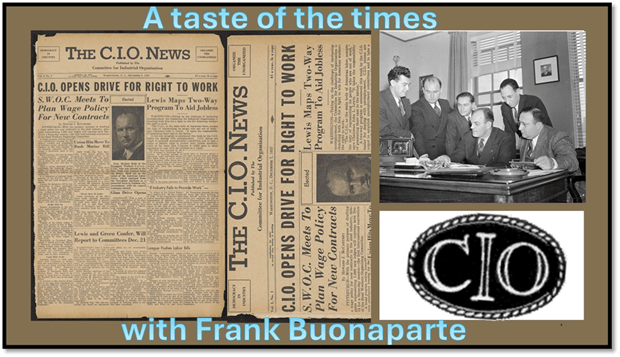
JOE: My brother Frank is an organiser for the C.I. O.
LORNA: What’s that?
JOE: If you worked in a factory you’d know. Did you ever work? [4]
Surely telling, this characterises Lorna’s ignorance of the world of working women and working men, and of a working-class culture where true use-value creation occurs. Tit also however evokes a world the play’s audience would know, for in 1937 depression, sparked globally by the USA in the first place, had returned and political change was in the air, not least through the work of the Congress of Industrial Organizations (C.I.O.) (Joe need only give the acronym since that is all that was needed at the time of first presentation of the play in 1937) Why does it matter, in relation to the ethics of rich and poor in an arch-capitalist nation, that the organisation for whom his brother, Frank, was the CIO. It matters, I think, for the same reason the brother is named Frank, for this marks him as a kind of moral centre of the social drama of the play that involves frankness in moral values. This is especially so in a play about people who peddle deceit in the manner of earning a living (men and women), except for Siggie, Anna and the extended community around the Bonaparte family).
Yet this social aspect of the play has another more existential framework to it – the moral world of Mr Bonaparte Senior. That is why I think Wiegand falls short in seeing social tragedy too thinly represented by this father and son, for they are different kinds of moral centre, though linked. We see the link in the conversation between Mr Bonaparte, his Jewish friend, Mr Carp, and Frank in Act One, Scene II, when Frank is shown as constantly in progress across the USA for his cause:
CARP: Going away gain?
FRANK: South. Tex-tiles. There’s hell down there in text-tiles. (He sits on the other side of the room and looks at a paper.)
CARP: I don’t begin to understand it – tex-tiles! What’s it his business if workers in tex-tiles don’t make good wages!
MR. BONAPARTE: Frank, he fight-a for eat, for good life. Why not!
CARP: Foolish!
MR. BONAPARTE: What ever you got in your nature to do isa not foolish! [5]
Frank, essentially different to Siggie, is not fighting to eat for his own family existing and to be alone but for humankind, including the largely poor white textiles workers in the Southern states, whose wages undercut those in New England textiles. It is possible that this reference was to the 1934 Textile Workers Strike in the South, where some workers were kept in federal concentration camps. Yet he is not the play’s centre – he just offers to Joe a moral standard against which he literally sets out to fight, but not in a class war but a prize-fight. The larger moral principle in this play however is Mr Bonaparte’s which champions and tries to support the individual nature of each of the humans in his care – his sons. -His support for Frank’s choice of commitment is not unlike that he gives to Joe – at first doggedly to his boyhood violin music, for which he had recognition as a schoolboy, but it’s one he is prepared to give to prize fighting if has he later thinks, he has been wrong about Joe’s nature. This is why he asks Lorna to discover if the success he seeks as a fighter is a ‘truthful success’; one true to his essential nature and not a mere aim for a despicable living in riches or otherwise. This is the central theme of Golden Boy in my estimation, one about an existential theme not unlike the way Antigone insists she must be true to herself, despite every persuasion, even threat of death, not to be.
And here we see too another thing Wiegand fails to understand. The concern about death, even that symbolically of children, is part of the tragic structure of the play that does not depend on the Bonapart’s wider family but on the choices Joe makes regarding his life outcomes. There are two reasons I believe, which both give a sense of the scope of the play, why and how boys can be ‘golden boys’. One is that the play often looks back to definitions of success hidden in the self-reflection of the USA about the course of its own success and failures, including economic boom and depression. His first and constant director, Harold Clurman, a man whose introductions to Odets’ own work he describes as ‘among the first-class theatre-writing of our time’, feels Golden Boy uses its symbols too simplistically and too shabbily to really represent the ‘forces to ‘tempt the young man’s spirit’ in 1930s American: he says these symbols are ‘the fist and the fiddle, the car , etc. –‘. Yet, Clurman says this play also is the easiest of his to see his central theme in other plays, including a play he favoured Awake and Sing!.
The play’s title springs out of the mouth of the prophet Isaiah, “Awake and sing, ye who dwell in the dust.” In so far as Odets’ model of a hopeful society in 1935 was the Soviet Union, his earliest plays are ‘dated’, but the basic theme, central to most of his work, is phrased to begin with, in Grandfather Jacobs’ observation in Awake and Sing!: “In my day the propaganda was for God .Now it’s for success”. [6]
This makes the same fundamental mistake about the play as I have tried to address from the beginning: the theme of the plays is, to me and whatever Odets himself believed, not the problems involved in capitalist models of success, set against truthful success alone, but the systems by which we establish, describe and assert the criteria of value in life: that which characteries truthful living against lies and oversimple fictions, equated with death, as the absence of live and living. Nevertheless estimations of the value of what success is are a good pathway to this theme amongst others. Clurman can be taken as an authority nevertheless on the source of Odet’s interest in Isaiah’s words, setting awakening to true value in a way of rising from dust, that thing to which bodies desiccate, and a symbol of, in the vision of Isaiah the absence of value in bodily life alone and what serves bodily life alone. And yet why did Clurman end his list of simplistic symbols, as he insists they are, in Golden Boy, and not mention the most obvious of these symbols – gold.
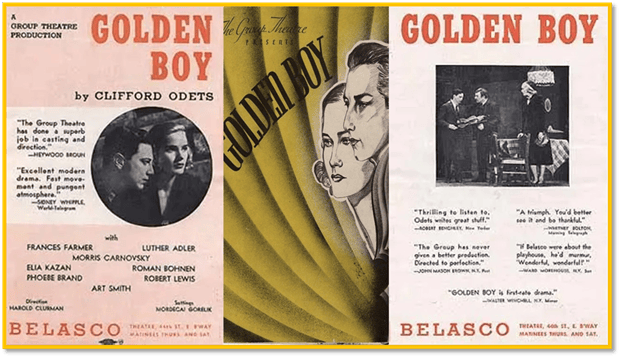
Gold is a standard of value and a metaphor of it in both material, imaginative and spiritual systems. Its use as a validation of national success was marked in the fixing of the nation’s currency value in the Gold Standard, a topic Ezra Pound chose to stand for standard setting in his poetry, and his model of fascist economics. The 1930s Depression cycles in America was at the time known to be related in their original causes to the fixing of the value of the dollar to the cost of gold, known as the Gold Standard, and to its global spread across other currencies and lingering effect in the USA after its modification in 1933 (as is discussed in the Explaining History Online website called ‘Golden Fetters’ (linked here).
Surely that last named essay might serve as a footnote to Tom Moody’s explanation of his dilemma as a long established but ageing impresario of prize-fighting, who contrasts the death of boxing talent in his present team compared to that he had in 1929, on which his reputation at the opening of the play rests, despite his awareness that his current champion, Kaplan, has little or no value except in his hopes and as a fiction he tries to sell. Tom says: “I’ve been off the gold standard for eight years. This used to be a gorgeous town. New York was hot with money”.[7] Likewise at the end of Scene II of Act One, where Joe uses his coming-of-age birthday to come the next day to be the day when ‘I change my life’ and predicates that change on the evidence that he can now earn money rather than moon over a violin, Frank says ‘It looks like the gold bug has visited our house’.[8]But elsewhere gold is not only related to belief in money as absolute value as in the myth of gold.
The present of a violin that Mr Bonaparte (the one that Carp says appears, in its case, ‘like a coffin for a baby’ is ‘the mosta golden present’ in Mr Bonaparte’s eyes but not just because of its expense. Wiegand shows us that the sum quoted would be more of a fortune then than we might now appreciate: ’ a $12,000 violin represents a ‘cost, comfortably more than an average worker’s yearly wages and thus akin to roughly $80,000 in today’s money, hits harder given the state of the US economy at the time’. However, the value it represents in this father’s eyes for a ‘boy’ gifted with the wherewithal for a life in music is meant to be greater. And nevertheless, it is also something that looks valueless to Joe as dust is, or being gifted a coffin for his death as a baby before becoming a money earning man.
But the title raises the true question about value in the play: the value of boys or young men or youth itself in men, in the eyes of men as they age. Why are boys golden? Despite Clurman’s statement on the simplistic symbolism of the play, relative to others by Odets he must mean, I wonder how nuanced you can be about a symbol that questions its own value, which the term usually does in poetry and literature, up to Rose Tremain’s The Colour. Take this iconic artwork – a lyric elegy which also mirrors the verse from Isaiah that Clurman quotes – within a drama, that drama being Shakespeare’s Cymbeline.
Here is the lyric elegy which uses the acceptance of the reduction of gold to dust in death in a fascinating way, for if golden youth (the colour of aristocrats) must come to ‘dust’ as well as the poorest chimney sweepers, the joke is that the value of aristocratic life is no more than the poorest of worker’s in its life earnings – the ‘wages’ of sin being death as well as the wages of hard labour.
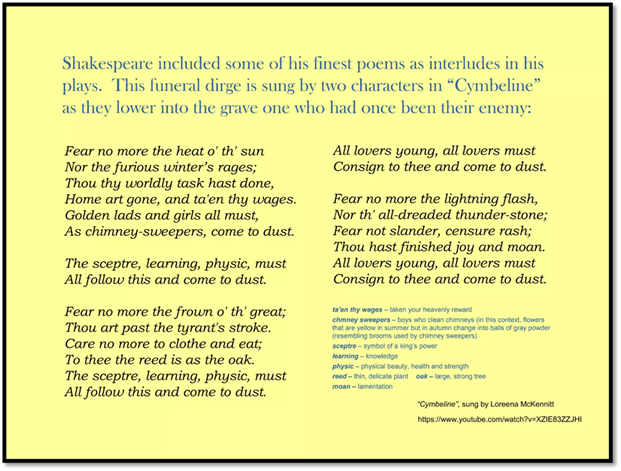
Song: “Fear no more the heat o’ the sun” By William Shakespeare, also available at Poetry Foundation: text at this link
How does this help us to answer the question, ‘Why are boys (or lads) golden?’ I think it does so because of the fact that as the life of the aged near death, boyhood (or girlhood where this play not as insistently masculinist as it is). I think it is because in this play it is the desire of old men to retrieve the past in which alone they found value. This is the import of Joe Moody, though possibly unconscious to him, as an older man, fishing for a younger wife in his romantic and sexual life (but willing to coin in her value if necessary as he does in using Lorna to capture Joe to his agency as impresario) but for a ‘living’ intent on finding a boy. He is ‘an old man’ he says when we first meet him unsure what he can give Lorna as a young girl, but his need to keep his standard in his work is get someone to find ‘me a good black boy’. The wish for a black boy addresses the paradigm of the Great White Hope syndrome of the time (as in the mythical life of Luther McCarty), and precedes Tom finding such a hope, who, without being black himself, will drop the Chocolate Drop (the deeply racist name of the current champion), whose death the play moves insistently toward. Yet that moment of giving in to the fact the search for a ‘good black boy’ is the only way forward for Joe, having gone off the ‘gold standard’, is deflected by Lorna: ‘Are good boys so hard to find’? When he insists they are she reveals in a further move to show that giving in to finding a ‘black boy’ rather than a ‘boy’ (presumed white) might mean Tom consider ‘a nice lady fighter with a beard –‘. That this is a ‘great white hope’ play too couldn’t be clearer.
However, even so, its structure is that of age looking to be renewed by youth, by old men seeking a boy to redeem them, their racist supremacy or meaning as human beings. My feeling is that Odets considered that the issue was almost existential – golden boys are sought as a source of value to redeem humanity (or white humanity depending on how racist you consider the tropes of the play are) from age, death and dust – a fight Shakespear’s lyric ‘Fear no more the heat of the sun’ has given up on in stoic beauty. But Joe’s pursuit of a boy is mercenary. That isn’t the case with other older men, notably Eddie Fuseli. Playing Eddie is a problem in this play. Mathewman in his critique of the National Theatre production feels that the actor’s performance is one of the discordances that spoil the play, though I am not sure if Mathewman has ever read it. He says that before Zubin Varla’s entrances as Fuseli our presumption (gained by virtue of the character-cast appearing thus far) of a stereotypically dated play of nevertheless ‘earnest naturalism’, but that is only until:
…. Zubin Varla makes his entrance as mobster Eddie Fuselli, who forces his way into buying a share in the business of promoting Joe. Varla is mannered to the point of caricature, with a performance that seems completely at odds with what is going on around him. While that’s clearly deliberate and does help give his character an air of unpredictable menace, it never really clicks with the stylistic choices elsewhere in this production.
Not that Varla’s performance is the only off-kilter element of this piece. A heavy punchbag, brought onto the stage once in each act, has a video camera embedded in it, unnecessarily projecting the bag’s eye view of O’Connor landing his punches on the back walls of Rosanna Vize’s otherwise naturalistic, multipurpose set.
It’s a strange kind of criticism this, that condemns by faint praise a cast as at least Stanislavskian acting material, a character actor who gives something obviously different from this and thus must obviously be ‘off-kilter’, like other expressionist, rather than naturalistic staged effects that match, Mathewman thinks, Varla’s ‘mannered’ performance. Mathewman does not even consider that productions aren’t judged by consistency of theatrical ‘style’ but by appropriateness to a theme, and that shifts between expressionist and naturalistic performance and staging are appropriate for a play known for its symbolism. I will assess my own feelings when I see the screening of the play, but even stills make me aware that Varla is capturing something of the Fuseli of which I read, as below:
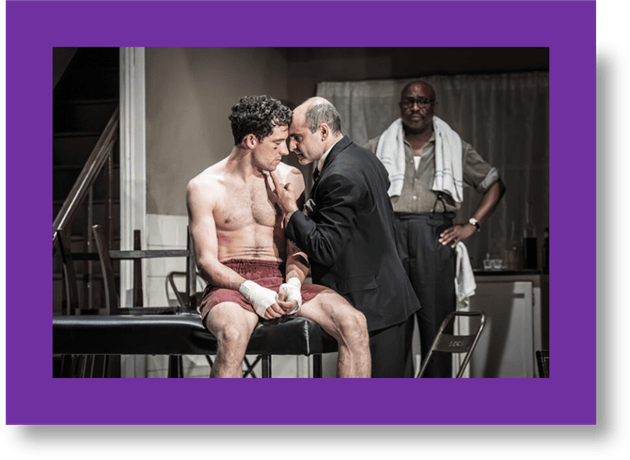
Josh O’Connor and Zubin Varla Image Credit: Marc Brenner
Naturalistic or otherwise, the iconography here is of an unlikely man wanting, finding (and manifesting his finding touchingly, in another way than Tom Moody), a boy that he was seeking. Behind them in the still is Tokio, Moody’s fighter trainer and muscle developer in boys who need it (given to the exposure of the boy worship which drives body moulding in the play as I read it), another factor in the boy-moulding experience of the play. When Clurman directed the play in 1937, it was obvious to him that Fuseli was one of the most ‘memorable’ of Odets’ creations – “the homosexual gunman, Eddie Fuseli, the golden boy’s demonic “guardian” (one of the most understanding studies, according to such experts as Tom Dewey and J. Edgar Hoover, of a gangster)’. Clurman says that Odets excels in having produced ‘some of finest love scenes to be found in American drama’, instancing those between Joe and Lorna in Golden Boy.[9] But he does not show how Odets alongside Eddie’s repressed love professions in form of a shaky ling that seems to fulfil his own self-esteem, who gets angry about Moody’s insults to Joe, when Tom guesses that the boy has taken a sexual bite of the apple he hung before him, namely Lorna. Eddie says (Act Two Scene IV):
(repressing a trembling voice): I don’t like no-one to laugh at that boy. You call a boy like that a rat? An educated boy? What is your idea to call him cock-eyed? When you do it in front of me, I say, “Tom don’t like himself” … for Bonaparte is a good friend to me ….
The whole must have had a stylish obviousness in Odet’s mind as a ‘repressed’ knee tremble, for when, after Joe, Eddie leaves, Lorna says she feels ‘sorry for him’ meaning Joe as she clarifies after this, but Tom feels she means Eddie: ‘Because he’s a queer?’, perhaps. Eddie is too repressed to lust after much of Eddie but the gloves his hands have sweated in, but the play has much play with the idea that Joe’s attractiveness is noticed not only by Lorna but by many men, some of which, like Tokio, in a detachedly professional way, although in one moment that detachment seems to melt in the oil with which Tokio rubs down his muscles into honied language. Preparing for his final fight with Chocolate Drop, Joe confronts his father with the fact that he no longer wants what a career with a fiddle can give him, He does it so effectively that Mr Bonaparte gives in to his desire to fight not give himself to music, for as his father says: ‘men musta be free an’ happy for music’ … not like a you’.
The violin rejected Tokio teaches him and us that Joe himself has become a ‘fiddle to be tuned up and played as older men run their fingers up and down his pliable body presumably like theirs once was, the professionally most lovingly of whom is Tokio;
TOKIO: Lay down. There’s five minutes left to tune you up.
JOE: (in a low voice): That’s right, tune me up …. (Joe stretches out on his stomach and TOKIO’s hands start up the back of his legs.)
TOKIO: (working with steady briskness) : I never worried less about a boy … in my life. You’re a real sweetheart … (suddenly JOE begins to cry in his arms. TOKIO looks down, momentarily hesitates in his work – then slowly goes ahead with his massaging hands. The BOY continues to shake with silent sobs. Again the bell clangs in the distance).
TOKIO: (in a soft caressing voice) You’re getting good, honey. Maybe I never told you that before. …[10]
The transformation back to the BOY (from JOE) ought to registered by an actor like Josh O’Connor is (in The History of Sound for instance)for it is a regression to weakness a clever man knows how to practice to render his lover boyish or feminised. Tokio in fact tells Tom that is what Joe needs as early as Act One Scene III, where he shows that though Joe may seem to think ‘he’s the best thing in shoe leather’ to Tom and oxy, he does not, yet!
TOKIO: I don’t like to contradict you, Tom, but he don’t. It’s seventy-five percent front. If you want the goods delivered you have to treat him delicate, gentle – like a girl.[11]
In truth, Joe does realise he is attractive to men. When Tom and Roxy question him about his side interests (they mean his fiddle playing and his care for his fiddling hands, about which Joe’s father has informed them without Joe knowing, Joe becomes suddenly suspicious that the men have a sexual interest in him that he was unknowingly feeding by saying, ‘I don’t go out with girls’. For despite this and his profession that his ‘looks don’t interest me’, he overinterprets Tom’s marriage metaphor about their relationship and asks: ‘Who’s being put to bed?’ Finally he appeals to TOKIO: “I don’t like this seduction scene. (To TOKIO) What are they after?
However, of the theme of the range of sexuality, covert or otherwise, the reviews I read are silent about this production’s contribution. Wiegand, again more overtly intelligent than Mathewman, reads the productions as equally divided between moments played and staged naturalistically or those played ‘as if in Joe’s mind’, utilising many expressionist elements – Joe’s double as a very young boy violinist being on stage in it but silent of voice, the director, Sam Yates, showing ‘music as a deeply individual, transportive passion preserved from youth’ and thus turning a piece of wall in a room into the proscenium of an inner stage with, on its inset stage, a ‘quartet often playing Isobel Waller-Bridge’s compositions’. When I look at that still below, I can’t see that the play aims at consistent naturalism with a few ‘off-kilter’ moments at all.
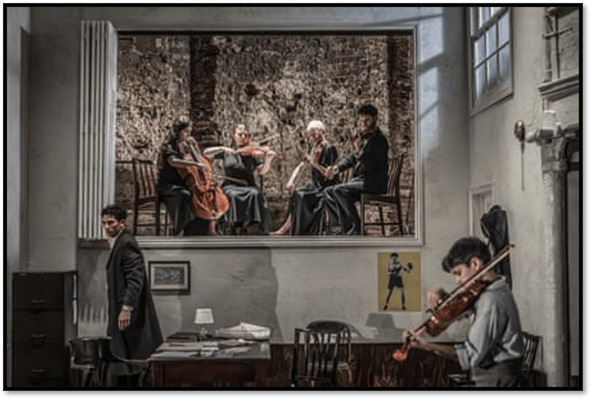
My point is not that the production I am looking forward to seeing is of any one theatrical ‘style’ or none but that it uses theatre to focus themes that are uncomfortable, as the pursuit of a Ganymede is in art, either to box for you and remake you or as a much more unspoken projection of one’s own boyhood narcissism, although I do not here want to see sexuality in the play only in terms of male narcissism, for Tom’s pursuit of the younger Lorna is narcissistic, even if Fuseli’s also meant might be of Joe, with its fetishistic elements (in Eddie’s taking of Joe’s boxing gloves after the death of Chocolate Drop – is he removing a deadly hard element from the glove by which he made sure Joe dangerously won the bout (unbeknownst to Joe) or just fetishistically claiming what has been so near to Joe’s hand.
Success is the aim of narcissism, and older men feeding off a young boy’s success is yet another, in whatever overt and covert ways they feed. But the theme is death, despair and, like the chimney sweeper ‘coming to dust’ like any other ‘golden lad’. Suicide and potential suicide play at the edges of this drama. We learn from Lorna speaking to Mr Bonaparte in Act One, Scene V, that, having fled a brutal husband (‘twice a week kicked my mother’s face in’) her mother died alone in Chicago: ‘As a matter of fact, she killed herself’. Lorna’s is the representative of the way in which vulnerability turns to collusion – her only hope as she sees it is to make her living on a man risking the violence with which he is involved, if only indirectly in Moody’s case. Her love of Joe is represented as an impossible dream of ‘golden lads and girls’ but ends in death, because, after all, neither of these two youngsters had any hope of sustaining themselves in 30s America, for their dreams are only that.
He and she die in a planned moment of success out of the world, where their separate versions of the world can only live in the moment of death – where men and women are the children they were become selves of a wished-for kind not a real and sustainable ones. Lorna sees success idealistically in an ideal community at an unattainable distance only fast car could reach, Joe more in a Gothic fantasy of what motor speed means – where an ‘easy way to live’ is to die while you are an imagined top. Unconnected being, after all, is more truly non-being:. All this is prompted by Joe recognising he is finished as a fighter, having killed a man, and as a violin it having ‘bust’ his hands.
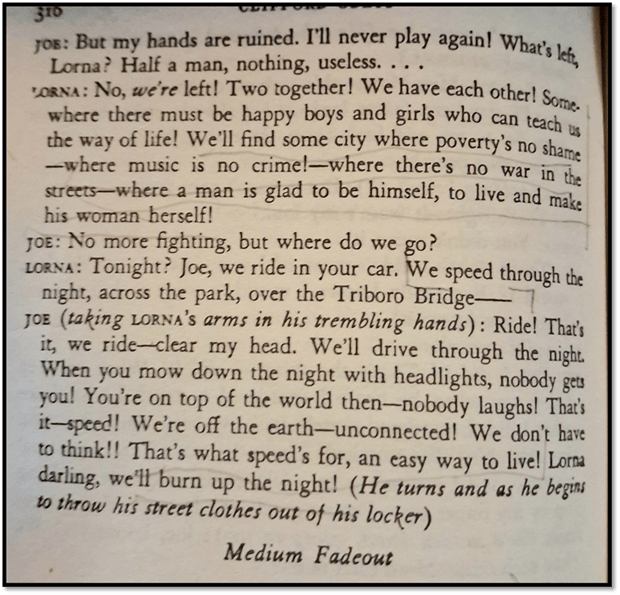
My photograph from Clifford Odets Golden Boy (Act Three, Scene II) in Clifford Odets (1993: 316) Waiting For Lefty and Other Plays, New York, Grove Press
Yet speed in Joe has always been an element of golden boy attraction. Tokio’s assessment of him from the first is that he is physically as ‘speedy as the wind’.[12] It isn’t a trait old men take easily to at first – when Joe insists he can fight for Tom, Tom says: ‘Go slow and tell me again … what?’[13] There is indeed something over impulsive in a youthful male’s love of haste for its own sake, which Joe associates with cares as ‘a poison in my blood’, and yet a metaphor too for overweening success such as Ganymede must have felt plucked up by Zeus. Though Joe might not down see it as sex, it makes him look to Lorna for the first time ‘a fresh kid’.
When you sit in car and speed you’re looking down at the world. Speed, speed, everything is speed – nobody gets me.[14]
Meanwhile, for Tom and the people who have an interest in his boxing, somewhere amongst financial, narcissistic reflection of their overwhelming need to return to boyhood desire, or love interest for the men who know how to handle a confused boy, speed turned into cars is merely dangerous (‘We can’t let him drive around like that!’), though it is the sexualisation of his Deusenberg auto that turns on Eddie to say: ‘I like to get a piece of that boy’. He means financially but would anyone play it like that without the evocation of the piece Fuseli desires.[15]By Act Two Scene II, speed has become internalised as high blood-pressure and even Joe fears its pace as a reminder of what he might be speeding to, that old men approach slowly:
Some nights I wake up – my heart’s beating a mile a minute! Before I open my eyes I know what it is – the feeling that someone’s standing at my bed.[16]
Nevertheless, speed remains his model of getting what you want, which is something that ought to be taken in the hot present and is the emblem of ll that Joe can think success may be. He urges Lorna to end her relationship to Tom and commit to him, but to succeed it needs to be done at pace:
JOE: : Swiftly, do it swiftly –
LORNA: Not tonight.
JOE: Everything’s easy of you do it swiftly.[17]
Yet the pace of time is already faster for a prize-fighter, and that may too be why in it age constantly chases youth, for as Mr Bonaparte belatedly learns, ‘In this business, twenty-nine is ancient’.[18] All of these contradictions feed into Joe’s final success – an easy suicide at speed, completed as the need arises so that it might as well be his greatest success, because of not despite danger, which is embraced with Lorna’s disappearing dram of justice – since it disappears as soon as it arises.
And Joe is defeated at the height of his success, for he is, as he tells his dad, ‘out for fame and fortune’.[19] By the beginning of Act Three, Odets says how success should be enacted: ‘His success has added a certain bellicosity to his attitude; it has changed his clothing to silk shirts and custom-made suits.’[20] Odets must have smiled as he read the line he wrote in his stage direction, as quoted here. Joe Bonaparte’s name is, of course, itself a joke in the play, one that lies behind his earned moniker as ‘Monarch of the Masses’, referring both to the Corsican Napoleon Buonaparte’s connection to the French Revolution and his betrayal of it to fund a personal cult as a dictator. In Act Three, Scene One when Joe boasts to the sports reporters, Drake and Lewis he justifies his own braggadocio in a way Drake feels conceited rather than proud, arguing that he no longer believes ‘that bull the meek’ll inherit the earth’. To which Drake retorts as if to the global ambitions of Napoleon I of France: ‘Oh, so it’s the earth you want!’ Joe is fired into even more bad-tempered self-defence, leading to Drake’s final dismissal of the boy: ‘Bonaparte, I’ll watch for Waterloo with more than interest!’.[21] It is as if everyone were in the joke about a name that typifies a narcissism that from the beginning can only succeed when it dominates the globe, or is defeated in one final battle like which finally ended the career of Napoleon I. Yet – and yet – no one really glories in the name of the Duke of Wellington. Not me anyway.
As for success and fame most tragedies and most tragicomedies offer that to protagonists before they are brought low by that fatal flaw, but Joe Bonaparte feels special to me, for so much of the feel of his tragedy is internal, as if BOTH violin and fighting were unsatisfactory representations of what he is seeking and yet cannot name. Take Act One Scene IV, an early scene alone with Lorna, where she is trying to do Tom’s bidding to invest the Golden Boy in fighting for a living. As we learn, as she learns more about Joe she falls in love with what she learns without quite knowing what it is either – somewhere nameless between the hope of a just society and a love of speed but it comes too from the fact that everyone wants a piece of a Golden Boy, but perhaps denies him true adult self-determination in the process. For we all think what is young will gild our age and perhaps redeem its faults, and in the process we sacrifice the kid from learning about himself except through symbols we pass to him – violins, boxing gloves or guns, and even weighty names. I know not what to make of this piece, though it moves me a lot: Sitting on a park bench they hear a carousel in the background:
LORNA: … That’s the carousel, that music. Did you ever ride on one of those?
JOE: That’s for kids.
LORNA: Weren’t you ever a kid, for God sake?
JOE: Not a happy kid.
LORNA: Why?
JOE: Well, I always felt different. Even my name was special … Bonaparte – and my eyes ….[22]
The kid with cock-eyes is not a happy kid, even though his name be turned to a prediction of his own legend and his cock eyes be recognised by those who love him; Lorna, Fuseli – perhaps even the professional boy moulder Tokio. But do we ever know what is special about Joe and what would amount for him to success? I think not. Success is always a distraction from the meaning that justifies our existence perhaps, especially if we want it to be the bearer of our happiness, sought since we were that kid who may not exist. Is that why Sam Yates invents in staging this production as the double of Joe!
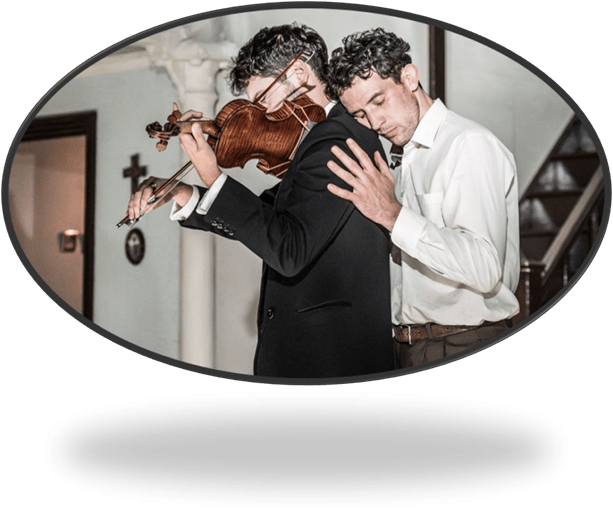
Roman Lytwyniw and Josh O’Connor. Photo by Marc Brenner
That’s all till I see the play on Sunday afternoon.
With love
Steven xxxxxxxxx
[1] From Clifford Odets Golden Boy (Act One, Scene V) in Clifford Odets (1993: 269) Waiting For Lefty and Other Plays, New York, Grove Press.
[2] Scott Matthewman (2026) ‘Golden Boy – Almeida Theatre, London Review’ in ‘The Reviews Hub’ (September 16, 2026) available at: https://www.thereviewshub.com/golden-boy-almeida-theatre-london/
[3] Chris Wiegand (2026) ‘Golden Boy review – Josh O’Connor swings between hope and despair in boxing melodrama’ in The Guardian [Wed 16 Sep 2026 10.53 BST Last modified on Thu 17 Sep 2026 13.05 BST] available at: https://www.theguardian.com/stage/2026/sep/16/golden-boy-review-almeida-theatre-london-josh-oconnor
[4] Odets op.cit: 263
[5] Ibid: 250
[6] Odets talks about Clurman in the ‘Preface’ (p. viii) to Odets, op.cit, vii-viii. Clurman is quoted from his ‘Introduction; to the same volume (ix-x), ix – xiv.
[7] Ibid: 238
[8] Ibid: 252f.
[9] Ibid: xii
[10] Ibid: 298
[11] Ibid: 255
[12] Ibid: 254
[13] Ibid: 240
[14] Ibid: 266
[15] Ibid: 276f.
[16] Ibid: 281
[17] Ibid: 284
[18] Ibid: 301
[19] Ibid: 298
[20] Ibid: 304
[21] Ibid: 305
[22] Ibid: 262

