What’s a small moment from your past that you still think about years later?
View all responses
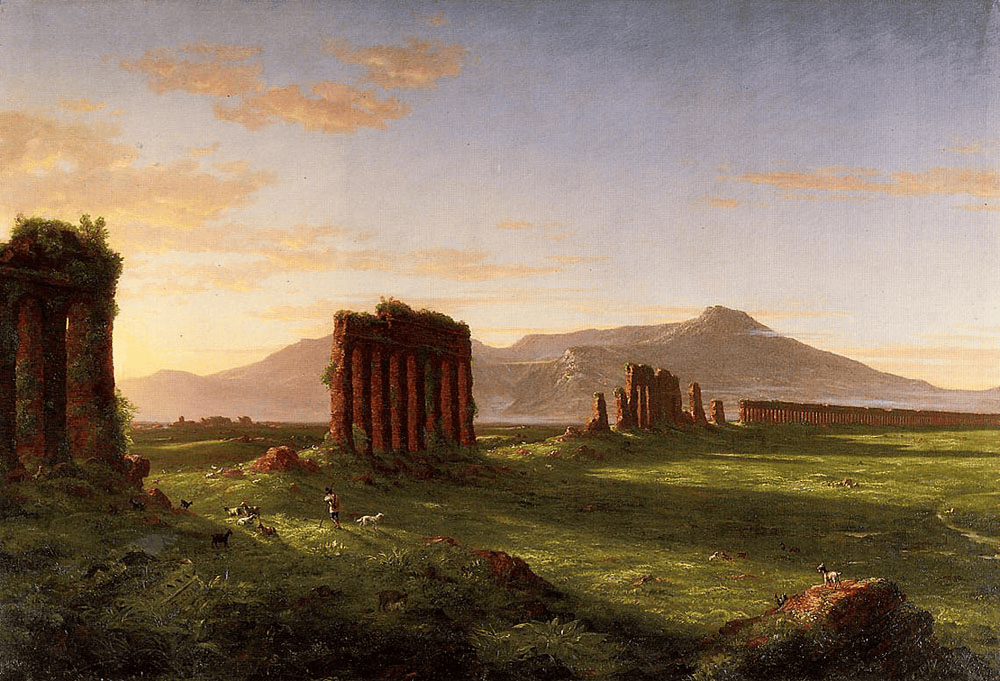
Roman Campagna by Thomas Cole in 1843.
Some questions have been definitively answered. so much so that they become a barrier for having anything to say of my own about them, except that I remember the ‘small moment’ of first contacting words on this subject that held me thrall since then, without claiming to fully understand them adequately, so deep runs the flow from them when they tunnelled down some crack in my consciousness to flow in darkness. These subterranean inner streams bubble up sometimes.
Well here are the words, from Robert Browning, set in a countryside emptied except by ruins from older stories – the Roman Campagna:
Two in the Campagna

By Robert Browning
I
I wonder do you feel to-day
As I have felt since, hand in hand,
We sat down on the grass, to stray
In spirit better through the land,
This morn of Rome and May?

II
For me, I touched a thought, I know,
Has tantalized me many times,
(Like turns of thread the spiders throw
Mocking across our path) for rhymes
To catch at and let go.

III
Help me to hold it! First it left
The yellowing fennel, run to seed
There, branching from the brickwork's cleft,
Some old tomb's ruin: yonder weed
Took up the floating weft,

IV
Where one small orange cup amassed
Five beetles,—blind and green they grope
Among the honey-meal: and last,
Everywhere on the grassy slope
I traced it. Hold it fast!

V
The champaign with its endless fleece
Of feathery grasses everywhere!
Silence and passion, joy and peace,
An everlasting wash of air—
Rome's ghost since her decease.

VI
Such life here, through such lengths of hours,
Such miracles performed in play,
Such primal naked forms of flowers,
Such letting nature have her way
While heaven looks from its towers!

VII
How say you? Let us, O my dove,
Let us be unashamed of soul,
As earth lies bare to heaven above!
How is it under our control
To love or not to love?

VIII
I would that you were all to me,
You that are just so much, no more.
Nor yours nor mine, nor slave nor free!
Where does the fault lie? What the core
O' the wound, since wound must be?

IX
I would I could adopt your will,
See with your eyes, and set my heart
Beating by yours, and drink my fill
At your soul's springs,—your part my part
In life, for good and ill.

X
No. I yearn upward, touch you close,
Then stand away. I kiss your cheek,
Catch your soul's warmth,—I pluck the rose
And love it more than tongue can speak—
Then the good minute goes.

XI
Already how am I so far
Out of that minute? Must I go
Still like the thistle-ball, no bar,
Onward, whenever light winds blow,
Fixed by no friendly star?

XII
Just when I seemed about to learn!
Where is the thread now? Off again!
The old trick! Only I discern—
Infinite passion, and the pain
Of finite hearts that yearn.
If I were asked why these words hold their power and dynamism for me, it would be its because of its grasp of the uncetain as a certain thing – a ‘good minute’ that ‘goes’ must be gone irretrievably and all future attempts at its recapture just a plea to someone, anyone to ‘help me to hold it’ that, unresponded to, subsides externally but, because unheld, unpossessed rumbles within, swelling at unexpected times. But ‘small moments’ from the past because they were gone before they were comprehended have that tendenceny of return, like the unconscious as Freud discerned it, and are never recaptured, except as things we see now, once no longer alive and stilled into motionless cetain objectivity that were, perhaps brought to an end, by the desire that plucked them like the rose in this poem from their life source. All poetry is a ‘putting of the infinite into the finite’ Browning said to John Ruskin, and it offers no ground to stand still upon it because we only know the infinite from the stance of a world in motion, even when we aren’t. In that finite world, time is the medium through which we see the timeless truth. That’s why, in comic mode, Browning imagined our attempts to capture what is gone or uncomprehended whilst it lived through a spirit medium, whom he called ‘Sludge the Medium‘, for finite time is a very sludgy thing.
Or else it ’s “What ’s a ‘medium’? He ’s a means,
“Good, bad, indifferent, still the only means
“Spirits can speak by; he may misconceive,
“Stutter and stammer, he ’s their Sludge and drudge,
“Take him or leave him; they must hold their peace,
“Or else, put up with having knowledge strained
“To half-expression through his ignorance.
“Suppose, the spirit Beethoven wants to shed
“New music he’s brimful of; why, he turns
“The handle of this organ, grinds with Sludge,
“And what he poured in at the mouth o’ the mill
“As a Thirty-third Sonata, (fancy now!)
“Comes from the hopper as bran-new Sludge, nought else,
“The Shakers’ Hymn in G, with a natural F,
“Or the ‘Stars and Stripes’ set to consecutive fourths.”
Wit love
Steven xxxxxxxxxx

