What’s a time you ignored your gut — and paid for it?
View all responses
There is fine line in the history of naming the mental act of ignoring something that lies between, on the one hand, (1) being totally unaware of the thing or things ignored and, on the other, (2) consciously choosing either ‘not to know’ (or pretending that is the case) told anything about the same object or disbelieving what are its supposed messages to you. Those ambiguities in the question are not unlike those that fuzzily ‘define’ the object acted upon; ‘your gut that is. After all, what ‘your gut’ might be is very difficult to know with certainty. It is likely that there is no option but to ignore some versions of what we mean by ‘the gut’.
Let’s start considering this prompt with the term, ‘my gut’, since it is the thing that any story might centre upon. The story however relates to ‘my gut’s’ supposed communication of a message of one kind or another, which I might ignore. It is, of course, possible to bypass the problem and say the our prompt question is using them the term as a ‘dead metaphor’ (one in which it is not meant that anyone should query the word ‘gut’ for it is a direct translation of the word ‘instinct’ or ‘feeling’ about an issue – whether, for instance I take a certain job role offered to me, for instance. But there is still an issue here – for both ‘instinct’ and ‘feeling’ are so vague that the dead metaphor turns out not to be so dead after all – most people assert not only an emotion in the ‘instincts’ but a sensation that it requires a body, or body part, to actually ‘sense’. Whether I feel this sensation or not the issue about invoking your ‘gut’ is one way of validating the ‘grounded reality’ of my instinct or feeling – a reference point.
So, let’s make some space for the reference point by considering the term ‘gut’. As a verb, it bears little or no ambiguity – to cut is a near synonym of ‘to eviscerate’ and is used, if ever to talk about extracting the ‘guts’, viscera, or ‘entails’. The vagueness of the terms perhaps belongs to the crude violence of the action of gutting as a means of ridding a consumable animal of parts not generally considered edible by humans. It is tts specificity as an action, and not one usually considered in written discourse that supports the fact that in the n-gram below (even considering their notorious unreliability of these charts), that verb ‘to gut’ is invariant in its generally low capture in text. of an animal the object – your gut. As a noun, however, the n-gram (again allowing for possible unreliability) is not so invariant over time since 1800) the word is not so invariant in frequency over the period:
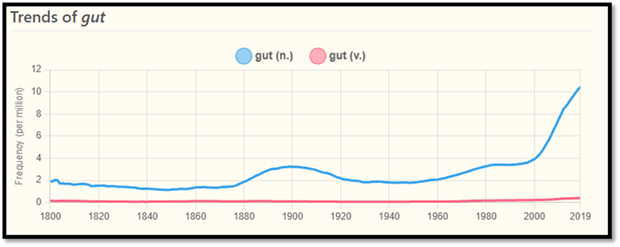
The tool is not reliable enough to explain blips in the readings, although the confluence of new public information in times of war might explain that one at the turn of the nineteenth century, but the remarkable rise in frequency of use of the noun is really from 200o, suggesting that the term has valance in folk psychology during that time, when every TV show based on guesswork uses the term ‘go with your gut’ repeatedly and having ‘guts’ is seen as the mark of resilience and bravery both.
The justification of that might have light shed upon it by the Online Etymology Dictionary entry from which the above n-gram is taken. Here is the somewhat edited entry from that resource:
Gut (n.) Old English guttas (plural) “bowels, entrails,” literally “a channel,” related to geotan “to pour,” from Proto-Germanic *gut-, from PIE root *gheu- “to pour.” Related to Middle Dutch gote, Dutch goot, German Gosse “gutter, drain,” Middle English gote “channel, stream.” Meaning “abdomen, belly” is from late 14c. Meaning “narrow passage in a body of water” is from 1530s. Meaning “easy college course” is student slang from 1916, probably from obsolete slang sense of “feast” (the connecting notion is “something that one can eat up”). Sense of “inside contents of anything” (usually plural) is from 1570s. To hate (someone’s) guts is first attested 1918. The notion of the intestines as a seat of emotions is ancient (see bowel) and probably explains expressions such as gut reaction (1963), gut feeling (by 1970), and compare guts. Gut check attested by 1976.
bowel (n.) c. 1300, usually plural, bowels, “human organs of the abdominal cavity,” from late 14c. specifically as “human intestines,” from Old French boele “intestines, bowels, innards” (12c., Modern French boyau), from Medieval Latin botellus “small intestine,” originally “sausage,” diminutive of botulus “sausage,” a word borrowed from Oscan-Umbrian.
The transferred sense of “the viscera as the seat of emotions” is from late 14c.; especially “inner parts as the seat of pity or kindness,” hence “tenderness, compassion.” Greek splankhnon (from the same PIE root as spleen) was a word for the principal internal organs, which also were felt in ancient times to be the seat of various emotions. Greek poets, from Aeschylus down, regarded the bowels as the seat of the more violent passions such as anger and love, but by the Hebrews they were seen as the seat of tender affections, especially kindness, benevolence, and compassion.
Splankhnon was used in Septuagint to translate a Hebrew word, and thence early Bibles in English rendered it in its literal sense as bowels, which thus acquired in English a secondary meaning of “pity, compassion” (late 14c.). But in later editions the word often was translated as heart. Bowel movement is attested by 1874.
guts (n.) “spirit, courage,” 1893, figurative plural of gut (n.). The idea of the bowels as the seat of the spirit goes back to at least mid-14c. (compare bowel).
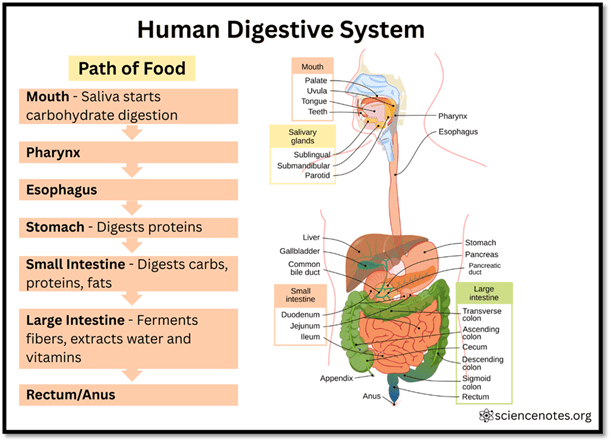
I have quoted comprehensively to illustrate two things. First, that ‘gut’ was unspecific perhaps from the start, for though the ‘bowels’ are part of any ‘gut diagram’ that might be drawn to enhance knowledge of the specific anatomical system we call the ‘digestive tract (see below), other words for which ‘guts’ might be a synonym in idiomatic usage, especially as metaphor, (for example, viscera in visceral feelings), are not necessarily specialised to one anatomical body system.
Second, the choice of one subsystem or organ from the gut subsystem as a whole can also be used with similar meaning applied to emotional states. The passage uses ‘spleen’, which was not specific organ either in Ancient Greek anatomy to show how in different cultures body parts are picked out to represent emotion, and for some older cultures equate with the actual physical origin of emotion in their models of what it is to be a person.
One specific part the Etymological Dictionary does not mention is ‘stomach’, used to describe possession of emotional readiness for action: as in ‘he hadn’t the stomach to fight back’, for instance. It’s an interesting one given the current interest in the fact that much central nervous system activity and sub-elements cluster in neurons that are in communication with the stomach, even tbough it is unlikely to be the reason for the metaphor, so little known is this fact popularly.
The main learning point of this excursion on names however, is that language use seems to preserve some of the direct association of feelings with elements of the invisible (to the external gaze) interior body with the capacity to express sensation from inside the body, whose prompting could not sensed by others in the external world, except in epiphenomena in body language. The function of gut feeling or instinct is obvious, it offers physical grounding for entirely subjective opinion regardless of any or no degree of thought process and a lot of support to the supposition of forms of magical thinking, around acts of wishing and dreading, and even of prediction.
Indeed some people believe the system of divination known as haruspicy used in Ancient Etruscan (and possibly Greek) religion depended on a belief that the inspection of freshly drawn animal guts by a privileged diviners known to us as a haruspex, worked by communication of the feelings embedded in the animals, thought to correspond to their visceral origin – often in the liver – as was possible only because the haruspex responds in their own gut in a way corresponding directly to the animal, and that this was but one step of the correspondence of the feelings embedded in animal viscera responding to the current attitude of the Gods to human ventures, and the needs thedy required met to ensure its success. Something like this is meant to be the process of Calchas, the Mantis in demanding of Agamemnon that he sacrifice his daughter Iphigenia to ensure the Gos’ grace for his sea venture to Troy. The power of correspondent feeling in the Mantis – mirroring the spirit of the Gods and the sacred sacrificial animals whose own entrail-bound emotions corresponded with those of the Gods and read by these specialised by nature and training. The whole system dependended on the belief of the entrails as the origin of emotion, as moderns use the ‘heart’, and can be seen in the etymology of haruspicy and its equivalents:
The Latin terms haruspex and haruspicina are from an archaic word, hīra = “entrails, intestines” (cognate with hernia = “protruding viscera” and hira = “empty gut”; PIE *ǵʰer-) and from the root spec- = “to watch, observe”. The Greek ἡπατοσκοπία hēpatoskopia is from hēpato- = “liver” and skop- = “to examine”. (from Wikipedia)
Today we think of ‘magic’ and ‘magical thinking‘ as an aspect of precognitive brain function (in pre-operational children in Piaget’s scheme, or in fixations of that fixed by trauma) though for all still present in dreams (and their handling of wishes and fears), and in the genesis of those who still claim second sight or magical preddiction propensities, reflexive on fears and desires, a claim impervious to argument and located in an overvaluation of the subjective as authority, which is not to say it is not an authority in some lesser manner.
However, the other side to this prompt relates to another term with an interesting etymology and semantic history – the word ‘ignore’, whose component parts as a work are ‘i(n) + gno +re (the latter a suffix From its passage through Latin and Old French to create the verb). Let’s check on the Online Etymological Dictionary first, ensuring that we do not ignore the now obsolete form of the word’s semantics:
Ignore (v.) 1610s, “not to know, to be ignorant of,” from French ignorer “be unaware of” (14c.), or directly from Latin ignorare “not to know, be unacquainted; take no notice of, disregard” (see ignorant). The original sense in English is obsolete. Sense of “pass over without notice, pay no attention to” in English first recorded 1801 (Barnhart says “probably a dictionary word”), and OED indicates it was uncommon before c. 1850. Related: Ignored; ignoring.
Ignorant (adj.) late 14c., “lacking wisdom or knowledge; unaware,” from Old French ignorant (14c.), from Latin ignorantem (nominative ignorans) “not knowing, ignorant,” present participle of ignorare “not to know, to be unacquainted; mistake, misunderstand; take no notice of, pay no attention to.”
This is from assimilated form of in- “not, opposite of” (see in- (1)) + Old Latin gnarus “aware, acquainted with” (source also of Classical Latin noscere “to know,” notus “known”), from Proto-Latin suffixed form *gno-ro-, suffixed form of PIE root *gno- “to know.”
A native word for it in Middle English was uncunning. Also compare uncouth.
Form influenced by related Latin ignotus “unknown, strange, unrecognized, unfamiliar.” Colloquial sense of “ill-mannered, uncouth, knowing nothing of good manners” attested by 1886. As a noun, “ignorant person,” from mid-15c. Related: Ignorantly.
*gnō-, Proto-Indo-European root meaning “to know.”
It might form all or part of: acknowledge; acquaint; agnostic; anagnorisis; astrognosy; can (v.1) “have power to, be able;” cognition; cognizance; con (n.2) “study;” connoisseur; could; couth; cunning; diagnosis; ennoble; gnome; (n.2) “short, pithy statement of general truth;” gnomic; gnomon; gnosis; gnostic; Gnostic; ignoble; ignorant; ignore; incognito; ken (n.1) “cognizance, intellectual view;” kenning; kith; know; knowledge; narrate; narration; nobility; noble; notice; notify; notion; notorious; physiognomy; prognosis; quaint; recognize; reconnaissance; reconnoiter; uncouth; Zend.
It might also be the source of: Sanskrit jna- “know;” Avestan zainti- “knowledge,” Old Persian xšnasatiy “he shall know;” Old Church Slavonic znati “recognizes,” Russian znat “to know;” Latin gnoscere “get to know,” nobilis “known, famous, noble;” Greek gignōskein “to know,” gnōtos “known,” gnōsis “knowledge, inquiry;” Old Irish gnath “known;” German kennen “to know,” Gothic kannjan “to make known.”
My insistence on the obsolete form now in English is that word is an inversion originally of what it means ‘to know’ (note the various ways the Proto-Indo-European (PIE) root resulted in famous ways of expressing knowledge as a function – the most telling being that in Ancient Greek, (γνῶσις) or gnōsis), a name for knowledge or knowing that has kept its importance in mainy words. The sense that to ignore meant the obverse of ‘to know'(created by i(n)- prefix) namely to ‘not know’, allows the word to be a positive expression of a active agent in human life – the act of not knowing or, in medieval mysticism ‘unknowing’, a state most of us must be in relation to God for instance. Its roots in Platonism and through Neo-Platonism make it both a recognition of necessary and inevitable human limitation that cannot be addressed (or not until the afterlife in Christian Neoplatonism). As a result, its necessoty is the only starting point for wisdom – acceptance of what is not yet and that which will never be known, in the earthly state of humanity.
In this cloudy obscurity or darkness, lies our respect for the insights that come not from external evidence but from promptings of the ideal (or divine in religious versions) within. If you like n’not knowing’ as a positive state is the basis of a trust in things divination of signs or correspondences within between humans and the divine, readable only by an elite. These super-subjectivities have a channel to the ideal, God or the gods, oft expressed by the viscera that cluster around that channel (the origin concept of both gut and gutter) from the mouth to the anus that serves life. But gut instincts are more fallible than otherwise and yet still continue to be considered a means of decision-making (eveb in the most absurd of choices in quizzes). They are little more than a belief in chance or ‘luck’ but given a kind of supernatural backing. They tend to be reported when luck strikes never when it does (even bad luck in the prediction of adverse events).

Perhaps, however, they keep up a sense of the value of the individual’s connection to things greater than themselves – like a prop to amour-propre, that is almost religious in nature, since it glories in the cognitively irrational. I doubt we’ll ever get rid of it. It is even more common to have a gut instinct that we choose not to act upon (or ignore in the modern sense) that can have attributed to it the retrospective thought that my gut feeling would have enriched me as things fell in life: one example might be that ‘had I followed my gut and invested in cryptocurrency, I would be rich now’, which still does not contradict the reason you didn’t – that cryptocurrency is like the South Sea Bubble of the eighteenth century – likely to burst and takes lives and livings with it, even if it hasn’t yet (and is equally based on relations of economic exploitation beloved of the Trumps and Farages of our world).
The gut is a focal point of phenomena deriving from cycles of hope and nxiety – and expressed in interbneuronal and hormonal interchanges that create sensation – I like it that the words origin in PIE may have been ‘to pour’ (don’t you just feel that pouring of hope and fear in you sometimes). To base decisions on these feelings might be opportune – in systems dominated by cognitive systems, some hopes and fears are based on overlearned rational methodologies – but this is never the case in ‘Deal or No Deal’ and its decision-types.

With love Steven xxxxxx

