What’s a book or movie that genuinely scared you?
View all responses
That which we fear we lock away, drown or bury, if we can and, hopefully, forever (or perhaps until Time catches up with desire at least). This is precisely what Max de Winter does with the body and memory of his first wife Rebecca and this is what makes the novel Rebecca by Daphne du Maurier ‘fearful’ for we collude in Rebecca’s continuing burial underneath the floorboards of comfortable lives. In Rose Tremain’s revisioning of some germ elements of that novel, we, with the narrator, a migrant Polish Jew called Lillianne Maria Danowski, called Danni for short, contemplate spaces in our lives that we consider “past and gone” and over which we are powerless to make them live again. In doing so, we may revisit with more troubling fullness why we did, as Lord Greville-Withers had commanded his housekeeper to do to the great ballroom at Manderville Hall on the death of his wife, the Lady Edwina: “Close it down, Danni. Put a dust sheet over the piano. Bolt the shutters. Turn the key”. [0] This is a blog on Rose Tremain (2026) The Housekeeper London, Chatto & Windus.
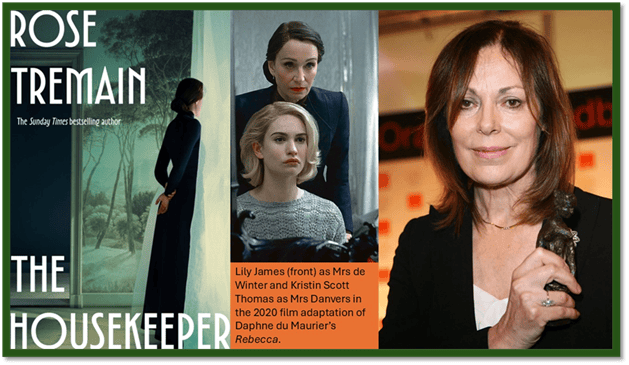
There are lots of reasons reviewers have shown some circumspection about The Housekeeper. One is that it is derived from a short story on the same subjects in a 2014 story, also called The Housekeeper and included in her acclaimed collection The American Lover’ in Clare Clark’s words in The Guardian and is turned into a novel to predate the film of the story in the making. Another reason is that in rewriting from a very much loved novel Rebecca a story in which .the author herself appears and confronts the supposed original in her own life-story of a female monster (a lesbian housekeeper called Mrs Danvers) in the form of much less powerful figure, a migrant Polish Jew called Lillianne Maria Danowski, also called Danni for short because the English people she works for and with find pronouncing her name difficult. Her work colleagues (the servants with their own form of ‘servant-speak’ so detested but yet required by du Maurier in the novel) however, preserve the hierarchy over which she is the female lead, the equivalent of the butler in fact, by calling her Mrs D., but the familiar and boyish name aristocrats can get away with in naming their ‘inferiors’. Yet, Clare Clark condemns the novel in fact because it is a poor comparison to the ‘power’ of the du Maurier novel, saying comparatively about each novelist’s creation of a Danni, ‘bloodless’ in Tremain’s case, this:
“What am I to do with you, Danni? How am I to make you come alive?” Daphne demands teasingly in The Housekeeper’s opening pages. Du Maurier, of course, faced just that problem with Rebecca and pulled it off spectacularly, creating a woman of such toweringly vengeful, transgressive authority that, even in death, she rises up to dominate the book. Tremain has done the opposite. By stripping her Danni of her fierce, quiet dignity, she has robbed her of her power.[1]
There seems to be no consideration here that that the vengeful and embittered lesbian lover using deceit and subterfuge is a trope of the representation of queer lives in heteronormative cultures. Clark’s opposite number in The Observer, Hannah Rosefield is so much sensitively aware of this issue. Whether Du Maurier’s Danni has ‘quiet dignity’ is a matter of interpretation, after all. She has always seemed to me a Gothic monster, wearing the otherness of the stereotypical lesbian of the period’s as embodied in touch that crosses the surface of a mirror, presented as female ‘obsession about self-reflected feminine beauty and sensuality of softness to the touch like ‘wax’ behind a hard surface, the name du Maurier gave to sexual coupling. When Tremain’s Danni reads Rebecca she says of the handling of her ‘character’, and particularly the lesbian motivation still hankering after the image of the lovely dead Rebecca de Winter that it is clear that Du Maurier will ‘not rest until I am thoroughly punished’. For provoking Daphne’s madness in being the cause of her ‘longing for me’ especially since ‘the more she is made guilty by these feelings, the more terrible she must make me’:
For I have become pure evil. I am not Danni. I am Mrs Danvers, Rebecca’s confidante. Rebecca and I conspire to bring about the ruin of a nameless girl-wife. Together, we bring darkness so profound that no light will break through.[2]
Of course that makes Tremain’s Danni less ‘powerful’ but not all power, even in a woman, is to be wished for or seen as admirable. In fact it is a kind of inversion of male power over women. This is how Rosefield reads the issue:
The married Du Maurier was violently attracted to women: her complicated, deeply closeted attitude towards her own sexuality lends Rebecca much of its darkly erotic charge. In the 2014 story, Tremain echoes that tension, offering, with her impeccable instinct for period, a masterclass in 1930s restraint. Danni is quite undone by Du Maurier, her careful armour torn away, yet bound, like the butler Stevens in Ishiguro’s The Remains of the Day, by the long habit of discretion; so she proves a tight-lipped narrator. Danni is the supplicant, the vessel; she knows she has no power. When Du Maurier, terrified of exposure, simply cuts her off, Danni scrabbles for ways to excuse her, to cling to what they shared. It is the discovery, more than a year later, that Du Maurier has immortalised her as the bitter and conniving Mrs Danvers, “ugly and diseased with jealousy”, that devastates her, smashing to pieces her passionately hoarded memories.[3]
That is right. Of course it would come as no surprise to this lesbian Polish Jew that Clare Clark uses her modern feminist credentials to see her as powerless, for ‘she knows she has no power’ as Rosefield says, and, in that self-knowledge, must find ‘dignity’ wherever she can – in fending off the blackmail of the servant colleagues she helps, even whilst helping them to fund their commercial venture – a sweet shop in Truro. Rosefield might lead us to the true theme of the novel, being the return of the repressed in the creation of Gothic characters. Yey Rosefield too uses her better awareness to betray awareness of Tremain’s prestige as a novelist, in my view one not unequal to du Maurier, who is very uneven outside Rebecca. There has to be a comparison that leaves us finding Tremain and her heroic lesbian protagonist wanting, as here in her final paragraph:
“What I felt I had with Daphne was not mere sex; for my part, it was love,” Danni writes. Yet this love remains inaccessible to the reader: though the women’s hunger for one another is powerfully conveyed, there is little sense of what Danni loves, or even likes, about Daphne – or what draws Daphne to Danni, beyond physical attraction. The Housekeeper is, instead, a fine exploration of the constraints that keep two women apart.
The certainty that the critic knows what ‘love’ is and that Tremain and her Danni do not, is crushing. Knowing ‘what [one person] loves, or even likes, about [another person]’ is not the articulable thing Rosefield feels it always must be and which she presumably finds in the exploration of the second Mrs de Winter to be feelings for Max de Winter before and after their marriage (for it shifts so, as it should). I can’t accept yet the secondary nature of this novel – for it has a lot to say about the nature of passionate relationships that may accompany, or be the participants equivalent of, love. Love is a more problematic phenomenon to either define or know in a manner that fits all uses of the word, especially in relation to what Danni calls ‘mere sex’, for sex in this novel is anything but ‘mere’. Indeed that may be a major theme of this problem novel – where the problem is love and sex, especially in relation to concepts of time in its onset and durability. Doesn’t Andrew Marvell’s To His Coy Mistress raise the same problem, even relating it to the Christian world’s antisemitic myths surrounding diaspora Jews like Tremain’s housekeeper’s Polish family, for ‘world enough and time’ in that poem is measured by the duration required for the ‘conversion of the Jews’:It’s most famous lines are however about the pressure Time puts upon us:
But at my back I always hear
Time’s wingèd chariot hurrying near;
And yonder all before us lie
Deserts of vast eternity.
Thy beauty shall no more be found;
Nor, in thy marble vault, shall sound
My echoing song; then worms shall try
That long-preserved virginity,
And your quaint honour turn to dust,
And into ashes all my lust;
The grave’s a fine and private place,
But none, I think, do there embrace.
     Now therefore, while the youthful hue
Sits on thy skin like morning dew,
And while thy willing soul transpires
At every pore with instant fires,
Now let us sport us while we may,
And now, like amorous birds of prey,
Rather at once our time devour
Than languish in his slow-chapped power.
It would be a mistake to miss the significance of the filmscript born along with this novel attracting Anthony Hopkins to the role of Lord Grenville-Whithers, known by his dead wife and aristocratic neighbours as ‘Perry’, and that Tremain acknowledges him, on his request, for inserting lines from T.S. Eliot into filmscript and the novel, about the ravages of Time on his power, reputation and authority in his own house. Clearly the role of Perry is a crucial one in terms of the novel’s themes, and especially that of Time. As he tries to assert his right, a thing he feels passing away from him over time, to take his beloved dog Baz into a dinner-party in his own great hall, he and Hopkins clearly felt the relevance to all he represents of lines from The Love Song of Alfred J. Prufrock a poem as stuffed with the influence of Marvell’s notion of the fear of Time’s effects on mortals as is The Waste Land; the echo of Marvell’s great poem being acknowledged by Eliot in his own notes to that latter modern anti-heroic epic:
“I’m taking Basil. He can bark at the dancers, and too bad, if they don’t like it, eh?’ Then he turned again, stood still and looked at the coats covering the bed, murmuring some lines which I now know to be by Mt. T. S. Eliot:
“I have seen the moment of my greatness flicker, / And I have seen the eternal Footman hold my coat, and snicker, / And in short I was afraid“.
“Too true,” he added, “all too true.” Then he left the room, with Basil at his side. [4]
Is ‘fear’, ‘in short’, always attendant on the losses and possible extinctions that Time entails. Certainly that might be the burden of most literature when it isn’t the hope of growth, again acknowledged in Marvell but only as a lost hope when the effect of the ‘eternal Footman’ and Time itself showing us the door for our personal exit with our coat in his hand. What Marvell says about our desire to see primacy of hope as mortals in growth is even ambiguous, as here:
My vegetable love should grow
Vaster than empires and more slow;
The conditional ‘should’ in this poetic phrase is entirely dependent on time staying still long enough or at least slowing down somewhat in order to accomodate the slow growth of things that in time pass away more quickly than they grew. But time doesn’t do this, does it, either in the poem or life? Moreover, for many the only alternative is to up our pace and outrun time, or at least feel that we are doing so. There is a kind of play with this idea in the novel’s structure. Danni’s narrative about her affair with Daphne du Maurier largely, is written in the pages of an old diary of her former mistress, now dead, Edwina: the type of a book that intends to organize human lives into a comprehensible temporal sequence of days. In this ‘diary’ Danni’s story grows but in the event grows beyond the capacity of a diary-form organisation: ‘my story has now overrun the pages of Edwina’s beautiful leather diary and straggles across the endpaper. There is no room for another word’. [5]
Herein lie a major structuring dynamic paradigm of this novel’s comtent about the human relationship to time – a process in fct that is forever locked between the desire to stay or the desire to leave (a house, a marriage, a role in life that is also one’s living or is interpreted as such by convention); between staying ‘still’ and movement on, or in the case of dancers, movement around and around the same space to make up for fear of standing ‘still’, a common ploy of modernist literature if only one mocked in this novel’s ‘Big Bash’, the party at Manderville Hall. Look how movingly the micro-scene above hinges on what happens unseen and unarticulated in full inside Perry as he ‘stood still‘ among the coats of his guests, lying ready for the guests’ departures, and contemplates his past losses, even those of which he barely allows consciousness, like his dead wife’s affairs with others mediated by endless successive train journeys, that become his means of understanding the loss of his wife to time. He sees too those losses about to come (his ‘whithers’ I suppose you could say, that are entailed in the passage of Manderville Hall to another, espeially Adelaide, a brash power hungry woman forever on the move and racing (even her horse and pitiful Jack Russell, who nearly dies in the imposed haste) because she can’t stand still, a bit like the modern Brittania she role-plays (‘”Speed!” said Jim to me. “That’s a madness in her, Mrs D, this passion for speed”.) [6].Let’s linger awhile (as the characters often do if but for a moment before moving on) in the evidence of that paradigm, for the first speed artist we meet is not in Adelaide, its Tory form dressed in national colours in the fancy dress Big Bash, but Miss du Maurier, upstart liberalism itself, when she first visits Lord Grenville-Withers, possibly with an offer to buy his home.
We learn about her pace of movement first, as often in this novel through a response to dogs, recalled to her as she admires his Lordship’s labrador, Basil, but in the following conversation also learn about her desire to somewhat ‘still the pace of passing time and motion, in a dream of the past represented by the English country house, as she looks at Grenvill-Withers’ faces seeing its ‘time-worn features’:
… I heard Miss du Maurier say,”Oh dogs! How I love them. Mine’s a West Highland terrier called Bingo and we go for strides together. I call walks “strides” because this is what I find myself doing: striding very fast, as if I were in some race. I don’t know why I do it, What am I racing against? I have no idea.”
“Time,” said Grenville-Whithers. “You’re racing against time.”
“Probably right,” said Miss du Maurier. “But you don’t know here at Manderville Hall … in great houses such as these … time seems to stop. Everything holds its breath. I think this is why we love them so much.” [7]
In responses to time, definitions of what and how we love might lie if we take this converation seriously. It is not that love helps us believe, fantasy though it may be, that time stands still or stops and is held at one point, but that the feeling of being held, even to the point of our breath rescinding its onward repetetive cyclical motion in and out, comes with it – however briefly and however illusorily.In the tour of Manderville, Danni starts Daphne off at ‘the foot of the staircase, where four suits of armour had always stood, rusting slowly, dumb sentinels of Time’, but Daphne is immediately silly about these, jokingly questioning Mrs D as to whether they ‘come alive at night … and tramp the passages …’. [8] But fear lies not in ghosts of the m,ythical national past for Danni, but in the constant hope that must be contained that she might express her capacity for love openly – at least to one other who excites her to that sensual life. In the presence of du Maurier lies the fear that the sight of ‘this beautiful laughing woman’ ‘was going to blind me’, a fear that her awareness of the lady’s gaze upon her, however still she holds herself, as her father taught her, beneath a severe black gown that someone might see ‘my heart’s sudden agitation‘: ‘This feeling of breathless fear was very familiar to me from my childhood in Poland …“. [9] It is the fear of exposure – a fear many in the novel come to experience for many reasons – even in the fear of blackmail, but in this specific case in a specific time and circumstance, a sexual exposure that queer people are well educated to feel and be informed (in the sense of being ‘formed within’) to experience. The fact of being just ‘Miss du Maurier’s only companion for an hour or more’ (a rather over-interpreted idea in the trembling and desirous lover of women) ‘both thrilled and terrified me’. [10]
Even a novice in psycho-biology can explain that the experience of sexual thrill has the same neurochemical architecture as the response of anxious stress – the drivers of flight or fight responses. The fear of Miss du Maurier is felt even jokingly in his lordship who imagines her a thief for a humane laugh at the world’s changefulness from turpitude. However, for Danni the threat of things being stolen from her, who has so little of her own, is more ominous. Writers are thieves, Daphne says, because things they see they ‘will into our heads’ and use them in the ongoing business of their lives as theirs to project into their writing. Being stolen from is not only about loss but about being forced to reveal those hidden things of value, to a novelist at least but also perhaps to a lover, buried and locked inside one as if in an inner safe, or as Danni speaks the thought about her childhood and her father’s advice to ‘keep myself yo myself’ hence, Danni says that though she often feels that agitatio, part thrill and part fear, ‘it very, very seldom happens that I tell anybody what I’m thinking,…’. [11]
In part queer people, and especially working class or other marginalised people – like Jews in Poland – learn this skill to wear the cloak of invisibility that being queer affors us if we play the roles of the validated and normative other well enough. For some it can sail near the mark – in the role of the socialite or novelist, who have worlds into which to project themselves whilst mainting some protection, like the glorious Lady Vandross playing Marie Antoinette at the fancy-dress Bash or the coded worlds of one’s writing, as in Daphne du Maurier, where one can ‘other’ one’s own lesbian desire in a Gothic or fantasy other – Mrs Danvers and Rebecca or symbolise it in protected sea-coves (as in Jamaica Inn and Rebecca), visited only and largely by the sea which renders them so inaccessible to non-acqueous persons. At that moment of transgressive over-interpretation of being near to Lady Vandross’s vagina,in order to allow her to micturate, she imagines a sexual threesome between self, Daphne and Viola Vandross, as she realises ‘what pleasure we, who understand women’s bodies, could all give each other‘. [10.1] Likewise measuring yp Emerald Langton for her wedding-dress she imagines both women ‘reaching out for each other’ in a recognition of their common lesbian identifications [10.2]. Writing can ‘outrun’ the mores of a particular time, as Danni realises as she builds out of her diary, that work of fiction, based on shadows of fact that is Rose Tremain’s The Housekeeper, with an openly unreliable narrator aiming to be a novelist as recognised as such. As her meditations on having overrun the ‘private’ diry of Lady Edwina, Danni looks again upon her writing and sees that she has ‘created a fiction’, at first apologetically but then to show that her punishment and betrayal, by du Maurier, was ‘for the simple act of losing my heart to another woman’:
.With this thought, my anger and my longing return, side by side, as if they were the chambers of my heart, the dark, churning spaces that keep me alive. [12]
Those interior spaces are dark because no-one allows a light into them and keeps them from the eyes of others in precisely that way, though in literature ‘dark’ language (as in Sir Walter Raleigh’s ‘School of Night’) has always meant coded and deliberately obscured language saying things not validated as sayable directly – most famoulys in Edmund Spenser’s definition of his major poem, The Faerie Queene, as a ‘“a continued Allegory, or darke conceit”‘, who turns Raleigh’s anarchic and dangerous intentions into love of the status quo. But if you want to find what keeps this uncommon commener who is Danni alive, you allow her to let in light where it isn’t usully shone – as in the hilarious episode in which she helps Lady Vandross to micturate from within her Antoinette type crinoline and looks to all intents and purposes as engaged in lesbian play – or that is at least how du Maurier in the novel at first sees it until better informed by the totally discreet Lady Vandross, who uses Danni for this purpose because she can be trust to keep hidden what ristocrats like to keep hidden.
But Danni’s writing opens up ll kinds of windows to lesbian desire, uncoupled from love romance as it always otherwise is in normative discourses about the excitation of female sexuality that is so often how Danni comes alive, which gives such frisson to du Maurier, as imagined in a day-dream fantasy to her, ‘giggling in her gilish way and saying “Oh for goodness ske, what am I to do with you, Dnni? How am I to make you come alive?’. [13] In a sense all novelists say that about the characters too but rarely ny placing them in explicit bodily contact with other women’s bodies, and especially their own as du Maurier does with her extensive demands about how pleasre might be excited and sexual hunger sated. We know too that Danni likes seeing women’s ‘private’ parts very much, even covertly. When fitting ladies for dresses that she caters to women who present to her (the verb is hers) ‘bossoms of astonishing amplitude and softness and I do not deny that while touching them very carefully and gently with my tape measure, I can sometimes feel a shameful little thrill’. And the thrill can get greater, when fitting for a girdle and removing a lady’s silk knickers for that purpose, those women who once out of her shop she ‘desn’t think of them again’ unlikePaphne whose invitation to touches is entirely catholic :
Thus I am sometimes alone with beautiful bodies naked from the waist down and cannot deny that I am made breathless by my longing to touch them, but of course I remain absolutely correct and distant, never letting my hand stray where it wishes to go. [14]
Those touches that never happen with hand and lips do happen on Daphne’s hungry demand, when the two have sex, though the range of actions is not described, the evocation of its range is obvious, and, anyway, touch and trespass, including those touches that trespss the norm of the social boundaries of the body are very much an issue in the novel. When du Maurier first touches Danni, but only ‘her shoulder’ if in a ‘tender and consoling’ way, and which moves Danni to show Edwina’s those ‘lovely gowns for Her Ladyship’ made by her that are ‘still in the wardrobe’, holding them against her skin in the event, du Maurier codedly says she would like to see ny that would not ‘trespass on your feelings’, finally deciding to have the fancy dress costume for Edwina in the character of the transgressive Anne Boleyn, held against her by Danni who in that stance feels the proximate warmth of Daphne’s body for the first time. [15] Yet the touch, especially when it trespasses on what is held dearest can feel to be evil, as in the moment that Danni expresses to herself her disgust at Adelaide as heir to Grenville-Whithers touching anything she had cared for and curated in the house, using an interesting mythical analogous belief about the contagion of touch used as an antisemitic trope, which suddenly puts her in the mind of the neirotic heteronormative thinking about being touched by queer people. It is a typical Freudian inversion, where disgust masks desire in complicated ways: ‘It was if I imagined there was some kind of contagion in her touch (such as some people in Radom imagined to be present in the touch of Jews’. [16] All of these ideas are in complex networks where desire and disgust play against each other – a necessity for queer people, and possibly Jews, to be constantly awate thereof if they are to be on alert for the effects on the life of exposure to a world phobic of them.
The issue then for Danni is the need to still what is agitated in its motion, or still what makes too much noise, or, if it cannot be still or stopped (as Rebecca and Mrs Danvers are resepectively by murder and reliance on the vulnerability of servant-class women to aristocratic denial of their right to a voice) in Rebecca) then somehow locked away and covered-over in the hope of being forgotten from non-use, like the ballroom at Manderville after the death of Lady Edwina Greville-Whithers.It is, after all, the role of a housekeeper, to ‘keep’ or sustain the house in stable form – to open and close spaces as she is entrusted so to do and to keep the keys for all of them (keys are another metaphor that is important for keys also break codes that secrete knowledge too). Danni tells Daphne early on that she has ‘the keys to every room and every building on the Manderville Estate’ and after many key usages throughout the novel managed by her, she reports later Daphne’s hunger to possess a key too but the ‘key to a story that no one will ever forget’ The story she wants to unlock is based on Danni’s wishful belief of a wishful fantasy island in the Azores where lesbian love (and or sex) is a norm of behaviour and indeed was ‘held sacred’.’”If only”‘, she has Daphne say, ‘” I could write a story about that! Shock the world with a forbidden thing”‘. [17]
And the key to all that lies in Danni who becomes the writer of that ‘shocking’ story, Daphne du Maurier never wrote except in inverted codes wherein femal love is the Gothic ghostly other to heterosexual achievement by nameless or lower class heroines. That key lies in Danni’s dreams, for dreams ‘hold’ time and ‘still’ it in a manner that can be written as art or attempt so to do (Freud would have understood that so well). Danni writes once she realises tht Daphne might sacrifice her private life to the writer’s ambition, skewed by repression, in a way that gets one over on Daphne, but only in the impossible notice of a time that can be controlled by internal wishes and desires, for which we all wke into reality – even in queer fiction of the time:
In my dreams, she is still with me. Very often we are in her boat, moving very fast across an infininity of silent ocean. Then suddenly, we stop. The boatturns lazily on its grapple of an anchor. We tke off our clothes and lie on the wooden planking of the boat floor. The sun stares down t and we’re helpless in its violent light. I know that, in a few moments, Daphne is going to turn to me and whisper to me in the profane language which excited her. But just she moves her head, I wake up. … [18]
This is not the Daphne of the first pges of the novel who retains all of her agency and robs Danni of a voice, but that is not because Danni as powerless in dreams and fiction as she is in life as a servant, even one superior in servant hierarchies. She can control, as a novelist does the pace of things – holding them ‘still’ if need be in retaining ‘still’ all the figures and landscapes of her dreamed spaces because time is more under her regulation. Even if Daphne remains a ‘fast mover’ in every sense of the phase, to move ‘very fast’ through infinity is almost the samne as staying still, since duration of time only matters when things end or have the power to leave you. The dream narrator knows what her Dpahne will do, and it is the measure of her desire that she will ‘turn to me’ and both will talk dirty as they so desire. Except when you wake up, dream time gives way to normative seqential time. But the dream is also like other places and spaces in this novel it is a secluded locked up space.
This is then why I entitled this blog as I did above, as a means of revisiting and, via our own rewriting, revising, as I said in the title:
spaces in our lives that we consider “past and gone” and over which we are powerless to make them live again. In doing so, we may revisit with more troubling fullness why we did, as Lord Greville-Withers had commanded his housekeeper to do to the great ballroom at Manderville Hall on the death of his wife, the Lady Edwina: “Close it down, Danni. Put a dust sheet over the piano. Bolt the shutters. Turn the key”. [19]
Housekeepers keep houses by controlling the keys to its various spaces, at another’s command of course but that doesn’t always seem to be the case, and in deciding to close down a space or reopen it, they can vary its meaning by appropriating (stealing) it and retelling in their own way in the reopening. That is Danni’s charge against du Maurier in the novel Rebecca that transformed her into Mrs Danvets. But when a housekeeper learns to perform as a novelist, tables can be turned, for who remembers exactly what lies under the dust sheet of the deliberately forgotten or repressed, except only that person with a key to the space.
In revising Daphne as she does, Danni creates a ravenous monster of sex, who consumes her, and a lot of the novel has much to say about eating and tbe nature of the desire we call hunger, often the greater in those deliberately starved. I don’t intend to follow through here on food in tne novel and its analogy with sex, but if anyone wants page references. I include some at this note. [20]
My interest in the novel is in its very full opening up of the dark spaces of Rebecca, resisting the dust covers du Maurier put over her own queer life history, explored only in much later biographies. Though I think, as Saudi above that Hannah Rosefield is the better critic of the two I have cited, she gets one thing wrong. It just doesn’t wash to say that we never know what Danni loves about Daphne. This is, in part, because what she loves can be written down as the attraction of ‘mere sex’, which Danni disclaims as a sufficient answer to her love.
Danni knows what Hannah does not, that ‘mere sex’ can change the boundaries of identity if allowed its full interactive play between persons, but also that sexual love is only part of the picture – that I think is the point of the subordinate narrative of the novel about the relationship of Perry and Edwina. Some love endures beyond the sexual, sometimes in the asexual figures of life like Perry. That is why the novel reconfigures Rebecca as the story not of a romance but of a house. But Manderley and Manderville Hall ate not the same, one reconfigurez the other and vice- versa in narratives that revise each other. Tremain allows her Manderville Hall to both evoke Manderley and replace it as a space where lesbian love is not given space but is not the only space where such love thrives even if only for a week. The section on the queer love nest in Hampstead is a beautiful gift to the earlier novel, changing its range of nuance about queer lives. Rosefield almost captures tbis in the paragraph I quote below, but not enough to take our understanding further of what Tremain gained by consulting Patrick Gale as a fellow novelist, as she tells us in her Acknowledgements. This is what she says, for as as a co-description of both novels it has great merit. For the scenes that capture Rebecca best are ones that entirely revise its take on tne history of English queerness.
The Housekeeper, …, is in part a re-creation of Rebecca, and its author. “Last night I dreamed I saw Daphne again,” the novel opens, mimicking Rebecca’s famous first line. Within a few pages, the Du Maurier character is looking at soaring gulls and musing, “Birds! How terrifying if, one day, they thought we were prey and started to attack us. It might signal the end of us all.” (Du Maurier’s 1952 short story The Birds, which became the Alfred Hitchcock film of the same name, dramatises just such a scenario.) This off-puttingly literal start gives way to a more inventive reimagining of many of the settings and events of Rebecca from a below-stairs perspective: the grand house rearranging itself after its mistress’s death; the secluded cottage that offers a venue for lovers’ trysts; the costume ball that goes disastrously wrong. [3]
The costume ball is integral to both novels. To read the section about it in both novels would make the point far better than I make it above. But, that is why tbis novel is masterful because it turns a novel that genuinely ought to scare queer readers, as Rebecca did me, I to one tbat shows tbe fear we feel in it is the product of heteronormative prejudice, a prejudice Danni in Rose Tremain’s eyes, triumphs over, but which Daphne du Maurier never did. It is Tremain’s best treatment of queerness yet.
With love
Steven xxxxxxx
[0] Rose Tremain (2026: 148) The Housekeeper London, Chatto & Windus
[1] Clare Clark (2026) ‘The Housekeeper by Rose Tremain review – a bloodless origin story for Du Maurier’s Rebecca’ in The Guardian [Mon 5 Oct 2026 09.00 BST] available at: https://www.theguardian.com/books/2026/oct/05/the-housekeeper-by-rose-tremain-review-a-bloodless-origin-story-for-du-mauriers-rebecca
[2] Rose Tremain (2026: 257) The Housekeeper London, Chatto & Windus
[3] Hannah Rosefield (2026)‘Rose Tremain’s riposte to Rebecca’ in The Observer [Wed. 16 September 2026] available in https://observer.co.uk/culture/books/article/rose-tremains-riposte-to-rebecca
[4] Rose Tremain (op.cit.: 186). The acknowledgement to Anthony Hopkins is ibid: 312
[5] ibid: 100
[6] ibid: 31. See also ibid: 35
[7] ibid: 5f.
[8] ibid: 8
[9] ibid: 4
[10] ibid: 6
[10.1] ibid: 172
[10.2] ibid: 282
[11] ibid: 9
[12] ibid: 100
[13] ibid: 2
[14] ibid: 73
[15] ibid: 11 – 13
[16] ibid: 44, Radom is the village Danni was born in in Poland.
[17] ibid 14 & 161 respectively
[18] ibid: 89
[19] ibid: 148

