



For some travel will always be made to include hard work and uncertainties
If you test an AI searcher like Co-Pilot on the origins of the word ‘travel’ these days, you get something like this (what I got today):
Historical Development
The English word travel first appeared in the late 14th century as trauel or travell, initially meaning “to make a journey” but closely linked to the idea of struggle or toil Etymonline+1. It is a variant of travail, which originally meant “painful effort or labor”. The semantic shift from “toil” to “journey” likely reflects the difficulty of travel in the Middle Ages, when journeys were physically demanding and often dangerous Etymonline+1.
Linguistic Roots
- Medieval Latin: trepalium, a device of torture made of three stakes (tres = three, palus = stake), used to restrain or punish readingworldmagazine.com.
- Latin verb: trepaliare, meaning “to torture on the trepalium,” which evolved into the notion of painful effort.
- Old French: travailler, meaning “to work strenuously or suffer,” which passed into Middle English as travailen or travelen, meaning “to toil, labor, or journey” wiktionary.org+1.
Semantic Evolution
Over time, travel shifted from a focus on suffering and labor to the more neutral sense of moving from one place to another. By the 15th century, it was commonly used to describe journeys or trips, and by the 16th century, the noun form travel referred to accounts of journeys Etymonline+1. Modern usage retains the sense of movement or exploration, often without the original connotation of hardship.
The validity of some of those sources used by the AI tool can be queried but the general sense that we move from seeing travel as a tortuous thing, involving labour and unforeseen difficulty (even monsters that may or may not be symbolic of difficulties psychological, physical or a mix of the two) is fairly indisputable.
The hardest test in our lives though is to have lost the place where we had thought we might stay in safety and with enough provision to endure forever, or for the length of our lives, and to be forced to travel with no clear destination and no awareness anyway of of the choices of direction we should take towards those options if we had them, or how to evaluate the choice between ways. That is the test Milton imagines God and his angels forcing on the first humans because of the ‘Disobedience’ to the one law he set that must not be transgressed. Here it is at the end of Paradise Lost.
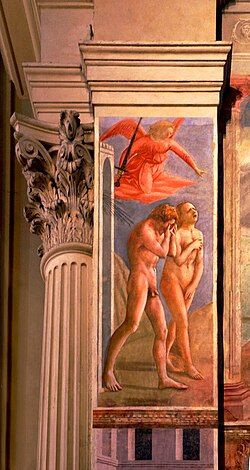
Massacio’s fifteenth century version of travel beginning for humankind. Shame has yet to be addressed with clothing and Adam forgets to use even his hand as cover.
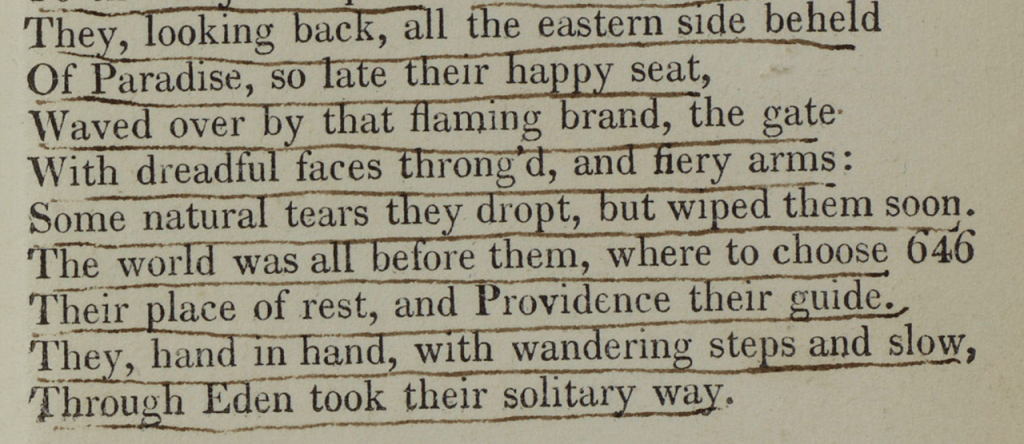
The law contravened by Eve and then Adam, the roots of the Tree of Life, was to eat an apple from a tree that grew very near to that Tree, the Tree of Knowledge. In Book IV of Paradise Lost, Satan after travelling through the immensities of space between Hell and Earth sees the layout of the land around those trees, and it is through his eyes we see the meaning God embued them with:
........, in this pleasant soile
His farr more pleasant Garden God ordaind; [ 215 ]
Out of the fertil ground he caus'd to grow
All Trees of noblest kind for sight, smell, taste;
And all amid them stood the Tree of Life,
High eminent, blooming Ambrosial Fruit
Of vegetable Gold; and next to Life [ 220 ]
Our Death the Tree of Knowledge grew fast by,
Knowledge of Good bought dear by knowing ill.
In fact there are two choices here – you can have life as it is without any awareness that there are alternate choices or you could decide that life without learning and knowing rather than being told things was nothing. Then having made that choice, you can decide to exercise it by enduring the difficulties of travelling through realms in space, time, or into the mind to face whatever will bring you knowledge of that choice being a good or a bad one. Of course, it is tbe same choice twice repeated
What Milton showed however is that anyone who chooses to know, and who would not being proud of our mortal being, chooses hardships and the unforeseen of the first requisite of any journey as it could be imagined in the seventeenth century with knowledge itself a goal of which we know nothing but its uncertainty, including whether it was better not to travelled to a yet unknown destination at all.
What Co-Pilot identifies as a semantic shift in the word ‘travel’ comes with travel being easily available in largely secure forms but at a monetary cost to the traveller rather than a physical, emotional or spiritual one, such as is endured in medieval romance and quest literature. Modern tavel comes with uncertainties, of course, but these ‘risk factors’ can be statistically calculated, and the optimum way of going between arrival and destination points that are predetermined can be defined. that is so, even if the destination is not always fully known in character yet, if that matters to the traveller and if they will take the trou le to investigate their desti ation beyond a beach and a hotel.
One characteristic of travel.as a commodity is that it is so often ‘packaged’ with only certain knowable aspects of the destination emphasised such that it has no character to the traveller that feels different at all from what they already think they know. All-inclusive holidays so metamorphosise the experience of difference that it need not be noticed or become a matter of awareness or knowledge at all. Such holidays used to be planned (often pre-packaged for working class families, with the advent of a world of cheaper fuel – although now rapidly disappearing) because the weather ‘abroad’ used to be guaranteed to be ‘better’, in terms of what it is thought to be at ‘home’
Now we are realising and coming to know good and evil in our ‘travel’ choices, unless wrapped in greedy entrepreneurial sef-interest. We know that ‘cheap fuel’ had very expensive hidden costs in climate change, and the idea of what might be ‘better’ weather is changing. The cost of fuel will anyway perhaps eventually exclude cheap travel for working class people and travel to ski resorts become the province of a rich few, who will still keep contributing to global warming because they can afford air conditioning at home, and holidays in any climate that constitutes a break – perhaps a cruise in an ‘icebreaker’ in the newly colossal polar seas.
How different from literature (and now recent film- for my blog on the latter see this link) that far from breathing breath into the desire for travel with labour and uncertainties involved, presents it as a challenge for which there is no clear prize. Having said that about war, in The Iliad, Homer shows nothing but hard work, uncertainty (and even death for those lesser people than the Kings of city-states) in The Odyssey.
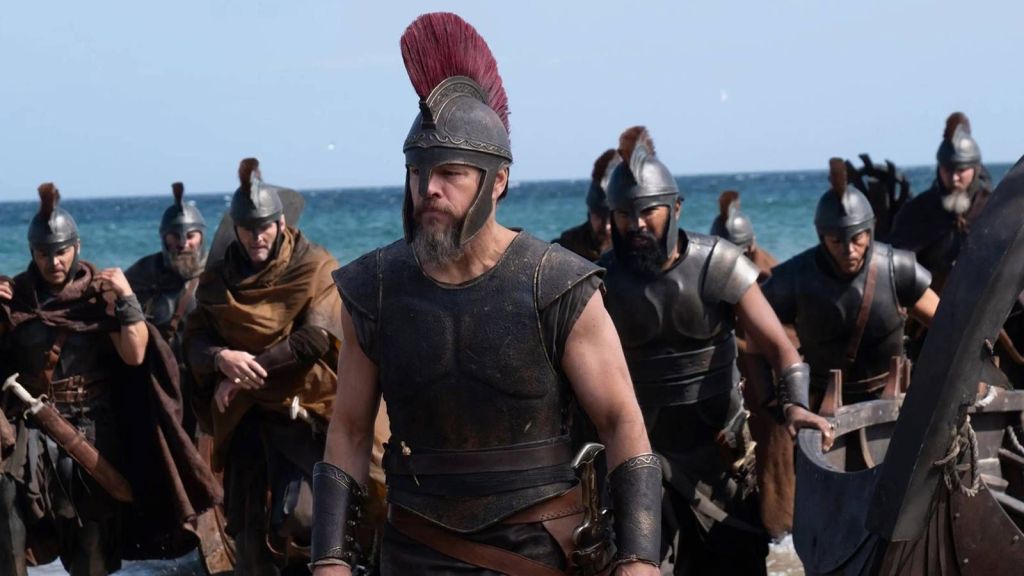
The same goes for Sir Gawain and The Green knight in English literature written in Middle English, its quest motif so well mock-Gothicized by Robert Browning in Child Roland to the Dark Tower Came. Only privilege sugars the pill of travel, and enables it to be honoured as quest in the Middle Ages and a Childe Harold’s Pilgrimage in the early nineteenth century. And, if they made hard work of their journeys, we’ll it was a penance on them to know the human condition better than most, for good and ill. Byron even made it the proof of his selection to the elite because he suffered as poets must. The lower classes had neither the tesources nor education to pursue knowledge because they were excluded from it.
That said, my husband and I both chose to travel routes in Ireland in pursuit of not only settings but the themes of books by Colm Tóibín. Out from Belfast to Enniscorthy, the writer’s birthplace and model of small town Ireland in Brooklyn and Long Island, although we travelled before those books existed. But Eamon Redmond in The Heather Blazing was born there and we searched the sea coast to see the houses falling into the sea from tjat novel . They are mainly now fallen rather than falling as some are already fallen in the novel. But we went further down the coast road to Wexford and saw Blackwater. where a family is tested by the care of a son with AIDS at the time it was a death sentence in The Blackwater Lightship.
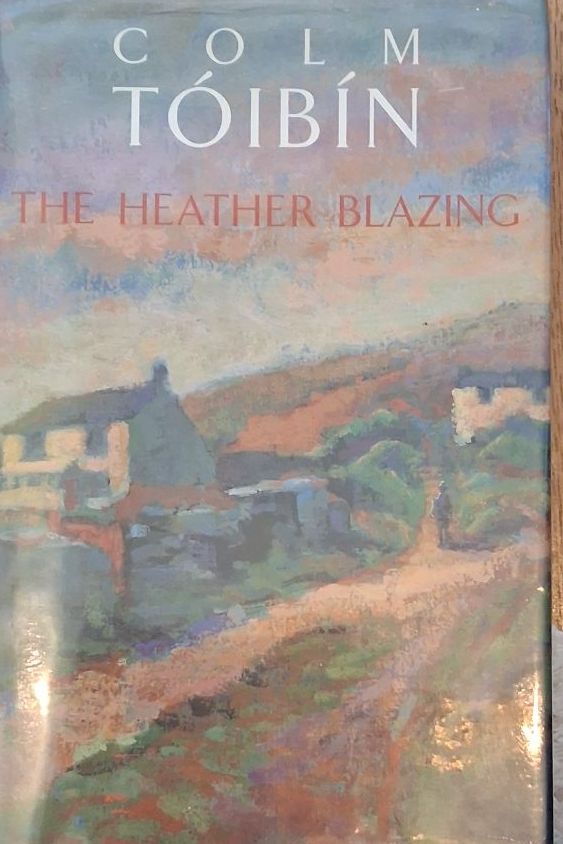
But was that ‘travel’, for what breathed like in it was a paragraph like this from The Heather Blazing [page 157 of the first hardback edition] describing light and dark from Eamon’s coastal home, outside and inside. It is about a destination you have to work harder to find than travelling by Irish ferry and car, and going deep inside where ‘light’ is knowledge but still unarticulatable, and darkness which is ‘everywhere outside’ is the common condition of what we see wherever we travel unless we strive for significance in life as Toibin’s character, Eamon does. This happens in bed one night with his wife, Carmel. after she has been sick, and perhaps is seriously ill. Carmel accuses him of not loving her nor his children any more and being distant in every sense:
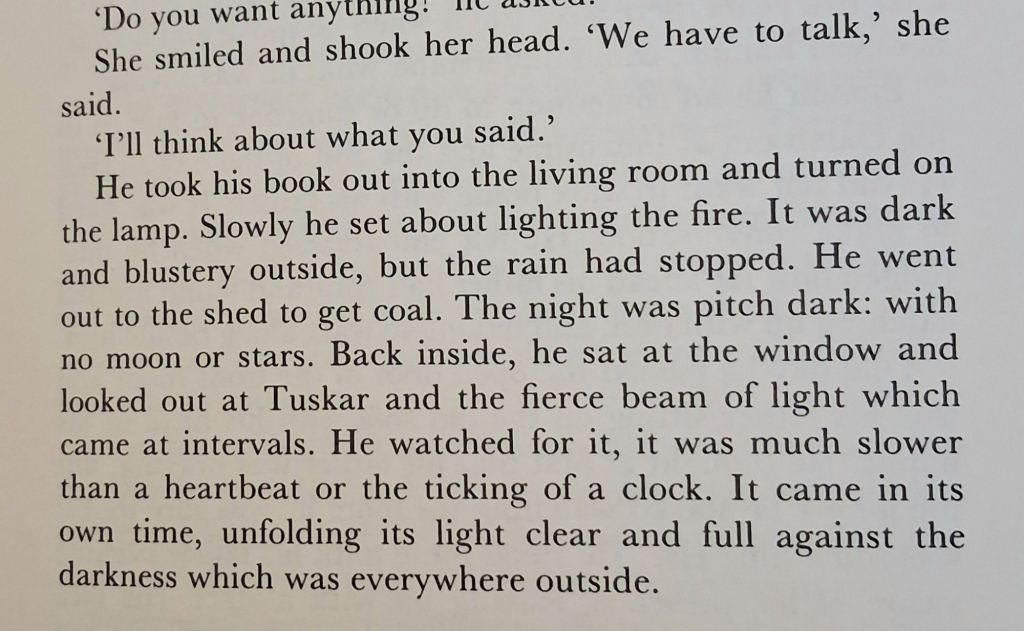
Though he says nothing and keeps his reserve, the battle of the knowledge of good and evil, so tied to mortality as Milton knew, goes in the interplay of intermittent light and spreading dark. Even to go there, you need to do the hard work and face uncertainties and yet, in Eamon’s case here, you need not move beyond bedroom and living room.
I loved seeing Tóibín’s settings, but did I see what ‘inspired’. Travelling to that place inside is a harder and much more uncertain one.
Bye for now
With love, Steven xxxxxxx

