


I promised myself to try to understand, not blame. It’s an impossible promise if applied solely to your relationships with those who fly into and out of your life. Practice it then with the characters of those in public art. Why not start with Odysseus? This blog responds to Christopher Nolan’s ‘The Odyssey (seen at 1.45 p.m. at Reel Cinema, Bishop Auckland)’.
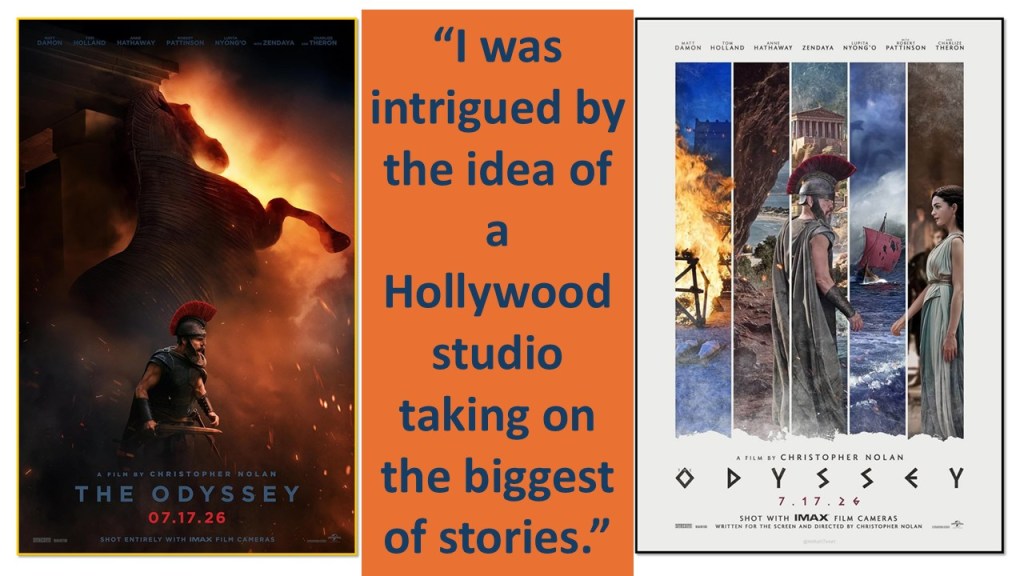
“I was intrigued by the idea of a Hollywood studio taking on the biggest of stories”, said Chropher Nolan apparently. I don’t know where he said it but Emily Hauser, feminist classical historian, quotes it on her classicist’s take on Nolan’s in The Guardian. Unsurprisingly, Hauser finds Nolan’s version as at base a modern crowd pleaser:
For audiences who are looking for a box-office smash with stunning visual action, epic proportions and a hero at the heart of it all, they will get it. Every reworking of Homer says what it wants to the people it is speaking to. [1]
This is not quite a cogent statement, as so often in judgements that blame a revision of a figure emerging from a long tradition of retelling and reinterpretations mainly by individual scholars on aspects of modern mass audiences that they dislike and who ‘want’ the wrong things, like over-simplified heroes. Nevertheless, that last sentence gets tied up in its rather embarassed elitism that makes sure that the ‘fit audience, though few, including feminisst classicists, are not included in the simplistic moderns who like their art stunning and their heroes uncomplicated.
To be fair, Hauser wants it both ways. Nolan wants, I think she suggests, a hero whose journey into a liberal distaste for imperialist wars in which he has taken large part himself, is straightforward, and thus misses the slippery character we see, she insists, that Odysseus actually is:
Because, yes, the Homeric epic is about Odysseus, and it’s about his journey home; it’s got gods and monsters, a father-fixated teenage son, Telemachus (Tom Holland), and a loyal wife, Penelope (Anne Hathaway). But it also has an Odysseus who … isn’t a straightforwardly moral modern leader, but who makes choices that are vexed and troubling and often unclear. That’s true for many of Homer’s other characters, too – including the women. … Penelope, in Homer’s epic, ready to admit that the beggar who has wandered into her household and executed most of the local nobility is actually her husband. Where is the challenge we see in Homer to whether she really wants him home or not? [1]
However, to pretend that any modern interpretation of any of the figures mentioned ed gets us near to a rounded character, or to feminist motivation in Penelope is a mistake. Such interpretations rightly are rewriting of a text without the same motivating factors of the original. As for Penelope, Hauser has a point but to make it is better not to claiim that one, as a classical historian, reads Homer better than the latest revision of the story into a version is to be misguided about the slipperiness of transhistorical meaning. To really articulate a meaning you want to see in Homer, it is more honest to write another version of him, as Margaret Atwood did in The Penelopiad, a revival of which I have just booked to see at the York Theatre Royal.
Even Simon Armitage, who has twice addressed the epic in dramas ( and The Iliad too once), in a 2006 BBC verse drama, Homer’s Odyssey and a play later, using some parys of the former, produced at the Liverpool Everyman Theatre, Missing, Presumed Dead, who has made a brilliant documentary on TV in wbich he followed Odysseus’s presumed route, even to the very physically located Hell, described to the hero by Circe, in order to dis over whether ‘he liked Odysseus’ as a character or not, makes versions of the art not assertions about the original based on modern theories of what a person is. Here is Armitage’s translation From Homer’s openimg from Homer’s Odyssey.
Muse, daughter of Memory and Zeus
Where to start this story is yours to choose.
Now, any reading is a matter of memory, and memory interprets even, but not only, past events to fit present conceptions (we know that as a scienfically supported hypothesis) but Zeus here represents something other than memory; a poqerful creative principle that tends to get what it wants. Moreover, the Muse of Armitage or Atwood is not Homer’s but neither is it any different for scholars who pretend to objectivity about Homer. Hauser may have intended to say that very thing, tbough she also wants to show her distaste for non-feminist modernity.
And yet, the film indisyry has been responsible much more for promulgating influentual images of women that have been and still are damaging to women attempting to live authentic lives of their own. In the case of films wherein women with power, potential and real, appear, female possession of power is too often intrpreted negatively, as if capacity to contral were a dangerous thing thing in the hands of women. Thus, Circe, Calypso, and Helen. At other times their lack of an equivalence to male power in the terms of the age in which they were conceived, they can also be also seen as dangerous. Thus Penelope.
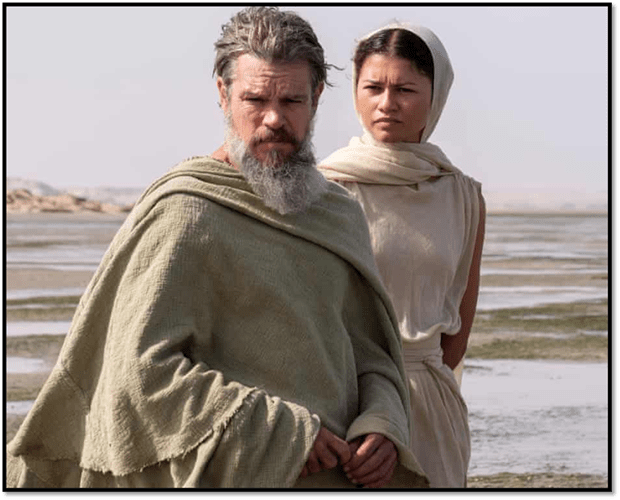
Matt Damon as the world-worn Odysseus with Wendy’s playing an Athena so femi used and pleading that tje androgyny usually associated with this pattriarchal God, born solely out of the head of Zeus, is lost for good or ill. You decide?
How this film handles the character of women holding power is not a matter of rejoicibg. As Hauser says women are seen as motivated mainly by their own interests, but Circe, at least, does not hold Odysseus up from his goals and the reasons why she sees men as a small is clearly stated. But a debate can be had about all these poqerful women powerfully cast. It is the latter fact that leads to oversimplified representation often determined as much by costume design and make up departments, as if these factors had to be treated differently in female than male actors. This is obviously the case on premiere nights but Anne Hathaway and Charlize Theron also plays Penelope and Calypso that not only show the grandeur of the Queens they represent but also their primary sex appeal to men.
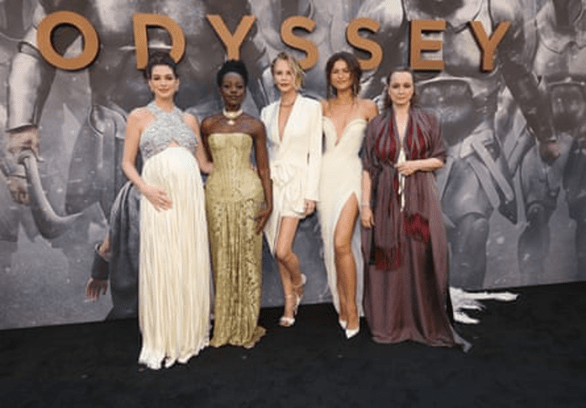
Anne Hathaway (Penelope), Lupita Nyong’o (Helen & Clytemnestra), Charlize Theron (Calypso), Zendaya (Athena), and Samantha Morton (Circe) attend the film’s New York premiere. Photograph: Kevin Mazur/Getty Images for Universal Pictures
Of course the film also has some fairly sexy men in it, if armoured to the gills so often their bodies of flesh are entirely invisible and replaced by armour. Their primary role as bearers of authority means they are allowed to bear their age as if it equated with greater power, if only in wisdom sometimes, rather than lesser. The critics who laud the film, all men in what I have read, emphasise themes most often associated with misery men in discourse, if not in truth; PTSD being non-binary in terms of more than male and female. We know, for instance, in Peter Bradshaw’s review in The Guardian that what is meant by PTSD is that version mainly represented in male war-veterans. But that is a real.enough thing and suffices to describe the way I think Odysseus’s story is used in Nolan’s film. What Bradshaw says is that the film:
speaks to the generational pain of PTSD; plenty of soldiers come home in person after any war promptly enough, but arriving back to their prewar state emotionally or spiritually can take years or decades and may never happen at all. The invisible odyssey of anguish is punctuated by flashback episodes, hallucinations, confrontations with the arbitrary gods of dysfunction. And all the time the spouses and children cannot move on with their lives. [2]
In effect, Bradshaw asserts that the film’s serial sea-adventures and island stays are a kind of allegory of mental disassociation and hallucinogenic horror that is the lot of a soldier, particularly I’d he begins to query the whole link between masculinity and the heroic mode of being that is all resilience and fight, with no need of the gentler pleasures. That resilience and fight also applies to a life of sexual affairs that are fed by fantasy, although only Calypso represents this in Nan’s film, Circe being too man-weary here to seduce him as Homer has her do.
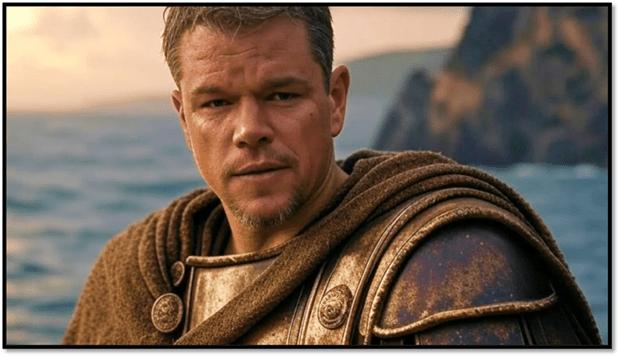
And as a film about masculine fantasy, it works. Matt Damon has the ability to be man and boy in his look to camera, both hardened and softened as need be:
And this variation does not always follow male stereotypes so often seen in movies and presumably liked by audiences, such as that promised in some of the film’s publicity, including that below showing the bloody killing in Troy, engineered by Odysseus’s scheming and deception, as a backdrop – for the Wooden Horse deception was his idea. The tramping war horse devised for the film as its version of the Wooden Horse is set against the background of a Troy in flames with a steel-plated and plumed-in-blood-red soldier, sword drawn in front of it, seems to promise mostly a film of fantasy hard men stuff.
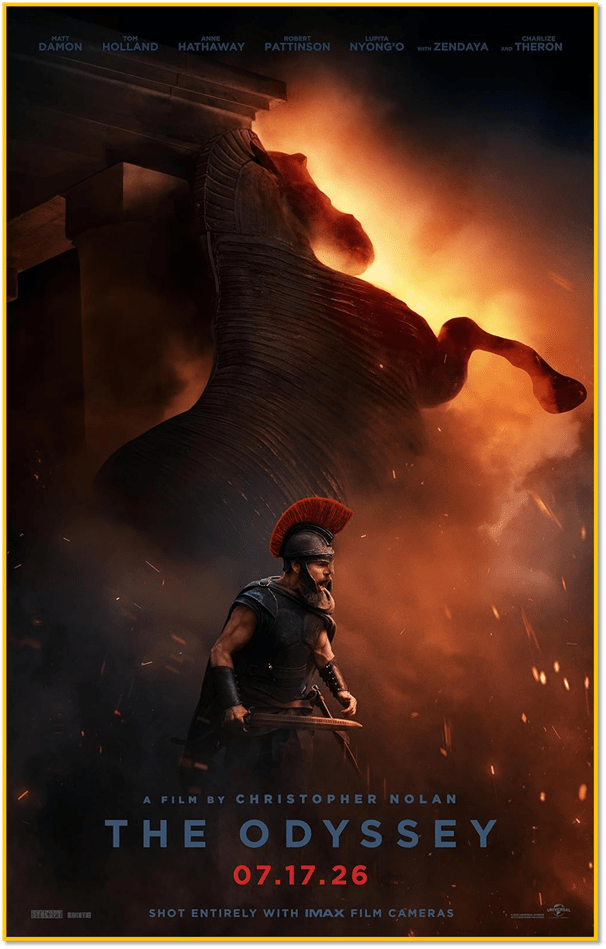
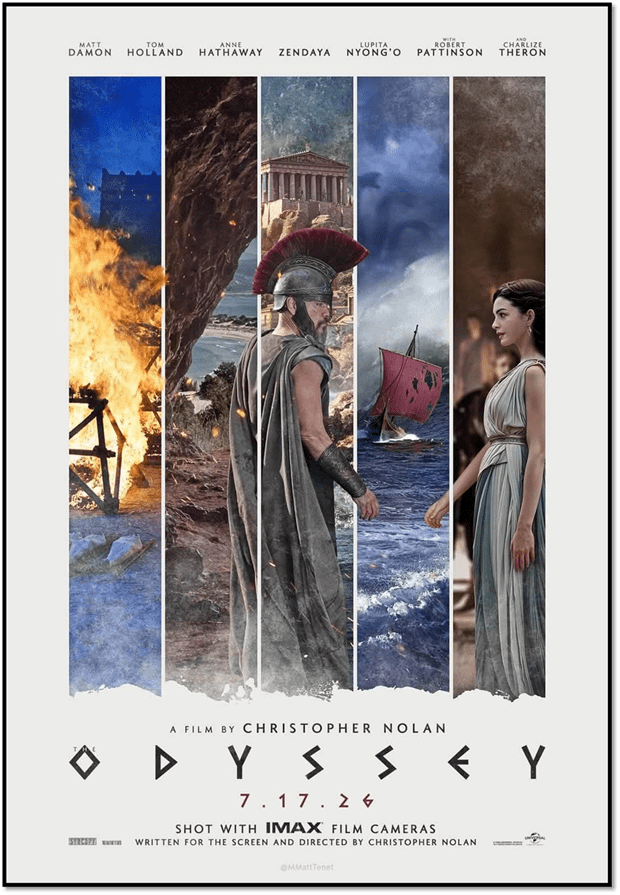
Otherwise the publicity goes for the safest of soft romance options around heterosexual marriage, that also is not quite catered for in the film as such, tbough the poster is a stroke of genius to sell such a fantasy, combining, as it does, serial strips with fantasy war, adventure and romance journeys appearing graphically on rhem, with an imposed alpha male in armour, Oddysseus, and a woman facing him but separated from him by barriers which nevertbeless, their hands transgress, without actually touching each other.
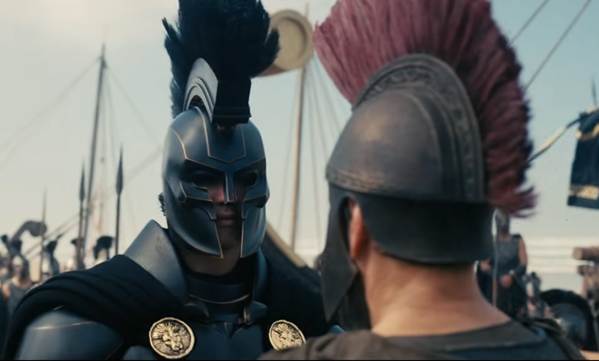
But this soft soap the film does not provide either. As far as fighting man confronts fighting man goes, that theme is taken up in encounters between Odysseus, his back to us below, and a version of King Agamemnon, whose mask makes a passable Darth Vader of him, even in voice, enacting a version of payriarchal command that draws fighting males tto him in following and imitation.
But the drift of the story, picked up in piecemeal as it is, is that Odysseus learns the model of command, including aggressive warfare to command trade routes like the Dardanelles over which Troy shone its golden and trade rich wealth and guarded with impregnably strong defences and attack strategies. Perhaps that the most stunning picture still of the film is of Agamemnon, now red plumed, but with the telling tail of golden vertebrae from his helmet is seen from.behind as he watches the devastation caused by war. The whole point of the shot is that we feel the nuance of Odysseus as a follower of Agamemnon, and remember the force of his decision, that his war craft will not follow Agammemnon on the way to their respective homes: ‘I have given up following Agamemnon’ is the strong line spoken, or something like it.
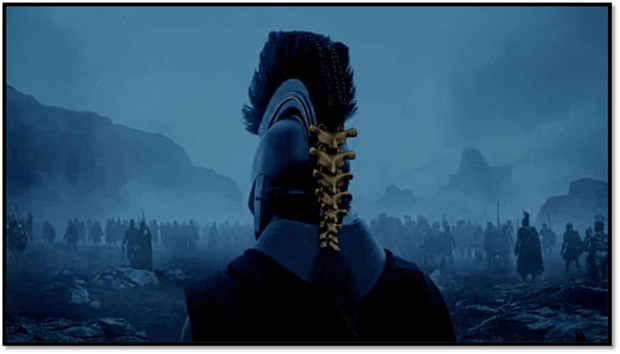
Matt Daman, as Odysseus, decides to sail his ship on another course than that of the fleet commander and overall general, the Argive King Agamemnon: “I am not following Agamemnon any more” – yet he takes his advice about how to return to your homeland and your wife, once Agamemnon’s dead and returned from the Underworld. … still from The Odyssey. Photograph: Collection Christophel/Alamy
But not to follow the authorised models of what things should be is a dangerous venture, as dangerous as choosing untried routes home, akin to questioning the status quo and often the natural order. Just as Homer’s The Odyssey is a strange sequel, if we are allowed to say it thus, wherein all that happens is a queer vision of different kinds of hospitality received or offered. The very air of the film is about the nature of homes and what makes it necessary for them to be treated with respect. Is that because the fall of Troy is achieved by men who win an invite inside the city home of the Trojans, only to destroy them in scenes deliberately meant to recall genocide in which a culture and its people must die:

That this is a betrayal is shown by how consistently in the wooden horse dupe, Odysseus betrays those he ought to care for. Bradshaw refers to Sinon in this respect, linking the dishonour against friends to the fact the horse gains its invite by pretence of being a gift to the Trojans, one authorised by the Gods:
It’s a trick that involves Odysseus having to deceive his own comrade and cousin Sinon (Elliot Page), a blood sacrifice for which he feels unending guilt. Nolan recreates the Trojan horse as a cross between the Statue of Liberty from Planet of the Apes and Shelley’s statue of Ozymandias.
I so rarely agree with Bradshaw I want to celebrate doing so here, his description of the Horse form the film uses being superbly linked to scenes of the fall of civilization in another film, namely The Planet of the Apes, and in Shelley’s iconic poem. The scene in this film feels, like those hymns to lost civilizations too, killed by their own hubris, but in this case by deception alone.
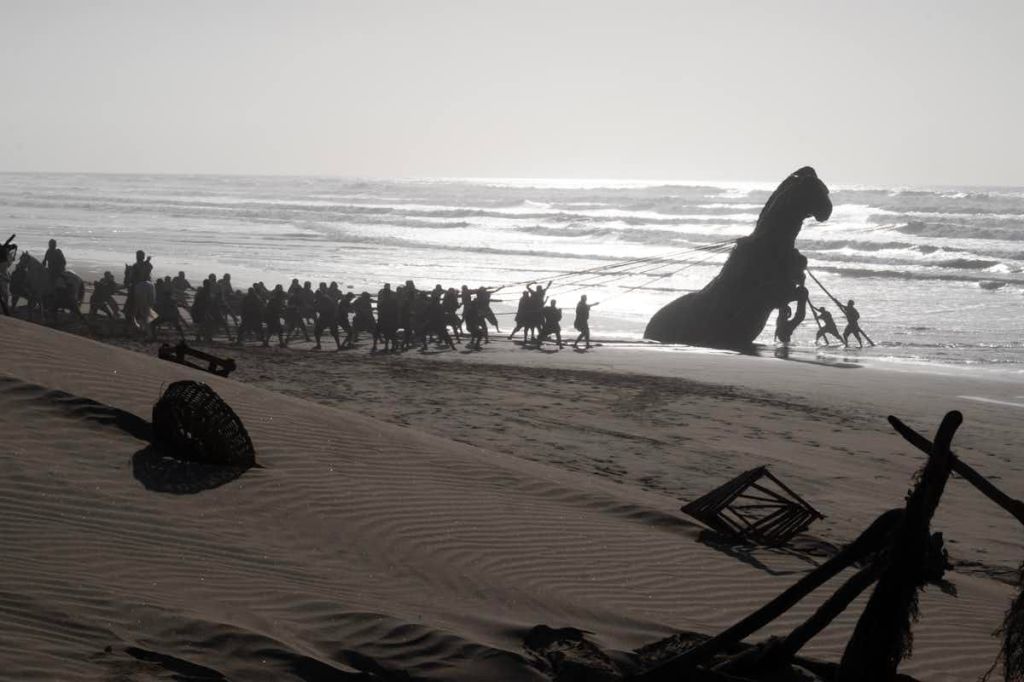
In truth Hauser admits to the same ‘complexity’ found in the character of Oddysseus by Nolan as well as Home, although she clearly finds this ‘complexity’ a much more simplified one than that in Homer, but isn’t that because it is, despite having the same title they are not only different works of art but address questions about how and where human nature need to find models that work for their age. Here is what she says:
Nolan’s Odysseus (played by Matt Damon) makes gestures to complexity too, but here is a modern-day Hollywood hero who learns remorse for the atrocities he commits and spends much of his time trying to excuse having lost all his men, and retrospectively (with a final journey, not in Homer, to pay homage to them) earning their forgiveness. … / There’s another layer that Nolan adds: his Odysseus is riddled with trauma and guilt, not only for the deaths of his men, but for the death and destruction (and, at one brief point, the assault on women) he caused in Troy.
I have no doubt that ‘trauma’ and ‘guilt’ matter for our age, as much as did the need to keep a close eye on the nature of power held by a few for the Archaic Greeks, and it is even stronger in our age for a film-maker to take an ancient civilization’s hospitality laws and regulations as theme. Homer clearly uses Polyphemus the Cyclops to show the extreme case of what a narcissistic self-interest in eating and sleeping and that alone does to the worth of a civilization’s values, degrading everything of meaning in a home into a mere defensive place to sleep and eat. In the film, unlike Homer, Or Euripides who riffed on Homer’s theme too some three hundred, at least, years earlier in his Satyr play Cyclops. Compare, for instance, Armitage’s version of Homer, where, after Odysseus asks for Polyphemus’s hospitality as a value held highly by God, Armitage has the Cyclops say:
Cyclops farts in Gods' faces, cyclops pisses on God's feet.
Cyclops does whatever Cyclops please.
Whilst Euripides has (in translation);
The earth perforce, whether she like it or not, produces grass and fattens my flocks, which I sacrifice to no one save myself and this belly, the greatest of deities; but to the gods, not I! For surely to eat and drink one’s fill from day to day and give oneself no grief at all, this is the king of gods for your wise man, but lawgivers go hang, chequering, as they do, the life of man! And so I will not cease from indulging myself by devouring thee; and thou shalt receive this stranger’s gift, that I may be free of blame,-fire and my father’s element yonder, and a cauldron to hold thy flesh and boil it nicely in collops. So in with you, that ye may feast me well, standing round the altar to honour the cavern’s god.
In Nolan, the Ithacan sailors only discover that the Cyclops has language after they have blinded him, and when they say they might have reasoned with him had they known, Odysseus says things have gone too far for that now. But nevertheless what occurs to the Cyclops is a crude reduction to what happened to the Trojans and will happen at every queer home, the saiors and Odysseus come upon hereafter:
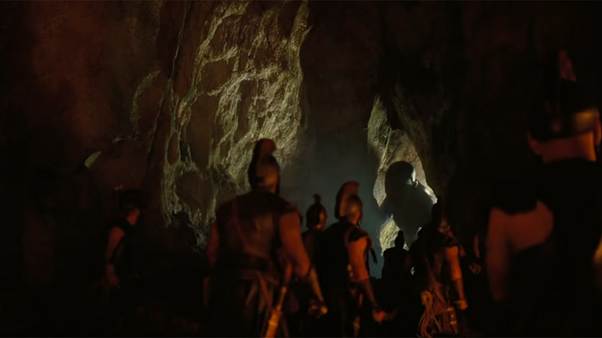
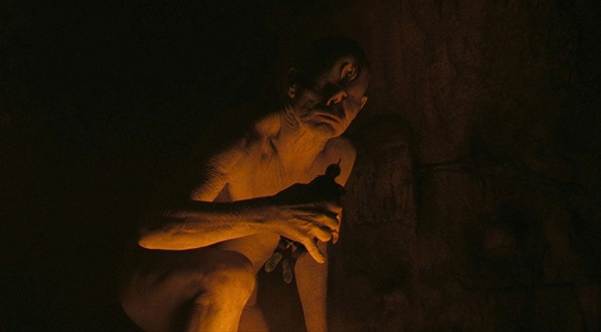
Nolan’s Cyclops eats his guests and locks them in his secure sleeping space.
At home where wife and son await the hero, hospitality has been abused by those seeking it, the suitors, and Odysseus’ family can only continue to give and resent their giving, finding means to plot against the suitors only when out of the home fortress:
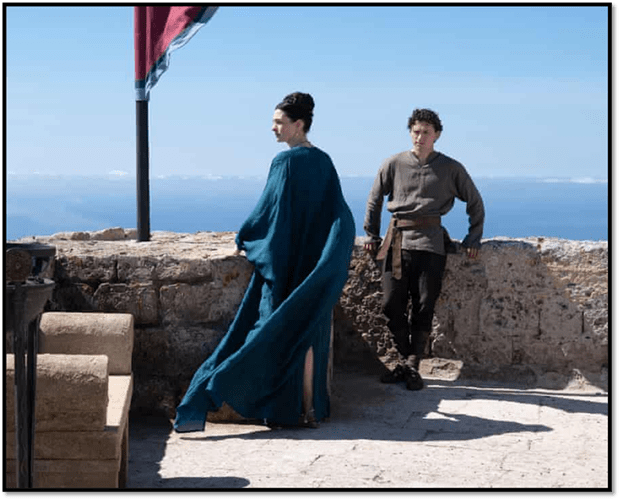
Anne Hathaway as Penelope and Tom Holland as Telemachus in Christopher Nolan’s Odyssey. Photograph: Melinda Sue Gordon/Universal Pictures
Antinous (Robert Pattinson), the chief suitor’s nastiness is proven mainly by his behaviour not to Odysseus’s wife, to whom he pretends courtly behaviour, but the weak son, the weaker blind servant Mentes, and that essential cast member, Odysseus’ hunting dog. I see no reference to this dog in the reviews but his fate broke my heart. We find him first as a puppy as his siblings are being cast over a cliff by the young prince Odysseus’ father, until the boy asks for this one to be saved. Old after his master’s long delay in coming home, Mentes tries to care for him but Antinous enforces his disposal, he now smelling aged, to live disabled on the dung heap at the door of the palace – where he dies after one tail-wag on his master’s return home. This too makes this a masterly modern masculine fantasy film.
Adding the dog is another justification for downgrading the marriage-bed as the most famous icon at the end of the story. Hauser says this of the omission:
In Homer but not in Nolan, Penelope proffers a test of her own (the famous bed–test) before she lets her guard down, not only showing herself a match for her cunning, complex husband but demanding that the recognition between them goes two ways: that if he forces her to recognise him, then she will make him recognise her. And it’s the sum of examples like these, I think, that shows where Nolan’s film makes its departure – in the focus that is placed on Odysseus’s turmoil, his trauma, his inner voyage as a leader, and the way that ends up taking the air out of other stories.
In Nolan, it is the old dog’s recognition that matters most – not some great tree which Odysseus himself fashioned into an unmovable bed for himself and his wife, carved into the rooted living tree. Home means something like that in that most famous of Homer’s symbols – now it’s the family et, the most alienating thing in modern masculinity being that point where modern man says: ‘even my own dog doesn’t love/recognise me’. The verbs mean the same in modernity. But I think Hauser is wrong to want symbols of this sort in modern epics, even those hat repeat an old story.
I think it a good film. Decide for yourself. As for judging the character of Odysseus. Practice not blaming him for shallowness compared to deep models of the human from the past. If we stop blaming and understand more, we learn that blaming a shallow person or values for being what they are is a waste of time, and probably is an error – for persons sometime prefer appearing shallow to sharing what is deep without total trust. Better to understand and love what you can, even when the proven shallowness of another moves then on from your demands, or so it seems (you will never know). Be responsible for yourself and the love of others that endures – which you can’t demand, possess or hold but only witness as it endures if it does. When it does, it is a blessing, as with my husband of now fifty years. xxx

With love
Steven xxxxxxxxxxx
___________________
[1] Dr Emily Hauser (2026) ‘A classicist’s verdict on Nolan’s Odyssey: a soulful hero flatters our times as women and nuance pushed overboard’ in The Guardian (July 15 2026) available at: https://www.theguardian.com/film/2026/jul/15/the-odyssey-christopher-nolan-classicists-verdict
[2] Peter Bradshaw (2026) ‘Doing full justice to the Homeric legend, Christopher Nolan amasses an epic cast to convey the true cost of war with film-making of thrilling ambition’ in The Guardian (Wed 15 Jul 2026 17.00 BST, Last modified on Fri 17 Jul 2026 17.37 BST) available at: https://www.theguardian.com/film/2026/jul/15/the-odyssey-review-christopher-nolan-matt-damon


2 thoughts on “I promised myself to try to understand, not blame. It’s an impossible promise if applied solely to your relationships with those who fly into and out of your life. Practice it then with the characters of those in public art. Why not start with Odysseus? This blog responds to Christopher Nolan ‘The Odyssey ‘.”