

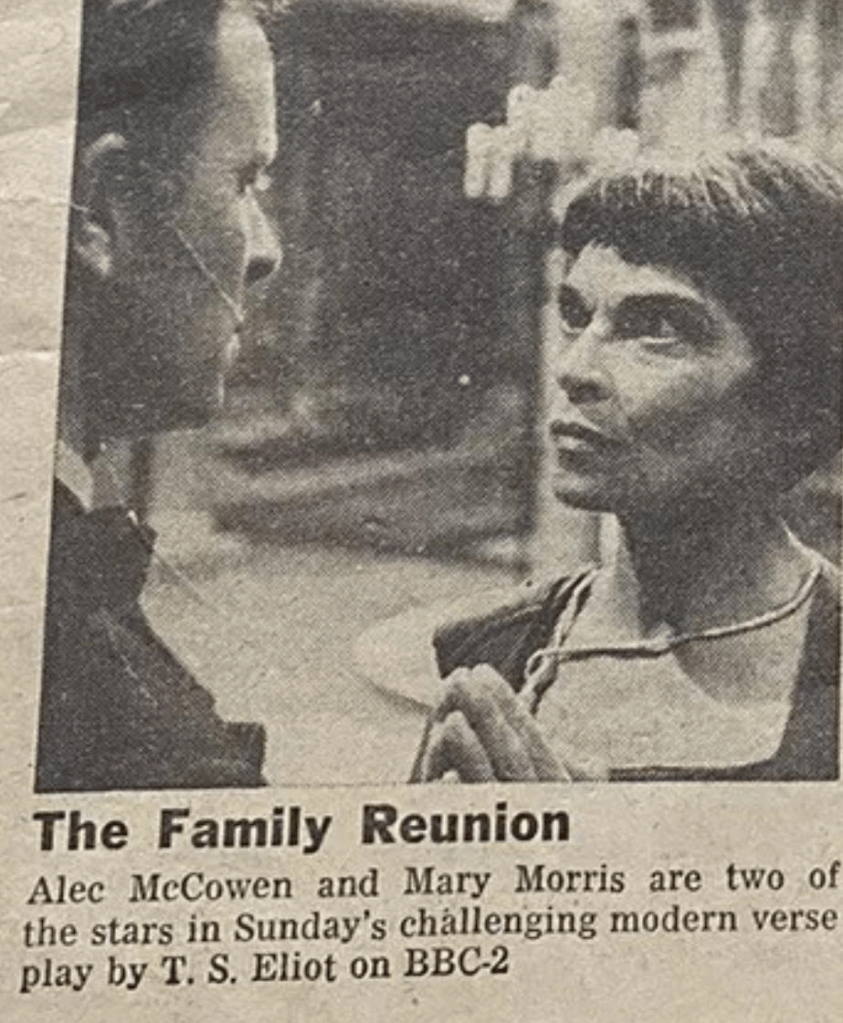
I was reading T.S. Eliot’s The Family Reunion, which is, I have to admit, a tedious bore to read and which I only took up as an example of a play based on the idea of The Oresteia by Aeschylus. The basis of comparison is very loose. It takes up the Oresteia late in the sequence of the trilogy, Harry – the current owner by inheritance, an inheritance (including the family home of Wishwood) he resists taking up as much as Orestes does that of Agamemnon, after the latter’s murder by his mother Clytemnestra. Yet he is also returning home, after the death of his wife who had fallen (or was she pushed – and more precisely was she pushed by Harry?). He is at the play’s start to arrive on the evening of Amy’s birthday. He may not arrive by the start of dinner and the rest of the family are to start without him. But, in the event, he gets home early.
Well, here I am ready to dine with the family, though I dread it. I will wait in the ancient herb garden where the smell of thyme mixes with smells I do not know – except for that of lavender. Lavender is such a strong smell – it reminds me of people trying to stop time in the evidence of moths that eat up everything that covers your nakedness. Meanwhile, inside, I think I am not expected. I see Amy, the Dowager Lady Monchensey, though she seems in so morbid a mood, whilst also being as imperious with her servants as ever.
Her man, Denham, comes to organise the room for the evening – light the lamps and make the shadows retreat that are crowding around Amy. This is how T.S. Eliot imagines her dealing with this intrusion, which she welcomes because it is a token of the fact that she still holds sway of power over her servants that she can display to her sisters who sit with her. She knows that she is the cause of everything they do on her command and they must never prejudge her wishes:
Amy
Not  yet!  I  will  ring  for  you.  It  is  still  quite  light.
I  have  nothing  to  do  but  watch  the  days  draw  out,
Now  that  I  sit  in  the  house  from  October  to  June,
And  the  swallow  comes  too  soon  and  the  spring  will  be  over
And  the  cuckoo  will  be  gone  before  I  am  out  again.
O  Sun,  that  was  once  so  warm,  O  Light  that  was  taken for  granted
When  I  was  young  and  strong,  and  sun  and  light  un-sought for
And  the  night  unfeared  and  the  day  expected
And  clocks  could  be  trusted,  tomorrow  assured
And  time  would  not  stop  in  the  dark!
Put  on  the  lights.  But  leave  the  curtains  undrawn.
Make  up  the  fire.  Will  the  spring  never  come?  I  am  cold.

Agatha
Wishwood  was  always  a  cold  place, Amy.
Having dinner with Amy is good but her sisters, even Agatha – the most interesting with a strong feel for the past importance of the family and the stately house they represent. But she is so literal! I can see Amy wince at the refusal of Agatha to see, or perhaps to acknowledge she sees though she in fact sees quite plainly, that the ‘cold’ that strikes Amy is that which continually chills her, when she imagines that, though her servants keep the rituals of time as she wishes and when she wishes, time is very much asserting its control over her with its intimations of mortality.
When the clocks stop for her, night might never turn to day nor the seasons cycle as they were wont. Indeed, the pace of time seems to have the strength she once had but now seeks from it in it in its warmth and light. Even the pace of her speech slows down time, or attempts that without succeeding, and even though the line, ‘I have nothing to do but watch the days draw out’ is one the slowest I have ever heard, it is only probably an effect of the preponderance of single syllable assonantal words,
The other sisters try to buck Amy up. They choose their subject unwisely – the thought of ‘wintering’ in the warmer South, just as during the Raj, English gentlemen wintered in the cooler North in India.
Ivy
I  have  always  told  Amy  she  should  go  south  in  the  winter.
Were  I  in  Amy's  position,  I  would  go  south  in  the  winter.
I  would  follow  the  sun,  not  wait  for  the  sun  to  come here.
I  would  go  south  in  the  winter,  if  I  could  afford  it,
Not  freeze,  as  I  do,  in  Bayswater,  by  a  gas-fire  counting shillings.

Violet

Go  south!  to  the  English  circulating  libraries,
To  the  military  widows  and  the  English  chaplains,
To  the  chilly  deck-chair  and  the  strong  cold  tea—
The  strong  cold  stewed  bad  Indian  tea.
I think Eliot gets the unashamedly ‘English’ Gerald, the brother of the deceased Lord Monchensey, to hint that Amy might rather prefer the superior service of the servants of the far South, he means India, to those of the cold English. He also gets the pain of the non-heirs, wasted boys and women reduced to a flat in Bayswater. But Amy is Queen of tbe English class system. Any hint that she lacks that kind of control rouses her ire and tsunamis her emotions beneath the veneer:
Amy
My  servants  are  perfectly  competent,  Gerald.
I  can  still  see  to  that.
The sisters and uncles start going on about the vulgarity of the younger generation, which rather upsets niece Mary, who leaves. The conversation does go on interminably. Somebody ought to change the subject! Gerald finds a way! Referring to the younger young men on the way to joint them: ‘That reminds me, Amy, / When are the boys all due to arrive? ‘ But Gerald just doesn’t get it. For Amy that brings Amy back to her old bugbear of the uncontrollable nature of time, and the losses against which every desire in her body is set. Hence, it takes her some time to answer Gerald’s question:
Amy

I  do  not  want  the  clock  to  stop  in  the  dark.
If  you  want  to  know  why  I  never  leave  Wishwood
That  is  the  reason.  I  keep  Wishwood  alive
To  keep  the  family  alive,  to  keep  them  together,
To  keep  me  alive,  and  I  live  to  keep  them.
You  none  of  you  understand  how  old  you  are
And  death  will  come  to  you  as  a  mild  surprise,
A  momentary  shudder  in  a  vacant  room.
Only  Agatha  seems  to  discover  some  meaning  in  death
Which  I  cannot  find.
—I  am  only  certain  of  Arthur  and  John,
Arthur  in  London,  John  in  Leicestershire:
They  should  both  be  here  in  good  time  for  dinner.
Harry  telephoned  to  me  from  Marseilles,
He  would  come  by  air  to  Paris,  and  so  to  London,
And  hoped  to  arrive  in  the  course  of  the  evening.
I am beginning to wonder if I no longer wish to have dinner with Amy, Dowager Lady Monchensey. Will she keep going on about how old I look and say, straight to my face: ‘death will come to you as a mild surprise, / A momentary shudder in a vacant room’? I am not sure I could cope with the doom and gloom – even as everyone is now beginning to think Amy is leaving it late to have her servants light the lamps.
But then I realise, it is not her gloom and fear of change that worries her, for there is that in her that thinks nothing ever changes, unless she allows it too – that her control may be as great over time, change and loss as over Denham and the other servants and professionals that visit – even that glum doctor who keeps hinting at the state of her heart. I see Agatha run straight into the trap, raising her belief that Harry, when he returns will find the changes to his childhood home hard to adapt to:
Agatha
....
Harry  must  often  have  remembered  Wishwood—
The  nursery  tea,  the  school  holiday,
The  daring  feats  on  the  old  pony,
And  thought  to  creep  back  through  the  little  door.
He  will  find  a  new  Wishwood.  Adaptation  is  hard.
Amy is having none of that. She snaps back at Agatha:
Amy
Nothing  is  changed,  Agatha,  at  Wishwood.
Everything  is  kept  as  it  was  when  he  left  it,
Except  the  old  pony,  and  the  mongrel  setter
Which  I  had  to  have  destroyed.
Nothing  has  been  changed.  I  have  seen  to  that.
Suddenly I remembered that at Wishwood dinner was only relieved by the way the ‘mongrel setter’ (I knew him as Ben) was the only person I liked when I visited last and then only saw him after dinner, slinking down the servant’s stairs. And besides it was dark in the herb garden now. Perhaps the ‘black bat, Night, has flown’. I think I’ll join Maud and go for dinner with Tennyson instead. By all accounts you can forget yourself dining with him:
Laden with flower and fruit, whereof they gave
 To each, but whoso did receive of them,
 And taste, to him the gushing of the wave
  Far far away did seem to mourn and rave
  On alien shores; and if his fellow spake,
  His voice was thin, as voices from the grave;
  And deep-asleep he seem'd, yet all awake,
  And music in his ears his beating heart did make.
Well that seems a night indeed, and not far from Wishwood is his home at Hazlemere.
with love
Steven xxxxxxxxxxxx

