


Superpower: the power to disallow others from having power over you ever again. In the end, it’s a paltry power but somehow it’s all we want and admire. A case study from seeing the Metropolitan Opera production of Tchaikovsky’s ‘Eugene Onegin’.
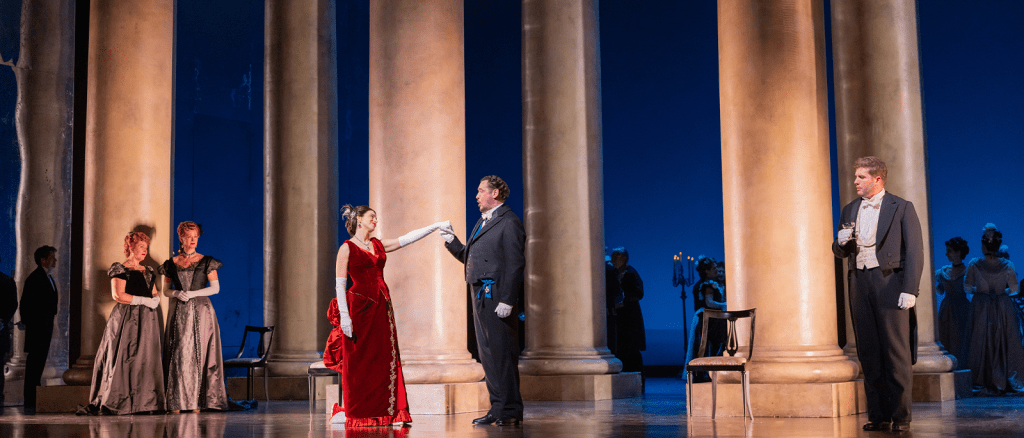
First of all, since I have twice blogged on preparations to see the present revival of Tchaikovsky’s Eugene Onegin (first on the ambivalence of Pushkin’s main character – at this link) – and second on the phenomenon of the folk diagnosis khandra – at this link) in the New York Metropolitan Opera’s version, let me say I was not disappointed. This was a production that excelled in its enactment of fine singing and superbly strong musical drama. Yes, I agree with the critics that the setting, especially of Act 1 Scenes 1 and 2 (even the staging of the otherwise extremely finely enacted scene dominated by the writing of Tatiana’s letter, is hard to justify, though more than made up for in Act 1 Scene 3, and all that follows, especially the final Act (Act 3) in which the power of St. Petersburg society speaks through the grandeur of the architectural columns (see above), holding up the whole facade of Western artifice on which Russian power was then modelled. They serve to hide things, such as Onegin’s chagrin at seeing Tatiana now dominating St. Petersburg society with her old, rich, and powerful husband, General Gremin, and making Eugene look marginalized and dominated by other men’s columns and power, no more the man that society looks towards.
Act 1 Scene 1 is very hard to stage no doubt, for Tchaikovsky insists on a chorus of serfs in folk and religious ritual of spring to shade the silliness of the gentry’s absorption in its petty dramas. This production rather de-pastoralises the whole thing, having a lusty peasant girl in red tossed above the heads of off-duty Cossacks to emphasise the strength of desire, but especially female desire in that part of the drama:
Peasant Girls: Pretty maidens, dear friends, come on out and play, girls! Let us be merry, my friends! Sing a favorite song, to lure a lad to our dance!
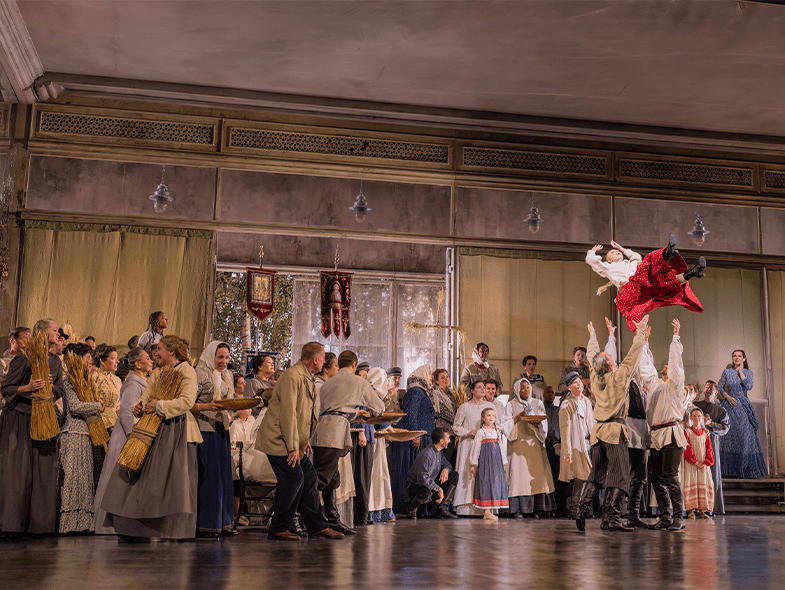
And seeing it streamed rather detracts from disappointment for, between the acts, the camera spans of the process of the stage’s management – the laying and rolling of carpets, the management of inside and outside scenes from a conservatory-like structure, placing of fallen trees and casting about of fake snow and fallen leaves to show the cruelty of winter in the duel scene. Moreover, the pantomime of the villagers at fun apart in Act 1 Scene 1, the simplicity of the sets focuses us on the brilliantly handled interchanges between the characters. And there was not a poor performer or singer amongst them, not even a disappointing one. Here is the cast as presented by the Opera’s website:
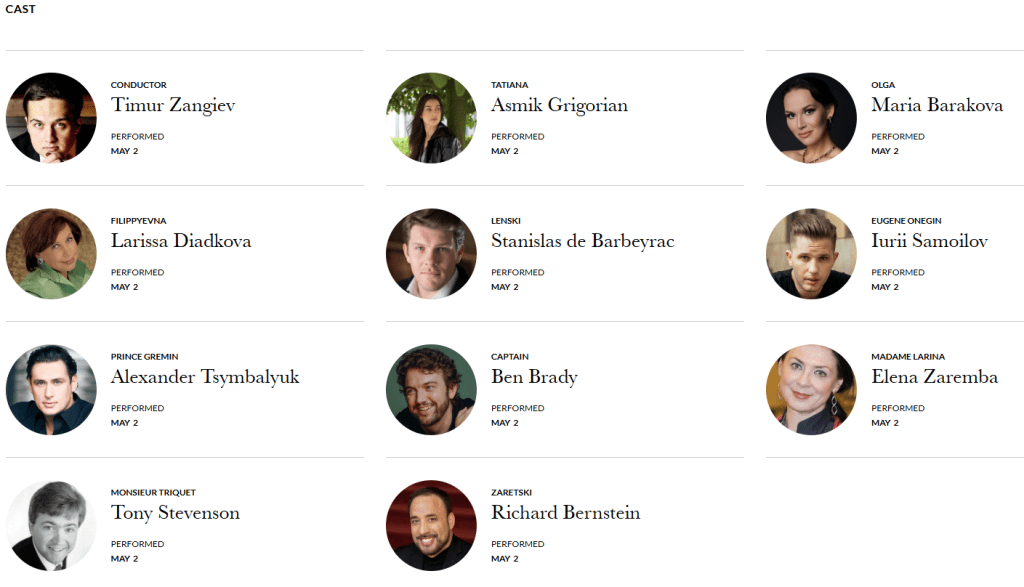
Gremin was wonderful in his moment of capture of the fact, in his set piece aria in Act 3 Scene 1, that older men love as seriously, if not more so, than young ones. Tony Stevenson was a brilliant lame Monsieur Triquet, hobbling about the stage, getting his object to support his bad leg as he sang her his appalling name-day verses. The older women, Filiippyevna and Madame Larina brilliantly sang of how submission to limited power and habit was preferable to ‘happiness’, except for serfs perhaps, a fine foil to the rather shady moral point of the opera that emphasises that habit even preserves women of exceptional power provided they learn to love the cage it puts them (so beautifully) in, as I think Tatiana does.
What this wonderful production focused upon in its character studies was hardly even near to any of the issues I prepared myself for in the preparatory blogs mentioned above. It seems to me now relevant to this prompt question: a case study of why and how people seek a ‘superpower’, a means not only of optimising personal power but demonstrably using it to show how high one can stand up over other people, even if it means putting up with less than what you actually desire. I have to say moreover that in the production I saw little of the queerness of the poem – even the relationship of Onegin and Lenski is very downplayed although Onegin’s grief at and embrace of Lenski’s body after he shoots him, is very moving.Instead, what I imagine to be the focus of the opera now is its concentration on the pain of rejection.
Even the subplot is a story of how not to deal with rejection, deliberately setting off the response of a naive man to imagined belittlement by those he believed in. Stanislas di Barbeyrac plays Lenski as Pushkin too might have imagined him – a man who refuses to grow up and uses the role of a poet to perform that act. Sillily in love, the still below shows how well the mise-en-scene can work in the production. Lenski chooses his lover well, Olga (Maria Barakova is just perfect in the role) for she is wilful and rather empty-headed but never seriously selfish. We see that she likes a good time, likes to dance with whomever catches her eye but that she does, as much as she is capable, love Lenski, whilst he is besotted in a way, that when he misses out of a moment of her time, he turns to childlike and vane dislike of those who hurt his amour propre. Below he has silly schoolboy eyes only for Olga, not even seeing the twisted branches and their dark shadows behind her. Not that that symbol represents Olga – she is too light for such weight – but they do represent the web Lenski’s supposedly loving eyes trap her within.
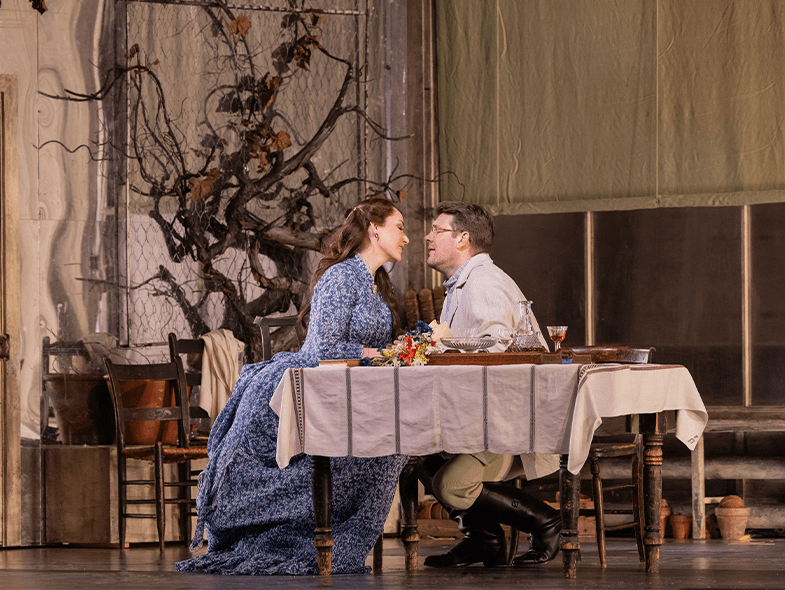
Lenski is very soon turned, as Olga shows she rather likes dancing with the more attractive Onegin and dislikes the possessive claims Lenski makes that she dance only with him, his ‘love’ turns quickly to murderous hatred of the woman and the male friend who has, he believes, ‘betrayed’ him.Some people are like that when rejected – the issue is complicated precisely because Lenski feels as betrayed by male love as female, seeing in the pair the betrayal of his childhood dreams by adult realities – love of power in the moment, or for longer, enjoyed by Olga because she likes a good time, by Onegin because he likes demonstrating he has power over everyone – its his superpower.
However, the key issue of the opera is rejection in one-sided relationships where one person holds all the cards, played out in the light where power interacts with sex/gender conventional hierarchies. The finest moment of Act One is a rejection of love offered to a man. I wonder if this strikes me partly because I believe that Tchaikovsky’s composes here what he felt like rejected by men who had power over him – socially or merely because of his love of them – and who let him down lightly without exposing his love to social ridicule, as Onegin does by returning Tatiana’s ill-judged letter to her, written in the passionate frenzy of one night and exposing herself. In Act One Scene 3, Onegin pities Tatiana whilst showing he likes her, even perhaps offers her the second prize of illicit sex, if this is what his shifty sung words below mean, providing she does not insist on marriage:
Judge for yourself what a thorny bed of roses Hymen would be preparing for us, and, perhaps to last for a long time! But one cannot return to dreams and youth; I cannot renew my soul! I love you with a brother’s love, or, perhaps, even more strongly!
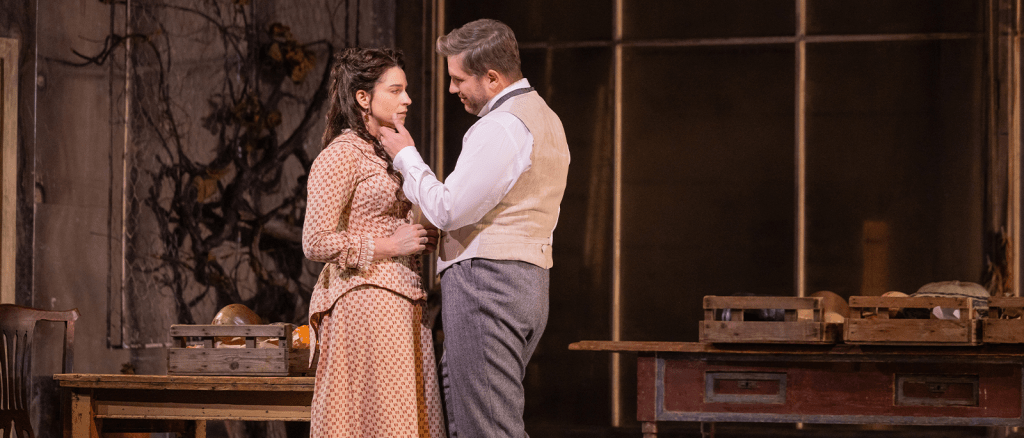
There is no sign in the opera that Tatiana recognizes Onegin’s offer of sex under the cover of a ‘brother’s love’ that is love ‘perhaps, even more strongly’ if she gives up the request for Hymen and the life of married habits but surely it is there, just not playing its hand so openly. Instead, we get the brilliant exchange visible even in the still below. The actors portrayed here know each other of old, the brilliant Asmik Gregorian playing Tatiana reveal;s in an interview in the screening, and here is a pas de deux of acting with nuance. Onegin plays on his power of the moment, of a man with money and status looking down, perhaps lovingly but certainly with ‘kind’ patronage on a woman dependent on a husband for status in society, chooking her chin and then leaning in to give a kiss – indicating his sexual liking but masked (if sex is out of the question) as a goodbye. It is moment in which social and sexual power, based on how social power relations construct sex-gender power differentials. Behind Tatiana is that same twisted dead tree with its shadows here more ominous for Tatiana than her sister with Lenski. All Tatiana can do is look as neutral as possible whilst allowing her eyes to speak of the pain of a rejection she must accept and not fight, for neither she, nor any woman in her position has that power
The end of the opera so astonishes because the scene is paralleled in Act 3 Scene 2, where , in this production, Tatiana uses the power a rich socially consequential marriage to a General of the Imperial Army gives her to reject Onegin and leave him to collapse against a pillar (the phallus of Gremin perhaps validated by imperial St. Petersburg and its Tsar) and slip down it to the base level of an alienated son of the minor gentry. Tatiana performs the rejection with a kiss that shows her sexual power but does not compromise her superior social power over Onegin. She makes it clear how conscious this is by positing that, though he treated her well in the process of rejecting her, now he implores her love because perhaps he knows that winning her would take away all the power she now has and worse, turn society against her as the adulteress who shames her noble husband.
The scene is played with aplomb. Both lovers lose the chance of love but Tatiana has demonstrated her ‘superpower’, exemplified in the need, often portrayed in society (in fiction and reality) to get revenge that parallels the circumstances of a former rejection (but much more skillfully than the silly Lenski), and, more importantly, in a manner that enacts disparity of power in one’s own favour now. For in Act 3 an otherwise vulnerable woman previously, now definitively has the upper hand. Only very great actor-singers can handle this and, in a cast of magnificent equals, the handling of the roles of Tatiana and Onegin stand out. Nevertheless, I still wonder if Tchaikovsky takes revenge here on men who treated his professions of love with grace, revealing nothing and not exposing him, but nevertheless firmly rejecting him.
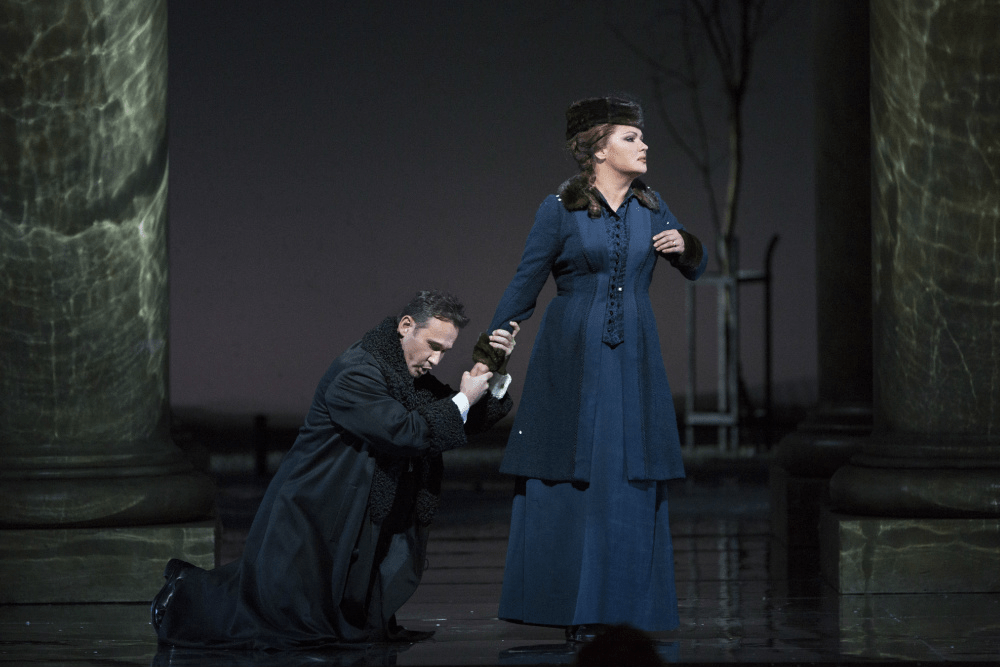
The actors of the Metropolitan Opera version are different because this is from an earlier production.
It is a paltry thing getting revenge, but maybe in our smallest of moral minds, it is what we wish for a superpower to be able to do – to get our own back, in imagination and art if not reality, on power structures and their representative enacters as decisively as possible. I hope I am better than this, but have my doubts. What of you?
With love
Steven xxxxxxxx

