The joys of getting in first: literary research and its purpose. More information turns up in the recent issue of Gay & Lesbian Revue on James Baldwin and the direction of the play ‘Düşenin Dostu’ (‘Friend of the Fallen’ in English), the Turkish version of John Herbert’s ‘Fortune and Men’s Eyes’ played in Istanbul.
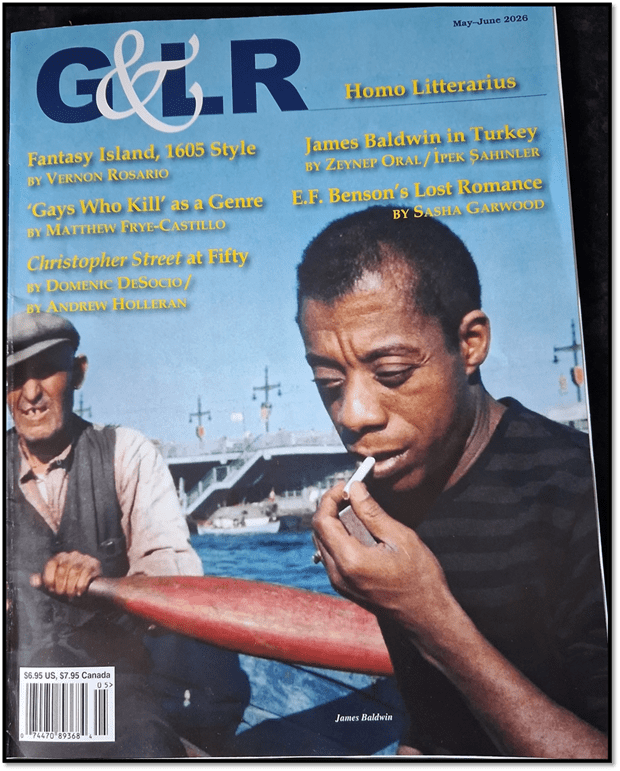
A short time ago I finished reading Nicholas Boggs’ startling new biography of James Baldwin. I blogged on it (see it at this link) with some enthusiastic emphasis on its new findings, about the depth of significance, in particular, of Baldwin’s final relationship with a bisexual artist. But most people saw the significance of that. To me what also mattered was the focus the book gave to Baldwin’s direction of the play Düşenin Dostu (Friend of the Fallen in English), the Turkish version of John Herbert’s Fortune and Men’s Eyes that was first played in Istanbul. When the new issue of Gay and Lesbian Review [G&LR] (the May-June 2026 issue subtitled Homo Litterarius) fell on my mat, then, it seemed miraculous that another researcher’s work on the latter was adding to our knowledge.
That researcher was a young Turkish-American student of comparative literature, İpek Şahinler, who having received a research grant from the G&LR was contracted to supply an article to the magazine. This was the result – a formal interview with the Turkish theatre journalist Zeynep Oral, also interviewed by Boggs, and the source of much of his information too about the play focused upon by both pieces of writing, although for Boggs one of many multiple foci. It is a delightful piece of literary research, although it does not lend itself to further progressing our view of this episode’s role in the development of Baldwin’s thinking on queer art.
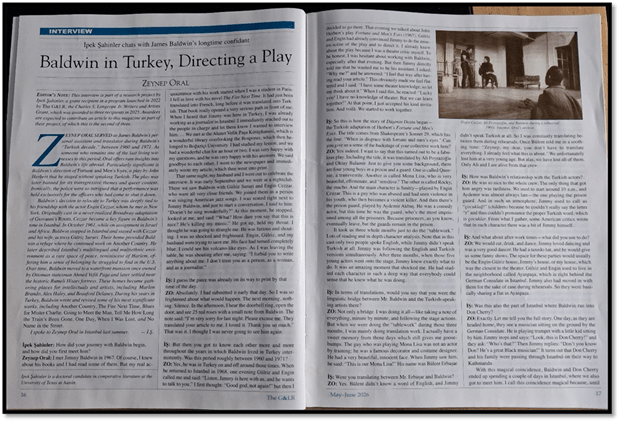
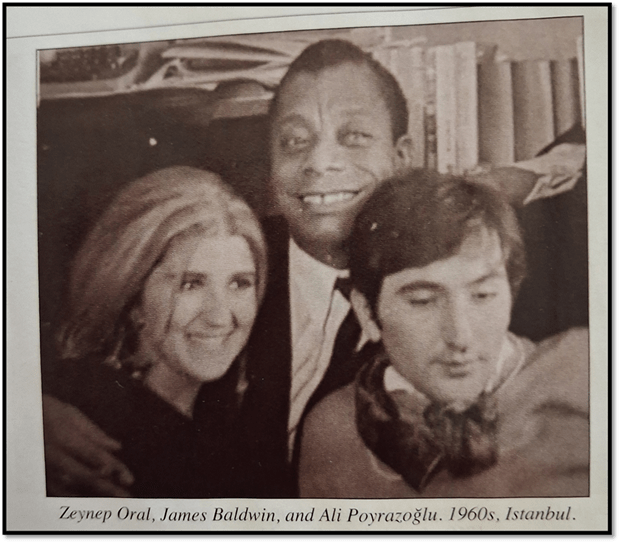
What it does help us see is the way people saw the man whom they knew as Jimmy in working with him and the many ambivalences in his character, especially in relation to his continuous drinking. Oral’s introduction to him, as Boggs also tells us, is through the writer’s response to an article she wrote on him based on an interview she held with him in a university library overlooking the Bosphorus, a favourable impression almost overturned by Baldwin’s drunken attack on her in a nightclub for saying things he found ignorant about the handling of American jazz music. At that time, Oral says, he ‘got up, held my throat. I thought he was going to strangle me’. Even though he apologised with flowers and warmth about her writing the day afterwards, it is hard to see how she could have forgiven him although on a return visit she risked visiting him on his request, to find herself enrolled as Jimmy’s assistant director on this play (partly because Baldwin had no significant understanding of Turkish). The photographs Şahinler and Oral use in this article tell a story very different than that near strangling covered over by a drunk’s over-profuse inadequate apologies. Below Baldwin towers over (surprisingly for a man of limited stature physically) his assistant director and one of the co-translators of the play, and actor of the role of the hardened prisoner, Rocky, Ali Poyrazoğlu. He looks like an indulgent father, but fathers are complicated things in Baldwin’s work.
I feel for Şahinler publishing on this in the wake of Boggs’ book – as any Ph.D examiner might note, the degree of original research it represents is severely curtailed by Bogg’s very comprehensive work. But there was here something new, for me at least, which is a set of examples that show that for the cast – see them in the collage from my earlier blog, repeated below as the final graphic of this piece – Baldwin became what he sometimes seemed to dream of being – the chosen father of a chosen family, an idea he clearly predicted in his novels before it became the clear reality of life in Greenwich Village, his once haunt. Oral is cited saying:
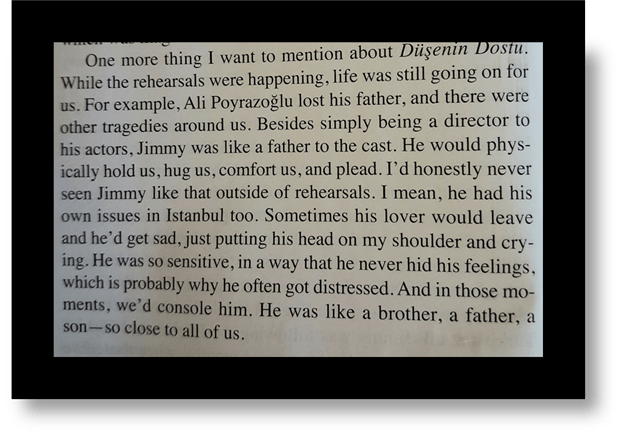
It is hard not to love that lasts sentence: ‘He was like a brother, a father, a son – so close to all of us’. What matters here is Oral’s sense that Baldwin operated without preselection of favourites among his chosen family, although clearly the ‘lovers’ were not quite always of this realm – not at least when they were his currently active lover, for most people fell Engin Cezzar, who played Smitty, had taken this role before his domestication and heterosexual marriage in Istanbul. Şahinler even proposes in one of remarks transitioning between comment and question: ‘It sounds like you weren’t only working together, but that you were like a queer family’ (page 18). Unfortunately Oral does not run with this suggestion in her answer to the question that followed about Baldwin’s haunts in Istanbul, which instead releases information about Baldwin favouring ‘being around regular folks, so he’d hang out at cafés where only locals went’ where ‘everyone’ called him either ‘Jimmy’ or ‘Arap’ (‘which just meant “Black” in Turkish’). None of that could exactly feel like uncomplicated acceptance amongst ‘regular folks’. All that is in Boggs anyway. Şahinler might have cut a path to originality from a direct answer to his half-suggestion about chosen family, but that is the problem of research – someone has nearly always been there before you
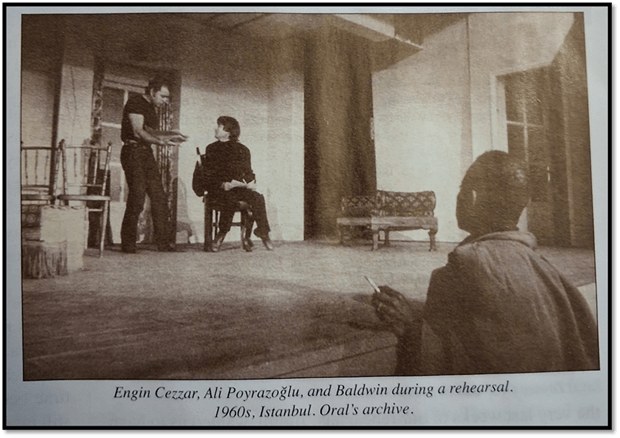
The photograph above from the article is both puzzling and beautiful. How might it have been analysed in chosen familial terms? Surely with interest and novelty. Baldwin leans against the proscenium platform of the stage still in a trench coat with one of his cigarettes hanging from his hand (for one was eternally on the go), listening to a language he does not understand coming from actors rehearsing in a set that clearly was not the one used for this play but possibly for another preceding it in this small professional theatre: the set being more bourgeois drawing room in properties than prison cell and the adjoining showers, where men distribute dom ‘masculine’ and sub ‘feminine’ roles in sexual acts reflecting the visible domestic ones in the cell (the actual set appears below, with the mock prison bars where a curtain to the proscenium might usually be). Can we imagine Jimmy still feeling yearnings for Cezzar here sublimated into this feat of direction? As with any family, how complicated this must have been.
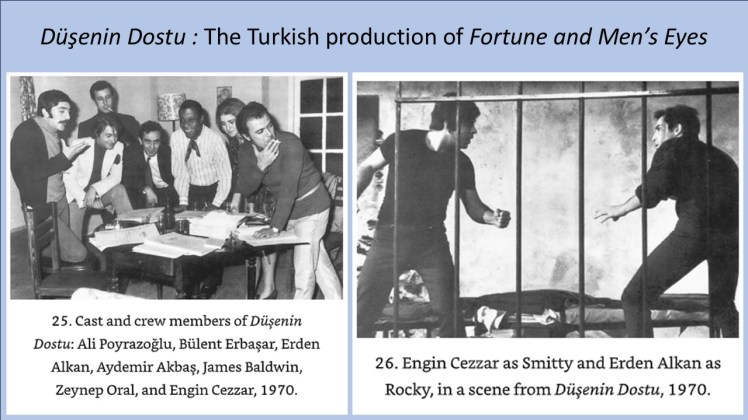
For more on the play consult the last blog:
Making you the man of nerve or nerves you are: from hard resilience to soft and fearful retreat. A case study based on Nicholas Boggs (2026) ‘Baldwin: A Love Story’ and the import he detects in Baldwin’s role as director of ‘Düşenin Dostu’ (‘Friend of the Fallen’ in English), the Turkish version of John Herbert’s ‘Fortune and Men’s Eyes’ in Istanbul.
Goodbye for now
With love, Steven xxxxxxxxxxxxx

