


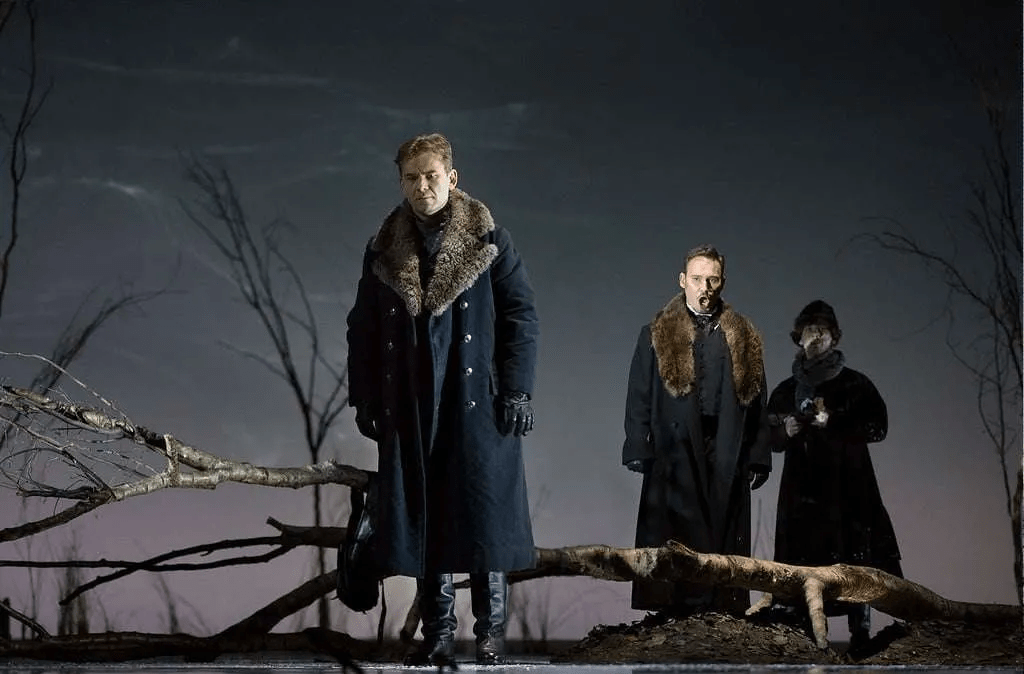
Tchaikovsky could only mount the story of Eugene Onegin according to the strict material limits of the nineteenth century opera and its conventions. There must be three Acts. What must have been clear to him that these acts needed each to revolve around a central dramatic encounter – of course three such were obvious.
- Tatiana meets her sister’s fiancé’s, Lensky, friend, Onegin, falls in love, writes a letter pleading for his love and is rejected in person when the letter is returned manually.
- At Tatiana’s name-day party, bored with Tatiana’s continued fascination with him, Onegin flirts with Olga, commandeering all her dances. Lensky is jealous. He calls Onegin to a duel with poisols. At the duel, Lensky is shot.
- Onegin meets Tatiana, now married to an older General (and therefore rich and powerful) in Moscow years later and now he falls in love with her and writes a letter. She rejects him in person, staying faithful to her husband
And this is what a brief synopsis shows is what we get in the opera: here in Glyndebourne’s reduced narrative:
Synopsis (from Glyndebourne website):
Act I
On her country estate Larina and her old servant Filipyevna listen to the singing of her daughters Tatyana and Olga. Olga’s suitor Lensky arrives unexpectedly and introduces his friend Eugene Onegin. They are invited to stay to dinner.
Later Tatyana stays up all night writing a love letter to Onegin. She begs Filipyevna to deliver it and anxiously waits for a reply.
Onegin himself arrives bringing her letter back. Though touched, he is not yet ready for marriage. It might be better to control her feelings – another man might take advantage of her.
Act II
At Tatyana’s name day party Onegin is bored out of his mind.
To keep himself entertained he flirts with Olga. Lensky grows insanely jealous and soon the situation is out of hand. Lensky challenges Onegin to a duel.
At dawn Lensky has time to reflect – Onegin is late. Though both men are reluctant to duel there is no going back. Onegin kills his best friend.
Act III
Onegin spends several years abroad. On his return to St Petersburg he attends a ball. His old friend Prince Gremin has taken a new young wife. When they are introduced Onegin recognises the Princess as Tatyana. He is besotted.
Tatyana refuses to reply to his letters, Onegin bursts in on her, begging her to run off with him: they are meant for each other. Tatyana cannot resist her turn to lecture. There is no way out.
Of course, just choosing those moments focused on actions represents a very different artwork to that represented by Pushkin’s novel in verse, in which the narrator is Pushkin, and Onegin a friend, if like, in many ways but not in others as the narrator keeps saying, the younger Pushkin. Onegin is characterised before and after his inheritance of a landed estate and he is throughout a ‘dandy’, a free-thinking liberal, though without the philosophical education in Romantic German philosophy as Lensky, but also a person affected by fashionable melancholy, after he fashion of Byron’s international reputation, based on his poetic hero Childe Harold, but called by the name of a peculiar syndrome thought to afflict the Russian landowning gentry, Kandra. Asked for a summary Google AI comes up with this:
“Kandra” is borrowed from New Latin hypochondria, it denotes a low-spirited, melancholy mood. In a Russian context, it most commonly refers to хандра́ (xandrá), a Russian noun meaning spleen, blues, melancholy, or a state of listless ennui. It is frequently used in literature to describe a deep, brooding boredom or despondency.
And the Pushkin poem elaborates this wide-ranging feeling, not quite the ennui of the existentialists Sartre and Camus but getting there, and with lots of claims for a ‘boredom’ that expresses a psychology separated from social and communal illusions like acceptance of the world as it is and of the potential in it of enduring happiness or fulfilment. Of course, the other thing it prefigures is a world in which persons give away their agency to a diagnostic category of sorts, supposed to explain everything (and hence its typification – perhaps even stereo-typification – in literature that might take in central characters in Tolstoy, Turgenev, and Chekhov and almost certainly had a root in Goethe’s Young Werther and his ‘sorrows’). There is something embodied and visceral in how Pushkin sees it in Onegin, which sees its operation as leading sometimes to suicidal motivation, if not (necessarily) practice, although based primarily in feeling entirely ‘emptied / Of all attachment to this life’.
No: soon a coldness numbed his feeling;
The social hubbub left him bored;
The fair sex ceased to be appealing,
To dominate his every thought.
Betrayals no more entertained him,
While friends and friendships simply pained him,
Since he, not always, it was plain,
 Could drink a bottle of champagne,
To down a Strasbourg pie and beef-steaks,
And scatter caustic words of wit,
While thinking that his head might split;
And he, a fiery rake, his leave takes
Of that exhilarating life
Of sabre, lead and martial strife.
38
A malady, whose explanation Is overdue, and similar
To English spleen – the Russian version,
 In short, is what we call khandra,
Possessed him bit by bit; not tempted,
Thank God, to shoot himself, but, emptied
Of all attachment to this life,
 He, like Childe Harold, would arrive
In drawing rooms, dejected, languid;
Neither the worldly gossiping,
Nor game of boston, then in swing,
Immodest sighs or glances candid,
Naught touched Onegin to the core:
He noticed nothing any more.
This feeling is no doubt explanatory of how young privileged men leave the military life to become inhabitants of the ‘drawing rooms’ of aristocratic parties and a feeling of alert lack of interest only expressible by Mitchell’s expression that that makes ‘nothing’ a physical presence he could either noticed or ignore or, even, negate. Out of the military and into the half-life of endless listless party-going, when Onegin unexpectedly inherits his uncle’s country estate (the story is still in Canto 1), his life there is one that fully institutionalises his khandra diagnosis, in which detachment is the time-honoured norm, delight a kind of passing belief in a tired convention – such as the idea that romantic loneliness is a panacea for the bored:
54
For two whole days the lonely meadows,
The bubbling brook’s tranquillity,
The oak wood’s leafy cool and shadows,
 Appeared to him a novelty;
The third day he could no more muster
Delight in grove or hill or pasture;
Already they put him to sleep;
Clearly he saw he could not keep
Out boredom in a country setting,
Though not a palace, street or ball
Or cards or verse were there at all.
Khandra was there, on guard and waiting,
And dogged him like a faithful wife
Or shadow fixed to him for life.
Khandra is ‘on guard and waiting’, half guardsman to the powerful and half footman to the wealthy and privileged, he is in both cases ‘male’, although soon opts to become (and the simile status matters) ‘like a faithful wife’, a woman although perhaps not so and instead a ‘shadow fixed to him for life’. Strangely enough these are the very things that Tchaikovsky and his collaborators, and perhaps because of the need for collaboration, leave out of the opera. In Act 2, Onegin is merely bored and looks to flirtation with Olga only for that reason. Pushkin makes it clear that Onegin turns to Olga not just for the fun of undermining his friend Lenski and that ‘poet’s’ over-romanticism but because he dislikes the dogged faithfulness apparent in Tatiana’s attitude to him still – as if loyalty itself were an issue which only complete negation of attachments to life can solve: It is all in Chapter 5 where the young men turn up at Tatiana’s name-day party and are sat together facing Tatiana:
The doors fly open, Lensky enters,
With him Onegin. ‘Lord, at last!’
Cries out Dame Larina, and fast
The guests make room, as each one ventures
To move a cover or a chair;
They seat the two young friends with care.
30
They sit right opposite Tatiana;
She, paler than the moon at morn,
More agitated in her manner
Than hunted doe, stays looking down
 With darkening eyes; a glow pervades her,
A surge of passion suffocates her;
She does not hear from our two friends
The salutation each extends;
About to cry, poor thing, she’s ready
To fall into a swoon or faint;
But will and reason bring restraint;
Clenching her teeth, remaining steady,
She quietly utters just a word
And from the table has not stirred.
31
With tragi-nervous demonstrations,
With maidens’ fainting fits and tears
Eugene had long since lost all patience:
He’d had enough of them for years.
Khandra, ‘like a faithful wife’ despises others who want, or can be interpreted as aspiration to, that role with the man who is like its smothered husband. In particular. khandra dislikes ‘tragi-nervous demonstrations’ of ambivalence for they are beyond its dog-like cowering persistence as a ‘shadow’, a mirror reflection of a man’s self-love. They had rather torment another man for believing all this stuff of longing, fulfillment and loyalty that Lensky makes such ‘tragi-nervous’ show of it all.
That Pushkin’s Onegin treats women badly because he wants men to think differently of what feminine submission means is clear. Killing Lensky means killing off forever he hopes that unrealistic and romantic dream of loyalty, although to what end he does not know. The opera libretto simplifies, in Act II, all this. The outrageous elderly gentry love to observe romantic trysting, even though they know it leads often to tragic couplings:
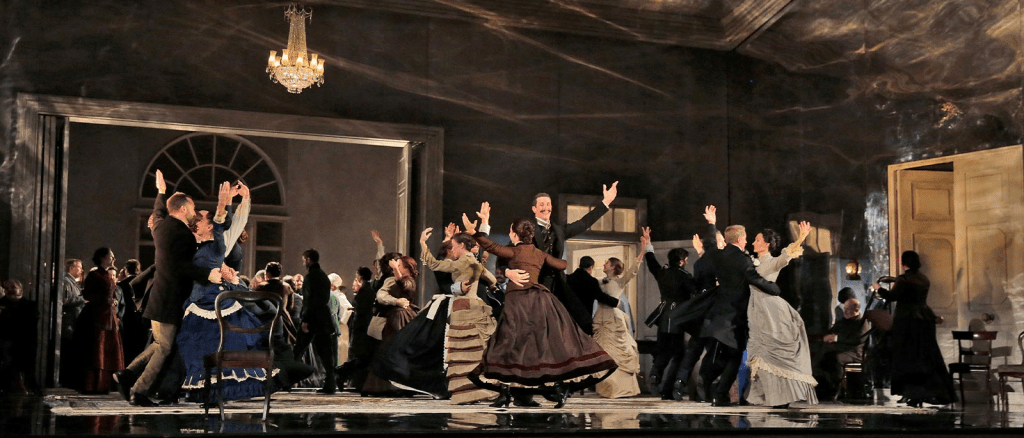
Elderly Country Squires: On our estates we rarely encounter the sparkle of such a jolly ball. The hunt is our only amusement; we love the noise and crackle of guns.
Elderly Matrons: Such fine amusement indeed! The whole day they dash over hill and dale, marshland and bushes! Then they’ve tired themselves out and collapse into bed; that’s all the entertainment we poor women get!
Onegin invites Tatyana to join him in dancing a waltz. Then, the other couples stop dancing and slowly leave the floor to watch them. Soon, Onegin and Tatyana are the only couples dancing.
Two Groups of Matrons: (conversing) Just look there! The lovebirds are dancing! It’s high time they married her off! But look at that fiancé! How sorry we are for Tanyusha! He’ll marry her and then play the tyrant!
Both Groups of Matrons: They say he’s a gambler!
Onegin passes by, overhears the conversation.
He’s dreadfully uncouth and behaves foolishly; he won’t kiss a ladies’ hands, he’s a freemason, and he drinks red wine by the glassful!
Onegin: (aside) (There’s public opinion for you! I’ve heard more than enough of this repulsive gossip! It serves me right! Why did I ever decide to come to this stupid ball? What for? I won’t forgive Vladimir for this! I’ll flirt with Olga and really get him mad! Here she is!)
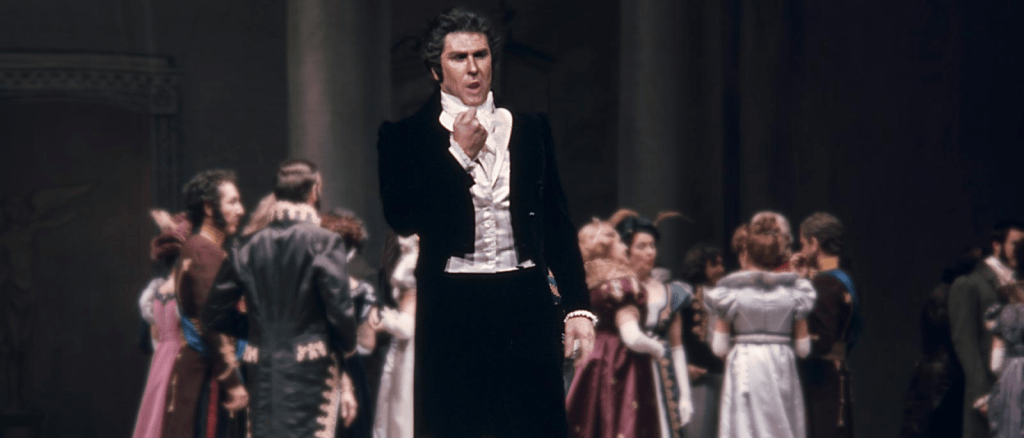
I say ‘simplifies’, but let’s see. Pushkin psychologises Onegin’s khandra – it is a condition that seeks ever to further detach hum from life. He does it brilliantly – in the manner of a great work of art. Pushkin writes Onegin’s distaste for women displaying the stoicism and loyalty they must inbuild into their psyche’s to survive in ways that emphasise the inner stuff of the drama of male narcissism, where man is alone with his own shadow, more nearly a man than a woman. The outcome of all this is deeply psychologically driven – into the murder by that man of his double. And into the elevation of Tatiana to true status based in reserve.
Tchaikovsky and collaborator turn this into a matter of competing social ideologies. For Onegin here the elderly gentry are not only hypocrites, they are cruel hypocrites. Desperately unhappy in their own heterosexual couplings, their want of pleasure leads them to mount for their own enjoyment balls where similar couplings will be set in motion. Observing Tatiana and Onegin dance, they savour the excitement and predict the worst – a lifelike theirs where men remain fixed in male pursuits and women must survive for excitement between social events.
Tchaikovsky’s Onegin does not want to reproduce such a society. He despises it when he overhears it gossiping about him and then locates the problem in Lensky. It is he who brought him into this society. He must be punished and shown its falsity – hence his plan to expose to Lensky behaviour that can be interpreted as disloyalty and unfaithfulness. Tchaikovsky does not mediate this through Onegin’s image of Tatiana at all – no, it is all about the drama in inter-male rivalry and queer unacknowledged affection.
Now having felt all this, I await seeing the Metropolitan Opera version. My hopes aren’t necessarily high. Reviews praise the music and performances, but some point out the dreadful conventions of the current institution of opera and ballet. In the latter productions are staged by companies with the constitution of institutions and then endlessly revived in the same form, even by other companies – hence the Royal opera in London stages The Metropolitan Opera Onegin (again!). That is not a recipe for staging innovation or boldness – yet we get Matthew Bourne in the ballet world.
So here I rest until Geoof and I see the opera streamed at the Gala on the 6th June. Watch this space
With love
Steven xxxxxxxxxxxxxxx


2 thoughts on “Is being productive the issue? Producing art or understanding thereof is more often about the analysis of the unproductive or listless: in Russian, the state of ‘khandra’. This blog is a case study based on preparions for seeing The Metropolitan Opera’s ‘Eugene Onegin’ streamed to Durham Gala on the 6th June.”