


What better thing to do in the gay community than remind it of its history and honour its actors: What counts as daring in the face of being true to love! Stefan Haupt’s 2014 film The Circle and the dilemma of postwar 20th century queer representations of love between men in Europe.
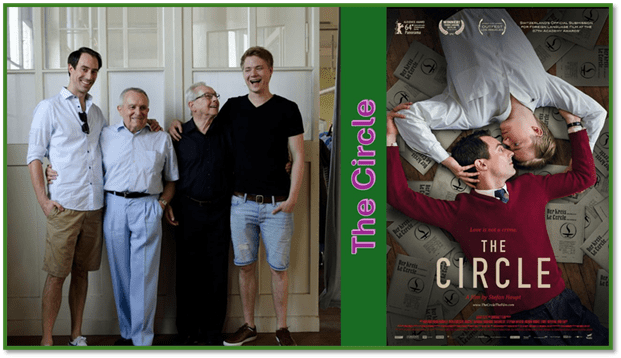
Left to right: Matthias Hungerbühler, Ernst Ostertag, Röbi Rupp, & Sven Schelker. The young actors, at each end of the line, each hold the elders whose youth in postwar Zurich they enact and perform in ‘The Circle’.
We sometimes talk of the representation of queer male love, romantic or sexual, as if it touched on no other issues but the law which articulated and contained it from its potential as human expression. As a result, we reduce the meaning of the relationships it touches upon. Some use this to reduce the significance of our history, others don’t. For an instance of the latter, take Glenn Kenny’s review of the film, which picks out a scene that intrigued me most, perhaps in part because I recognised the quotation, the secondary schoolteacher Ernst came into his class of girls to read out: “Aujourd’hui Maman est morte. Ou peut-être hier, je ne sais pas.” (Mother died today. Or maybe yesterday, I don’t know.)
The lines were unmistakable to me – read out to the school class I was in by my own adored secondary schoolteacher – the first sentences of Albert Camus’ L’Etranger (The Stranger). Glen Kenny describes the incident thus:
The movie economically limns the social currents spreading across post-war Europe by depicting one of its lead characters, Ernst (Matthias Hungerbühler) teaching Camus’ “The Stranger” to his French class, and being gently warned off such material by a colleague. “Wait until you’re certified” before risking such edgy material, the colleague suggests, and this advice feels like a leitmotif once we see how it pertains to the rest of Ernst’s life. [1]
At the time, we miss some of nuance of this scene to the rest of Ernst’s life. The ‘colleague’ mentioned is, in fact, the principal of the girls’ school Ernst works in responsible for organizing the ‘certification’ of Ernst as a teacher or not. He seems a figure of fun, equating existentialism as the next thing to communism and advising Ernst to stay with the French classics of the eighteenth and nineteenth century (a canny liberal female colleague slyly suggests Madame Bovary and the Marquise de Sade’s novels (notoriously sexually salacious examples), to the principal’s chagrin). Ernst even does this. On the day of the visit of the school inspectorate, responsible for certification assessment, he is teaching Racine’s Andromaque, which, although a story of some notoriety in its own time was still a recognized standard classic of French literature (seventeenth century but let that pass because Racine had the status of a French Shakespeare). I will return to the cleverness of using this play for that scene in the context of the film’s message.
What we do not know at this point is that the principal Max Seiber (played brilliantly by Peter Jenklin) is a closeted queer man (Ernst only finds out when he perchance meets him in a toilet – used for sexual escapades by men in hiding and rent boys – and they pretend not to know each other). Max’s extremely repressive attitudes relate to his well-hidden sexuality, and his later suicide when turned in from a note discovered on a rent boy by the police, and his family leave him alone to face the scandal.
There are queer resonances patterned into the film by the existentialist icon of the alienated ‘stranger’ of course. Ernst, as a closet poet has a rich reading of the word ‘strange’ – it appears in a poem that he writes for his lover, the young drag queen, Röbi Rupp, to sing at a masked ball that is cancelled by police order. The lyric sung expresses the feeling embodied by the voice of Rupp to express the way he is forced to feel about himself, as a migrant fleeing the continuing enforcement of Paragraph 175, the severe clause in law, used by the Nazis to incarcerate queer men in concentration camps, and used legally to imprison even after the ‘liberation’ of Germany by the Allies. Now even reviews blind to the film’s strengths, hail this song. Take this bit of an otherwise terrible review by Henry Barnes in The Guardian, referring to the real and now aged charactwr for whom the song was written:
Seventy-something Röbi opens the film in drag, singing brazenly about his love for “rare plants that grow south of the border”. More of his real-life vivacity would have made The Circle a more satisfactory whole. [2]
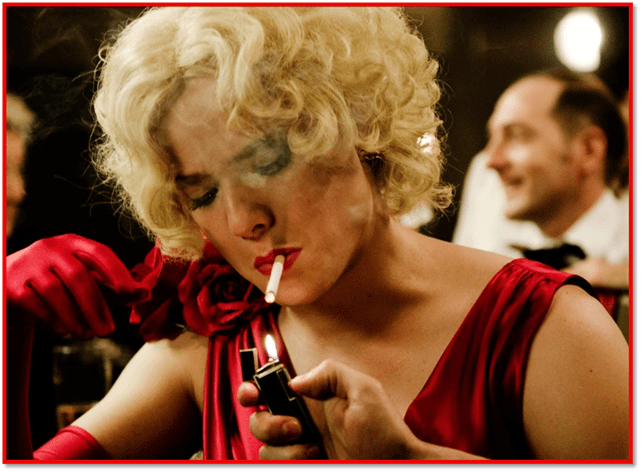
I wonder whether Barnes realised that the song sung at the beginning by the elder Rupp, and reprised twice at the end is what it is: a poem by Ernst donated to Röbi as a lyric to the song of their triumph as a strange queen. It is described as such before it is sung by the young actor performing as young. Röbi
That this is not to Barnes a ‘satisfying whole’ might be attributed to how little he sees of what the film attempts to do ‘as a whole’. Instead, he sees it as an amateurish attempt at mixed genre narrative, he calls docudrama;
The early days of gay rights are lovingly, clunkily presented in director Stefan Haupt’s docudrama about Swiss gay magazine the Circle. Launched in 1942, it was smuggled thoughout Europe and offered advice, entertainment and erotica for people in countries where homosexuality was still illegal. Haupt cuts between contemporary interviews with Röbi and Ernst, a couple who orbited the magazine’s staff, and a shonkily acted drama about the start of their relationship. The magazine presented a high-minded ideal of homosexuality as close friendship, removed from public salaciousness. Haupt’s film is less polite, but Röbi and Ernst’s courting is still not particularly sexy. [2]
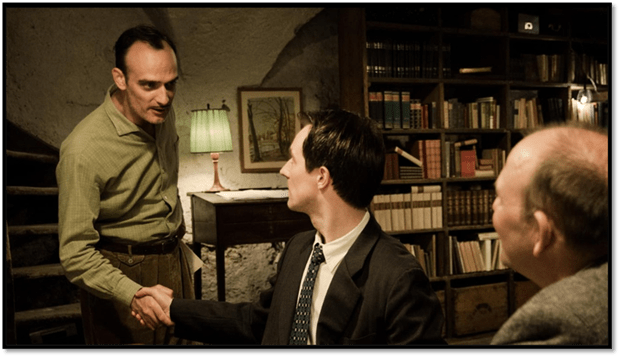
This a most unsubtle way of saying the film is spoiled by its earnest over-loyalty (with no regard to directorial talent) – how else do we interpret ‘lovingly, clunkily‘ as descriptors of the film work – to queer history in its detail,the detail only lovers notice in the beloved one. In the scene below where Ernst first joins the ‘Circle’, the room is lined with books – presumably of German sexology largely – and the kindly editor of The Circle magazine, Rolf (played by Stefan Witsch) is perfectly represented by his late-middle-aged balding – whilst Felix (Anatole Taubman) holds hands a little too earnestly to be less than a declaration of sexual interest:
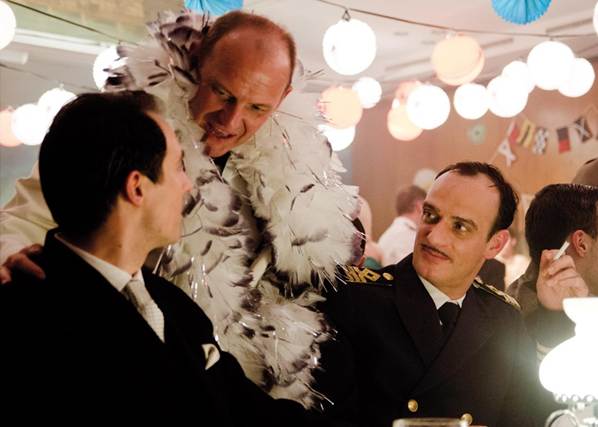
Rolf dressed for the ball he organises is a different kettle of fish. He dresses to show the mix of sex characteristics the Der Kreis (The Circle) magazine circle made possible – a world of naughty play where Rolf seems to bless the flirtation of Ernst and Felix:
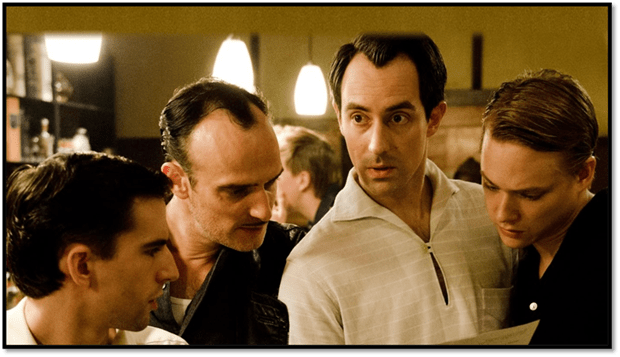
There are also certainly moments where you see the absurdities of the kind of radicalism involved, and the over-egged seriousness on activist faces (in the scene below the young men realise the importance of the murder of someone from the same closeted community – though not part of The Circle – by a rent boy, for this will put their community under more active police surveillance (do Ernst’s eyes rather overplay the matter – myself I think not, so much had to be unsaid in the group):
You get the gist in Barnes however that the idea of queer experience and how to characterise it, especially with regards to campaigning rhetoric and its distinction from sexual acts which was (in terms of one or the other of these) what some thought wrongly it was all about) a problem in the period: which it was for many reasons. Barnes has no truck with any of that as the content of good filmic works, or indeed good acting – which in the dramatised sections he describes as shonky, a term that queries the validity and integrity of what is enacted for us, even the sex, which is, he says ‘not particularly sexy’.
This is not I have to say how non-professional critics who identify primarily as gay men themselves see it. I agree entirely with Michael Scott, who also identifies as a ‘documentarian’ intriguingly, who says:
Haupt presents their lifelong love affair though an evocatively constructed docu-drama, which pairs slick film-worthy recreations with contemporary interviews with the surviving participants. It’s an approach that works off the best of both styles; the acted portions, far more cinematic than rudimentary dramatisation, take centre stage, with the more traditional talking heads inserted as breakout annotations. It’s a wonderful means of contextualisation, and one that adds a surprising amount of both gravitas and drama to the film. There is no escaping that these events were real and had wide reaching, very personal impact in the Swiss community and beyond. [3]
Perhaps the problem is with identification if the point is that the material seems unreal and a disappointment to your imagination of what it means to be ‘sexy’. Scott sees as I do the young men above becoming aware and frightened for the first time of a state machinery that had once seemed friendly, or at least neutral, to them. Witness Michael Scott, for instance noticing the painful content that he rightly saw as still relevant in 2014 in Western Australia
The film captures an important turning point in queer culture, that violent shift from thriving cultural underground to exposed, uncloseted struggle for acceptance. Switzerland, like ’30s Berlin before it, provides a gripping case study of just how suddenly the social climate can turn. A few rent boy murderers and the Circle’s decadent anonymity dissolves under a barrage of police brutality and open blackmail. [3]
But, to me, the fault in Barnes runs deeper. He has no sense of the lives, intellectual, sensual, and playful, of the characters as they might in queer history, with its many determinants, have been. In particular, as I have shown I think, he lacks any idea of what the content of social oppression is,whether state-led in law or through variations in the power of certain negative perceptions held socially, and performed out by institutional employers and the police. And this goes further than sex, or love relationships. It implies too the freedom to think.
For Ernst, teaching the existentialist idea mattered, over and above the socially estranged desires and romantic feelings he experiences. He believes that young people need freedom from the constraint of moral prescription that existentialism set itself against. Yet Ernst will always provide that context of interpretation whatever he teaches. In the scene where the School Inspector observes his teaching as part of the certification process, he has, as I have already said plumped for teaching Racine’s Andromaque. As the children consider the extremes of passion – what someone will do for a love that is intense whatever the mores and laws that contend against it – he asks the children, what they might do for someone they really loved regardless of prior relationship to them. Their answers are that they would do ‘anything for love’, whatever. The eyebrows of the School Inspector arch. we know he may fail to impress the hidebound official.
It is a chilling scene in which existence precedes essence – the performance brought on by love exceeds the defined category of love in society. This must come back to Ernst when quizzed by them, because Rupp has blurted out that Ernst is his boyfriend (or nearly – enough for the word to be guessed) to defend him from being thought a ‘rent boy’ and therefore potential murderer at this point of the story.
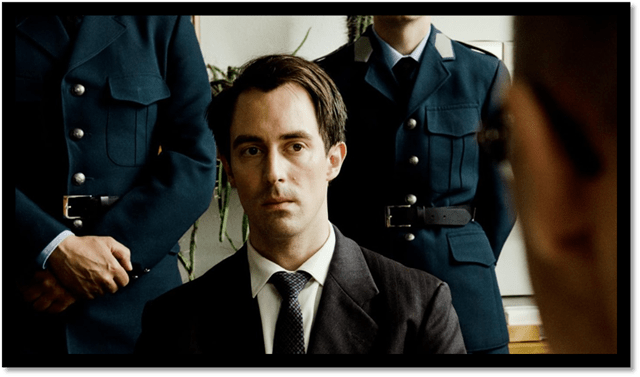
Ernst’s suffering is in fact though itzelf 9existential anxiety (angst).

And it comes from the mauvaise foi (‘bad faith’) of enacting a role that is inauthentic existentially, which his lover, Röbi Rupp, also fights, although the fight is only convincingly holding back tears:

Of course, one thing heteronormative critics get terribly wrong is the role of play in all relationships – it is what makes them all queer. The film is earnest about play in the way that the magazine (Der Kreis) at its centre is.
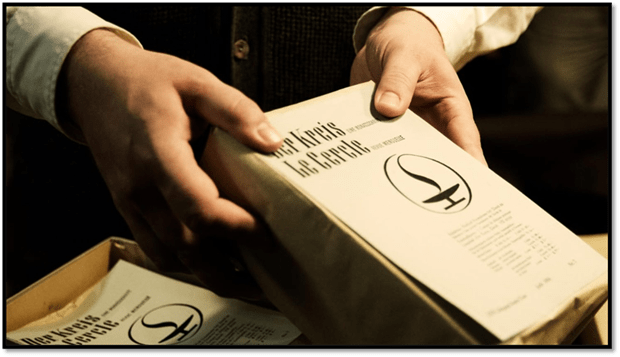
The ball scenes are remarkable in this respect. It is not that men kiss but that they do so in sailor costume.
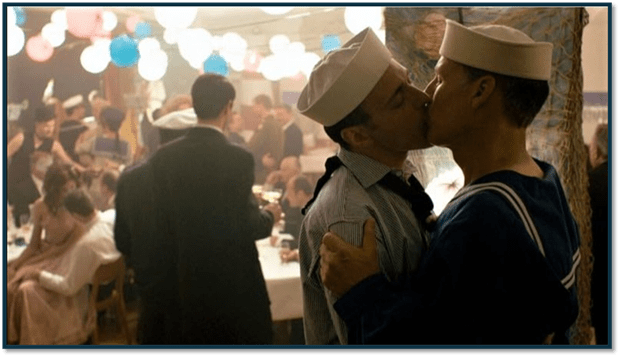
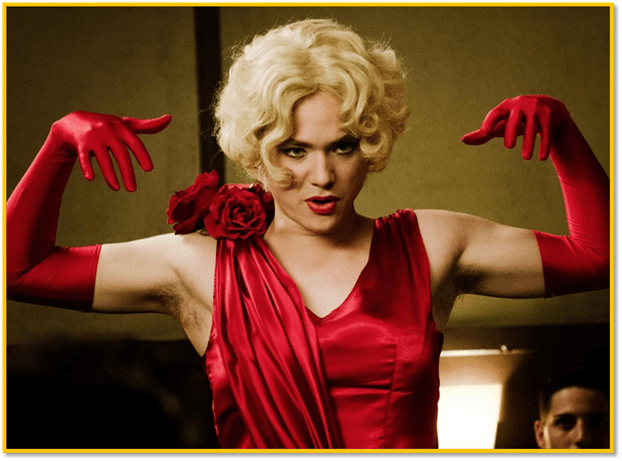
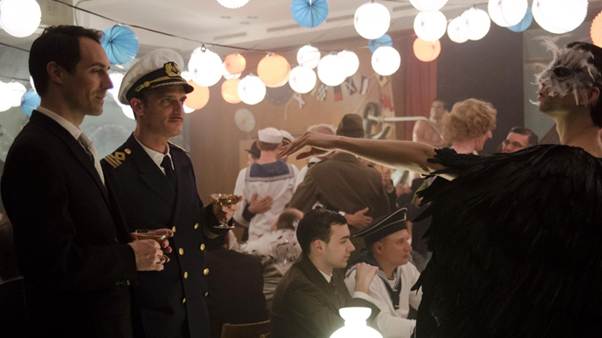
It is not that earnest theories of nonbinary identity were propounded, though they were but that binary roles were made the stuff of play, as in Fredi’s (Claudio Schenardo) diva below:
But the player extraordinary is Röbi, variously entertaining everyone, when Ernst first sees him he bets that he is a ‘real woman’, and loses his bet.
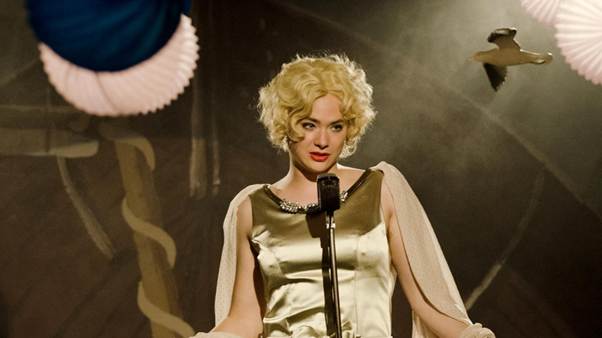
She is what she is to the crowd.
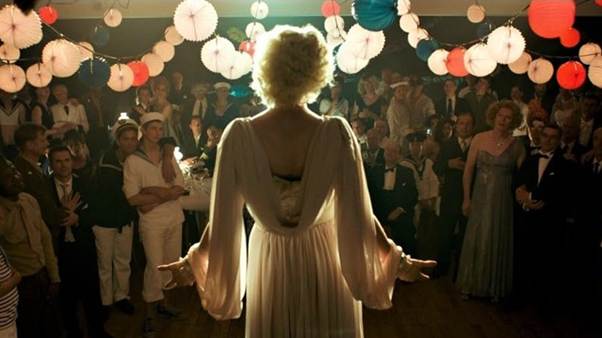
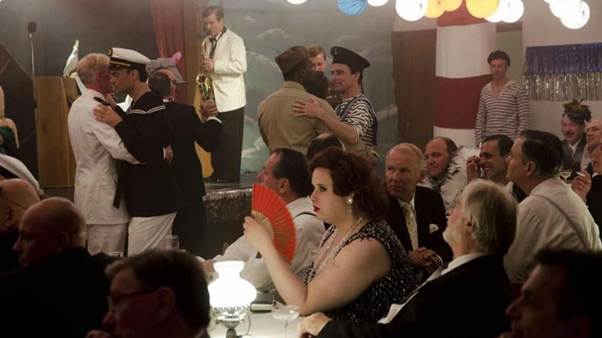
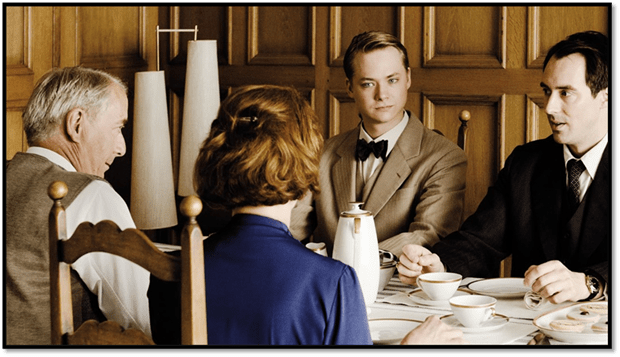
It is not that they perform to ‘be’ any sexual identity. They do that no more than the most conventional heterosexual couples of the time – notably Ernst’s bourgeois mother and father before whom (even to his sister – who appears in the film in her own right and laughs about it) even Röbi Rupp enacts a conventional man, and friend of their son. This is the excruciating ‘real life’ roleplay radical drag aimed itself at:
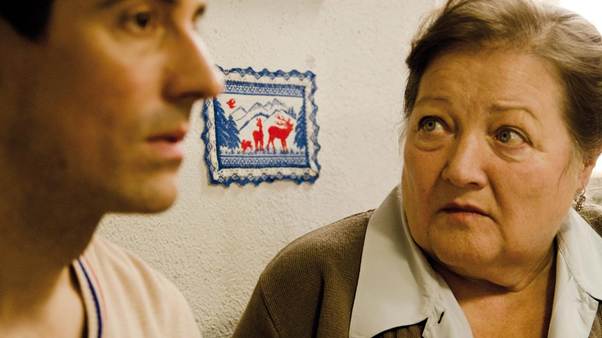
And maybe the sex is underplayed. But in queer lives it can be just as much as any other life in which it features largely or, sometimes, less so, wherein relationships (in families too) get restructured. Rupp’s mother (Erika Rupp played by Marianne Sägebrecht) is a wondrous thing in this film, a mother to Ernst too.
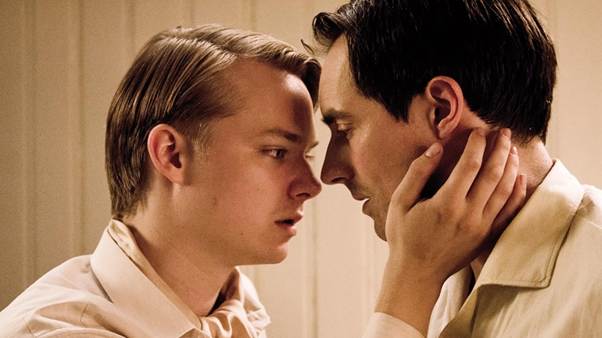
And I loved the acting of the loving that Barnes feels shonky.
In scenes where the cast meet up with the central characters (the real ones in their seventies) there is community – across age at least. Isn’t that a step to community – fairy step though it be.

I am sure everyone knew about this film already, but if you (like me) didn’t and you want to imagine queer community through hard and soft representations see it.

With love
Steven xxxxxxxxxxxxxxxxxx
______________________________________________
[1] Glenn Kenny (2014) ‘The Circle: review’ (November 21, 2014) available at: https://www.rogerebert.com/reviews/the-circle-2014
[2] Henry Barnes (2014) ‘A loving but clunky docudrama about the early days of gay rights, which would benefit from more vivacity’ in The Guardian (Thu 11 Dec 2014 21.30 GMT) available at: https://www.theguardian.com/film/2014/dec/11/the-circle-film-review
[3] Michael Scott, review available at: https://letterboxd.com/walypala/film/the-circle-2014/

