


Directing a man’s future being, or, Trans-ing Eugene Onegin
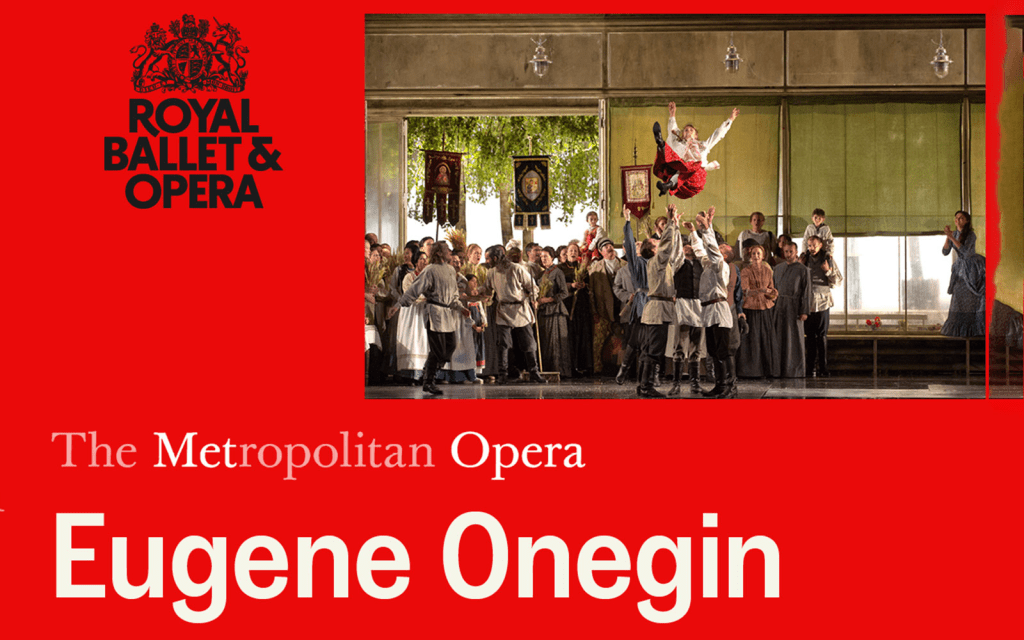
Let’s divert the question a moment, because I am preparing myself to see Tchaikovsky’s Eugene Onegin streamed (the second time for the opera but then I only saw a live student production: see this blog) from the Metropolitan Opera, and in the middle of re-reading the great source story by Alexander Pushkin Eugene Onegin: A Novel in Verse and the opera’s very different libretto. I am sure that this is probably a sign of mis-direction in my own life, or at least ‘wandering lonely as a cloud’ over the great artworks of the Western world. But there is a point I think, in thinking at the same time of ‘what gives you direction in life’ and the story of Onegin as Pushkin and Tchaikovsky in different vehicles of art tell it. For to both this man is a sign of the times; of an deracinated supposed aristocracy of males (paragons of Empire, the State and manhood at the same time), too self-obsessed to even look for direction and finding it, if at all, in a mirror. In the poem, the key is stanza 25 of Book: Onegin thinks himself a ‘man of action’ or ought to, as Pushkin suggests, but spends hours in his dressing closet with his mirror-reflection as he tends to his image. Here is the stanza:
| А. С. Пушкин Роман в стихах Евгений Онегин Глава I Строфа XXV |
| Быть можно дельным человеком И думать о красе ногтей: К чему бесплодно спорить с веком? Обычай деспот меж людей. Второй Чадаев, мой Евгений, Боясь ревнивых осуждений, В своей одежде был педант И то, что мы назвали франт. Он три часа по крайней мере Пред зеркалами проводил И из уборной выходил Подобный ветреной Венере, Когда, надев мужской наряд, Богиня едет в маскарад. |
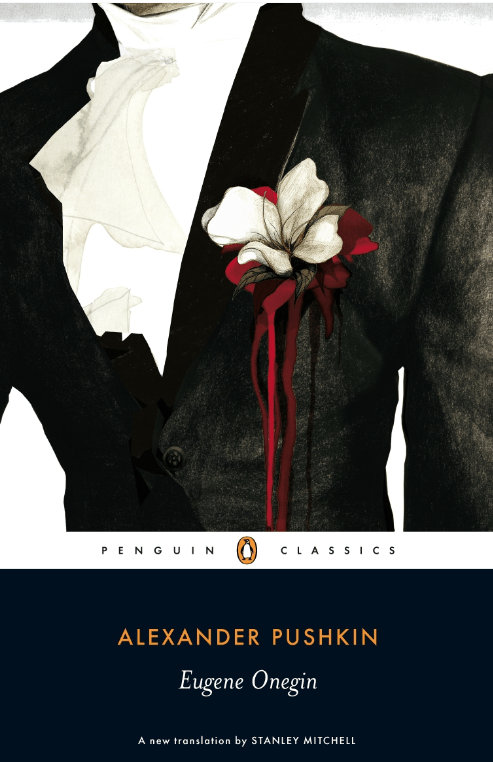
Don’t even try reading the above – I didn’t. I haven’t a word of Russian and can’t even recognize or sound out the character-letters of the language.And besides, its probably best to have more of the context verse (and in a good translation by Stanley Mitchell – one thoroughly informed by the nearest unrhymed – for more literal accuracy – translinear version by Vladimir Nabokov). The new Mitchell Penguin translation even has a totally appropriate cover – pretending to be Onegin finely dressed and represented not by a face but glamorous attire sporting a huge attention-drawing lapel bloom and red ribbon.
So here is Stanley Mitchell’s take on the dressing scene in Book 1 (by the way some lines – like the sumptuously autoerotic ‘Одет, раздет и вновь одет?’ (‘Is dressed, undressed and dressed again?’) make you yearn to know the sounds in Russian, as a Russian speaker might speak those lines).By the way, it is useful to have the translator’s note to the name in stanza 25, namely: ‘ Chaadaev: Pyotr Chaadaev (1794–1856), dandy and libertarian thinker, later a mystic, influenced the young Pushkin, famous for his later Philosophical Letters, contrasting Russian history unfavourably with the West, with which Pushkin disagreed. The journal carrying the first Letter was suppressed, Chaadaev being declared insane and placed under house arrest’. This context give away an important subtext. Onegin is modelled on Lord Byron and Chaadaev and poked fun at as being the kind of effeminate Western-ideas-orientated waste of space, Pushkin came to believe, having been an early fan, Western artists were.
Already, though, Onegin’s gone
To put some new apparel on.

23
Shall I attempt to picture truly
The secret and secluded den
Where fashion’s model pupil duly
Is dressed, undressed and dressed again?
Whatever trinket-dealing London
To satisfy our whims abundant
Exports across the Baltic flood,
Exchanging it for tallow, wood;
Whatever Paris, in its hunger,
Having made taste an industry,
Invents for our frivolity,
For luxury and modish languor –
These graced, at eighteen years of age,
The study of our youthful sage.

24
Pipes from Tsargrad, inlaid with amber,
Bronzes and china on a stand,
Perfumes in crystal vials to pamper
The senses of a gentleman;
Combs, little files of steel, and scissors,
Straight ones and curved, and tiny tweezers,
 And thirty kinds of brush to clean
The nails and teeth, and keep their sheen.
Rousseau (I’ll note with your permission)
Could not conceive how solemn Grimm
Dared clean his nails in front of him,
The madcap sage and rhetorician.
Champion of rights and liberty,
In this case judged wrong-headedly.

25
One still can be a man of action
And mind the beauty of one’s nails:
Why fight the age’s predilection?
Custom’s a despot and prevails.
My Eugene, like Chaadaev, fearful
Of jealous censure, was most careful
About his dress – a pedant or
A dandy, as we said before.
At least three hours he spent preparing
In front of mirrors in his lair,
And, stepping out at last from there,
Looked like a giddy Venus wearing
A man’s attire, who, thus arrayed,
Drives out to join a masquerade.
But before going on, lets’s just think a bit about the transsexual metaphor chosen to characterise Onegin by Pushkin that says that Eugene: ‘Looked like a giddy Venus wearing / A man’s attire’. Note that if you insist this is transvestism not trans-sexuality, you have to explain why Eugene looks like a transvestite woman! No! He is (or ‘looks like’) a woman in ‘man’s attire’. The whole import of this is that for a Russian of Pushkin’s time assessing the attempt of fashionable Russia to ape the manners, morals and look of the West (since the rule of Tsar Peter the Great, in fact), rather than the East where some thought Russia should look for its models, the change in Western mores that they detected had a great deal to do with the feminisation of masculine virtue in Byron and Chaadaev. After all, since the Romans and their poetry, vanity (except in certain flawed men blamed for their feminine qualities) was a female thing. The key text is Alexander Pope’s The Rape of the Lock, a misogynistic satire aimed at powerful women, trivialising them and blaming them for that fact, and minimising the power imbalance ‘rape’ represents (even if only of a lock of hair). Here is the famed scene from Canto 1, where Belinda, like a High Priestess, sits at her ‘toilet’, her make-up table as if it were an altar.
And now, unveil'd, the toilet stands display'd,
Each silver vase in mystic order laid.
First, rob'd in white, the nymph intent adores
With head uncover'd, the cosmetic pow'rs.
A heav'nly image in the glass appears,
To that she bends, to that her eyes she rears;
Th' inferior priestess, at her altar's side,
Trembling, begins the sacred rites of pride.
Unnumber'd treasures ope at once, and here
The various off'rings of the world appear;
From each she nicely culls with curious toil,
And decks the goddess with the glitt'ring spoil.
This casket India's glowing gems unlocks,
And all Arabia breathes from yonder box.
The tortoise here and elephant unite,
Transform'd to combs, the speckled and the white.
Here files of pins extend their shining rows,
Puffs, powders, patches, bibles, billet-doux.
Now awful beauty puts on all its arms;
The fair each moment rises in her charms,
Repairs her smiles, awakens ev'ry grace,
And calls forth all the wonders of her face;
Sees by degrees a purer blush arise,
And keener lightnings quicken in her eyes.
The busy Sylphs surround their darling care;
These set the head, and those divide the hair,
Some fold the sleeve, whilst others plait the gown;
And Betty's prais'd for labours not her own.
Imperial Eighteenth Century Britain uses the materials it exploits (that ‘glitt’ring spoil’) from its vast colonies to feed this vanity, but, being on a woman, where the military metaphor is extended only to beauty accoutrements, it does less harm.
But not so the Russian landowner, exerting himself to use beauty’s accoutrements not to find female prey, except for one-night stands, but to ‘pamper’ the male body and its senses.
Pipes from Tsargrad, inlaid with amber,
Bronzes and china on a stand,
Perfumes in crystal vials to pamper
The senses of a gentleman;
Combs, little files of steel, and scissors,
Straight ones and curved, and tiny tweezers,
 And thirty kinds of brush to clean
The nails and teeth, and keep their sheen.
The stress on decorative miniaturisation is the condemnation of the man, a manner too ‘gentle’ to be the ‘man of action’ he claims to be. This is the man who barely knows what it is to love with passion, is satisfied by merely the stroke of clothes on his body, and whose only emotion is contempt for any quality that is not measured by his deluded vision of himself. And, think again of that autoerotic line, where continually undressing and dressing are stimulation enough of the senses.
Before I see the Tchaikovsky opera again and even read tne translation of the libretto, I wonder how a queer artist of his stature read this great poem of Russian manhood and its promises,in particular its privileged of the Russian sensibility of Tatiana, who will eventually turn Onegin around, but to what end. Well, more reading to come!
With love Steven xxxxxx
More blogs to come.


3 thoughts on “Directing a man’s future being, or, Trans-ing Eugene Onegin”