


Should we ever regret taking the risk of not giving a straight answer to a queer question? In My Year in Paris with Gertrude Stein: a fiction, Deborah Levy examines, amongst other things why: ‘Stein had put so much in the way. In the way of understanding. She did not believe in it’. [1] The novel starts thus: ‘Eva called to say she had lost it. / She meant her cat who had gone missing’. [2] The narrator of the novel continually, from then on, asks: ‘What is it?‘ of numerous ‘its’ that are so often getting lost to good, ill or mixed ends. Sometimes, as in the case of Eva’s missing cat, it explains what ‘it’ might be, but perhaps without full certainty. For instance asking why, regarding modernist art, the Nazis saw it as the enemy, it is implied that some questions have multiple answers: ‘Why was it degenerate? / It had lost it. / Lost what? / Representation. Naturalism. Nostalgia. Obedience. Conformity. Certainty‘.[3]
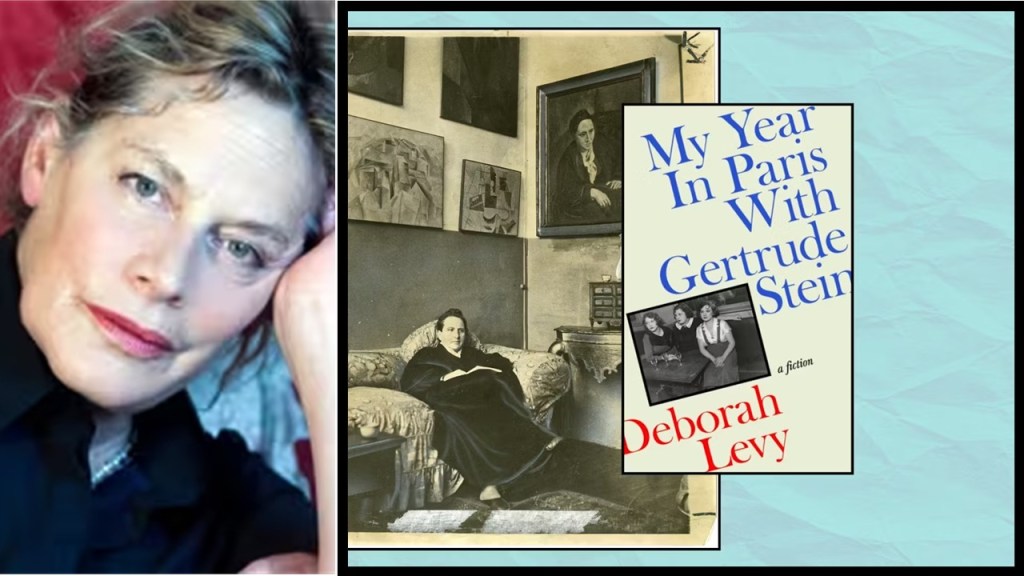
When we regret imprecision in our speech or writing, the reason turns out to be so often the use of the word ‘it’ as a pronoun, to refer back to too many, too distant, or hidden potential nouns for being summarised as ‘it’ in the utterance or paragraph. Here is Google AI mode on the issue:
Using “it” in a confusing way often stems from ambiguous pronoun reference, where it is unclear which noun “it” replaces, or using “it” as a dummy subject without a clear context. This leads to sentences that are hard to follow, leaving the reader or listener feeling bewildered.
Common Ways “It” Becomes Confusing:
- Ambiguous Reference: Using “it” when there are two or more potential nouns it could refer to.
- Example: “The computer connected to the printer, but it broke.” (Does “it” refer to the computer or the printer?)
- Missing Antecedent: Using “it” without having previously mentioned the noun it represents.
- Example: “I finally got it finished.” (What is “it”? The report? The homework?)
- Hidden Antecedent: Placing the noun too far away from the pronoun “it,” making the connection hard to track.
- Vague “It” as a Dummy Subject: Using “it” in a way that doesn’t actually refer to a specific object or subject, making the statement overly abstract.
Tips to Avoid Confusing Usage:
- Be Specific: If “it” could refer to more than one thing, replace it with the noun.
- Check Proximity: Ensure “it” is close to the noun it replaces.
- Use Descriptive Words: Instead of “it,” use noun phrases (e.g., “the report,” “the situation,” “the problem”) to clarify meaning.
So much is that the case that Deborah Levy has written a novel about the imprecision, whilst insisting, in my view at least, that sometimes the obscurity of reference in the pronoun is worth preserving, as one many issues underlying the use of pronoun that we properly (in as much as grammar constitutes the rules of propriety in a language) are asked to call the ‘impersonal pronoun’. The narrator’s part in Levy’s novel literally ends with her hearing from her friend Eva that that she will write ‘for you’ (this is an echo to which we have to return) a book, a kind of autobiography, the narrator ought to write instead of researching an ‘essay’ on Stein, of which, she says, ‘the title will be My Year with Gertrude Stein’. Of this, Eva says in a sort of obscure summary, using many repeated concepts from Stein and this novel but notably the search for the ‘bottom of it’: “Gertrude Stein was a big presence, but I don’t think anyone can ever get to the bottom of it”. [4] In a book in which certain phrases that talk about the impersonal pronoun echo for me, the one I keep returning to is this that speak of Stein: ‘Creating herself. Creating themselves. The performance of it. The confusion of it. The pleasure of it. Gertrude Stein’. [5]. Herein is the reasoning of the impersonal pronoun as it moves beyond personal pronouns, so scarred by gender in every language (herself not himself) to plurals that counter binaries (themselves) to an impersonal that is what it is only as it performs, confuses with multiplicity and option and pleasures. It is the created and the made in art, including performance art, and what art is not, in some way a performance.
Let’s look back at the near end of the novel (the end of Chapter 32 where the central ‘throuple’ of the novel: the 3 women Eva, Fanny and the narrator – although the word is used to describe the relationship of another three women, the narrator, Gertrude Stein and Alice B. Toklas – are beginning their separation by leaving Paris on different paths to different goals. Eva prompts the disintegration of the three: ‘We are moderns’ … ‘We do not linger in the past’. [6] She intends to return to her husband Hamish, who whose prior loss in the novel she appeared to the other two women to mourn less than the loss of her cat. Nevertheless, the three women are now prompted to begin to piece together how they all met in the past but only in the knowledge that each will now move on to a different future. Eva had propelled the action of the novel from the first chapter along a long search and quest for her lost cat, who she called ‘it’ (the novel’s first sentence being, as already quoted in my title: ‘Eva called to say she had lost it. / She meant her cat who had gone missing’. [2]). Perhaps to persuade Eva to change her mind about leaving Paris, having failed in this purpose to persuade Eva that, as a ‘Danish Spanish immigrant’, it is likely that in Trump’s America she would be deported, responds to the explanation by Eva of her decision to go in the quotation below, Fanny (who all along before this had tried to persuade all three women to call the cat ‘it’ by the name of ‘Bob’) now reverts to ‘it’ to increase the pressure on Eva by reminding her she is abandoning ‘it’:
         "I have finished my graphic novel and that is what I came to Paris to complete. How do you think I earn my living? I am an artist with a commission. And now I am going to sell my novel to America and live with Hamish in the house he has built for us."
         "And what about it?" Fanny said, hands on her narrow hips.

What is it?
          America. A land of immigrants.

If Bob was trying to find his way home to Montmartre, it seemed that Eva was trying to find her way back to make a home. [
In transcribing that quotation I use WordPress’s verse mode as the only one capable of preserving the variation of indentation of paragraphs (or their absence) and line spacing differences, because both of these issues in the presentation of text have an affect on its meaning. Who is it, hearing Fanny, of all people – the one who wanted ‘it’ to to be named ‘Bob’ – who says ‘What is it?‘ and demands it break the line and indentation rules in the text around it, except for that paragraph that forces ‘it’, the cat, to be ‘Bob’, the cat, with a male sex/gendered personal possessive pronoun ‘his’to boot. It is the same force that reverts Eva to normative sexuality and sex/gender too, as she returns to a home made by her husband as ‘her’. It is a force that allows ‘it’ to refer back to as many prior nouns as it likes, even ‘America. A land of immigrants’, to critique the world of modern politically rightist America, that institutes severe immigration controls, and a homogenisation of its citizens. It is a dense bit of reading here, turning around the capacity of the impersonal pronoun ‘it’, to be – well – impersonal and apply itself to multiple things and concepts regardless of any binary that seeks to regulate it. This is I think one of the most moving as well as cognitively dense uses of ‘it’ in the book, but we have been prepared for it over the long duration of the short novel.
Our first introduction to the ‘confusion of it’ is one Levy uses from a passage in Stein’s The Autobiography of Alice B. Toklas, one that has always puzzled me without understanding why because it did so because in a sense the passage appears lucid. Others not so ‘lucid’ were available. Look, for instance, at one I have examined before in an earlier blog – linked here – on her book The World Is Round (for my blog on Francesca Wade’s stupendous life of Stein follow this link).Which follows up the story in the illustrated Canadian version of chapter 26 below:
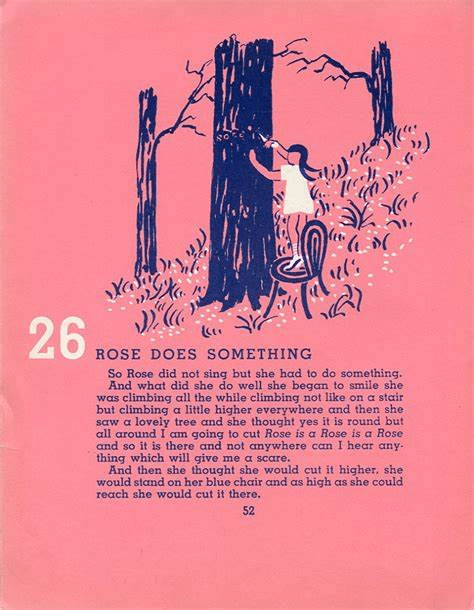
… she was cutting in the last Rose and just then well just then her eyes went on and they were round with wonder and alarm and her mouth was round and she had almost burst into a song because she saw on another tree over there that some one had been there and had carved a name and the name dear me the name was the same it was Rose and under Rose was Willy and under Willy was Billie.
It made Rose feel very funny it really did’. [8]
Ask yourself the question? What made Rose ‘feel very funny’? What is it? Is ‘it’ the ‘same it’ (the absence of commas makes this phrase directly available to us) that appears to have ‘the name Rose’ as its referent – and hence the ‘same it’ – or is the ‘it’ that makes her ‘feel funny’ the fact of Willy underwriting or being under Rose (for the name Willy is under Rose’s name) and even more so Billie (who is under Willy and once was what Willy now is). ‘No answer’ comes the rotund reply from the passage – as rotund as her eyes and mouth. Gertrude Stein used ‘it’, however, also in ways that don’t sound confusing or incoherent, but are entirely the vehicle of noun phrases, that only lose clear meaning when they are examined. Levy makes sees this I think and thus emphasies all the more Stein’s intelligence, by choosing a piece of Stein’s prose as one of her epigrams (the other is about games of being lost and found like ‘it’ the cat) that appears entirely lucid, as everyone says the book as a whole, the passage come from does: [9]
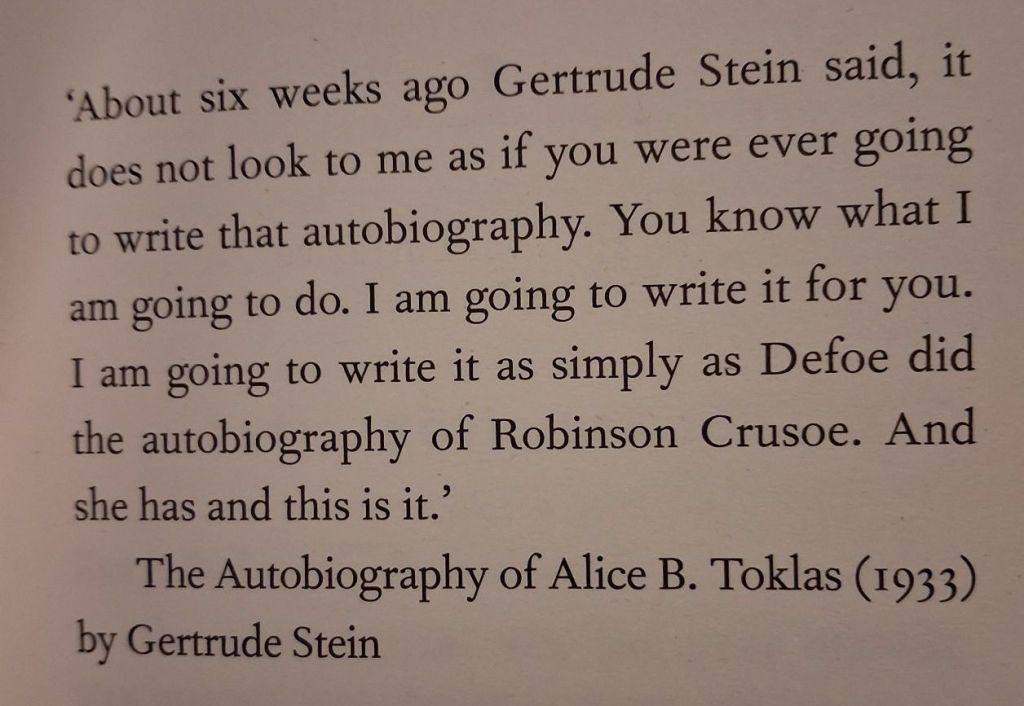
Is ‘this is it’, but what exactly is this? The obvious answer, given the obvious referenced noun is ‘that autobiography’. Yet it isn’t true is it that ‘this’ is ‘that autobiography’, for ‘it’ is one written in a way that wasn’t intended for that autobiography by its subject but for an autobiography written by someone whose life it did not tell, in the simple style of a notoriously ‘other’ fictional autobiography. What is it? Is it this, or ‘that autobiography’, or something other. In the novel, ‘it’ can be quite radically dislocated from obvious referent and / or meaning. Sometimes the dislocation is puzzling obvious, as in the comparison the narrator makes of Gertrude Stein with a major determinant of the consciousness of the modern other than Karl Marx, Sigmund Freud, initially focused on the coincidental fact that both were medically trained but had diverted into psychology, Stein under the tutelage of William James, the theorist of the fluidity of modern consciousness – as Freud was that of the modern ‘Unconscious’ and that both had ‘art collections’. After several pages of illuminating cross-referenced quotation, the narrator says:
There they are, Freud and Stein, preoccupied with their mutual collections of art, ancient and modern, searching for it.
           What is it?
           How we put ourselves together. [10]
The more you read this the greater the problems. Take the strange choice of the word ‘mutual’ when we might expect ‘respective’ to describe that fact of the difference between the collections – Freud’s being of ‘ancient’ art, Stein’s of decidedly ‘modernist’ modern art. The only way we can justify the adjective ‘mutual’ is that both collections were mutual in their purpose expressed in the phrase ‘searching for it’. And searching for what? Thence follows that ubiquitous queer question that queries the meaning of ‘it’: ‘What is it? Lots of its are lost and searched for and not usually found other that the call called ‘it’, that others call Bob because ‘we know where we are with Bob’. [11] The literary joke behind all this is that Freud’s contribution to psychology was to stress the role of the Unconscious and therefore unknown in psychology, a mental function he called in German ‘Es’ (literally ‘It’ but translated to the Latin ‘Id’ by English translators) and which he saw in dynamic interaction with the ‘ich’ (literally ‘I’ but again the Latin’ ‘ego’ in English translation) and super-ego. The whole point of the ‘I’ being ‘where the ‘it’ was in Freud’s formulation is as it is with Bob,, we know where we are with ‘I’ but not ‘it’.
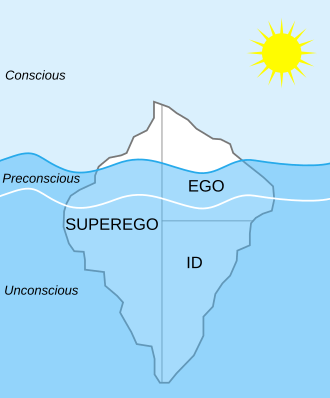
Personally, I think this diagram over-diminishes the ‘It’ (ID).
The text sometime proposes an answer to this question ‘What is it?’ as it recurs. In the passage above the proposed solution is ‘How we put ourselves together’. But note the ‘we’ here – does it refer to how people in relationships, couples, throuples, or more, including social groups ‘put ourselves together’, or is the plural merely standing for the fact all people have a mutual task, with different solution for each of putting themselves together. At other points it stands for the principle of ‘composition’ in painting (the theme of modernism the novel tells us from the work of Cezanne onward to Picasso and Matisse – see page 52), as well as the psychology of the self or selves, as in the following assertions from earlier in the novel about Stein as deracinated writer-psychologist, ‘made’ immigrant Jewish-American or remade European, lover and art collector. Take, for instance, this contemplation of what it is to be ‘yourself’:
How do we put ourselves together? Stein, the daughter of immigrants, was obsessed with what she called ‘composition’.
Composition from the Latin componere, meaning ‘to [put together’ or ‘to bring the parts together. [12]
And then consider this, speaking of how the young medical student of developmental neurology Stein transitioned to whatever it was she became:
There she is. A future pioneer of the modernist movement wearing a blouse with large puffed sleeves and a bell-shaped skirt stiffened with a lining of horsehair. Sitting at a desk in the laboratory staring down a microscope, one of the early female sudents at Hopkins taking a medical degree. She will eventually stare at modern art instead and try and work out how it is put together. She had no idea of how to put herself together. [13]
Note the aim here is to as ‘how it is put together‘! Searching for it and putting it together are two cognate ideas. Lots of the ‘its’, as well as the cat ‘it’ are things lost and hard to find even though we search (or re-search) them. Sometimes the lost ‘it’ is unclear: ‘I had lost it. Gertrude Stein’. [14] At other times the term appears to be the lost we seek through wet Parisian streets but then is queried as perhaps being somewhat other than the cat, something like a psychological trait:
I am hiking in the rain in the hope I might find it.
        What is it?
        Daring.
        Courage. [15]
Is a lost ‘it’, an ‘orphan’.[16] The only thing that always get found when it’s lost is Jean-Luc’s stick: ‘Somehow it found me and will not leave.’ [17] Is to be lost to lack roots or be ‘deracinated‘ in a later term of importance in the novel, that links to the them of migration, especially immigration. [18] Is ‘losing’ some ‘it’ essential to gaining a something else or just something with a name: Stein’s artistic aspiration:
Gertrude Stein was becoming something.
She was losing it.
She had to.
What was it?
Being nameless. Sitting in the shadows.
This set of words with a ‘What is it?’ comes as Stein’s career begins to move into that of a known writer and recognition by Alfred Stieglitz, whom he had before seen as ‘a woman, dark and bulksome’ [19]. Later, ‘Alice B. had lost it. / What is it? / Drudgery. / Housekeeping …’ for men. [20] Art movements too like ‘modernism by losing some other it, as in my title quotation: ‘Why was it degenerate? / It had lost it. / Lost what? / Representation. Naturalism. Nostalgia. Obedience. Conformity. Certainty‘.[3] Perhaps even it the cat has a chance of being renewed: ‘It was lost. / It was having something to live for’. [21]
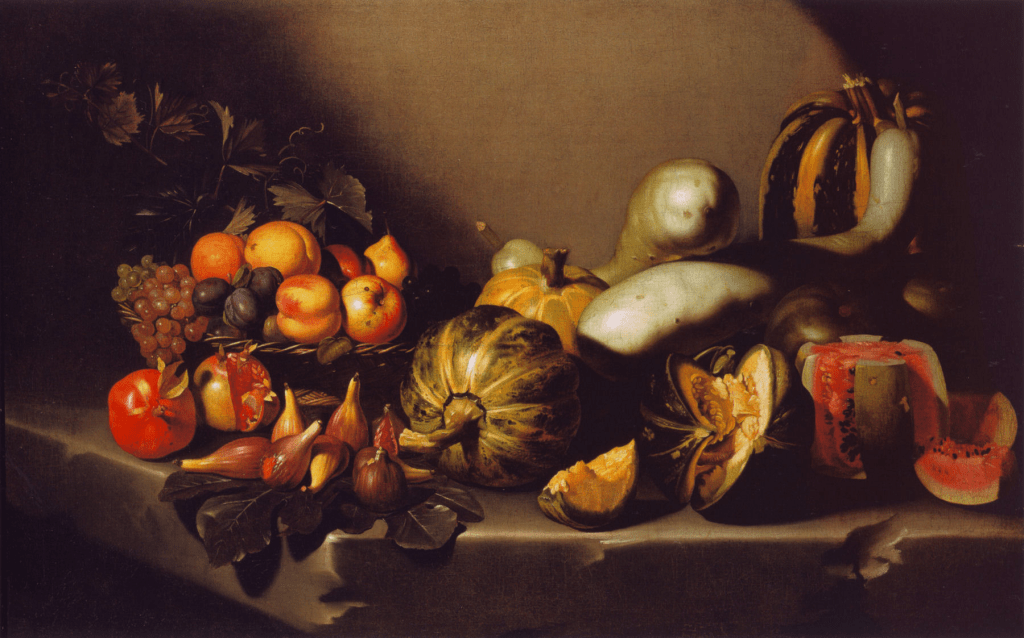
And of course, there is a more obvious modern colloquial sense in which one is said to ‘have it’, or be ‘losing it’, wherein the question ‘What is it?’ rarely has to asked but seems near equivalent to mind, or spirit or ‘having something to live for’, that fits into the theme of suicide in this novel, almost as if it had learned this from Jean Rhys’ Paris novels (see my blog on Miranda Seymour’s brilliant Rhys biography at this link). Eva threatens to ‘jump into the Seine’ if cat ‘it’ isn’t found, at which point the narrator notices she has a ripening persimmon on her window ledge to ripen, apparently without relevance to her comment.Later Eva proposes group suicide for the ‘throuple’ if there is a war, as there was for Stein. Eventually the persimmon returns, in a painting: ‘It did look quite suicidal pierced precariously on the ledge. …. Was the persimmon a surrogate for her cat, or had she projected herself into the persimmon, or was it just a still life?’ [22] The idea of a still life on the moment of suicide from a ledge with the thoughts of a possibly dead cat called ‘it’ is a rich one, especially in sentences beginning with ‘It’. It reminds you of the association of still life with death, perhaps even Fruits on a Ledge, putatively by Caravaggio.
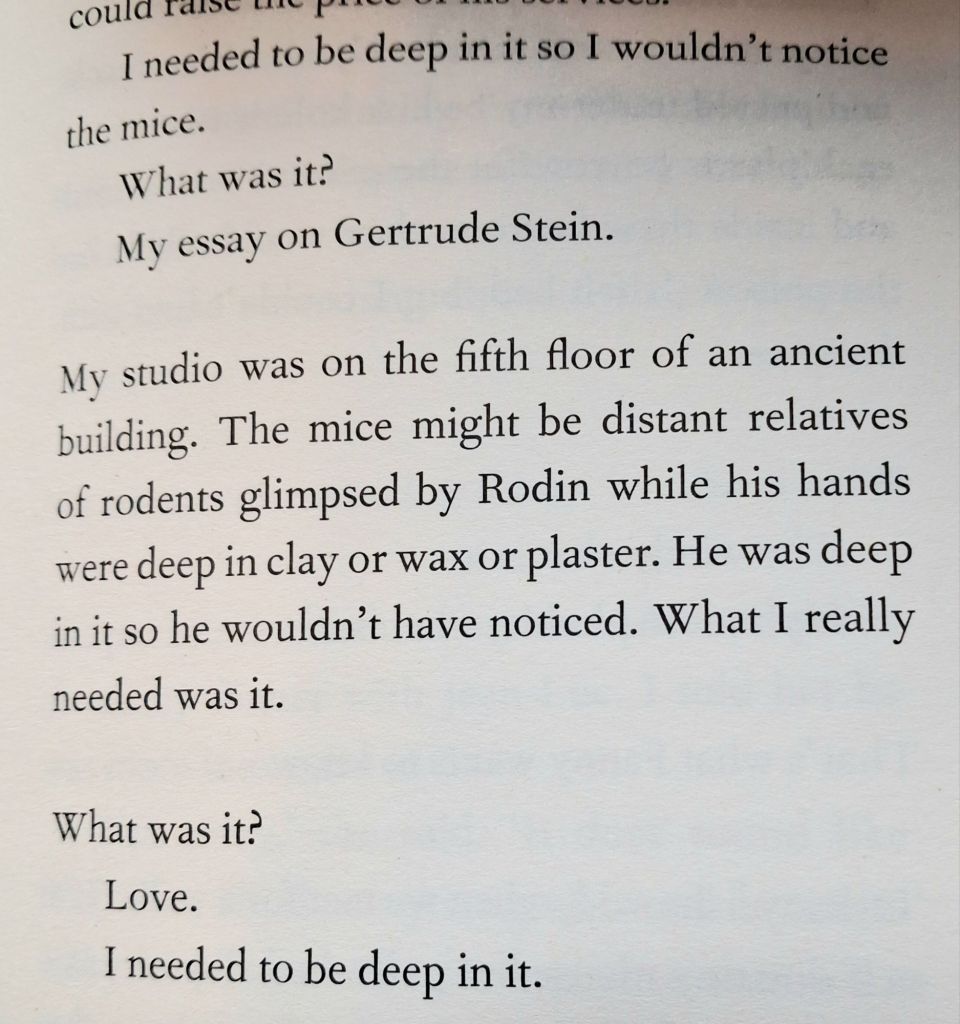
I think we can see that ‘it’ is a deeply structured impersonal thing, akin to an existential statement (‘It is …’) more profound than Yahweh’s ‘I am that I am’ or Descartes ‘ cognitive shadow of that made visible and tangible by Rodin’s The Thinker (Cogito ergo sum – I think therefore I am), because it is something larger than being yourself, something you can be ‘in’ and contained by not just ‘be’. This seems to be part of a desperation of the later repetition of the question when the narrator, plagued by mice needs to be in something to evade tiny disturbances. Is ‘it’ her ‘essay on Gertrude Stein’ or is it ‘Love’. Whichever, or something else: ‘What I really needed was it’: [23]
At various times the ‘What is it? question yields various variants of things to be in or with like dying in a certain tree , inside the being of the ‘wind’, being in, until it is lost and finally sacrificed, ‘the life of (a) mother’, and so on, many of which instances I have already cited above. [24] Stein was a fundamentalist. She wanted to get to the ‘bottom of it’, called her language a ‘bottom language’, perhaps with an echo of Shakespeare’s Bottom (in A Midsummer Night’s Dream)on his dream that he names after himself ‘because it hath no bottom’. [25] Bottom matters here because he gives up thinking he will ever get to the foundation of his dream, but that is, this novel asserts in its narrator, the case with Gertrude Stein, and the narrator trying to ‘understand’ Stein and the defence of a life that evades suicidal responses, whilst in the midst of wars and international contradictions and the need for profound personal change. Does understanding, particularly getting to the ‘bottom of it’ really matter as much as living in it, and its confusions, performative demands and the rest. Hence my favoured piece of the whole of this beautiful book, already in my title: ‘Stein had put so much in the way. In the way of understanding. She did not believe in it’. [1] Why would you need to believe in ‘it’, whether it be understanding, the Unconscious or your lost mother (or cat called it), if you can live in it, deep in it and survive. And so to the other epigram of the novel from the wonderful Donald Winnicott on why children play with reality: ‘It is a joy to be hidden, and a disaster not to be found’. For lots of things (notably things called ‘it’) are lost in this book and some are not found, and it is not a disaster as children awaiting the good-enough mother to find them feel it to be. The phrase itself is mirrored in the novel. Here is one example, concerning Stein’s desire, as a beginning writer, to be understood or not: [26]
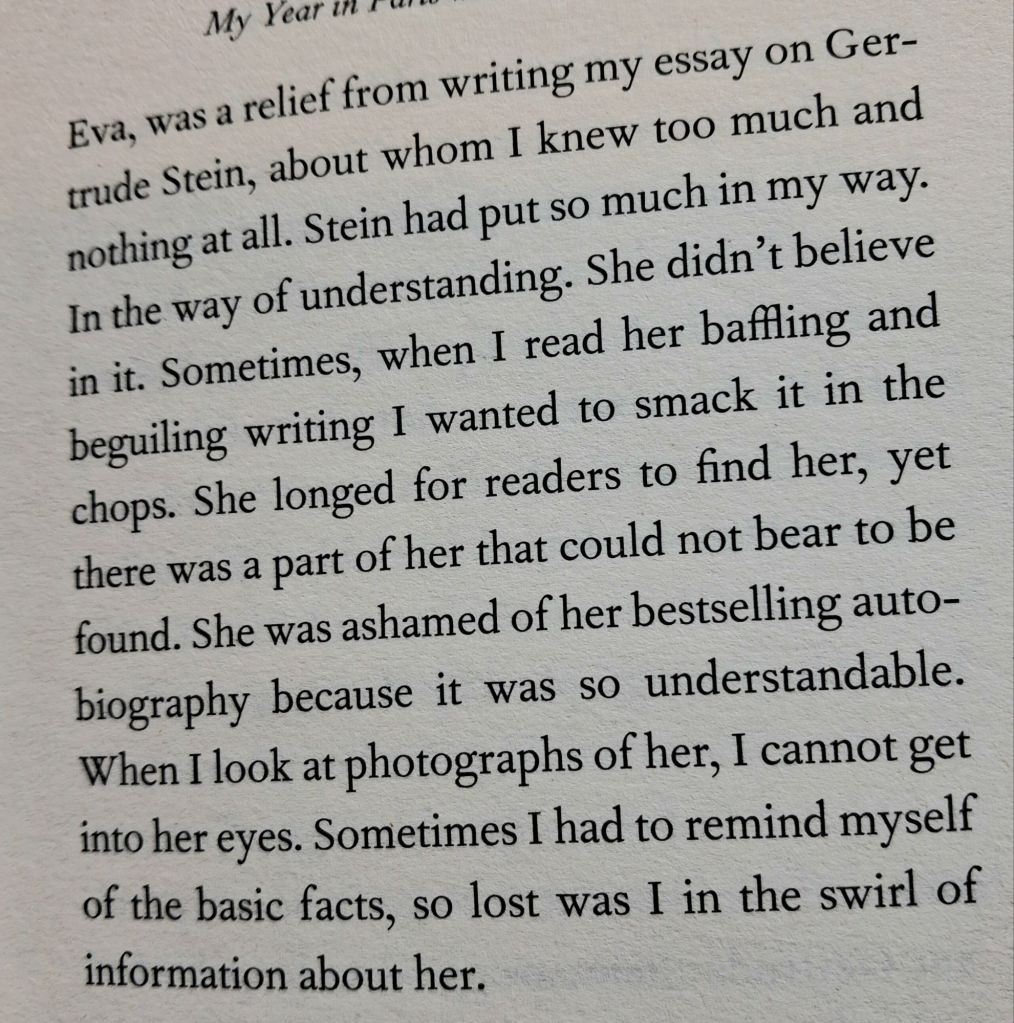
I love that writing. It is the perfection of Levy, who I always red though I do not always keep her for rereading. This one I must and will – but only in part because she is a perfect writer, for that goes with all her books, but because it moves us nearer to Gertrude Stein, and that is worth a lot to me. And, I agree, I am not sure I believe in the primacy given to ‘understanding’ in all realms – sometimes it defects from deep learning, because it puts articulation needs before the purpose of learning, whatever it is! If you need more lovely expression of it see this:
And I was thinking about Gertrude stein’s definition of intelligence as knowing something before you knew it.
I knew something about it that I did not yet know. [27]
Or this:
Was it madness to glimpse a greater meaning hiding in plain sight amongst those words? Yet, is not that wehat litersture is for? To search the hills for greater meaning hiding in plain sight?
It is hard to know. [28, my bolding]
Do read this novel
With love
Steven xxxxxxxxxxxxxxxxx
________________________________
[1] Deborah Levy (2026: 5) My Year in Paris with Gertrude Stein: a fiction, Hamish Hamilton, Penguin Random House.
[2] ibid: 1.
[3] ibid: 117.
[4] ibid: 224 – 225
[5] ibid: 30
[6] ibid: 216 – 217
[7] ibid: 218 – 219
[8]Gertrude Stein (1939: 51) The World Is Round London, B.T. Batsford Ltd. cited in my blog: https://livesteven.com/2025/06/15/the-name-dear-me-the-name-was-the-same-it-was-rose-and-under-rose-was-willy-and-under-willy-was-billie-it-made-rose-feel-very-funny-it-really-did-the-propriety-and-ethics-of-name-dropping/ See blog for illustration page also in the Canadian edition.
[9} My photograph of the first of the novel’s epigrams that face the copyright page in ibid.
[10] ibid: 199
[11] ibid: 2
[12] ibid: 7
[13] ibid: 17
[14] ibid: 6
[15] ibid: 19
[16] ibid: 36
[17] see ibid 114f.
[18] ibid: 151, repeated 164
[19] ibid: 85
[20] ibid: 98
[21] ibid: 141
[22] ibid: respectively 9, 44, & 66f.
[23] my photograph of ibid: 173
[24]see respectively ibid: 111, 153, & 180f.,
[25} see as instances ibid: 79 & 225.
[26] my photograph of ibid: 5.
[27] ibid: 175
[28] ibid: 183 .
 Steve_Bamlett_blog