


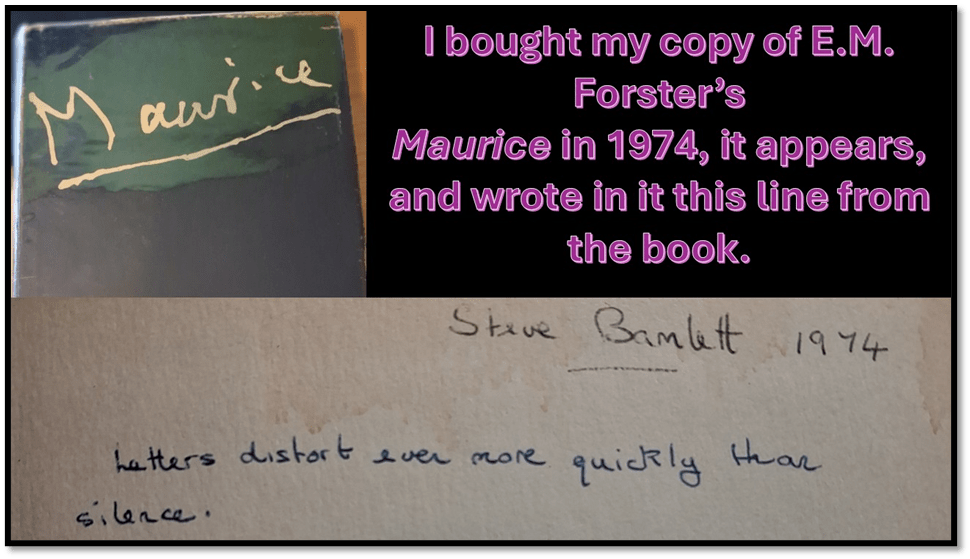
It must have seemed a mystery to me, else why did I write it so carefully on the front endpaper of my copy of Maurice (written in 1914 but first published in 1971, and mine was a first edition), at the age of 20 to consider why it seemed to matter so much to me – in those days I believed in a ‘soul’ . It seemed portentously to say that everything lovely was or became distorted in writing, both in what was already written (letters seems to mean both the characters used in a written language, the correspondence between people – even potential lovers, and the short form of the word ‘literature’) and in the things you yourself wrote in order to justify or confess yourself. At 20, we imagine we have undergone a lot and this may have been especially the perceived case for queer men of my age and time then, for the images available in writing of queer loving were so few and often either figures of fun for an audience alien, or forced to be so by the culture they aped in order to ‘fit in’, to the substance they might have tried to convey, of suspicious or downright evil suggested predation or tragic ‘victim’ figures consumed in loss.
The temptation to write your love to someone or of and about someone seemed dangerous because what you wrote was either filtered into distortion through your fears and damaged self-esteem or in the eyes and ears of their recipient, whose filters for what you said were compacted of prejudicial images and/or pre-distorted image filters. So loud was the background noise filtering ideas of loving another man, that even silence distorted what you could not say in that noise. And, if distortion were inevitably the end to which love was aimed, why compound it in letters? Whether the letter was a private one to your roommate or a novel – say Maurice – you might prefer to stay silent, at least in public spaces as Forster did from 1914 to his death, or self-distort the image such that its coded realities could be encoded by those in the know. Such codes involved adopting a vision or point of view thought of as female, as in A Room With A View, as Forster did or leaving clues for later extension in a more empathetic climate, as in his novel The Longest Journey.
When I transcribed that sentence from the novel in is front endpaper it seemed a thing I would never get my head around – it comes inside the novel’s story from the days, weeks and year after Maurice had parted from Clive, his lover in Cambridge, and in the wake of Clive marrying, taking up his role as a conventional Tory landowner, and reconstructing his past with Maurice as an ‘aberration’, about the nature of which he wanted both himself and Maurice to agree. Should Maurice write his love in a letter. No! For ‘letters distort even more quickly than silence’. It was the mystery of the inevitability of distortion that puzzled me then, because perhaps I did not think in as nuanced a way about the noise that lies behind silence as I should have done.
At the time I was reading Keats too, who says something similar about the effects of those things written in letters, ironically in one of his most beautifully tragic letters. Perhaps I wondered, it was a general truth that no beautiful thing lasts for ever, and that Keats knew he was writing of the lies of fiction in Endymion, from the offset:
A thing of beauty is a joy for ever:
Its loveliness increases; it will never
Pass into nothingness; but still will keep
A bower quiet for us, and a sleep
Full of sweet dreams, and health, and quiet breathing.
Therefore, on every morrow, are we wreathing
A flowery band to bind us to the earth,
Spite of despondence, of the inhuman dearth
Of noble natures, of the gloomy days,
Of all the unhealthy and o'er-darkened ways10
Made for our searching: yes, in spite of all,
Some shape of beauty moves away the pall
From our dark spirits. Such the sun, the moon,
Trees old and young, sprouting a shady boon
For simple sheep; and such are daffodils
With the green world they live in; and clear rills
That for themselves a cooling covert make
'Gainst the hot season; the mid forest brake,
Rich with a sprinkling of fair musk-rose blooms:
And such too is the grandeur of the dooms20
We have imagined for the mighty dead;
All lovely tales that we have heard or read:
An endless fountain of immortal drink,
Pouring unto us from the heaven's brink.
The strain is there – almost in contradictory irony in those lines, al;most as if you read their shadow as you spoke them:
A thing of beauty is joy for few days
Its loveliness decreases; it will always
Pass into nothingness;
Does the ‘pall / From our dark spirits’ stay exactly where it was though, no – it distorts that thing hidden under its cover.

In these days we seem immune from mystery because letters are universal – tapped into the ether on laptops and smartphones, short emails (or even more so longer ones that seem so obsessively self-serving) give way to ever briefer DMs (direct messages) – easily deleted, at least from the hardware that stores them, but not always from the noisy brain busy distorting them under the pressure of noises and voices both external and internal (the latter both from memory and reconstruction – and sometimes redestruction).
Now, I think loss is perhaps a positive response to the fact that at some point people – including oneself – fail to receive (in the fullest sense) what they read, but receive what they think must be meant, or count as delusions the denials and nuancing of messages, so that they read their disbelief in the person’s protestations. Loss anyway is not necessarily a passing ‘into nothingness’, for the lost object lives differently in us – not stuck in amber like Miss Havisham’s bridegroom and transformed into a generalized bitterness about the world and interactions in it because the amber is as impossible to pass through as time itself, but as a living breathing thing known as what might have been perhaps but not as a counterfactual in history, but an alternate path, if you see it that way, to the future. Of course, you need to realise that ways of skewering things in one time by writing them down oft not only distorts the thing skewered but means that it dies even if not visibly distorted, it is within – like the butterfly collectors encased specimens. Letters distort more quickly than silence but if we embrace the distortion it may be still a thing of beauty, though its life is in the letters not in the object about which they speak or are addressed. Beauty of communion is not a thing you can grasp and hold. It lives in a delusional ‘us’ (from the perspective of a single time) that should it be realised in moments will reflect what love and spirit means. But it remains a ‘mystery’. Some of the noise that lies behind silence is beautiful too, after all, or perhaps we all want to see ‘scars, failure, disorder, distortion’ in our imperfect beauty, the only true one.
With love
Steven xxxxxxxxxxxxxxxxxx

