


I read this book and it changes you. ‘In his preface to The Spoils of Poynton, Henry James talks about this idea of a “germ”, what he called “a mere floating particle in the stream of talk”, something that “has the virus of suggestion”. Life, as James would have it, is “all inclusion and confusion”, just as art is “all discrimination and selection”. If you are seeking the inspiration for a story, then very little is more than enough. Something hinted – a clue, a suggestion – can do more in the imagination than something spelled out’. In Colm Tóibín’s art, as perhaps in Henry James’s art, everything about experience must be implicit rather than explicit, not bluntly spelled out but written with as much ‘nuance and ambiguity’ as he feels he ‘can and also make it matter’. Tóibín claims that only then will he ‘make his arrow hit the mark’. [1] Is this the pattern of a queer art that matters rather than one that is merely an attempt to capture queer life. This blog considers the short stories in Colm Tóibín (2026) The News From Dublin London & Dublin, Picador.
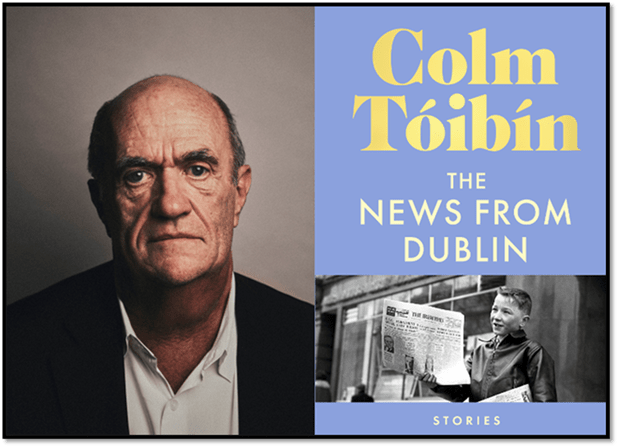
I have written on the novels of Colm Tóibín since I began blogging but that was long after I started reading him. {Check out my blogs at the links here though for House of Names, Long Island, and The Magician.} But as I think about his life’s work, I have to admit that I do not think that the primary aim of Colm Tóibín is to achieve a specifically defined queer art, for his view of narrative and other art remains inclusive, rooted in great traditions of narrative art and painting like the subjects on which he writes critically, such as Jane Austen or James Baldwin (see my blog on his book on Baldwin at this link) in writing or Frank Auerbach or John Singer Sargent in painting.[2] And although I do not think either that Henry James’s view of art is one that exhausts every kind of writing or mark-making that can be still called art, it is without doubt the key to the art that is created by the greatest living queer male writer of our age, who is Colm Tóibín in my view.
I am biased I think to Tóibín’s position on art, having been formed (or damaged, depending on how you view the matter) by an education in literary criticism and, for a space (of about eleven years) teaching it. However, I do not think it not the only position on determining the quality of art, especially narrative art. Neither I think does Tóibín’s practice as a storyteller entirely match his theoretical Jamesian starting points else his novel The Master might not have been possible, which constantly insists that its own art skirts over the surface of Henry James’ queer life. Likewise, his well-known attachment to the novels of James Baldwin can only be ever so Jamesian to a degree, in as much as Baldwin too sometimes felt he himself was heir to that great American, Henry James, to a degree. In important ways Tóibín’s reaction to James’ elite selectivity of focus in subject-matter is crucial in some stories that he felt needed telling. Sometimes we can only react to the messy way that subjects that matter get knottily interlinked in life by doing the same in story and the result is not Jamesian. I will return to Baldwin’s example for it arises in an interesting way in the story entitled Sleep.
But James remains vital to Tóibín. In a fine introduction to his stories published quite separately from them in The Guardian in 2026, he gives an account of a number of ways in which these stories are Jamesian in conception. First, he argues that stories originate as James’ did (James claimed in the preface to The Spoils of Poynton, from a ‘germ’, a moment of experience or knowledge of the experience of others, which is then processed creatively, often over long duration and uneven progress sometimes, into a story. Secondly, the narrative truth of the completed story would not depend on relevance to the story of the ‘germ’, its relationship to the story proper is merely an accident to prompting. Thirdly, ‘the germ’ was not in itself something that was fundamentally a hint that suggested a dramatic confrontation between the values of the characters in it, at least overtly – for such confrontations arise from the storyteller’s nuanced treatment of the subject-matter. Moreover, fourthly and finally the germ, even its setting in time and space, must be regarding a matter that had already occurred and been resolved in terms of the stuff of ongoing life. The place in which the occurrence was set had to be in the past and the story cycle around an event that was (apparently) concluded, in spacesthat ‘could only be visited in (his) memory or in (his) imagination’, as with the room around which the story Sleep centres.
Thus the germ of the story of Five Bridges was simply an experience in 2008 in San Franscisco, quite ordinary in its nature, and without an apparent weight of human significance:
… I went with three friends on a hike near Muir Woods overlooking the Pacific Ocean. At the summit, there was a kind of lodge where you could get a bed for the night and use the kitchen to make your own dinner. The view was spectacular.
A story like The Summer of ’38 .derived from a story told to Toibin by female elder, a historian, who once was invited to meet a general from Franco’s army, whom she had known and pretended to accept fully in her company during the Spanish Civil War. Yet, once the novelist hear that germ of an idea: ‘That was all I needed. I almost asked the historian to tell me nothing more beyond that single encounter on the street’. It isn’t only however that the less one knew of the literal facts of the germ experience was itself a necessity but that any dramatic confrontation in it could be held in reserve or left out entirely to deepen the story’s significance, as again in the story last mentioned but also A Sum of Money, wherein no-one dares confront the apparent sin and crime committed.1 Even more is this the case in the story A Free Man, which dances around the presence of institutionally validated abuses of youth near the centre of Catholic ritual practice and the priestly role.
Yet there is a large fissure in this theory and artistic in the article, especially when Tóibín allows his germ to mix with half-understood energies that emerge from ‘rooms’ or other spaces in the past, where very little has been resolved and which therefore live on in half-life as ‘ghosts’ or ‘dreams’ of which the writer is not in control.
I get energy from rooms I knew but no longer live in, from things that have gone, from spaces that seem oddly haunted and have lodged in the memory or could come back in dreams.
I mentioned earlier that the writer suggests that the story Sleep centres on a ‘germ’ but he speaks of this one in terms of a queerly and strangely ominous passage:
In Sleep, I could venture into an apartment I sublet near Columbia University in 2012 and 2013. I could put my hero in my bed. I could have him watch from the same window as I watched from, with a view of the George Washington Bridge.
But the ‘germ’ here is far from simple and far from lacking dramatic confrontation, though of a transpersonal kind, neither spoken nor spelled out. There is a frisson in the statement about the writer putting his hero in his ‘own bed’, as if he had still not quite vacated it. Due we for a moment see the hero and writer in bed together, and if so for what reason. This is the issue in the story itself where the ‘hero’, an older male, shares his bed and the space of the room with a younger man with unspecified mental health issues, including those only suggested but unsaid in the fact that there is ‘a year missing in your stories of your life, and this makes everyone who loves you watch you with care’.[3] Haunting this story is an empty story whose events may recur, but whose contents can only be guessed, that never gets stated. And, if they do, it is because the germ contains other clues that are not fully stated either, in this case that clue being that the ‘same window as I watched from’ had ‘a view of the George Washington Bridge’.
Tóibín is not filling out all the gaps in his germ her, though it is clear he knows, in this case what they were, because, in the story the George Washington Bridge does not arise alone out of the mind as a view from a window from a room but is tied to its use as a complex setting in James Baldwin’s Another Country (for my blog on this novel see this link). However, when we read the passage from Sleep that notes that moment – as a room from which germinates the whole story we find, as I’ve already said two people ‘put’ into Tóibín’s ‘own bed’ – the older Irish male ‘hero’ himself and his younger Jewish lover, and their relationship full of silences and cautions, about what it is safe for each to know about the other that implicates the George Washington Bridge as almost a symbol of suicide that occurs around it. The younger man becomes a focus of the elder’s fear that he will read Another Country and its story of the bridge. Here is the passage from Sleep first:[4]
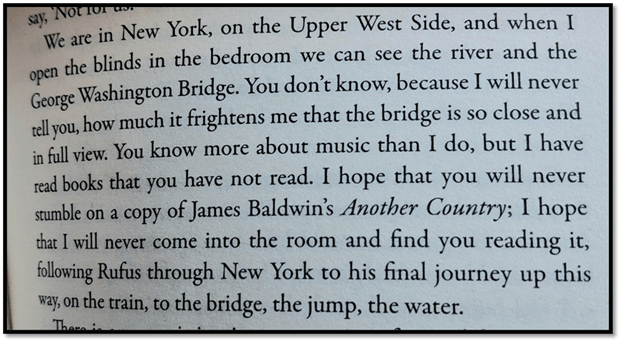
The moment described is entirely visual – emphasised by the opening of ‘blinds’ in order to ‘see’, but though the view is uncovered, the narrator’s fears for his partner’s mental health (which in the story get re-projected back upon him) are not, and seem entirely focused on Rufus’s suicide jump from George Washington Bridge. The hero imagines his partner reading through the journey taken by Rufus to his death, which occurs in the very first section, known as ‘Book One’, of Another Country. That journey takes over 3 pages to narrate up Rufus’ fall into the cold back water.[5] However, it is itself already predicted in an earlier part of the story of Rufus in the novel, when Rufus and the white Southern woman, Leona, who are in a relationship share a view from an apartment balcony very like that. That earlier passage is much nearer in event the one in Sleep above.
In it Rufus joins Leona on the balcony of the apartment where she and he share the view: ‘She was staring up the river, toward George Washington Bridge’. They share a view but their interpretation of what they see is indicated to involve massive dislocation of its meaning. Leona describes that view as ‘just so beautiful’ but we learned a few short paragraphs earlier that it was associated by Rufus with the Harlem river underneath it where he and other black children played on the ‘garbage-heavy bank’ and jumped from ‘rotting promontories’, a dark cold place on the margins of American life, where he remembers one black child dying after leaping from a promontory.[6] It is similar mainly then because it is the marker of the dislocation of the two unlikely lovers’ respective view of New York, for which here the George Washington Bridge stands in both stories.
That this is the ‘germ’ of what the story of Sleep actually is, is difficult to dispute. Of course the issue is different. Baldwin wrote of Rufus in part to balance the idea that black men were necessarily just victims of white society as he saw to be the case in the novels of Richard Wright, for instance, amongst emerging Black writers, without the Black person themselves playing any apparent part in bringing about, or holding any responsibility for, the negative conclusion of so many of their stories. Tóibín writes about it in his introduction to Baldwin’s novel thus:[7]
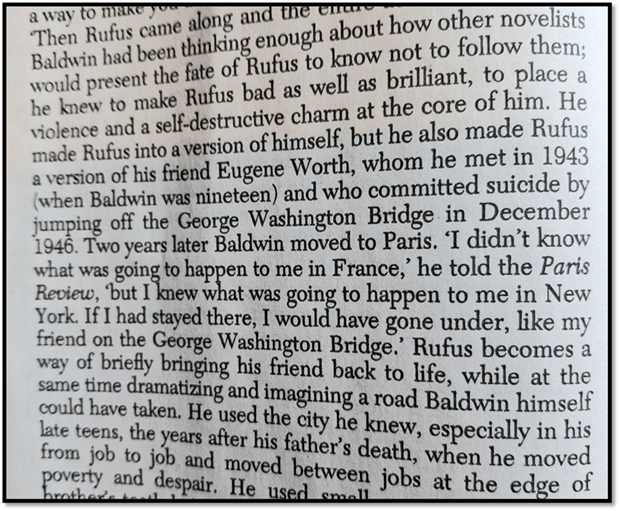
In Sleep, one character is an Irish immigrant and the other Jewish with German-American family memories of the Holocaust that make him wish German music that he listens to was not so sublime. Even though, in the long duration both white former Europeans, are arguably themselves oppressed minorities in the USA, this is not the issue so much though their status as queer lovers may be. This may be so even though the ‘hero’ (the more you repeat the word, the more ironic it seems) is ‘old enough to remember when things were different’ and though he also knows that ‘no one cares now, in this apartment building or in the world outside, that we are men and we wake often in the same bed’.[8] Whatever the issue of their oppressions, shared and individual, the real problem seems to be that the couple in the novel are throughout entirely passive to events that they imagine have already moulded them in the past and to be awaiting a fate that that might be triggered at any particular time by an event as yet unknown. Clearly the passage on Baldwin’s novel is about the fear, and hypervigilance attached to it, of the exaggerated effect of some specific events – such as the partner reading Baldwin. Of his own fear of unspecified things, the narrator says, ‘It is not under my control’.[9] The sense of a fate-bearing fear or angst echoes in both men, who are never more to themselves than their pasts, even, they think, in sleep when pasts are viscerally relived, or so they are prepared to be persuaded.
Germany, Ireland, the internet, gay rights, Judaism, Catholicism, they have all brought us here. To this room, to this bed in America. How easy it would have been for this never to happen. How unlikely it would have seemed in the past.[10]
These men are being driven by the fear of the younger one but the elder, particularly of the unspecifiable in the fear of the elder that he feels must be so ‘Irish’ in nature that it can only be addressed by an Irish psychiatrist. The elder man never challenges that drive from his partner until, at last, he lets the relationship pass into a natural death, and himself into a lonely but deeply unsatisfactory unconsciousness, where he may still shudder with fear in his sleep but there is no-one there to tell him that. Earlier, his thinking becomes so bizarre that he feels that he ought to have been aware that the sound of students talking beneath their apartment window might prompt an unconscious fear in him, but he accepts that interpretation when given by his fearful ‘lover’, as if it were fact easy to be understood, as ‘you do’ he insists to his partner to whom the story is addressed:
I don’t remember how it starts, but you do. … You say that it is more like someone shuddering, recoiling in fright, but still I have no memory of this. When you try and fail to wake me, you are suddenly afraid. I know that everything you do, the way you manage your day, is driven by the need never to be afraid.[11]
Managed by resistance to feeling afraid may well be, I think, the problem for this pair, driven by the younger. They both refuse responsibility for their own union and its maintenance and let what happens in sleep and what is unsaid between them imply a too easy interpretation as being symptomatic of a possible suicidal fate (a fate they know still common to queer men no doubt) and which still dictate their response to each other’s unexplained behaviours. Instead of embracing their ability to change with each other, they stand back from change, fearing even contact with otherness that is not validated by their individual past lives – the lover likes music, the narrator reads novels, but neither seems ready to take the other’s interests seriously and grow them into communion.
Only in hypnosis – reliving he thinks his brother’s death – does the narrator allow a promising if unspecified narrative drive with a tendency to a future to emerge: ‘just a desire or a need, which seems natural, to allow things to proceed, not to get in their way’.[12] For heretofore the couple seem to have allowed almost anything to get in their way, even an innocent view of the George Washington Bridge, allowing it to carry such heavy baggage that they are not able to move at all. How different this from what the pattern of both sleeping and waking is for the purposeless couple who sleep in the same bed in the story’s opening, and who touch each other but only with eyes still closed, as if what they were to each other was just another ‘one’, not a person who could be known :
… it is as though you were still sleeping – there is no sound from you, just a need, almost urgent, but unconscious, to be close to someone. This is how the day begins when you are with me.[13]
This story, if my reading holds water at all, is one in which the story cannot be reduced to a ‘germ’, and it may be that it is the kind of story that resists such herms and spaces (‘rooms’) in the past that contain us in a desire to fight our unconscious reliving of pasts, even those read in novels, that don’t belong to us anymore or don’t need to, at least, and get on with our futures by becoming conscious of our present as a thing that should not be lived in fear. As I come out of the story and the fear it can provoke in its ending of almost unliveable isolation, where no-one hears you scream or even knows whether ‘you scream’, at all. Some stories in order to defend their selectivity as a work of art create barriers and defences against anxiety and fear by merely containing them. In this story I want the men to work with fear and ‘allow things to proceed, not to get in their way’. For fear provoked from the past is real enough but in life we must work through them actively and cooperatively as they proceed, and for a couple that means working through them together, not at a distance from each other as persons. This almost sounds as if I see the story working to promote a queer morality – so be it, even though that is not a Jamesian objective. It relates however best to the fact that the ‘you’ the story is addressed to is the younger man.
I want to posit that that the story works itself out in the relationship between writer and reader – like that of couples who intend their relationship to survive and have meaning, where that is possible – and it isn’t always in messy lives – this relationship must be an active relationship in which the reader is not lulled to sleep by the prose and its beauty but keeps awake in order to understand it WITH the writer, not as a thing handed down by the writer and impervious to re-writing its implications. This is why I consider Colm Tóibín an urgent modern queer writer not just a throwback to the beauty of hard gemlike novel form of the Jamesian aspiration, though not always of his practice, He wants us to feel but he also wants us to see that felt material in his stories are capable of revision. I will try to defend this view later.
Critically, the consequence of the choices for an artist in their art can be illustrated by a good reviewer of it like Sarah Crown. I say she is good because I more than agree entirely with a reading of one story from this collection mentioned in her review of the stories in The Guardian. The story is A Free Man and she say that it ‘is the collection’s standout piece’. She goes on to spell out why:
… in A Free Man, the question of the extent to which our passions define us is the point. The story follows the path of Joe, a man in late middle age, newly released from prison in Ireland and disowned by his family. The nature of Joe’s crimes, and the breadth of his guilt, are unveiled slowly, alongside other details from his life that may – or may not – contextualise them. These gradual revelations are interspersed with cheerless scenes from his current existence: a bruising encounter with a banking clerk; a stuffy hotel room, where he “woke and slept and woke again” and arose feeling “drained” and “desperate”. As past and present unfold in tandem, our empathy builds even as our unease mounts – and Tóibín’s decision to leave us poised between the two, without resolution, sits as a comment on the ambiguity at the heart of the tale. In A Free Man, form and content come together to enhance one another, and the result is a story of profound, disquieting power.[14]
This is a superb critical paragraph and I can only let it stand as it is as a comment on the piece, though I disagree with why the story’s effect of creating balanced empathy with disquiet that we can empathise with the kind of criminal thought to be outside empathy in human life makes it so vital as a work. For me, the ‘disquieting power’ is not the result of craft alone, but of an intense concern with how to proceed with the detritus of the past that Toibin so brilliantly analyses in A Guest At The Feast (see my blog at this link). But why do I think Crown wants to aestheticize the reason why this story is so perfect a marriage of form and content. It comes from a significant disagreement with her generalisations on the methods of the other stories, even those she likes, in the volume.
My chief critical objection is to her stated feeling that other stories suggest a writer of characters, that ‘at times read as dispassionate observers of their lives and circumstances, rather than flesh-and-blood participants’.14 Crown seems to have little or no conception that sometimes ‘abstraction’ and thought process is a resource used in and because of being ‘real flesh-and-blood’ in embodied characters that convince me if not her. I sense the same muted ‘anger’ with reviewers in me now that A.S. Byatt sometimes expressed about those who accused her of over-intellectualising human responses, for when she did, it was because the character would have done so themselves. Let’s take one application of her critique, the first story in the volume, The Journey to Galway. This is how Crown views the story by arguing that it, like other stories, and with this I wholeheartedly agree, always establishes a ‘sense of dislocation’ in characters, settings and even in space (and rooms) :
…That sense of dislocation is established in the opening story, The Journey to Galway, set during the first world war, in which once again the interaction between title and content proves delicately wrongfooting. This “journey”, we discover, is not about attaining a longed-for destination, nor even really about forward motion; rather, it’s a moment of suspension, between one reality and the next. … And it is this liminal time, untethered and provisional, that is the “journey” of the title – a Schrödinger’s-cat caesura, in which the terrible event both has and hasn’t taken place. “Until she appeared in the doorway of that house, there would not be death,” the woman thinks. “But once she appeared, death would live in that house.”
If this seems an oddly abstract reflection for a newly bereaved mother, that’s no accident: abstraction is the essential quality of Tóibín’s collection. Again and again, he takes devastating raw materials – a father on the cusp of indefinite separation from his daughter; a man struggling to save a brother who is slowly dying – and presents them lightly, obliquely, allowing his readers to absorb the breadth of their implications before becoming overwhelmed. Grief, betrayal and moral complication are rendered in calm, frictionless paragraphs; Tóibín lulls the reader into a kind of complicit attentiveness, so that the full force of what has happened only lands after the sentence, or the story, has finished. …14 (my emphasis)
We have seen that only in A Free Man does Crown think Tóibín achieves his aim fully and that otherwise characters ‘at times read as dispassionate observers of their lives and circumstances, rather than flesh-and-blood participants’. This is clearly what is hinted at the picture of a ‘newly bereaved mother’. But that determination that being ‘oddly abstract’ is NOT what we should expect of a mother in bereavement is a gross generalisation. People deal with loss in different ways: some with abstraction, and in the case of the paragraph of the actual story referred to here, abstraction is in fact a means of control, rather than of presenting the issue ‘lightly, obliquely’. The unnamed mother of the dead soldier of the story is taking news of his death to his wife, who in truth should have received it first for the news she carries is in a telegram that was ‘not addressed to her but to Margaret’, her son’s wife in Galway.[15] The pieces as ‘strangely odd’ in Crown’s mind appear in the wonderful paragraph below, which starts by contrasting her own day and its meaning in her mind with the same day in the minds of the men she knows and meets as usual on a journey she clearly often makes:[16]
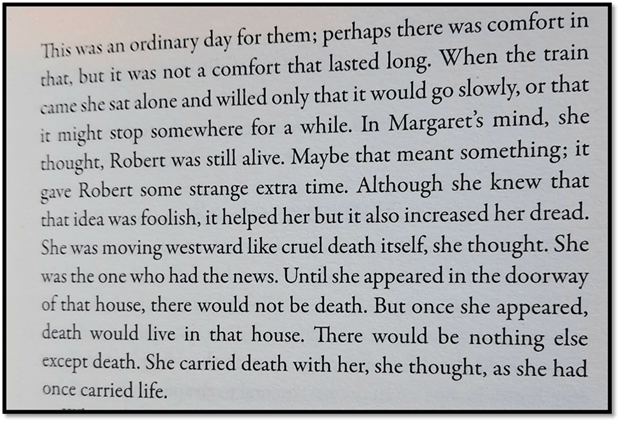
There is abstraction here, yes, but, despite the fact I am not a biological woman I do not find it an ‘strangely odd’ picture of an elder woman, in one way reduced to a ‘carrier’ of someone else’s telegram about a loss that was hers as well as the recipients, a loss of the life she ‘carried’ in a different way to carry a telegram for her daughter-in-law, whose grief must be allowed some formal primacy. That she sees herself as ‘cruel death’ (a very stereotypical phrase) personified is a way of not being absorbed by loss and of thinking of death’s operation as no more than a delivery, not of a baby but of a death, or perhaps even of a distancing style that stands at a remove from raw feeling.
The whole powerful weight of this story comes from its attempt to control grief or to feel what it means for death to ‘live in that house’ to which she progresses westwards. But the sentence ‘There would be nothing else except death’, is very far from being typified as ‘abstraction’. As a carers’ worker I have heard practically the same sentence from people whose lives focus on a loved one suddenly reduce to their death that infects their relationship to everyone. It was for similar reasons that Byatt, long tortured inwardly at the death of her young son, felt the triteness of those who felt her over-intellectual (‘for a woman, they mean’, I once remember her saying).
If anything, Colm Tóibín is a writer who very carefully balances Jamesian practice with more of a kind of romanticism than James ever allowed himself, so obsessed was he by the construction of classical form in art. It is a carefully regulated form of romanticism but akin to the way writing from a germ and fitting form to emergent content is balanced by use of self in his novels, from the very beginning when he would even transpose his experience to a very fine female central character, in The South, his first novel set in Barcelona. I would instance that balance in the longest, and final story in this book, The Catalan Girls, which returns to those days for him. Here is his description of the story from The Guardian introduction to the book already cited
In spring 1988 I decided to find a small apartment in Barcelona. One day, as I waited to be shown around a possible rental, three women in their 60s joined the queue. We spoke for just two or three minutes, but enough for me to discover they were sisters, they were Catalans, they had come back from living in Argentina for many years, they found prices in Barcelona very high. They finished one another’s sentences.
I waited 30 years to write The Catalan Girls. It is, at 30,000 words, the longest story in my latest collection. I imagined the lives of those three women I had fleetingly encountered. I dreamed up how and why they went to Argentina, how each of them lived there, and then how they came back to Catalonia. I made the middle one lesbian, the youngest dreamy and the eldest bossy. I gave them lovers and husbands. I imagined that the bossy one bossed her two younger sisters into getting the same hairdo as she had before they travelled back to Spain.
I moved closer also to what I knew. I imagined the three sisters attending the same festival in the village of Tírvia in the Pallars as I attended in July 2017. I could easily have seen them if I had looked over. I knew what music the band was playing.
Other elements in the story came from memory. The house where the middle sister lives in the outskirts of Buenos Aires is precisely where I lodged in the spring and early summer of 1985. Her room is my room. The apartment where the youngest sister lives, paid for by her lover, is where I also lived in the spring of 2013.1
I loved it that most details from his life are invested in the middle sister, the one he ‘made a lesbian’, and house, in Buenos Aires in the home in which he lodged some time later. Yet here again Crown gets something precisely correct about the story when she says that: ‘The story’s length permits nuances of allegiance, language and loss to emerge, so that when the final, quiet conclusion is reached, it lands like a blow’. It is the ‘nuances of allegiance’ that I like here, which to me signifies the ways the writing shifts its proximity to the characters’ , but especially to the narrator, the youngest sister, Montse (Montserrat), whose distancing picture of her ‘bossy’ and class-bound eldest sister, Núria, is balanced by the hard to explain identifications with that sister, which, in the end always exclude the middle one, the marginalised lesbian Conxita (the happiest sister nevertheless) and her superb dalliances with her, perhaps, employer Maria Luisa and a Catalan artist with whom she goes bathing in the nude.
It is difficult to overpraise this volume for it is stupendous – mature fruit at its most luscious. If you want fruit that changes you – forget the apple in The Garden of Eden. Please read this set of stories.
Bye for now, with love.
Steven xxxxxxxxx
[1] Quotations here are from Colm Tóibín (2026a) “‘I’ve learned first-hand how evil is tolerated’: Colm Tóibín on living in the US under Trump” ’in The Guardian [Sat 21 Mar 2026 09.00 GMT] available at: https://www.theguardian.com/books/2026/mar/21/ive-learned-first-hand-how-evil-is-tolerated-colm-toibin-on-living-in-the-us-under-trump?CMP This is a very fine introduction to this collection by the novelist himself.
[2] For another blog on literary critical and current affairs essays see the link here: Guest At The Feast.
[3] Sleep in Colm Tóibín (2026: 61) The News From Dublin London & Dublin, Picador.
[4] My photograph below of a paragraph from Sleep in Colm Tóibín (2026: 61) The News From Dublin London & Dublin, Picador.
[5] James Baldwin [intro. by Colm Toibin].(2001: 90-93, the novel was originally published in UK 1963) Another Country Penguin Classics
[6] ibid: 26f,
[7] My photograph below of a paragraph from the intro. by Colm Toibinin James Baldwin [intro. by Colm Toibin} op.cit: viii
[8] Sleep, op.cit: 62
[9] Ibid: 63
[10] Ibid: 62
[11] Ibid:65
[12] Ibid: 71
[13] Ibid: 60
[14] Sarah Crown (2026) ‘The News from Dublin by Colm Tóibín review – subtle short stories about being far from home’ in The Guardian (Tue 24 Mar 2026 07.00 GMT) available at: https://www.theguardian.com/books/2026/mar/24/the-news-from-dublin-by-colm-toibin-review-subtle-short-stories-about-being-far-from-home
[15] Journey to Galway in Colm Tóibín (2026: 6) The News From Dublin London & Dublin, Picador
[16] My photograph of ibid: 11
 Steve_Bamlett_blog