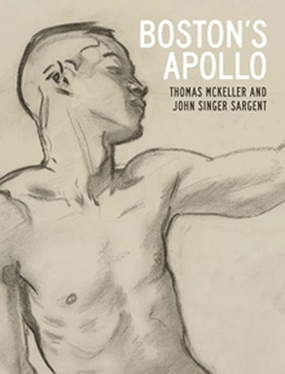
‘Sargent, like James, was fascinated by the world of appearances, by the pose, by the gaze. … in the concealed self, the arranged presence, the surface elements used to hide and reveal, as though painting and sitting were a game, a way of handling and handing over power’.[1] As I see it, Colm Tóibín’s essay in this volume implicitly challenges the history of art as a discipline with a plea for a nuanced social history of appearances and disappearances in both graphic and literary art. Reflecting on the significance of Colm Tóibín’s (2020) ‘Secrets and Sensuality: The Private Lives of John Singer Sargent and Henry James’ in Nathaniel Silver (Ed.) Boston’s Apollo: Thomas McKeller and John Singer Sargent, Boston, Isabella Stewart Gardner Museum & New Haven and London, Yale University Press, pp 117 – 132.
Let’s start with a bow contained in the essay by Tóibín to the renowned curator and Sargent biographer, Trevor Fairbrother. The latter first indicated (as Tóibín tells us) in his wonderful work of 2000, John Singer Sargent: The Sensualist, the perception that his late male nude portraits of a black male model were ‘made with desire’.[2] Trevor Fairbrother is also, significantly for my concerns in this blog, a gay man who braved openness about that fact whilst working and publishing in the public realm when it was not easy to do so. He was also open to the threat to black men and their public identity posed by their exoticisation and sexualisation by white Westerners, including white gay artists like the photographer Robert Mapplethorpe, which was being exposed by the African American artists such as Glenn Ligon, whose work Fairbrother also publicly supported.[3]
There is an essay by Fairbrother in this same volume edited by Nathaniel Silver named ‘1986’. It is named after the year in which he wrote the proposal for acceptance by the trustees at the Museum of Fine Arts in Boston of a work he had publicised first in his popular biography (for Smithsonian’s The Library of Modern American Art) of Sargent in 1994. In that work he entitled the work Nude Study of Thomas E. McKeller. In this central publication he dared to say that: ‘If Sargent suffered through sexual inhibition or socially induced shame about homosexuality, he may have been able to express this part of his personality by painting Thomas McKeller’.[4]
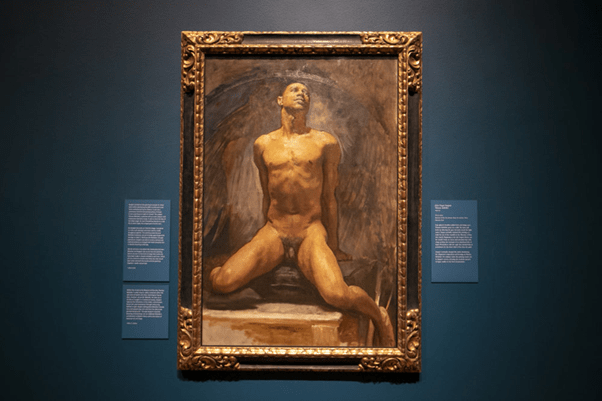
This work is a full frontal portrait from Singer Sargent’s personal collection of a naked black man painted, though unfinished in many senses, by him in 1917-21. Now known usually as Thomas McKeller, it is interesting that Fairbrother in 1994 chose to title it a ‘study’ in order to play down the forces at play in terms of the public exhibition (and inhibition) of a ‘portrait’ of a naked man exhibiting his genitals. This is particularly the case in relation to African American men, though Fairbrother’s text is richly aware of the latter issues even in 1994, where it was not so usual to be ‘open’ in the public discourse of institutions like the Smithsonian at that time. It is this very taboo that Mapplethorpe was later to think he was so radically exposing in his photographs without apparent awareness of the racist effects responded to by Ligon in his ‘artistic response to Mapplethorpe’s depictions of black men’.[5]
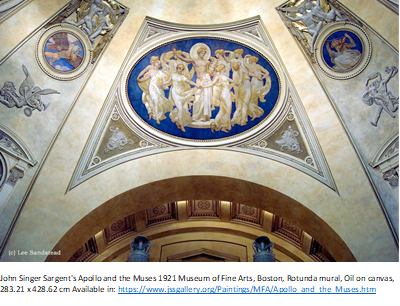
We must keep returning to this beautiful and erotic portrait in this blog, as do the writers for the Boston’s Apollo exhibition catalogue (McKeller was the body model for a that very unrealistically white-skinned Olympian God for Sargent’s late Boston murals). But for now, I want to just concentrate on the care Fairbrother felt he had to take in naming the possibility of Sargent’s sexuality in a conditional clause. In the same way people were likewise careful of references to co-Anglo-American artist (in words) Henry James’s sexuality at the time. By 2000 and Fairbrother’s monograph on Sargent, Fairbrother was able to be much more open in his speculative perceptions about Sargent’s sexuality. As we shall see what Tóibín (and humbly myself) would see as ‘insights’ into the ways and means of experiencing queer sexualities in the early twentieth century are still being branded perceptions. Fairbrother cites Ligon’s brilliant contribution in private letters to himself in the essay of 2020 named ‘1986’:
… I think the difficulty is that gay artists / curators / writers who choose to talk about these issues are always accused of narcissism (gays have to see themselves everywhere) or are accused of doing something terrible to the artist we are talking about …. The “objective” norm is heterosexual. So, for a painter like Sargent, we must be “seeing things” because he could not have placed his gayness in front of the public.[6]
Of course, this happens in quite subtle ways. Let’s take the case of publication from 1999, a year before Fairbrother published drawings from the Album of Figure Studies.[7] This book is edited by John Esten, a scholar of the life and work of Thomas Eakins, and called John Singer Sargent: The Male Nudes. This book sells now second-hand (there was no modern reprints) for high prices in line with other classic and limited run male nude art books by modern artists.[8]
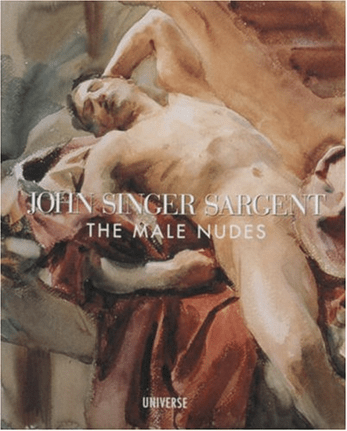
It contains an introduction by Donna Hassler, then a humble curator but now Executive Director at Chesterwood / National Trust for Historic Preservation at Stockbridge, Massachusetts, in the United States. No-one then is better placed for the views of the art historical establishment, at least at the current time. In 1999 she still writes guardedly, presumably in obeisance to the ‘discipline’ of the history of art about Sargent’s ‘strong interest in the male figure as a subject’.[9] This may, of course, always have been intended as a means of saying, without saying as it were, that Sargent’s interest might have been also sexual at least at the level of unspoken and unacted desire but, almost as a routine, Hassler does not follow the route of ‘recent scholarship’, presumably Fairbrother, that has ‘speculated on the homoerotic tendency of this particular work’.[10] Instead she refers to the value of these works, on the first run of explication as studies containing ‘graphical solutions to anatomical problems’ related to the torsion of male anatomies and on the second run a more abstract ‘appreciation of Sargent’s virtuoso draftsmanship (sic.) and important artistic contribution to the timeless exploration of the male nude in Western art’.[11]
Now Donna Hassler cannot be accused of homophobia but her insistence that the objective issues raised by the drawings and paintings is primarily aesthetic has the effect, as Ligon shows, of returning us from ‘speculation’ to objective knowledge, the presumption of which is decidedly heteronormative. I am sure that this is the case with Esten, the editor of this collection also. In his own essay, ‘The Absolute Male’, he likewise relegates issues regarding Sargent’s sexuality to the arena of the ‘private’; characterising those who asks such questions of artists as ‘busybodies and biographers’.[12] This is the case even in citing the words of Nicola D’Inverno, the Italian model whom Sargent engaged at the age of nineteen in 1892 but whom (in his own words), after posing ‘for him for about a year, I became a member of his household’. Sargent also provided paid membership, once his household was in the United States, at the Quinting Hogg Gymnasium.
Esten turns his attention explicitly to the work of Fairbrother in relation only to the latter’s suggestion of any homoeroticism that Sargent may have demonstrated in his male nudes. Esten’s critique is posed in the form of a rather catty and personalised sarcasm typical of academia at the time: ‘Like beauty, homoeroticism is in the eye of the beholder’. Esten’s interpretation of Sargent’s interest is reductive: saying that because Sargent in 1874 ‘“spent a couple of hours every day in drawing from the nude”…’ in order to matriculate from the Ecole des Beaux Arts, that this gave him his ‘enduring subject’: ‘capturing “the human form divine” – in portraits of the fashionable and famous and the absolute male’. The final phrase allows Esten to test out a thesis he was to take further in his future biography of Thomas Eakins.[13]
It is a common strategy for art history to indicate that the history of both intra- and inter-subjectivity is entirely a ‘private’ matter, as if the construction of the cusp between the public and private were not a matter of concern for both ‘history’ and the definition of ‘art’. This strategy remains current and the volume I’m currently addressing redresses the balance of commentators. Most are not art historians, and all favour a psychosocial responsiveness to the issues; one that is literate in social psychology. The redress comes from an essay by Erica E. Hirschler called (the clue is in the title) ‘John Singer Sargent: Academician’. [14]
To understand the relationship of artists and models from two different classes of society more is needed however, I suggest, than an awareness of the academic life class tradition of the national art schools. This is is also true in trying to understand the motivation of persons who become life-class models, which, of necessity, must include some raw appreciation of the power of an unequal labour market in respect of class, race and income. Hirschler opens her argument, much like Esten, by insisting that the paintings for which Thomas McKeller modelled, of white men and women (not that white is actually the skin colour of Greek nationals now and then) were classifiable as ‘an academy, a particular type of study that had occupied Sargent since his earliest training’.[15]
Now I have two issues with where Hirschler takes this undoubted truth, which has been studied from a queer perspective too by Edward Lucie-Smith in a fine Gay Men’s Press (GMP) publication.[16] First, in terms of what the ‘type of study’ implied about the role of models, and the ‘model’s’ understanding of that role, whether ‘professional’ or not (in scare quotes because the term itself, as understood in the twenty-first century at least, is a kind of anachronism). Second, the failure to take into account queer readings of how the tradition of the academic male nude opened up, in the atelier of Emile Auguste Carolus-Duran (1838 – 1917), for instance, the artist under whom Sargent chose to study in Paris, an interest in using paid models to capture one specific man and ‘all his physical idiosyncrasies’.[17] Let’s take these one at a time.
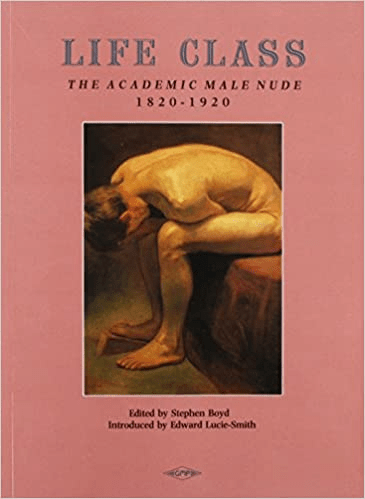
Although Lucie-Smith too calls models in London and Italy ‘professional’, I think there is a problem with a term that carries a burden of nineteenth century value systems. To accept any paid work is rarely a matter only of choice, and although many young men will have enjoyed the chance to share their own self-celebration in their body, this cannot really be read as a ‘professional’ attitude to one’s work and source of (very limited) income, as we will find Hirschler asserting. Lucie Smith argues that models may not have been not only the ‘down and out’ in Paris and London but include working class and lower middle-class men on low incomes happy to receive a fee, however small.[18] Though an essay in the same volume by Lorraine O’Grady, a black artist, makes it clear that, even when Thomas McKeller became a ‘postal employee;, it was in the lowest paid, lowest status and labour-intensive role as ‘mail handler’ in common with other African American employees like him. Those others were often internal emigres too from the oppressive South of the USA whom, even in Boston, had much poorer access to work-role hierarchical progression than white peers.[19] For Hirschler, with much wringing of hands, says that her personal values are those of the liberal present and not those of a past she sees as forgivably ignorant (a past in which Thomas McKeller had escaped persecution in his Southern home town). It feels unforgivable to me that ‘professional’ and well-paid art historians should say that her perspective:
… empowers McKeller as a professional, a model, part of an international community of men and women whose trade it was to appear – or disappear – in order for an artist to realize his or her artistic vision.[20]
…
… modelling was usually a working-class occupation, often populated by immigrants, the poor, or retired and needy military men from the ranks. But it was a profession and a difficult one. Models took their job seriously – …[21]
There are truths told here but I strongly believe that they twist the experience of the consciously oppressed into a hopeful vision for status-quo liberalism, together with much else of the ‘objectivity’ of academic history of art. There is no doubt that McKeller was aware that his good looks and good body gave him access to jobs closed to the less well endowed physically. Few young black men were given chance to take even the lowly role of bell-hop in the elevators of the fashionable and WASPy Hotel Vendome in Boston where Sargent met McKeller in the lift.[22] No-one even imagines how this meeting led to Sargent’s invitation to Thomas to pose for him in the nude in these essays, and to later make this his full-time employment; before it was supplemented by mail-handling. I cannot myself imagine the scene but someone needs to write the novel. Although I do not have time to develop this, I think that we need a radical vision of the psychosocial acts of erasure by which the lives of all black men and women were treated in twentieth-century white post-imperialist cultures. Nikki Greene’s brilliant eassay on this is a good antidote to Hirschler, fenced in as the latter is by the comforting bourgeois values of connoisseurship in the history of art.[23]
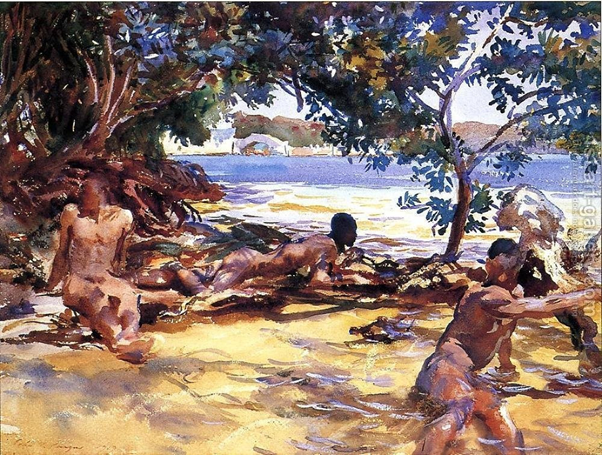
It is in this light that we should return to Fairbrother’s essay ‘1986’, since this is an essay about how uneasily queer men sat in art history, even in the States and even in the 1990s dominated by contemporaries like John Esten and their values, liberal or less so. Ligon’s understanding of this status is very precisely correct, both in terms of the role of the queer curator, yet to come into being, and of the intersectional effect on black queer artists like himself by multiple interacting oppressions. White professionals like Hirschler justify in this condition of things the cancellation of black lives from representation. They also refuse to foreground Sargent’s complicated relation to issues of race, sexuality and status, attributing it to the values of the time. These complicated relationships are shown in the watercolour/gouache works Man and Trees, Florida and The Bathers of 1917. Both paintings were not made public in Sargent’s lifetime but both seek to paint male bodies in relation to environmental interactions, where the senses other than sight are invoked, especially in the brushstrokes representing water in the latter picture, and which still seem to bear the feel of the hand that applied them, as in some Titian effects. The same is true however of his war art paintings of working class white men such as the startling Tommies Bathing (1918) in which the whiteness of skin is an effect of light and shadow falling differently and in abstract blocks of colour, that problematises the vision of ‘whiteness’.
Fairbrother corrects this bias from the parameters of the discipline in his essay but I think his most important perception for us is that art criticism has gained greatly from contributions outside the rigidities of the ‘discipline’s’ borders.
Four decades have passed since I first speculated about his sexuality;’ [see quotation at Steve’s note 4 above] ‘in recent years, despite a few objections from traditionalists and pedants, the topic has met with greater openness (see the essay by Colm Tóibín in this volume)’.[24]
This is more hopeful than I manage to be about the culture of the history of art, especially given the special case he uses. Tóibín is a writer who has written not only on visual art, but novels of a high order, including The Master on Sargent’s near artistic double, Henry James. In particular as a queer artist, he has negotiated a path between expectations of that category – framing queer issues in ways that do not exclude other arenas in which art required its audience to be in contact with unspoken selves and their desires, sometimes secreted even in effects of syntax. Likewise with Jame’s sentence handling, Sargent and complex technique with paint. Paint could cover AND reveal. For both this could happen just as easily in the portrait of a fashionable lady.
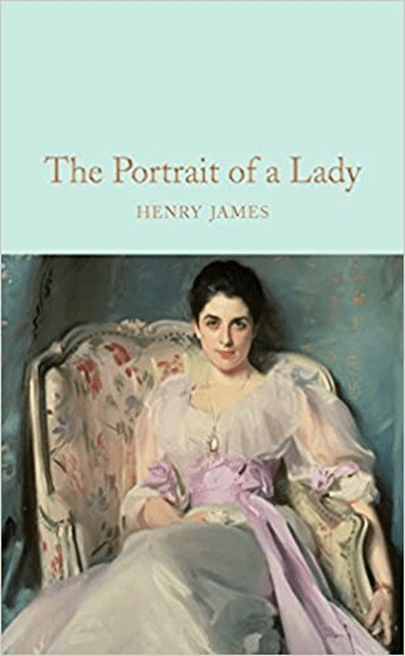
Or as Tóibín puts it, making it clear that what is irreducible in art is the queer nature of the external world and its interaction with the less certain internal arena of desire. Speaking of how James’ inner life is articulated more in private letters and Sargent’s in the private drawings and watercolours and the painting of McKeller, he says:
This is not to suggest that … the frankly sexual portrait of McKeller represents Sargent’s real work, while his other work, as a portraitist of women, for example, is dishonest, evasive, or less worthy of our attention than these powerful and arresting homoerotic images. All of us who work as artists or writers seek metaphors, search for ways of appearing and disappearing in the art we make, offering clues and then finding the world outside ourselves more intriguing and absorbing than the shivering, uncertain world within.[25]
We are in a different realm in the understanding of the history of visual and written art here than in that of the increasingly irrelevant nineteenth century relic called the history of art that still hangs on in our universities. And what a difference to the generalised statements that have heretofore satisfied people as a representation of what Sargent did with portraits of ladies. In the Royal Academy exhibition of the comparative art of the decade around 1900, Robert Rosenblum summarises his role in ways that leave little or no room for any suggestion of subtlety, so sure are they that Sargent’s only aim was to resurrect the faded imagery of the old aristocracies for the new haute bourgeoisie. The latter, he says:
… felt the need to commemorate themselves as people born to lifestyles once fit only for kings. Many cosmopolitan society portraitists helped them crate their self-images. At the fair [The 1900 Paris Exposition Universelle] Sargent, certain to dazzle both his sitters and their audience, showed his triple portrait of Mrs Carl Meyer with her son and daughter, the family of a Jewish banker associated with the Rothschilds. This gorgeous confection would resurrect the Ancien Regime, not only with the Louis XV sofa and Rococo boiseries, but through the renewed image of a drawing-room environment of cossetted casualness awash with delicate pastel tonalities. The informal but staged postures, complete with the thrust of a foreshortened fan, further endorse the sitters’ claims to be members of a new aristocracy. Sargent’s … bravura brushwork so swift in seizing the glimmer of expensive fabrics and jewels, recalls the techniques of masters like Velásquez and Van Dyck.[26]
How vapid is Rosenblum’s Sargent and it is this time-serving artist that I was wont to see before the eye-opening perceptions offered by critics of the value of both Fairbrother and Tóibín. Compare it with Henry James’ vision of a painting that dazzled not by the force of ostentatious show as seen by Rosenblum but of some much richer kinds of nuance:
“Mr. Sargent has made a picture of a knockdown insolence of talent and truth of characterization, a wonderful rendering of life, of manners, of aspects, of types, of textures, of everything”.[27]
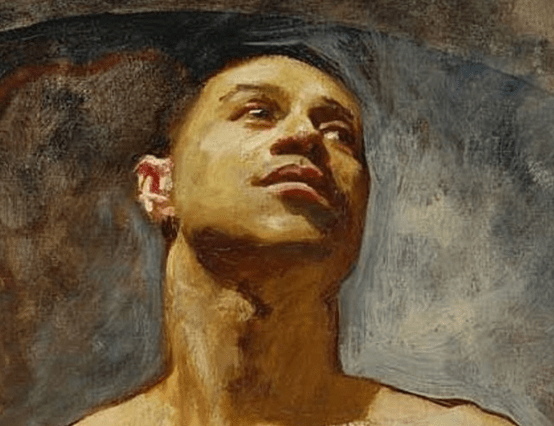
And everything in this painting is indeed operating under cover of the settings of artifice, playing of roles and the wearing of costume appropriate to artifice and hiding. Yet in the interchange of eyes in this family there is something extremely knowing, a question as deep into the character of our human consciousness as that in James’ What Maisie Knew, where knowing itself is both an insolent act and a puzzle and open to grotesque mistakes. And this is the Sargent of Tóibín. It is a Sargent in the know about the difficulty of knowing the meaning of attitude, gesture and pose of human ‘subjects’, or as Tóibín puts it: ‘The distance between face and pose, between control and loosness in the methods of painting and composing, gave Sargent’s best portraits a dramatic force …’.[28] It is, in my opinion, Tóibín’s Sargent of ‘masks and metaphors’ the world needs in order to see its own artifice and the flaw in its current humanity and ideologies of sociality they reveal. Tóibín understands that both James and Sargent were artists who were, in part, great because they could not articulate their feelings more openly and feel safe. Only their private letters and drawing are ‘unguarded’; ‘because they could no longer contain the complex silences that they covered in their work with distraction, decoration, artfulness’.[29] And once unguarded, Tóibín sees in Sargent as an artist not the uncovered homosexual but something still more queer and complex. He spends some time interrogating McKeller’s face and in it, ‘a great tenderness’:
It is as much an act of sympathy, empathy, as it is a set of erotic gestures. … His pose is sexual: he is naked and on display. But there is a sense of striving in the painting too, as though the spirit will not be simply contained and will make uneasy any eye that attempts to gaze with too much intensity, too much raw desire, on the naked body.[30]
This is an art worthy of our attention and it is the same art that, I believe, unites Sargent, James and Tóibín. And it is an art invisible to the hegemonic forms in which the history of art is daily reproduced in our universities and sent out to be further reproduced in schools, newspapers and journals. And if we can read this art, we can begin to look again at issues like the erasure of McKeller when Sargent uses his body, but not his face, to represent big White Western ideas like Apollo or men in philosophic reflection.

There is hope for learning but it does not rest with the zombie university and its old guarded ‘disciplines’. Let’s realise it. Read more and, as E.M. Forster says: ‘Only connect’.
“Only connect! … Only connect the prose and the passion, and both will be exalted, and human love will be seen at its height. Live in fragments no longer.”
from Howard’s End (1910)
All the best
Steve
[1] Toibin (2020: 125)
[3] See Fairbrother, T. (2020: 149) ‘1986’ in Nathaniel Silver (Ed.):op.cit.:132 – 153.
[4] Fairbrother, T. (1994: 142f. – to include first full colour and full-page reproduction of painting) John Singer Sargent (The Library of American Art) New York, Harry N. Abrams Inc., & Washington, D.C., The National Museum of Art, Smithsonian Institution.
[5] Foe an example of Mapplethorpe see the 1979 photograph of Phillip Prioleau, for instance, in the Getty Museum; available at: http://www.getty.edu/art/collection/objects/255741/robert-mapplethorpe-phillip-prioleau-american-1979/. For quotation Fairbrother op.cit.: (2020: 149).
[6] Private ‘note’ to Fairbrother from Glenn Ligon 15th March 1992 cited Fairbrother op.cit. (2020: 149)
[7] In Fairbrother op.cit.: (2000: 180 – 212)
[8] Heaven, or some other place, knows why?!.
[9] Hassler, D. (1999) ‘Preface: More Than Just An Academic Pursuit’ in Esten, J. (Ed.) John Singer Sargent: The Male Nudes New York, Universe Publishing, pp.11f.
[11] ibid: quotations from p. 11 & p. 12 respectively
[12] Esten, J. (1999) ‘The Absolute Male’ in Esten, J. (ed.) op.cit: pp.17 – 19.
[13] ibid: 19.
[14] Hirschler is a Sargent scholar and art historian, whose subject position is well described in the short opinion piece available from the link following. It is socially responsive but is it responsive enough? See https://editions.lib.umn.edu/panorama/article/whither-connoisseurship/erica-e-hirshler-croll-senior-curator-of-american-paintings-museum-of-fine-arts-boston/
[15] Hirschler, E.E. (2020: 99) ‘John Singer Sargent: Academician’ in Nathaniel Silver (Ed.) Boston’s Apollo: Thomas McKeller and John Singer Sargent, Boston, Isabella Stewart Gardner Museum & New Haven and London, Yale University Press, pp. 99 – 115.
[16] Edward Lucie-Smith (1989) ‘Life Class: Introduction’ in Boyd, S. (Ed.) Life Class: The Academic Male Nude 1820 – 1920 London, GMP, pp. 5 – 13.
[17] ibid: 11
[18] ibid: 9f.
[19] Lorraine O’Grady (2020: 93) ‘NOTES on Living a Translated Life’ in Nathaniel Silver (Ed.) op.cit. pp. 82 – 97.
[20] Hirschler op.cit.: 100
[21] ibid: 108
[22] O’Grady, op. cit.: 90
[23] Nikki A. Greene ‘Thomas McKeller sous rature: john Singer Sargent’s Erasure of a Black Model’ in Nathaniel Silver (Ed.) op.cit. pp. 62 – 81.
[24] Fairbrother (2020) op.cit.: 145
[25] Tóibín (2020) op.cit.: 145
[26] Robert Rosenblum (2000:50f.) ‘Art in 1900: Twilight or Dawn?’ in Rosenblum, R., Stevens, M. & Dumas, A, (Eds.) 1900: Art At The Crossroads New York, Harry N. Abrams, Incorporated, pp. 26 – 53.
[27] Henry James reviewing the appearance of the painting in 1898 and cited in The New York Times September 30 2016 Available at: https://www.nytimes.com/2016/09/30/arts/design/the-secrets-behind-sargents-intimate-portrait-of-a-jewish-family.html?
[28] Tóibín (2020) op.cit.: 119
[29] ibid: 123
[30] ibid: 129f.


6 thoughts on “‘Sargent, like James, was fascinated by the world of appearances, by the pose, by the gaze. … in the concealed self, …’. Colm Tóibín’s essay implicitly challenges the history of art as a discipline with a plea for a nuanced social history of appearances and disappearances in both graphic and literary art. Reflecting on the significance of Colm Tóibín’s (2020) ‘Secrets and Sensuality: The Private Lives of John Singer Sargent and Henry James’ in Nathaniel Silver (Ed.) ‘Boston’s Apollo: Thomas McKeller and John Singer Sargent’”